
Your mind blanks on a question you knew an hour ago. Your hands are cold walking into the hall. It’s 2 a.m. the night before and you’re still reading the same paragraph for the fourth time. If any of that sounds familiar, you’re not the exception — you’re most students. This page brings together the dua for exam, the dua before exam, and the dua for test moment itself, each one with its Arabic text, its actual source, and exactly when to say it — not a vague “recite this and you’ll do well.”
You may also know this practice as a wazifa for exams — a structured, often-repeated recitation. Wazifa and dua overlap heavily in South Asian tradition, and everything below works whichever word you use for it; we’ll flag anywhere the two genuinely differ.
Quick answer: The dua most Islamic scholars point students to is Rabbi zidni ilma — “My Lord, increase me in knowledge” (Quran 20:114) — recited before and during study. On the exam morning itself, pair it with Musa’s (AS) dua for calm and clear expression, Rabbi ishrah li sadri (Quran 20:25–28). If you blank mid-exam, pause and silently repeat either one before moving to the next question.
What Is the Dua for Exam?
A dua for exam isn’t a magic formula — it’s a supplication asking Allah for the same things any hard task needs: retained knowledge, a calm mind, clear expression, and an outcome you can accept either way. “Dua before exam” and “dua for test” describe the same practice at different moments — one before you walk in, one for the moment you’re actually being evaluated. A wazifa is simply one of these duas recited in a set, repeated pattern (often a fixed number of times) rather than said once — the content is the same; the format is what differs.
Is There a Specific Dua for Exams in Islam?
Here’s the part most pages skip: there is no single hadith that prescribes an “exam-day formula.” A number of exam-specific duas circulating on WhatsApp forwards and social media have no chain of narration at all and are falsely attributed to the Prophet ﷺ. IslamQA — one of the more widely consulted Islamic fatwa services — has addressed this directly, stating plainly that no exam-specific supplication exists in the Sunnah and cautioning against duas that get passed around without any real source. (If “fatwa” is a new term for you, here’s a plain-language breakdown of what a fatwa actually is.)
That doesn’t leave you empty-handed. The duas below are entirely authentic — they’re just general-purpose Quranic and Prophetic supplications for knowledge, ease, and courage that students have applied to exams for generations, rather than duas revealed for exams specifically. Knowing the difference is what makes the rest of this page trustworthy.
The Core Duas for Exam Success
1. Rabbi Zidni Ilma — “My Lord, Increase Me in Knowledge”
Arabic: رَبِّ زِدْنِي عِلْمًا Transliteration: Rabbi zidni ilma Meaning: “My Lord, increase me in knowledge.” Source: Surah Taha, 20:114
This is genuinely worth pausing on: it’s the only place in the entire Quran where Allah commands the Prophet ﷺ to ask for more of something worldly. Everywhere else the instruction is patience, gratitude, or restraint — here it’s “ask for more.” Recite it opening a study session, before the exam starts, or any time you feel like you need to have learned more than you did. Want the fuller context? Read Surah Taha in full alongside your regular Quran study.
2. Rabbi Ishrah Li Sadri — Musa’s (AS) Dua for Courage & Clarity
Arabic: رَبِّ اشْرَحْ لِي صَدْرِي وَيَسِّرْ لِي أَمْرِي وَاحْلُلْ عُقْدَةً مِنْ لِسَانِي يَفْقَهُوا قَوْلِي Transliteration: Rabbi ishrah li sadri, wa yassir li amri, wahlul ‘uqdatan min lisani, yafqahu qawli. Meaning: “My Lord, expand for me my chest, ease my task for me, untie the knot from my tongue, so they may understand my speech.” Source: Surah Taha, 20:25–28
Musa (AS) said this the moment Allah told him to go confront Pharaoh — about as high-stakes an evaluation as anyone has faced. Each clause maps neatly onto what a student actually needs: calm nerves, a manageable task, clear communication, and an examiner who understands your answer the way you meant it. It’s arguably the single most exam-relevant dua in the Quran, and it’s fully authentic simply because it’s Quranic text — reciting it is reciting Quran, full stop.
3. Allahumma La Sahla — “Nothing Is Easy Except What You Make Easy”
Arabic: اللَّهُمَّ لَا سَهْلَ إِلَّا مَا جَعَلْتَهُ سَهْلًا، وَأَنْتَ تَجْعَلُ الْحَزَنَ إِذَا شِئْتَ سَهْلًا Transliteration: Allahumma la sahla illa ma ja’altahu sahla, wa anta taj’alul hazna idha shi’ta sahla. Meaning: “O Allah, there is no ease except what You make easy, and You make difficulty easy if You wish.” Source: Sahih Ibn Hibban, narrated by Anas ibn Malik (RA), graded sahih (authentic) by Ibn Hajar al-‘Asqalani and later by Al-Albani
Worth being upfront about: you’ll see this hadith numbered differently across sources (2427 in some editions, 974 in others) depending on which arrangement of Ibn Hibban’s collection is being cited — that’s a numbering-system difference, not a discrepancy in the hadith itself. What matters for your purposes is that it’s graded sahih, not a folk saying with no backing.
4. Allahumma Anfa’ni Bima ‘Allamtani — The Post-Study Dua
Arabic: اللَّهُمَّ انْفَعْنِي بِمَا عَلَّمْتَنِي، وَعَلِّمْنِي مَا يَنْفَعُنِي، وَزِدْنِي عِلْمًا Transliteration: Allahumma anfa’ni bima ‘allamtani, wa ‘allimni ma yanfa’uni, wa zidni ilma. Meaning: “O Allah, benefit me with what You have taught me, teach me what will benefit me, and increase me in knowledge.” Source: Sunan Ibn Majah — the specific chain is graded da’if (weak) in some editions, though a closely related wording is graded sahih by Al-Albani via Jami’ at-Tirmidhi
This one is the natural bookend to Rabbi zidni ilma — where that dua asks for more knowledge, this one asks that what you’ve already studied actually sticks and actually helps you when you need it. Say it at the end of a study session, not the start. (If you want to understand how scholars sort hadith into sahih/hasan/da’if categories in the first place, here’s a plain explanation of what a hadith is and how grading works.)
5. The Entrustment Dua
Arabic: اللَّهُمَّ إِنِّي أَسْتَوْدِعُكَ مَا قَرَأْتُ وَمَا حَفِظْتُ فَارْدُدْهُ إِلَيَّ عِنْدَ حَاجَتِي إِلَيْهِ Transliteration: Allahumma inni astawdi’uka ma qara’tu wa ma hafidhtu, fardud-hu ilayya ‘inda hajati ilayh. Meaning: “O Allah, I entrust to You what I have read and memorized, so return it to me when I need it.” Source: Not found in the major hadith collections — a widely practiced scholarly/folk supplication, not a transmitted hadith
Stating this plainly rather than burying it: this one doesn’t have a hadith citation behind it the way the four above do. Many students still say it, and there’s nothing wrong with the content — asking Allah to help you recall what you studied is a legitimate request — but it belongs in a different category from Rabbi zidni ilma or Musa’s dua, and you deserve to know that distinction.
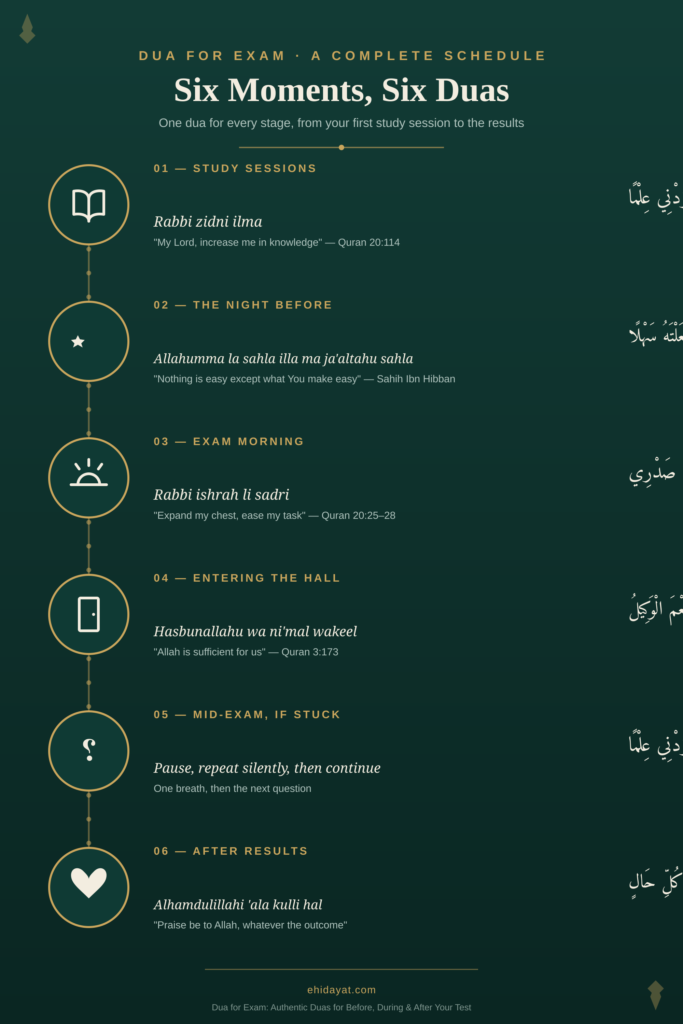
Your Complete Dua for Exam Schedule
[Infographic placeholder — a horizontal timeline graphic showing: study session → night before → exam morning → entering the hall → mid-exam → after results, with the matching short transliteration under each stage. Alt text: “Timeline infographic showing which dua to recite before, during, and after an exam.” This is the single most shareable/pinnable element on the page — worth commissioning from your design team rather than skipping.]
| When | Dua | Source |
|---|---|---|
| Before/during studying | Rabbi zidni ilma | Quran 20:114 |
| End of a study session | Allahumma anfa’ni bima ‘allamtani | Sunan Ibn Majah |
| Night before the exam | Allahumma la sahla, plus your normal night recitations — Surah Al-Mulk and the last two ayat of Surah Al-Baqarah are both well-established for before sleep | Sahih Ibn Hibban; Bukhari & Muslim (nightly recitations) |
| Entering the exam hall | Rabbi ishrah li sadri, or Hasbunallahu wa ni’mal wakeel (“Allah is sufficient for us, and He is the best disposer of affairs”) if you need a shorter line of trust | Quran 20:25–28; Quran 3:173 |
| Mid-exam, if you blank | Rabbi zidni ilma or Allahumma la sahla, silently, then move to the next question | — |
| After results — good or bad | See the section below | — |
Dua for Different Kinds of Tests
“Test” covers more ground than school exams — and the same core duas apply, just weighted differently depending on what you’re actually facing:
| Type of Test | Best-Fit Dua | Why |
|---|---|---|
| School or university written exam | Rabbi zidni ilma | Knowledge-recall is the main challenge |
| Professional or certification/board exam | Rabbi zidni ilma + Allahumma la sahla | Combines recall with the pressure of a high-stakes outcome |
| Driving test or practical/skills test | Allahumma la sahla | The task is physical/procedural, not knowledge-based — “make this easy” fits better than “increase my knowledge” |
| Oral exam, viva, or interview | Rabbi ishrah li sadri | Written specifically for a moment of being evaluated through speech |
If the Result Isn’t What You Hoped For
If it goes well, two rakahs of gratitude (salat al-shukr) is a beautiful way to close the loop — dua isn’t just for asking. If it doesn’t go the way you wanted, the honest response is sabr, not despair, and definitely not silence about it. A disappointing result doesn’t mean your dua went unanswered; the Quran itself gives a reframe for exactly this feeling — the idea that a thing you dislike may be the very thing that’s good for you (Surah Al-Baqarah, 2:216). That doesn’t erase the disappointment. It does mean the outcome you’re sitting with isn’t necessarily the end of the story.
Can I Make Dua in English If I Don’t Know Arabic?
Yes. Sincerity matters more than the language. Learning the short Quranic duas above in Arabic is worth doing over time — there’s real merit in the original wording — but personal supplication outside the five daily prayers is fully valid in whatever language you actually think in. Ask for what you need, plainly, in your own words, in English or otherwise.
Etiquette (Adab) of Making Dua During Exam Season
A few small habits change how a dua lands, not just what you say:
- Open with praise of Allah and salawat on the Prophet ﷺ before asking for anything specific.
- Raise your hands if you’re somewhere private enough to do so.
- The last third of the night carries particular weight for dua — the same window recommended for Tahajjud prayer, so if you’re up late studying anyway, that’s not a bad time to also make dua.
- Combine dua with actual effort. The well-known instruction behind “tie your camel, then trust in Allah” — a man asked the Prophet ﷺ whether he should leave his camel untied and simply trust Allah to protect it, and the Prophet ﷺ told him to tie it first, then trust Allah (Sahih Ibn Hibban 731, graded hasan) — is exactly the model here. Study, then make dua. Neither replaces the other.
If any of this feels heavier than it should, it’s worth saying plainly: exam anxiety is common, not a personal failing. A 2024 meta-analysis hosted on NCBI’s PubMed Central found test-anxiety prevalence reaching 89.4% among students in the UAE and 65% in Saudi Arabia — among the highest rates recorded anywhere. If you’re dreading an exam, you’re standing in a very large, very normal crowd.
FAQ
What is the best dua for exam success? Most scholars point to Rabbi zidni ilma — “My Lord, increase me in knowledge” (Quran 20:114). It’s the only place in the Quran where Allah commands the Prophet ﷺ to ask for more of something worldly. Pair it with Musa’s (AS) dua for clarity and courage (Quran 20:25–28) on exam day itself.
Is there a specific dua for exams in Islam? No single hadith prescribes an exam-day formula, and IslamQA has noted that many exam-specific duas circulating online have no authentic basis. What students recite are general Quranic and Prophetic duas for knowledge, ease, and courage, applied to the exam context.
When should I recite dua before an exam? Recite Rabbi zidni ilma through your study sessions, one of the night-before duas listed in the schedule above, and Musa’s dua just before entering the exam hall.
Can I make dua for a specific grade or mark? Yes — be specific and sincere, then leave the outcome to Allah. Asking for a particular result is entirely permitted.
What dua should I recite if I blank mid-exam? Pause briefly, silently repeat Rabbi zidni ilma or Allahumma la sahla, take a breath, and move to the next question — come back to the one you’re stuck on later.
Can I make dua in English if I don’t know Arabic? Yes. Sincerity matters more than the language used. Personal supplication outside the five daily prayers can be made in any language.
What should I do if I studied, made dua, and still didn’t pass? Respond with sabr and honest reflection rather than despair. A disappointing result doesn’t mean the dua was rejected — Surah Al-Baqarah 2:216 describes exactly this: an outcome you dislike may be redirecting you toward something better.
Is the dua different for a driving test or professional exam compared to a school exam? The core duas are the same; which one you lean on shifts. Musa’s dua (for speech and being understood) fits oral tests, interviews, and driving tests especially well, while Rabbi zidni ilma fits any knowledge-based written exam

One Response