
A fatwa is a formal, non-binding religious ruling issued by a qualified Islamic scholar in response to a specific question. That’s the short version. The longer version — how one actually gets made, who’s allowed to make it, and why the word conjures images of death sentences for a lot of non-Muslims — takes a bit more unpacking.
What Does Fatwa Mean?
Fatwa (فتوى) comes from the Arabic root f-t-y, which carries the sense of “clarifying” or “explaining.” In Islamic terminology, it’s a scholar’s answer to a question about how Islamic law applies to a real situation — anything from “can I brush my teeth while fasting” to “is this financial product halal.”
You’ll see the word spelled a few different ways depending on the source: fatwa, fatawa (the Arabic plural), fatwah, or fetva (an older English rendering that came through Ottoman Turkish). They all point to the same thing. If you’ve searched “fatwah meaning” instead of “fatwa meaning,” you’re in the right place.
One thing a fatwa is not: a law. Nobody is required to follow it, and unlike a court ruling, it’s built entirely from information the person asking the question chooses to share.
Who Can Issue a Fatwa?
The person issuing a fatwa is called a mufti. The person asking is the mustafti. Not just anyone with an opinion and a following qualifies — classical manuals on fatwa etiquette (adab al-fatwa) set the bar deliberately high:
- Deep, working knowledge of the Qur’an and hadith
- Familiarity with the major schools of jurisprudence (madhhabs)
- Training in the reasoning process (ijtihad and qiyas, or analogical deduction) used to apply old texts to new situations
- The judgment to sort actions into obligatory, recommended, permissible, disliked, or forbidden
One detail that gets lost in most explanations of this: classical Islamic legal theory doesn’t restrict the role to men. A qualified female scholar can issue a fatwa on the same footing as a qualified male one. Historically, some of the earliest fiqh scholarship — including rulings attributed to the Prophet’s wife Aisha — took exactly this form.
How a Fatwa Is Actually Made: The 4 Stages
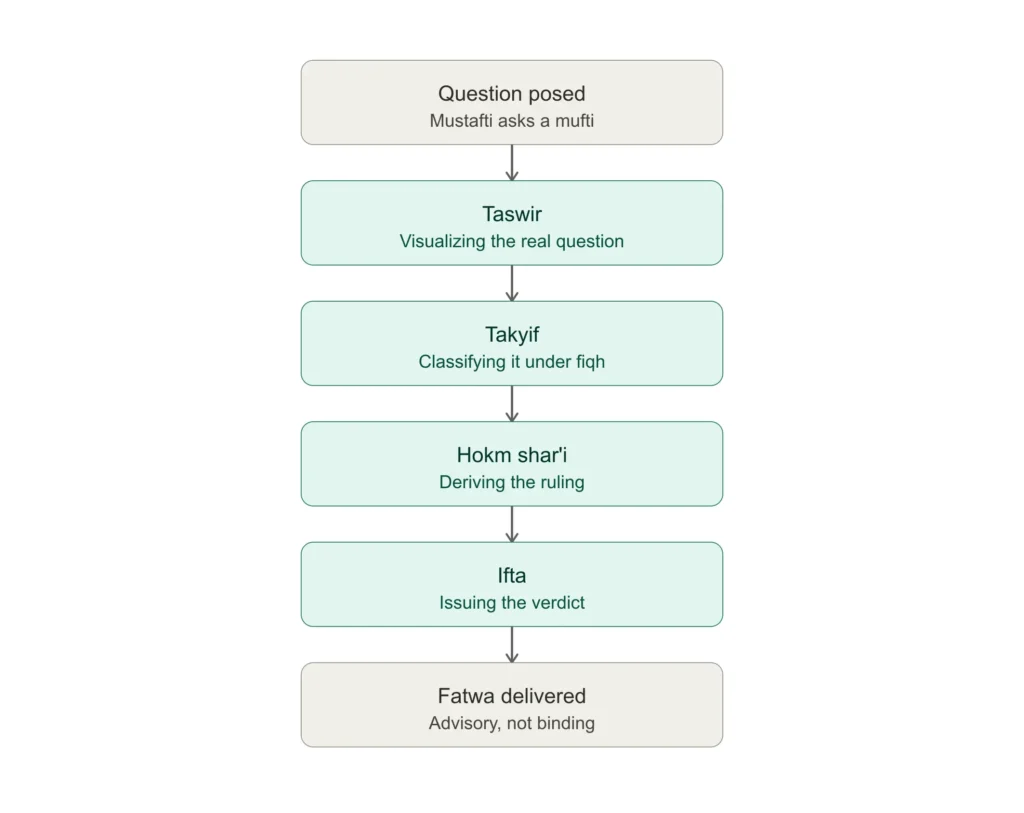
Egypt’s Dar al-Ifta, one of the world’s most established fatwa-issuing institutions, breaks the process down into four stages. It’s a useful mental model even if you never plan to issue one yourself:
- Taswir (visualization) — The mufti makes sure they fully understand the actual question, not just the words used to ask it. A vague or incomplete question gets clarified before anything else happens.
- Takyif (classification) — The question gets filed under the right area of jurisprudence: is this about worship, marriage, finance, something else entirely?
- Hokm Shar’i (deriving the ruling) — The mufti works out what the Qur’an, Sunnah, scholarly consensus, or analogical reasoning actually say about the situation.
- Ifta (issuing the verdict) — The ruling gets applied to the specific case and delivered to the person who asked.
Time, place, the people involved, and the surrounding circumstances can all shift where a fatwa lands — which is part of why two muftis can look at the same question and arrive at different, equally defensible, answers.
Fatwa vs. Qada vs. Ijtihad: What’s the Difference?
A fatwa is not the only Arabic legal term that shows up in this conversation, and the three most commonly confused are worth separating cleanly.
| Term | Who issues it | Binding? | Basis |
|---|---|---|---|
| Fatwa | A mufti (qualified scholar) | No — advisory only | Information the asker chooses to provide |
| Qada | A qadi (judge) in a court setting | Yes — a binding verdict | Active investigation of competing claims by both sides |
| Ijtihad | Any qualified jurist reasoning independently | Not a ruling itself — a method | The broader process of deriving law from primary sources when no clear precedent exists |
The short version: a fatwa answers a question, a qada resolves a dispute, and ijtihad is the reasoning toolkit both draw on.
Does a Fatwa Always Mean a Death Sentence? (No)
No — the overwhelming majority of fatwas deal with everyday matters like prayer, fasting, marriage, and personal finance. The “fatwa equals death sentence” association comes almost entirely from two unusual, heavily publicized cases.
The first is Ayatollah Ruhollah Khomeini’s 1989 fatwa condemning Salman Rushdie over his novel The Satanic Verses, calling on Muslims to kill him. The second is Osama bin Laden’s 1996 declaration of war against the United States, which he framed as a fatwa. Neither case reflects how the term is used day to day, and mainstream Islamic scholars have widely rejected bin Laden’s authority to issue either a fatwa or a call to jihad in the first place. Khomeini’s own approach to clerical authority was considered unusual even among senior scholars of his own sect.
What Kinds of Fatwas Are There?
Fatwas get categorized a few different ways, depending on what angle you’re looking from.
By the underlying ruling:
| Type | What it means | Example |
|---|---|---|
| Obligatory (fard) | Must be followed — tied to clear, binding texts | Rulings on the five daily prayers |
| Recommended (mustahabb) | Encouraged, not required | Extra voluntary acts of worship |
| Permissible (mubah) | No restriction either way | Everyday personal choices |
| Disliked (makruh) | Discouraged but not sinful | Certain customs without clear prohibition |
| Forbidden (haram) | Prohibited under Islamic law | Rulings against usury or theft |
By format and scope: a brief fatwa states a well-established point of law without much elaboration, while a long fatwa works through the scholarly reasoning behind an unprecedented or contested case. And by authorship: an individual fatwa comes from one mufti, while a collective fatwa is issued jointly by a panel or council of scholars — which brings us to one of the more interesting fatwa-issuing bodies outside the Arab world.
In practice, most fatwa requests are far less dramatic than the historical cases below. A large share are simple ritual-timing questions — when exactly Hajj falls each year, for instance, or how to correctly perform an optional prayer — which is exactly the kind of “brief fatwa” described above.
How Fatwas Work in Indonesia: The Role of MUI
Indonesia — home to the world’s largest Muslim population — has its own dedicated fatwa institution: the Indonesian Ulema Council, or Majelis Ulama Indonesia (MUI). Founded in 1975, MUI operates as a collective fatwa body, meaning its rulings come from a panel of scholars rather than a single mufti.
Like any fatwa, MUI’s rulings aren’t legally binding on the Indonesian state. In practice, though, they carry real weight. MUI has described its own fatwas as a source of “legislative inspiration,” and its halal certification fatwas shape what food, cosmetics, and pharmaceutical products actually reach Indonesian shelves. In 2016, MUI issued a fatwa declaring slash-and-burn land clearing religiously forbidden (haram) — reasoning grounded in specific hadith and Qur’anic verses about environmental harm, not just secular environmental policy. That fatwa is a good example of how a centuries-old legal tool gets applied to a distinctly modern problem.
For Indonesian and Malay-speaking readers, this is often the fatwa body whose rulings you’ll encounter directly, rather than those of scholars based in Cairo, Mecca, or Najaf.
What Does Islam Say About Issuing a Fatwa Without Knowledge?
Islamic tradition takes the responsibility of issuing a fatwa seriously enough that it shows up directly in the hadith literature. Sunan Abi Dawud 3657 records the Prophet Muhammad ﷺ saying: “If anyone is given a legal decision ignorantly, the sin rests on the one who gave it.” This hadith is graded hasan (good) by the hadith scholar Shaykh Shu’ayb al-Arna’ut, who judged all narrators in its chain to be thiqah (reliable) — meaning it carries solid, if not the very highest, authenticity.
The point isn’t a minor technicality. It’s baked into the discipline itself: a mufti who doesn’t actually know the answer is expected to say so, not guess. A related principle preserved in Sunan al-Darimi puts it plainly — “uttering ‘I don’t know’ is part of knowledge” — traced to a chain judged sahih (authentic) back to the early scholar al-Sya’bi. Sahih Bukhari 100 and Sahih Muslim 2673 both carry parallel warnings, describing how, as knowledgeable scholars pass away, unqualified people can step in to answer religious questions they aren’t equipped to answer — a risk the tradition treats as serious, not incidental.
You can read the full hadith text and its chain of narration on Sunnah.com.
Famous Historical Fatwas
Two cases dominate how fatwas get discussed outside Islamic scholarship, and both are worth understanding on their own terms rather than through headlines alone.
The 1989 Rushdie fatwa remains legally unresolved in an odd way: Iran promised in 1998 that it would not enforce the ruling, but because a fatwa can typically only be withdrawn by the scholar who issued it, and Khomeini had died in 1989, it was never formally rescinded.
A very different kind of “fatwa” came in 2005, when hundreds of scholars from across the Muslim world signed the Amman Message — itself functioning as a kind of counter-fatwa. Among its conclusions: takfir, the act of declaring another Muslim an unbeliever, cannot be issued except by qualified scholars meeting strict conditions, closing the door on the practice of individuals or fringe groups using the language of religious authority to justify violence against other Muslims.
FAQ
What is the literal meaning of fatwa? Fatwa comes from the Arabic root f-t-y, meaning “to clarify” or “to explain.” In Islamic terminology, it refers to a formal legal opinion issued by a qualified scholar in response to a specific question.
Is a fatwa legally binding? No. A fatwa is an advisory opinion, not a binding court judgment. A person who finds a fatwa unconvincing may seek an opinion from a different scholar, except in the rare cases where a fatwa is issued by a government-appointed judge in an Islamic state.
Who is allowed to issue a fatwa? Only a mufti — a scholar trained in Qur’an, hadith, and Islamic jurisprudence, and formally recognized as qualified — is authorized to issue one. Classical theory permits qualified women to issue fatwas as well as men.
What’s the difference between a fatwa and a fatwa council ruling like MUI’s? A single mufti issues an individual fatwa; a body like Indonesia’s MUI issues a collective fatwa, produced jointly by a panel of scholars. Collective fatwas typically carry more social weight than one scholar’s individual opinion.
Does “fatwa” always mean a death sentence? No. The overwhelming majority of fatwas address everyday questions on worship, family life, or finance. The perception that a fatwa is a death warrant comes mainly from two atypical, widely publicized cases — the 1989 Rushdie fatwa and a 1996 declaration by Osama bin Laden — neither of which most Islamic scholars considered a legitimate use of the term.
What is the plural of fatwa? The Arabic plural is fatawa (فتاوى). “Fatwas” is also widely accepted in English usage.
Can a fatwa be reversed or changed? Yes, under specific conditions. Fatwas based on independent reasoning (ijtihad), custom, or public interest can shift as time, place, people, or circumstances change — while fatwas addressing fixed obligations, like the five daily prayers, don’t.