
Tahajjud is a voluntary night prayer performed after waking from sleep, sometime between Isha and Fajr. It isn’t one of the five obligatory prayers, but it’s one of the most highly recommended, and it carries a specific weight in the Quran and Sunnah that most nafl prayers don’t. Allah says in the Quran:
“And from [part of] the night, pray with it as additional [worship] for you; it is expected that your Lord will resurrect you to a praised station.” (Surah Al-Isra, 17:79)
That “praised station” — Maqaman Mahmuda — is one of the reasons Tahajjud gets singled out. This guide walks through exactly how to pray it: timing, rakahs, the step-by-step movements, what to recite, and the questions people actually ask once they’ve decided to try it — including a few that most guides skip entirely, like what to do if you’re on your period, or whether Tahajjud and Tarawih can both fit into one Ramadan night.
What Is Tahajjud?
Tahajjud is the voluntary prayer performed after waking up from sleep during the night. It’s distinct from Qiyam ul Layl, which is the broader term for any act of worship — prayer, Quran recitation, dhikr, dua — performed anytime between Isha and Fajr, whether or not you’ve slept first. Every Tahajjud is a form of Qiyam ul Layl. Not every Qiyam ul Layl is Tahajjud.
The word itself comes from the Arabic root hajada, which means to struggle against sleep. That’s not incidental — the specific reward tied to Tahajjud is bound up in the effort of waking up when your body wants to stay asleep. The Prophet Muhammad ﷺ prayed it consistently, and he told his companions:
“Hold tight to the night prayer, for it was the way of the righteous before you, a way of drawing closer to your Lord, an expiation for wrong deeds, and a shield from sin.” (Sunan al-Tirmidhi 3549, graded Hasan)
When Is Tahajjud Prayed?
Tahajjud can be prayed anytime after Isha and before Fajr, but the last third of the night is the most virtuous time to pray it.
Here’s why that specific window matters so much. The Prophet ﷺ said:
“Our Lord descends every night to the lowest heaven when one-third of the night remains, and He says: ‘Who will call upon Me, that I may answer him? Who will ask of Me, that I may give him? Who will seek My forgiveness, that I may forgive him?'” (Sahih al-Bukhari 1145, Sahih Muslim 758)
That’s a Sahih hadith on both counts — it’s not a weak or disputed narration, which is worth knowing since a lot of what circulates about “the golden hour of the night” gets attached to hadith without anyone checking the grading.
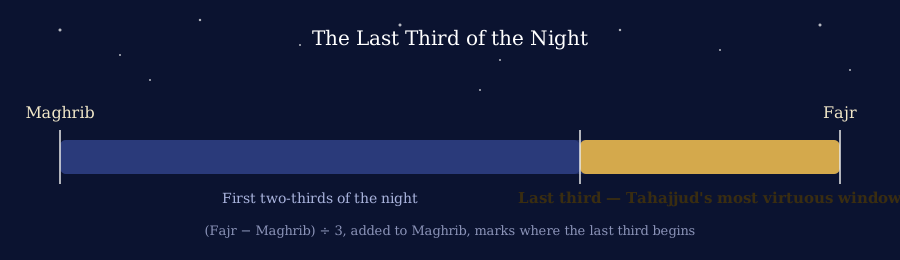
To find your own last third of the night, you don’t need an app. Take the time between Maghrib and Fajr, divide it into three equal parts, and the final part is your window.
| Scenario | Maghrib | Fajr | Night length | Last third begins |
|---|---|---|---|---|
| Short winter night (example) | 5:30 PM | 5:45 AM | 12h 15m | ~1:45 AM |
| Long summer night (example) | 8:15 PM | 4:30 AM | 8h 15m | ~2:55 AM |
The formula: subtract Maghrib from Fajr to get the length of the night, divide by three, then add that figure to your Maghrib time. In winter, when nights are long, the last third starts later relative to midnight than most people expect. In summer, with short nights, it can start well before 3 AM. If you’re setting an alarm, it’s worth doing this calculation for your actual location rather than assuming “around 3 AM” applies year-round — it doesn’t, and the gap between a winter and summer last-third start time can be well over an hour.
How Many Rakahs Should You Pray?
The minimum is two rakahs, prayed in pairs, with no fixed upper limit. The Prophet ﷺ commonly prayed eight rakahs of Tahajjud followed by three rakahs of Witr — eleven total — though narrations describe him praying anywhere from two to thirteen depending on the night. Aisha (RA) described his night prayer as “four rakahs, then four rakahs, then three” (referring to the Witr).
Two short rakahs done every night, consistently, is better than eight rakahs prayed once a month. The Prophet ﷺ was explicit about this: “The most beloved deeds to Allah are those that are consistent, even if they are small” (Sahih al-Bukhari 6464, Sahih Muslim 2818).
A note on Sunni and Shia practice. If you come across Tahajjud described elsewhere as exactly 11 rakahs split into three named parts, that’s typically describing the Twelver Shia structure: Nafilat al-Layl (8 rakahs, prayed two at a time), followed by Shafa’ (2 rakahs), followed by Witr (1 rakah). Sunni practice doesn’t fix the count this precisely — it treats 2 as the minimum and leaves the total flexible, closing with an odd-numbered Witr of 1, 3, or 5 rakahs. Neither structure is “the” way to pray Tahajjud; they reflect different schools, and it’s worth knowing both exist so you’re not thrown off if you see the 11-rakat breakdown somewhere and it doesn’t match what you were taught.
How to Pray Tahajjud, Step by Step
Before you get to the prayer itself, three things need to be in place: wudu, a quiet clean space, and a rough idea of how many rakahs you’re aiming for. None of that has to be elaborate. A lot of people build the habit by keeping their prayer mat out the night before, as a small physical reminder of the intention.
1. Wake up and make wudu. Wash your hands, mouth, nose, face, arms to the elbows, wipe your head, and wash your feet to the ankles.
2. Make your intention (niyyah). This doesn’t need to be spoken aloud — a firm intention in the heart is enough. Something like: “I intend to pray two rakahs of Tahajjud, voluntarily, for the sake of Allah.”
3. Stand facing the Qibla. Feet roughly shoulder-width apart, hands relaxed at your sides.
4. Say the opening Takbir. Raise your hands to ear level and say “Allahu Akbar.” Fold your right hand over your left above your chest.
5. Recite Surah Al-Fatiha, then another surah or a few verses of the Quran. There’s no fixed minimum beyond Al-Fatiha itself, though a longer recitation is generally considered superior to rushing through more rakahs.
6. Bow (Ruku). Say “Allahu Akbar,” place your hands on your knees, and say “Subhana Rabbiyal Azeem” (Glory be to my Lord, the Most Great) at least three times.
7. Rise from Ruku. Stand upright, saying “Sami Allahu liman hamidah” (Allah hears those who praise Him), followed by “Rabbana wa lakal hamd” (Our Lord, to You is all praise).
8. Prostrate (Sujood). Say “Allahu Akbar” and place your forehead, nose, palms, knees, and toes on the ground. Say “Subhana Rabbiyal A’la” (Glory be to my Lord, the Most High) at least three times.
9. Sit briefly between the two prostrations. Say “Allahu Akbar,” and in the sitting position it’s recommended to say “Rabbighfirli” (My Lord, forgive me) a few times.
10. Return to a second Sujood. Repeat the same words as the first.
11. Stand for the second rakah. Say “Allahu Akbar” and repeat steps 5 through 10.
12. After the second rakah, sit for Tashahhud. Recite the testification of faith, then send salawat (blessings) on the Prophet ﷺ.
13. Close with Tasleem. Turn your head to the right, then the left, saying “Assalamu alaikum wa rahmatullah” each time. This ends the two-rakah set.
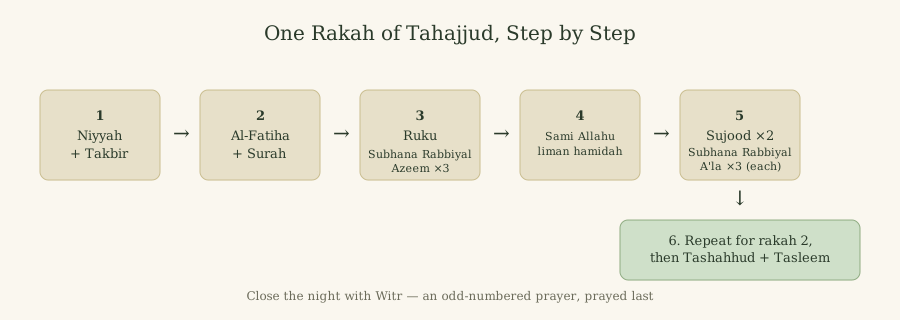
If you’re praying more than two rakahs, repeat the full cycle in pairs, always closing each pair with its own Tasleem.
For quick reference, the three recurring supplications during the movements:
| Position | Dua | Meaning |
|---|---|---|
| Ruku (bowing) | Subhana Rabbiyal Azeem | Glory be to my Lord, the Most Great |
| Sujood (prostration) | Subhana Rabbiyal A’la | Glory be to my Lord, the Most High |
| Between the two Sujoods | Rabbighfirli | My Lord, forgive me |
14. End with Witr. Once you’ve finished your Tahajjud rakahs, close the night with Witr — an odd-numbered prayer of 1, 3, or 5 rakahs. Witr should always come last. If you already prayed Witr earlier in the night (say, right after Isha, in case you weren’t sure you’d wake up), don’t repeat it — there shouldn’t be two Witr prayers in one night. (IslamQA has a detailed breakdown of Tahajjud-and-Witr sequencing if you want the full fiqh discussion.)
Can a Woman on Her Period Pray Tahajjud?
No — ritual prayer, including Tahajjud, is exempted during menstruation, the same as the five daily prayers. This isn’t a punishment or an exclusion from worship; it’s a concession scholars describe as part of Islam’s built-in ease around a woman’s physical state.
What’s less commonly mentioned is what to do with that time instead. A recommendation found in Hanafi fiqh is that a woman still make wudu at her usual prayer times, sit in the place she normally prays, and spend that time in dhikr, dua, and istighfar — specifically so the habit of showing up at that hour doesn’t break just because the prayer itself is paused. (SeekersGuidance covers this in more depth, including what’s and isn’t permissible around reciting and touching the Quran during this time.) You can still listen to Quran recitation, reflect on its meaning, and make heartfelt dua during the last third of the night even without praying the rakahs themselves. As one often-cited teaching puts it: praying while pure is worship, and refraining from prayer while menstruating — in submission to what Allah has decreed — is also worship. Both count.
Can You Pray Tahajjud Without Sleeping First?
Yes, though the fuller reward specifically tied to the word “Tahajjud” is linked to waking up after sleep — that struggle against sleep is what the word itself describes. If you stay up and pray at night without sleeping first, that’s more precisely called Qiyam ul Layl rather than Tahajjud, and it’s still highly rewarding. Some scholars hold that Tahajjud, strictly defined, requires having slept at least briefly beforehand; others use the term more loosely for any voluntary night prayer. Practically, if staying awake works better for your schedule than trying to wake mid-sleep, that’s a legitimate way to pray at night — just know the terminology shifts slightly.
Can I Pray Both Tarawih and Tahajjud in Ramadan?
Yes. Tarawih is typically prayed at the start of the night, right after Isha, often in congregation at the mosque. If you wake up again later — in the last third of the night — you can pray additional Tahajjud rakahs on your own. The one thing to watch for is Witr: if you already prayed it at the end of Tarawih, don’t pray it a second time after Tahajjud. Some people intentionally delay Witr until after their final night prayer of the night, precisely so they can combine both without repeating it. Either approach works — the rule is simply one Witr per night, prayed last.
What to Recite During Tahajjud
Surah Al-Fatiha is required in every rakah, followed by any other surah or at least a few verses of the Quran — there’s no restriction on which one. Longer surahs like Al-Baqarah, Al-Imran, or An-Nisa are recommended for those who have them memorized and have the stamina for it, since a lengthier recitation is generally considered more virtuous than rushing through extra rakahs. But that’s a recommendation, not a requirement — someone reciting a short surah with focus is doing this correctly.
Surah Al-Mulk is a common choice for night recitation more broadly — read our full guide to Surah Al-Mulk for its meaning and virtues if you want a manageable surah to build into a regular night-prayer habit. The last two ayat of Surah Al-Baqarah are another well-known night recitation and pair naturally with Tahajjud if you’re looking to extend your recitation without committing to a full long surah.
Dua After Tahajjud
After finishing your rakahs, sit and make dua. This is considered one of the most valuable times in the day for supplication, precisely because of the descent hadith cited earlier — “Who will call upon Me, that I may answer him?” (Sahih al-Bukhari 1145, Sahih Muslim 758). It’s a good time to ask for forgiveness, for your own needs, and for family and community.
One dua reported from the Prophet ﷺ, said when he rose at night to pray:
“Allahumma lakal-hamd, anta qaiyyimus-samawati wal-ard wa man fihinna…” — “O Allah, all praise is for You, You are the Sustainer of the heavens and the earth and all within them…” (Sahih al-Bukhari 1120)
Beyond memorized formulas, this is also a natural time to call on Allah by His names — many people structure part of their dua around specific attributes relevant to what they’re asking for. Our guide to the 99 Names of Allah breaks down which names fit which kind of need if you want to build that into your Tahajjud dua specifically. If you’re facing a difficult situation, the phrase Hasbunallahu wa ni’mal wakeel — “Allah is sufficient for us, and He is the best disposer of affairs” — is a well-known line to fall back on during this time.
Many people also use this quiet hour to make dua for loved ones who have passed away. If that’s part of your night, our guide to dua for the deceased covers the general wording, and this piece has the specific phrasing for a female relative — “Allahummaghfirlaha warhamha,” O Allah forgive her and have mercy on her.
Benefits of Praying Tahajjud
- Sin is expiated and wrongdoing is prevented — directly stated in the Hasan-graded hadith cited above (Tirmidhi 3549).
- Duas made at this hour are especially likely to be answered, given the descent hadith’s explicit framing of the last third of the night as a time Allah is actively inviting requests (Bukhari 1145, Muslim 758).
- Consistency is rewarded over quantity — the “most beloved deeds” hadith (Bukhari 6464, Muslim 2818) means two rakahs prayed nightly outweigh a large amount prayed rarely.
- It’s one of the last things the Quran singles out believers for, tied to reaching a “praised station” (17:79) — not a vague spiritual benefit, but a specific promise attached to this specific act.
FAQ
What time should I pray Tahajjud? Tahajjud can be prayed any time after Isha and before Fajr, but the last third of the night is the most rewarding time. To find it, subtract your Maghrib time from your Fajr time, divide by three, and add that to Maghrib — the final third begins there.
How many rakahs is Tahajjud? The minimum is two rakahs. The Prophet ﷺ commonly prayed eight, followed by three rakahs of Witr, for eleven total — though there’s no fixed upper limit, and consistency with fewer rakahs is preferred over occasional large numbers.
Can I pray Tahajjud without sleeping first? Yes, though the specific reward tied to the word “Tahajjud” (from the Arabic root for struggling against sleep) comes from waking up after rest. Prayer at night without sleeping first is more precisely called Qiyam ul Layl.
What’s the difference between Tahajjud and Qiyam ul Layl? Qiyam ul Layl is the broader term for any night worship — prayer, Quran recitation, dhikr, or dua — performed any time after Isha. Tahajjud is more specific: the voluntary prayer performed after waking from sleep during the night.
Do I pray Witr before or after Tahajjud? Witr should be the last prayer of the night. Pray Tahajjud first, in sets of two rakahs, then close with Witr — and don’t repeat Witr if you’ve already prayed it earlier in the night.
Can a woman on her period pray Tahajjud? No — ritual prayer is exempted during menstruation. Many scholars recommend she still make wudu, sit in her usual place of prayer, and use the time for dhikr, dua, and istighfar instead, to keep the habit alive.
What should I recite during Tahajjud? Surah Al-Fatiha in every rakah, followed by any other surah or at least a few verses of the Quran. Longer surahs are recommended for those who can manage them, but this isn’t a requirement — a short surah prayed consistently is better than a long one prayed rarely.
Can I pray both Tarawih and Tahajjud during Ramadan? Yes. Tarawih is typically prayed at the start of the night after Isha; if you wake again later, you can pray additional Tahajjud rakahs. Just don’t pray Witr twice in the same night — end your final prayer of the night with it once.