
A hadith is a recorded report of something Prophet Muhammad ﷺ said, did, or silently approved of, passed down through a chain of narrators known as an isnad. Alongside the Quran, hadith forms the second major source of Islamic law, and for many rulings — how to pray, how much charity to give, what breaks a fast — it’s the only source, since the Quran often commands an act without spelling out the mechanics.
That’s the short version. The longer version is more interesting, and it’s the part most articles skip: how scholars actually decided which reports to trust, why the same word gets spelled four different ways depending on where you’re from, and where the honest disagreements sit.
Hadith, Hadees, Hadeeth, Ahadith — Are These the Same Word?
Yes. Every one of these refers to the same thing. The differences come down to transliteration, not meaning.
“Hadith” is the standard English spelling, adapted from the Arabic ḥadīth (حديث), a word that literally means “report,” “narration,” or “news.” “Ahadith” is the Arabic plural — though in everyday English writing, “hadiths” gets used just as often. “Hadees,” “Hadeeth,” and “Hadiith” are alternate romanizations that show up constantly in Pakistan, India, Bangladesh, and other regions where Urdu, Hindi, and Bengali are the primary languages people search and read in — which is also why you’ll see “islam hadees” typed into search bars just as often as “islam hadith.” In Indonesian, the spelling shifts again to “Hadits,” which readers of ehidayat.com’s Indonesian-language content will already recognize.
None of these variants change the underlying concept. If someone asks “what is hadees in Islam,” they’re asking exactly the same question as “what is hadith in Islam.”
| Spelling | Where It’s Common | Notes |
|---|---|---|
| Hadith | English-language sources worldwide | Closest transliteration to the Arabic حديث |
| Ahadith / Hadiths | Academic English, plural form | Ahadith is the Arabic plural; “hadiths” is the anglicized plural |
| Hadees / Hadeeth / Hadiith | Pakistan, India, Bangladesh (Urdu/Hindi/Bengali speakers) | Same word, different romanization convention |
| Hadits | Indonesia, Malaysia | Indonesian/Malay spelling convention |
Isnad and Matn: The Two Parts of Every Hadith
Every hadith has two components, and understanding both is the key to understanding how the entire science of hadith works.
The isnad is the chain of narrators — the list of names tracing a report back, person by person, from the scholar who wrote it down, through however many generations, to the Companion who heard or witnessed it directly from the Prophet ﷺ. The matn is the actual content: what was said or what happened.
Why does the chain matter as much as the content? Because for the first two centuries of Islam, hadith wasn’t written and centrally archived the way scripture was — it moved person to person, largely orally, before being systematically collected. The isnad is the paper trail that lets later scholars check whether a report is even plausible: did this narrator ever actually meet the person he claims to be quoting? Was he known for a reliable memory, or had he been caught making mistakes before? A hadith with a strong matn but a broken or dishonest isnad doesn’t get accepted, no matter how good the content sounds — and that discipline is exactly what separates the science of hadith from simply collecting popular sayings.
How Scholars Grade a Hadith: A Worked Example
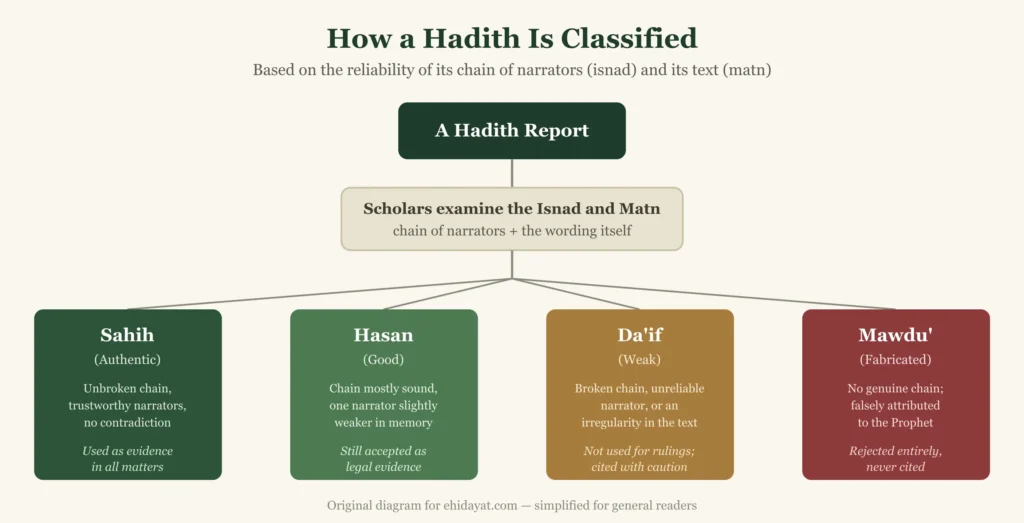
Hadiths aren’t treated as uniformly reliable. Based on the strength of the isnad and the soundness of the matn, classical scholars sorted them into four main grades.
Take one of the most frequently cited hadiths in Islamic scholarship, recorded as the very first entry in Sahih al-Bukhari: the Prophet ﷺ said, in essence, that actions are judged by intentions, and each person gets credit only for what they intended. Scholars classify this as Sahih — authentic — and the reasoning isn’t mysterious once you see it laid out:
- The chain of narrators is unbroken, with each person confirmed to have directly met and heard from the one before them.
- Every narrator in that specific chain was independently verified as trustworthy and known for an accurate memory — not just generally respected, but specifically checked.
- The content doesn’t conflict with the Quran or with other established hadith.
That’s what “Sahih” actually requires — not “a hadith everyone repeats,” but a report that passes a specific, checkable standard on both ends. You can look up the exact wording and its chain-of-narration details on Sunnah.com, which hosts searchable hadith collections with their original chains and grading.
Here’s how all four grades break down:
| Grade | Meaning | Chain Requirement | Can Be Used As Evidence? |
|---|---|---|---|
| Sahih | Authentic | Unbroken, all narrators verified trustworthy and accurate | Yes — in all matters of religion |
| Hasan | Good | Mostly sound, but one narrator is slightly weaker in memory or precision | Yes — accepted as legal evidence |
| Da’if | Weak | Broken chain, an unreliable narrator, or a documented error in transmission | Not for rulings; some scholars permit it cautiously for general encouragement (targhib), never contradicting the Quran |
| Mawdu’ | Fabricated | No genuine chain — falsely attributed to the Prophet ﷺ | No — rejected entirely |
That fourth category matters more than it might seem. Fabricated hadiths circulated for political, sectarian, and even commercial reasons in early Islamic history, which is precisely why the science of isnad criticism developed in the first place — it was a direct response to people inventing sayings and attaching the Prophet’s ﷺ name to them.
The Major Hadith Collections: Sunni and Shia
Once hadiths started being systematically gathered, scholars compiled them into books — and Sunni and Shia scholarship developed separate canons, compiled by different scholars using somewhat different methodologies.
| Tradition | Collection Name | Compiler | Approx. Scope |
|---|---|---|---|
| Sunni | Sahih al-Bukhari | Imam al-Bukhari | ~7,558 hadiths across 99 chapters |
| Sunni | Sahih Muslim | Imam Muslim | ~7,563 hadiths (with repetition) across 58 chapters |
| Sunni | Sunan Abu Dawood | Abu Dawood | Focused on legal rulings |
| Sunni | Jami’ al-Tirmidhi | al-Tirmidhi | Known for noting each hadith’s grade |
| Sunni | Sunan al-Nasa’i | al-Nasa’i | Emphasizes legal traditions |
| Sunni | Sunan Ibn Majah | Ibn Majah | Sixth of the “Six Books” |
| Shia | Kitab al-Kafi | al-Kulayni | One of the “Four Books” |
| Shia | Man La Yahduruhu al-Faqih | Ibn Babawayh | One of the “Four Books” |
| Shia | Tahdhib al-Ahkam | al-Tusi | One of the “Four Books” |
| Shia | Al-Istibsar | al-Tusi | One of the “Four Books” |
Sunni scholarship refers to the first six as the “Kutub al-Sittah” (the Six Books), with Sahih al-Bukhari and Sahih Muslim — often called simply “the two Sahihs” — treated as the two most rigorously authenticated. Shia scholarship instead centers on the “Four Books,” compiled independently and drawing heavily on narrations transmitted through the Prophet’s ﷺ family (Ahl al-Bayt). The two traditions don’t fully overlap in which narrators they trust, which is exactly why a hadith accepted in one collection sometimes isn’t accepted in the other.
Why Is Hadith Important If We Already Have the Quran?
Because the Quran frequently commands an act without explaining how to perform it, and hadith is where that missing detail lives.
The Quran instructs Muslims to establish prayer, but it doesn’t specify the number of daily prayers, the number of units in each, or the precise physical movements involved — all of that comes from hadith recording how the Prophet ﷺ himself prayed. The same pattern holds for zakat (charity): the Quran commands it, but the specific percentage and the categories of wealth it applies to are detailed in hadith.
A clear, concrete example of this is how to pray tahajjud — the voluntary night prayer. The Quran references night prayer in general terms, but its specific timing, structure, and virtue are established almost entirely through hadith describing the Prophet’s ﷺ own practice. Without that hadith record, Muslims would know night prayer was encouraged but have no idea how to actually perform it. That’s the practical relationship between the two sources in a nutshell: the Quran sets the principle, hadith supplies the method.
A Note on the Quranist View (For Completeness)
For fairness, it’s worth acknowledging a minority position within some modern circles, sometimes called Quranism, which holds that the Quran alone should carry religious authority and treats the hadith corpus with significant skepticism — arguing it was compiled generations after the Prophet’s ﷺ death and can, in places, be inconsistent with the Quran itself. This view is a small minority position and is rejected by mainstream Sunni and Shia scholarship, both of which hold that the Quran’s own instructions cannot be fully practiced without the explanatory detail hadith provides. It’s mentioned here simply so the picture is complete, not because it reflects mainstream Islamic scholarship.
Hadith Qudsi vs. Hadith Nabawi
One more distinction worth knowing: not all hadiths are the Prophet’s ﷺ own words.
A Hadith Qudsi (sacred hadith) is a report in which the Prophet ﷺ conveys words attributed to Allah, spoken in the first person, but which are not part of the Quran itself and aren’t recited in prayer the way Quranic verses are. A Hadith Nabawi (prophetic hadith) — the far more common type — records the Prophet’s ﷺ own sayings, actions, or approvals in his own words. The distinction matters for how each is treated liturgically, even though both are still hadith in the broader sense.
Frequently Asked Questions
What does hadith mean in Islam? A hadith is a recorded report of something Prophet Muhammad ﷺ said, did, or silently approved of, passed down through a chain of narrators (isnad). Alongside the Quran, hadith forms the second major source of Islamic law and guidance.
What is the difference between hadith and Sunnah? Sunnah refers to the Prophet’s ﷺ established practice or way of life; hadith is the recorded report that documents that practice. A hadith can describe a Sunnah, but not every element of Sunnah necessarily has one specific supporting hadith.
What are the 3 main types of hadith? Based on authenticity, hadiths are classified as Sahih (authentic, meeting all conditions), Hasan (good, but with a slightly weaker narrator), or Da’if (weak, with a broken chain or unreliable narrator). A fourth category, Mawdu’ (fabricated), is also widely recognized.
What is isnad in hadith? Isnad is the chain of narrators through which a hadith was transmitted, from the Companion who heard it from the Prophet ﷺ down to the scholar who recorded it. Scholars examine each narrator’s honesty, memory, and continuity of contact to judge a hadith’s reliability.
What is the difference between Hadith and Hadees? Hadith and Hadees refer to the exact same thing — the recorded sayings and actions of the Prophet Muhammad ﷺ. “Hadees” is simply the common transliteration used in Urdu, Hindi, and other South Asian languages, while “Hadith” is the standard English/Arabic-derived spelling.
What are the most authentic hadith books? Sahih al-Bukhari and Sahih Muslim are widely regarded by Sunni Muslims as the two most authentic hadith collections, together known as “the two Sahihs.” Shia Muslims instead rely primarily on the “Four Books,” compiled by different scholars.
Can a weak (Da’if) hadith still be used? Weak hadiths are generally not used to establish rulings in Islamic law, but many scholars permit citing them cautiously in matters of virtues or general encouragement, provided they don’t contradict the Quran or authentic hadith.