
The last 2 ayat of Surah Qalam — verses 51 and 52 of chapter 68 — are some of the most widely recited verses in the Muslim world, quoted in homes, hung as calligraphy, and repeated after every prayer by people worried about the evil eye. They’re short. Two verses, thirty-one Arabic words between them. But almost every page ranking for this search either skips the sourcing behind them or gets a basic fact about the surah wrong. This one won’t.
Surah Qalam Last 2 Ayat in Arabic, Transliteration, and English Translation
Here’s the Arabic text of both verses together, exactly as they appear at the end of Surah Al-Qalam:
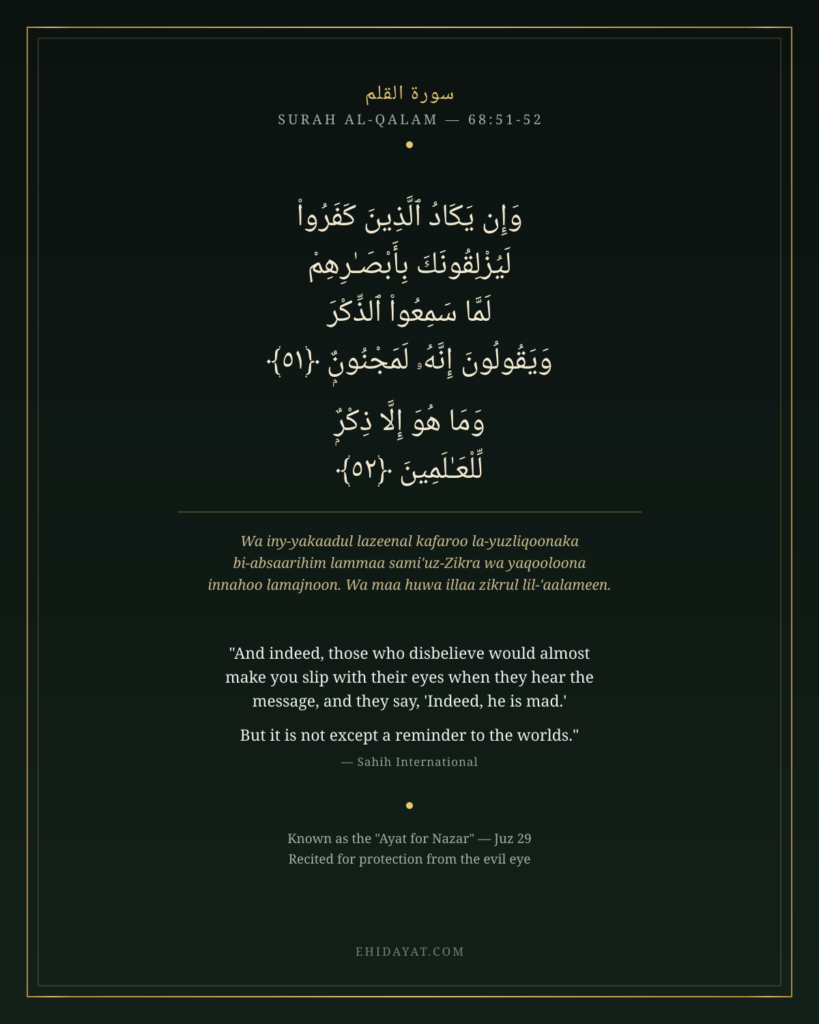
وَإِن يَكَادُ ٱلَّذِينَ كَفَرُوا۟ لَيُزْلِقُونَكَ بِأَبْصَـٰرِهِمْ لَمَّا سَمِعُوا۟ ٱلذِّكْرَ وَيَقُولُونَ إِنَّهُۥ لَمَجْنُونٌۭ ﴿٥١﴾ وَمَا هُوَ إِلَّا ذِكْرٌۭ لِّلْعَـٰلَمِينَ ﴿٥٢﴾
Transliteration: Wa iny-yakaadul lazeena kafaroo la-yuzliqoonaka bi-absaarihim lammaa sami’uz-Zikra wa yaqooloona innahoo lamajnoon. Wa maa huwa illaa zikrul lil-‘aalameen.
Different English translators render the same two verses with slightly different shades of meaning. Reading more than one is worth the extra thirty seconds:
| Translator | Verse 51 | Verse 52 |
|---|---|---|
| Sahih International | And indeed, those who disbelieve would almost make you slip with their eyes when they hear the message, and they say, “Indeed, he is mad.” | But it is not except a reminder to the worlds. |
| Yusuf Ali | And the Unbelievers would almost trip thee up with their eyes when they hear the Message; and they say: “Surely he is possessed!” | When it is naught else than a Reminder to all the worlds. |
| Pickthall | And lo! those who disbelieve would fain disconcert thee with their eyes when they hear the Reminder, and they say: Lo! he is indeed mad. | And it is naught else than a Reminder to creation. |
| Abdel Haleem | The disbelievers almost strike you down with their looks when they hear the Quran. They say, “He must be mad!” | Yet it is nothing but a reminder to all people. |
Notice the spread: “slip,” “trip up,” and “disconcert” are all attempts to translate one Arabic verb, layuzliqoonaka — literally, to make someone’s feet lose their footing. That’s a physical image, not a figure of speech. The disbelievers’ stares were understood as forceful enough to knock the Prophet ﷺ off balance.
Quick Facts About Surah Al-Qalam
Before going further, it’s worth getting the basics right — a few sites currently ranking for this term don’t.
| Fact | Detail |
|---|---|
| Chapter number | 68 (not 66 — an error that shows up on at least one competing page) |
| Meaning | “The Pen” |
| Also known as | Nun, after the single disjointed letter that opens the surah |
| Revelation type | Meccan |
| Total verses | 52 |
| Location in the Quran | Juz 29 (Juz Tabarakalladhi) |
Surah Al-Qalam holds a specific place in Quranic history, too: it’s one of the earliest revelations, sent down while opposition to the Prophet ﷺ in Mecca had turned genuinely hostile — not just verbal mockery, but the kind of targeted hatred the closing verses respond to directly.
What Do the Last Two Ayat of Surah Qalam Mean?
Read on their own, verses 51 and 52 answer an accusation with a fact. Read in context — they close a surah that spends its first fifty verses defending the Prophet’s ﷺ character against people calling him insane — they land as the final word in that argument.
Ayat 51 — The Disbelievers’ Hostile Gaze
Verse 51 describes something specific: disbelievers listening to the Quran being recited and reacting not just with words but with a kind of look — intense enough, the verse implies, to almost make the Prophet ﷺ stumble. Then comes the insult: they call him majnoon, mad. It’s the same accusation the surah opened by refuting in verse 2 (“You are not, by the favor of your Lord, a madman”), so by verse 51 it’s being answered a second time, from a different angle.
Ayat 52 — A Reminder for All the Worlds
Verse 52 doesn’t argue back. It just states what the Quran actually is: dhikrun lil-‘aalameen — a reminder for all the worlds, not a message limited to seventh-century Mecca or to Arabic speakers, and not something that loses relevance no matter how loudly it’s dismissed. The contrast is the point — hostility on one side, permanence on the other.
Why Are These Verses Called the “Ayat for Nazar” (Evil Eye)?
Because classical scholarship ties verse 51 to an actual historical account, not just a general warning about jealous looks. Mufti Muhammad Taqi Uthmani’s Ma’ariful Qur’an records that Imam Baghawi and other early commentators reported a specific incident behind this verse: a man in Mecca known for being able to cast the evil eye on camels and livestock — reportedly killing them with a look — was hired by the Prophet’s ﷺ enemies to turn that ability on him. It didn’t work. Allah protected him, and the verse was revealed describing the attempt.
That background is why these two verses, and not some other pair, became the go-to recitation for evil eye protection. The same source, Ma’ariful Qur’an, records that the Tabi’i scholar Al-Hasan Al-Basri would recommend reciting and blowing these verses on anyone affected by nazar.
It also lines up with an authentic hadith on the subject generally. The Prophet ﷺ said, “The effect of an evil eye is a fact” — recorded in Sahih al-Bukhari (5740), graded sahih. A version in Sahih Muslim (2188) adds that if anything could outrun divine decree, the evil eye would be what does it, and instructs performing ghusl when asked to. Between the asbab al-nuzul and that hadith, there’s real textual grounding for treating nazar as something the tradition takes seriously — not folklore bolted onto the verse after the fact.
Is the “Recite 7 Times” Wazifa for Nazar Authentic? What Scholars Say
Here’s where most articles on this topic stop short. The popular practice — recite verses 51-52 seven times after Fajr and Maghrib, blow on your hands, wipe them over yourself or your children — shows up on nearly every site covering this keyword, usually presented as settled fact.
It isn’t quite that simple.
Asked directly whether this specific formula is established from the Quran or Sunnah, the scholar Sheikh Assim Al-Hakeem answered no. His guidance points elsewhere: maintain the five daily prayers without fail, keep a fixed time for reciting Quran, and hold onto the regular morning and evening adhkar — the ones collected in books like Hisnul Muslim — along with ruqya when needed. That, he says, is what actually carries the weight of protection from every kind of harm, evil eye included.
That doesn’t make reciting Surah Qalam’s last two ayat wrong — plenty of scholars, going back to Al-Hasan Al-Basri, have recommended exactly that. What it means is that the specific number seven, and the specific timing after two particular prayers, is a popular refinement layered on top of a genuinely rooted practice, not a rule with its own separate textual basis. Worth knowing before treating it as a fixed prescription.
How to Recite Surah Qalam’s Last 2 Ayat for Protection (Step by Step)
Given the above, the more grounded approach looks like this:
- Recite verses 51-52 — in Arabic if you can, or alongside the transliteration if you’re still learning — as part of your regular daily adhkar rather than as an isolated ritual.
- Pair them with Ayatul Kursi and the four Quls (Surah Al-Falaq, An-Nas, Al-Ikhlas, and Al-Kafirun), which have their own well-established place in daily protection.
- If reciting over someone affected by the evil eye, recite and blow gently on them — this is the same method used for ruqya generally, not something unique to these two verses.
- Treat the number of repetitions and exact timing as flexible rather than fixed, since that detail isn’t the part with firm textual support.
- Keep the five daily prayers and general adhkar as the actual foundation. These two verses are a meaningful addition to that foundation, not a replacement for it.
Other Verses Recited for Protection From the Evil Eye
Surah Qalam’s last two ayat rarely stand alone in practice. Ayatul Kursi (2:255) is the single most commonly paired verse, and Surah Al-Falaq and Surah An-Nas — the “two protective surahs” — are recited together specifically because of their subject matter, which includes seeking refuge from an envier’s harm by name. For a fuller breakdown of which duas and verses are used against nazar specifically, ehidayat.com’s guide to dua for evil eye and nazar walks through the full set.
It’s a separate case, but worth knowing about if you’re building this into a habit: the closing two ayat of Surah Al-Baqarah carry their own well-known protective role, recited more for nighttime coverage than for nazar specifically. ehidayat.com’s guide to the last two ayat of Surah Baqarah covers the meaning and hadith behind that one.
FAQ
What are the last 2 ayat of Surah Qalam? Verses 51 and 52 of Surah Al-Qalam (68:51-52) — the closing verses of the surah, describing the disbelievers’ hostile stares at the Prophet ﷺ and affirming the Quran as a reminder for all people.
Why do Muslims recite Surah Qalam’s last 2 ayat for nazar? Because classical tafsir, including Ma’ariful Qur’an, links verse 51 to an actual incident of the evil eye being directed at the Prophet ﷺ, and early scholars are reported to have recommended reciting and blowing these verses on someone affected by nazar.
Is reciting Surah Qalam 51-52 seven times for evil eye protection an established Sunnah practice? It’s a widely followed popular practice, but at least one contemporary scholar has said the specific “seven times” formula isn’t explicitly established from the Quran or Sunnah, and points instead to general daily adhkar and ruqya.
Which Juz and Para is Surah Qalam’s last 2 ayat in? The 29th Juz, known as Juz Tabarakalladhi.
What does Surah Qalam mean and why is it also called Nun? It means “The Pen.” The name “Nun” comes from the single disjointed Arabic letter that opens the surah.
Can these verses be recited for someone else affected by the evil eye? Yes. The common method is to recite them and blow gently on the affected person — the same approach used for ruqya with other Quranic verses