
You post a photo of your new home, and by evening something breaks. A relative compliments your baby, and the child won’t stop crying that night. Most of us have had a moment like this and wondered, quietly, if it was nazar — the evil eye. Islam doesn’t ask you to dismiss that instinct as superstition, and it doesn’t ask you to panic over it either. It gives you something concrete to do about it: specific duas from the Quran and the Sunnah of the Prophet ﷺ that guard against nazar and undo its effects when it has already happened.
This guide brings together the core duas for evil eye and nazar — Arabic text, transliteration, and meaning — along with the Hindi and Urdu versions many readers specifically look for, a step-by-step ruqyah routine, and a few genuinely underexplored questions: can you give yourself the evil eye, how do you avoid casting it on someone else, and what does the Quran’s own story of Prophet Ya’qub teach about protecting the people you love.
What Is Nazar (Evil Eye) in Islam?
Nazar (from the Arabic nazar, meaning “gaze” or “look”) is the belief that a person can be harmed by someone else’s envious or admiring look, whether or not that person meant any harm. In Islamic terminology it’s called al-‘ayn, and it isn’t treated as folk superstition — the Prophet Muhammad ﷺ said plainly, “The evil eye is real” (Sahih Muslim 2188). That single hadith is the reason nazar sits inside Islamic belief rather than outside it: it’s a real, unseen cause of harm that Allah has permitted to exist, and one that believers are taught to guard against through faith, not fear.
Is the Evil Eye Real? Evidence from Quran and Hadith
The clearest textual proof is the hadith recorded in Sahih Muslim, where the Prophet ﷺ said the evil eye is real, and that if anything could ever outrun the divine decree, it would be the evil eye — a way of stressing just how seriously the harm should be taken, even while everything ultimately remains under Allah’s control. The Quran backs this up indirectly rather than by name: Surah Al-Falaq closes with a request for refuge “from the evil of an envier when he envies,” which scholars have long read as a direct reference to the harm of envy and the evil eye together.
There’s also a narrative example in the Quran itself, in Surah Yusuf, where Prophet Ya’qub takes a very deliberate, practical precaution against nazar for his own sons — a story most guides on this topic skip entirely, and one we’ll come back to in full further down.
Signs and Symptoms of Nazar
Islamic tradition and lived experience both point to a loose cluster of signs people associate with nazar, though none of them are proof on their own — and that caution matters as much as the list itself.
| Symptom | Common Interpretation |
|---|---|
| Sudden fatigue, headache, or illness with no clear cause | Physical harm attributed to an envious or admiring gaze |
| Disturbed sleep or excessive crying in a baby or child | Children are considered especially vulnerable to nazar |
| Sudden family conflict or loss of harmony | Envy disrupting relationships or household peace |
| Wealth, success, or a new blessing abruptly disrupted | Harm directed at something recently admired or announced |
A necessary balance: Islam does not encourage attributing every setback to the evil eye. Ordinary illness still calls for a doctor, and ordinary misfortune is still part of life. The guidance is to take spiritual precautions and deal with the practical causes of a problem — not to replace one with the other.
The Most Powerful Dua for Nazar (A’udhu Bikalimatillah)
If there’s one dua most commonly cited for protection from nazar, it’s this one, recorded in Sahih Muslim (2708):
| Arabic | Transliteration | Translation | When to Recite |
|---|---|---|---|
| أَعُوذُ بِكَلِمَاتِ اللَّهِ التَّامَّاتِ مِنْ شَرِّ مَا خَلَقَ | A’udhu bikalimatillahi at-tammati min sharri ma khalaq | I seek refuge in the perfect words of Allah from the evil of what He has created | Morning and evening, and any time you sense unease |
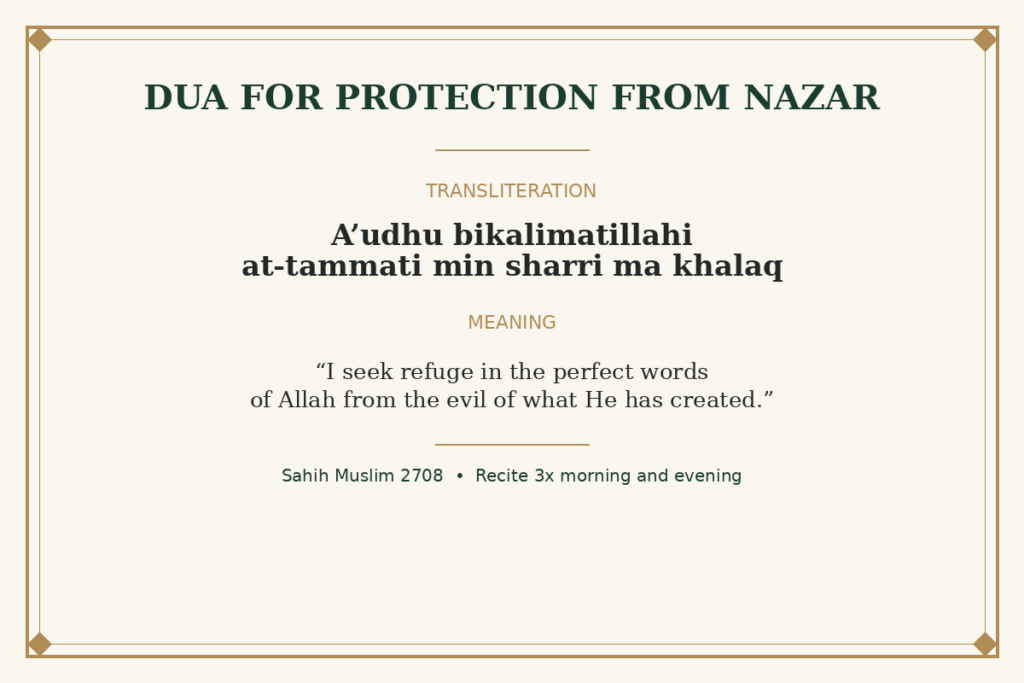
This dua is deliberately general — it covers the evil eye along with every other unseen harm — which is exactly why it’s recited as a standing daily habit rather than only when trouble is suspected.
Surah Al-Falaq and Surah An-Nas for Protection from Nazar
Surah Al-Falaq (113) and Surah An-Nas (114), the Quran’s final two chapters, are known together as Al-Mu’awwidhatayn — “the two chapters of refuge.” Al-Falaq closes by naming envy directly as one of the harms a believer seeks refuge from, and An-Nas broadens that refuge to cover whispered evil more generally. The Prophet ﷺ recited both nightly, cupping his hands, reciting into them, and wiping them over his body — a practice recorded in Sahih al-Bukhari (5017) that’s still followed today before sleep.
If you want to build a fuller nightly routine around these two surahs, it’s worth pairing them with other short chapters recited for protection and blessing — read Surah Al-Mulk in full is a natural next step, since it’s the other surah most commonly recited before sleep in the same spirit of seeking refuge and mercy.
Ayat al-Kursi for Protection from Evil Eye
Ayat al-Kursi (Surah Al-Baqarah, 2:255) is recited after every obligatory prayer specifically for its protective quality — a hadith found in An-Nasa’i and Ibn Hibban notes that whoever recites it after each prayer is under Allah’s protection until the next one. Its content — Allah’s complete knowledge, His sovereignty over everything in the heavens and earth — is why it functions as a daily shield rather than a dua reserved for moments of crisis.
It’s often recited together with the last two ayat of Surah Al-Baqarah, which carry their own well-known protective virtue and are commonly paired with Ayat al-Kursi in the same nightly routine.
Nazar Ki Dua in Hindi and Urdu
Most English guides on this topic stop at Arabic and Roman transliteration, but a large number of readers specifically search for the dua in Hindi or Urdu script. Here is the same core protection dua in all four forms:
| Arabic | Hindi (Devanagari) | Urdu | Roman Transliteration |
|---|---|---|---|
| أَعُوذُ بِكَلِمَاتِ اللَّهِ التَّامَّاتِ مِنْ شَرِّ مَا خَلَقَ | अऊज़ु बिकलिमातिल्लाहित तम्माति मिन शर्रि मा ख़लक़ | اَعُوذُ بِکَلِمَاتِ اللّٰہِ التَّآمَّاتِ مِنْ شَرِّ مَا خَلَقَ | A’udhu bikalimatillahi at-tammati min sharri ma khalaq |
Meaning in simple words: Main Allah ke mukammal kalimaat ki panah maangta hoon har us cheez ke sharr se jo usne paida ki hai — “I take refuge in Allah’s perfect words from the evil of everything He has created.” Whether you know it as nazar ki dua, nazar e bad ki dua, or simply whats nazar in your own search, the Arabic text above is the same authentic dua behind all of those phrasings.
Dua for Nazar for Children and Babies
Children are considered especially exposed to nazar, partly because they draw open admiration so easily. The Prophet ﷺ used to seek Allah’s protection for his own grandsons, Hasan and Husain, with these words:
Arabic: أُعِيذُكُمَا بِكَلِمَاتِ اللَّهِ التَّامَّةِ مِنْ كُلِّ شَيْطَانٍ وَهَامَّةٍ وَمِنْ كُلِّ عَيْنٍ لَامَّةٍ Transliteration: U’idhukuma bikalimatillahi at-tammati min kulli shaytanin wa hammah, wa min kulli ‘aynin lammah Translation: “I seek refuge for you both in the perfect words of Allah, from every devil and poisonous creature, and from every harmful, envious eye.”
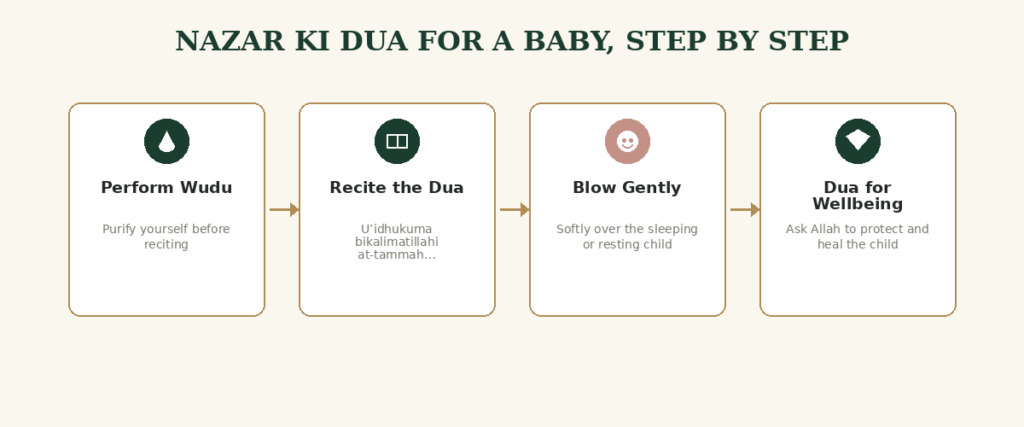
In practice, most parents build this into a few fixed moments rather than trying to remember it constantly: before the child sleeps, before leaving the house, and quietly after a visitor has praised the child. Saying it doesn’t require any ritual beyond sincerity — a parent’s own dua for their child carries particular weight in Islamic tradition.
How to Perform Ruqyah to Remove Nazar (Step-by-Step)
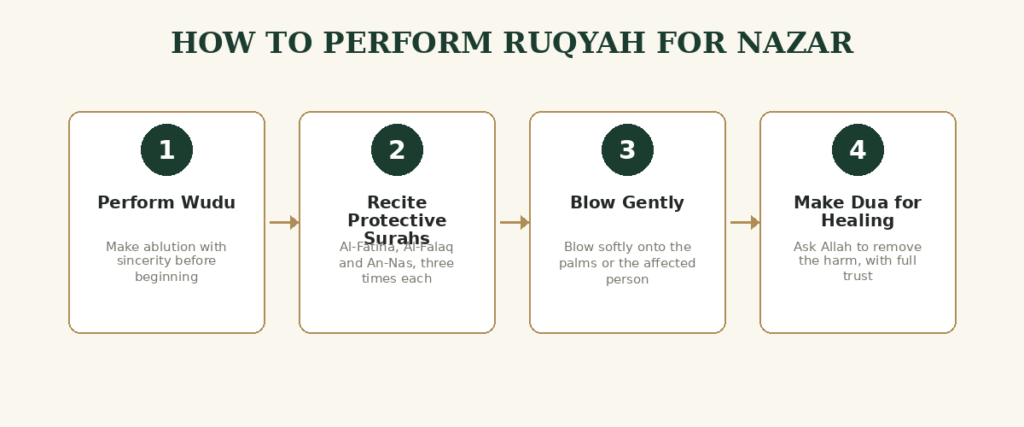
Ruqyah is the practice of reciting Quranic verses and prophetic duas over a person to seek healing, and it’s the standard response once nazar is suspected to have already taken effect.
| Step | Action |
|---|---|
| 1 | Perform wudu (ablution) before beginning |
| 2 | Recite Surah Al-Fatiha, Al-Falaq, and An-Nas, three times each |
| 3 | Blow gently onto your palms, or directly and lightly onto the affected person |
| 4 | Make personal dua asking Allah to remove the harm and grant healing |
A less-documented but genuinely practiced variation: some recite the same verses into a container of water, which the affected person then drinks from or bathes with. This isn’t a required step and has no strict hadith mandating it specifically, but it’s a known extension of ruqyah worth mentioning rather than treating as fringe.
Can You Give Yourself the Evil Eye?
Yes. Scholars note that a person can affect themselves or their own belongings through their own admiring gaze — looking at your own health, wealth, or a loved one with pleasure but without acknowledging Allah as the source of it. This is precisely why saying Masha’Allah or Tabarakallah is recommended even when you’re the one admiring your own blessings, not only someone else’s. It’s a small habit, but it’s the one piece of advice on this topic that most guides skip entirely, even though the underlying concern — self-inflicted nazar — is a real and common question.
How to Avoid Giving Someone the Evil Eye
Most advice on this topic is written for the person worried about being affected by nazar, but Islam gives equally direct guidance on not becoming the source of it. When you admire someone’s child, their new home, or a recent success, saying Masha’Allah (“what Allah has willed”) or Tabarakallah (“blessed is Allah”) acknowledges that the good you’re seeing comes from Allah, not from the person alone — and tradition holds that this simple phrase blunts any harm your admiration might otherwise carry. It’s also worth sharing good news moderately rather than broadcasting it widely, simply to reduce the number of envious glances a blessing draws. This overlaps with everyday Islamic etiquette more broadly — see this guide to common Muslim greetings for the fuller set of phrases Muslims use in these everyday moments.
Surah Yusuf 12:67 — Prophet Ya’qub’s Precaution Against Nazar
This is the story almost no guide on nazar tells, even though it comes directly from the Quran. When Prophet Ya’qub’s sons prepared to travel back to Egypt for a second time — this time with their youngest brother, Benjamin, alongside them — he gave them one specific instruction: don’t all walk in through the same city gate together. Enter through separate gates instead.
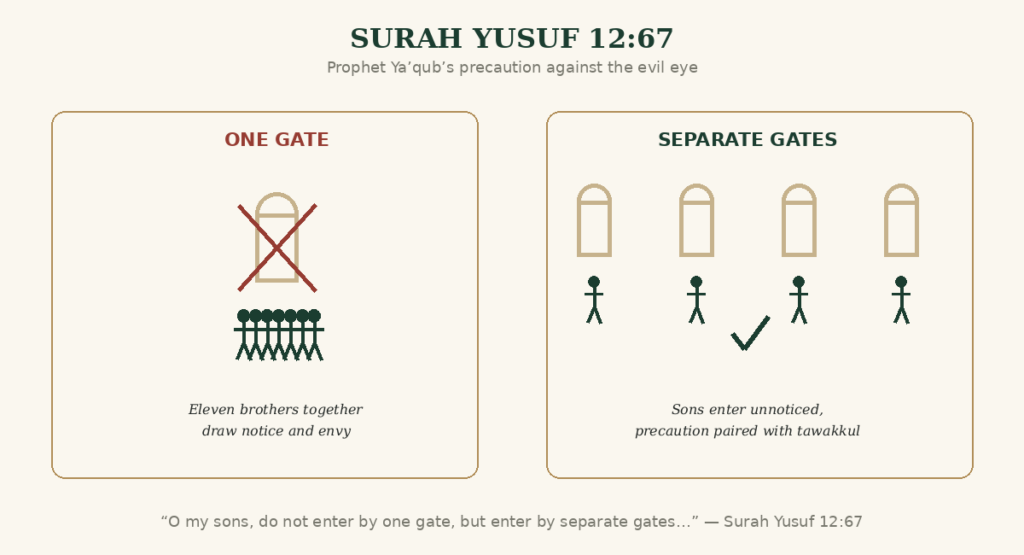
That pairing is the real lesson. Ya’qub didn’t rely on blind faith while ignoring sensible precaution, and he didn’t rely on precaution while forgetting that outcomes belong to Allah. He did both at once. It’s the clearest Quranic model for how a believer is meant to treat nazar generally: take reasonable, practical steps, and hold onto tawakkul — trust in Allah — regardless of the outcome.
Are Amulets (Taweez) Allowed for Evil Eye Protection?
This is a genuinely contested question, and it deserves a fair answer rather than a simple yes or no. Amulets or charms that don’t contain anything from the Quran — beads, symbolic objects, or items believed to carry protective power on their own — are generally considered impermissible in Islam, since attributing independent protective power to an object rather than to Allah touches on shirk (associating partners with Allah).
Amulets containing only Quranic verses are a different, more genuinely disputed matter. Some scholars permit them, reasoning that the words themselves are from the Quran and cannot cause harm. Many others discourage the practice as a precaution — worried about the amulet being treated carelessly, or about the line between “using Quranic words” and “trusting the object itself” becoming blurred over time. What isn’t disputed at all is direct recitation: reciting the duas and surahs above, without needing any physical object, is the position every school agrees on without argument.
Daily Routine to Stay Protected from Nazar
| Time of Day | What to Recite | Purpose |
|---|---|---|
| After Fajr / morning | Surah Al-Falaq, An-Nas, Ayat al-Kursi, A’udhu bikalimatillah | General daily protection |
| Before sleep | Al-Mu’awwidhatayn recited into cupped hands, wiped over the body | Nightly protection following the Prophet’s ﷺ practice |
| After every obligatory prayer | Ayat al-Kursi | Protection until the next prayer |
| When admiring your own or another’s blessing | Masha’Allah / Tabarakallah | Preventing self-inflicted or unintentional nazar |
| When nazar is suspected | Full ruqyah routine (see steps above) | Removing harm already believed to have occurred |
FAQ
What is the most powerful dua for nazar (evil eye)? The most widely cited is “A’udhu bikalimatillahi at-tammati min sharri ma khalaq” — “I seek refuge in the perfect words of Allah from the evil of what He has created.” It’s recorded in Sahih Muslim and recited three times in the morning and evening for general protection.
What does nazar mean? Nazar (نَظَر) literally means “gaze” or “look.” In Islamic belief it refers to real, unseen harm caused by someone’s envy, jealousy, or even excessive admiration — intentional or not — affecting a person’s health, wealth, or peace.
Is the evil eye real in Islam? Yes. The Prophet Muhammad ﷺ stated plainly that the evil eye is real. Islam treats it as a genuine spiritual reality, not folklore, while still discouraging superstition or panic over ordinary misfortune.
Can you give yourself the evil eye? Yes — scholars note a person can affect themselves or their own belongings through their own admiring gaze if they don’t acknowledge Allah with a phrase like Masha’Allah or Tabarakallah. It’s one reason the phrase is recommended even when admiring your own blessings, not only someone else’s.
How do you remove nazar (evil eye) once it has affected someone? Perform ruqyah: make wudu, recite Surah Al-Fatiha, Al-Falaq, and An-Nas three times each, then blow gently on the affected person while making dua for their healing. Some also recite into water for the person to drink or bathe with.
What is the dua for nazar for children? The Prophet ﷺ recited this over his grandsons Hasan and Husain: “U’idhukuma bikalimatillahi at-tammati min kulli shaytanin wa hammah, wa min kulli ‘aynin lammah” — “I seek refuge for you both in the perfect words of Allah, from every devil, every poisonous creature, and every evil eye.”
Are amulets (taweez) allowed for evil eye protection in Islam? Non-Quranic charms are generally considered impermissible. Amulets containing only Quranic verses are a matter of genuine scholarly disagreement — some permit them, many discourage them as a precaution — while direct recitation of protective duas has no such dispute.
What does the Quran say about the evil eye? Surah Al-Falaq instructs believers to seek refuge “from the evil of an envier when he envies.” Separately, in Surah Yusuf (12:67), Prophet Ya’qub tells his sons to enter Egypt through different gates rather than as one striking group, out of concern for the evil eye — an example of taking sensible precaution alongside trust in Allah