
Kullu Nafsin Zaikatul Maut” means “Every soul will taste death.” It’s one of the most repeated phrases in the Quran, appearing three separate times, and it’s the line many Muslims reach for — in a khutbah, a social post, or a quiet moment after hearing sad news — as a plain, unavoidable statement about mortality.
Below is the Arabic text exactly as it appears in the Quran, ready to copy, along with the transliteration, the meaning, and the small but important differences between the three verses.
What Does “Kullu Nafsin Zaikatul Maut” Mean?
It means “every soul will taste death.” The sentence is built from four Arabic words:
- Kullu (كُلُّ) — every, all, without exception
- Nafsin (نَفْسٍ) — soul, self, the conscious being
- Zaikatu (ذَآئِقَةُ) — tasting; from the root for “to taste”
- Al-Maut (الْمَوْتِ) — death
The choice of “taste” rather than a blunter word like “face” or “meet” is deliberate. It suggests the soul doesn’t simply vanish — it passes through the experience of death rather than being erased by it. That single word choice is part of why this phrase gets quoted so often outside of formal study: it says something specific about what death is, not just that it happens.
Kullu Nafsin Zaikatul Maut Arabic Text (Copy & Paste)
Here is the Arabic text for all three occurrences of the phrase in the Quran, with the transliteration underneath each one, so you can copy whichever version you need without digging through a full page of commentary.
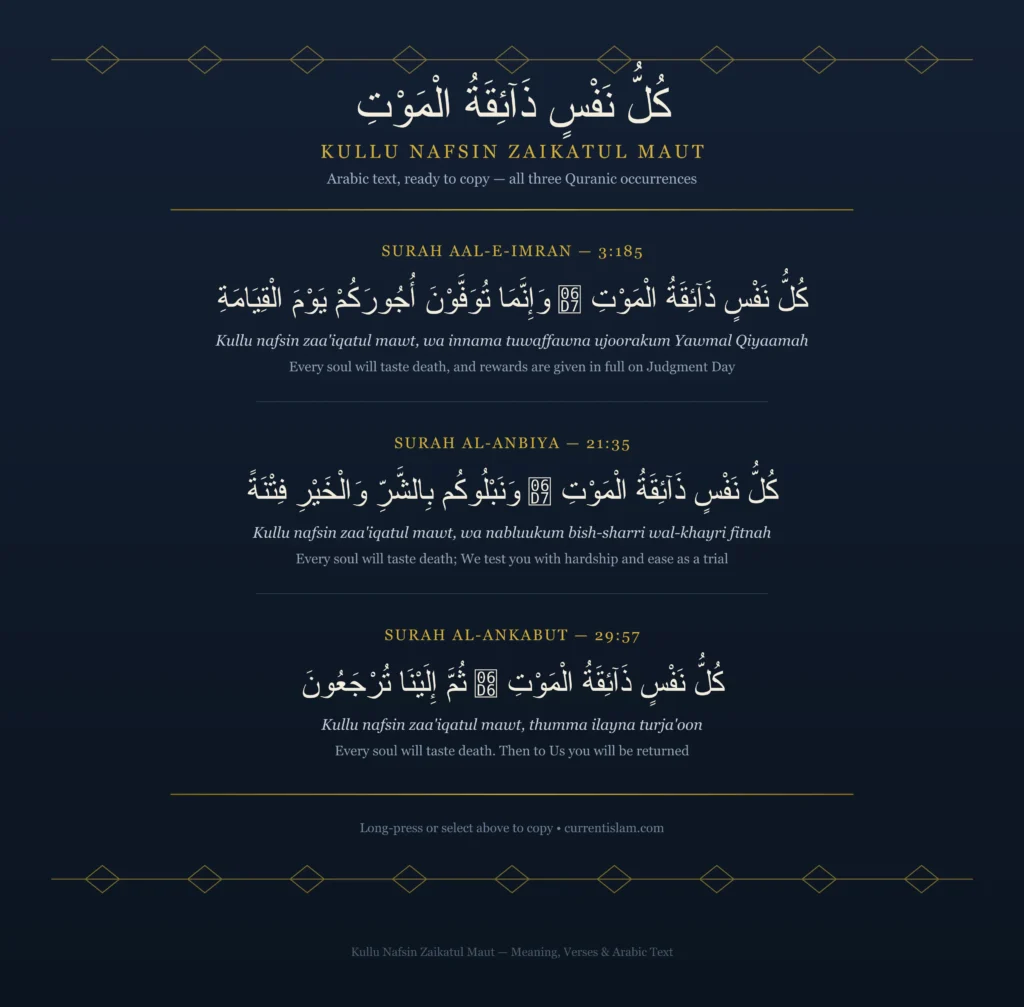
Surah Aal-e-Imran 3:185 كُلُّ نَفْسٍ ذَآئِقَةُ الْمَوْتِ ۗ وَإِنَّمَا تُوَفَّوْنَ أُجُورَكُمْ يَوْمَ الْقِيَامَةِ Kullu nafsin zaa’iqatul mawt, wa innama tuwaffawna ujoorakum Yawmal Qiyaamah.
Surah Al-Anbiya 21:35 كُلُّ نَفْسٍ ذَآئِقَةُ الْمَوْتِ ۗ وَنَبْلُوكُم بِالشَّرِّ وَالْخَيْرِ فِتْنَةً Kullu nafsin zaa’iqatul mawt, wa nabluukum bish-sharri wal-khayri fitnah.
Surah Al-Ankabut 29:57 كُلُّ نَفْسٍ ذَآئِقَةُ الْمَوْتِ ۖ ثُمَّ إِلَيْنَا تُرْجَعُونَ Kullu nafsin zaa’iqatul mawt, thumma ilayna turja’oon.
The opening five words — كُلُّ نَفْسٍ ذَآئِقَةُ الْمَوْتِ — are identical in all three verses. What changes is what comes after, and that second half is where each verse’s real message sits.
Transliteration & Word-by-Word Pronunciation
If you’re reading this in Roman letters rather than Arabic script, here’s how it’s said: Kul-lu naf-sin zaa-i-qa-tul mawt. The stress falls evenly, without any sharp emphasis on one syllable — it reads more like a calm statement than an exclamation, which fits the tone of the verse itself.
| Arabic word | Transliteration | Literal meaning |
|---|---|---|
| كُلُّ | Kullu | every / all |
| نَفْسٍ | Nafsin | soul / self |
| ذَآئِقَةُ | Zaa’iqatul | tasting (of) |
| الْمَوْتِ | Al-Mawt | the death |
Want the fuller context behind each of the three verses — who they were revealed to and why — rather than just the text? Read the full breakdown of each verse’s context in our companion piece.
Why Is It Spelled “Zaikatul,” “Za’iqatul,” or “Zaiqatul”?
They’re the same word. ذَآئِقَةُ comes from the Arabic root zawq (ذوق), meaning “to taste,” and every one of these spellings — zaikatul, za’iqatul, zaiqatul, zaaa’iqatul — is just a different attempt to write that one Arabic word using the Latin alphabet. There’s no standardized system for transliterating Arabic into English, so different scholars and sites land on different spellings depending on whether they’re prioritizing the sound or the exact letters. None of them is “more correct” than another; they all point back to the same word in the same verse.
The 3 Verses at a Glance
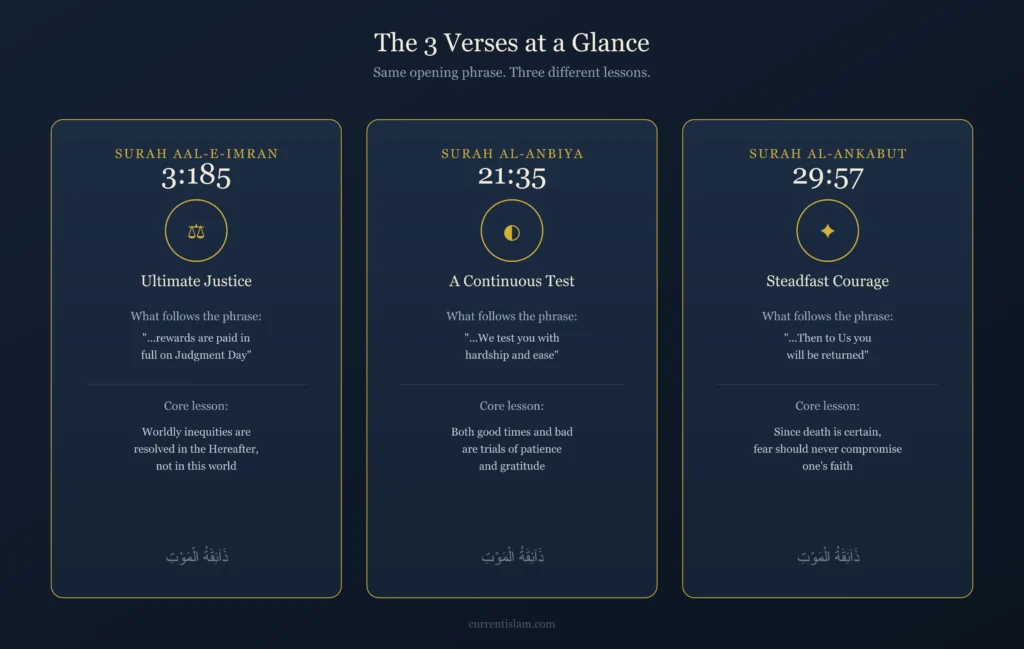
The phrase itself never changes, but each verse pairs it with a different message, aimed at a different situation. Seeing them side by side makes the pattern clearer than reading three separate translations in isolation.
| Surah & Ayah | What follows the phrase | Core lesson |
|---|---|---|
| Aal-e-Imran 3:185 | “…you will be given your full reward on the Day of Resurrection” | Worldly unfairness gets settled in the Hereafter, not in this life |
| Al-Anbiya 21:35 | “…We test you with hardship and with ease, as a trial” | Both suffering and comfort are tests, not random luck |
| Al-Ankabut 29:57 | “…Then to Us you will be returned” | Because death is certain either way, fear should never be a reason to abandon one’s faith |
Aal-e-Imran 3:185 is generally read as a message about accountability — the reminder that whatever imbalance exists between people in this life gets resolved on the Day of Judgment. Al-Anbiya 21:35 reframes life itself as a trial, where both hardship and ease are tests rather than rewards or punishments in themselves. Al-Ankabut 29:57 was revealed at a moment of real pressure on early Muslims, and reads as a message about courage — since no one escapes death regardless of what they do, there’s no practical reason to compromise one’s beliefs out of fear of it.
For the complete verse text with audio recitation, you can read the full verse and audio recitation on Quran.com, which carries every translation and the original Arabic for all three ayat referenced here.
When Do Muslims Say Kullu Nafsin Zaikatul Maut?
Most often, it’s quoted the way any well-known scriptural line gets quoted: in a khutbah about mortality, in a social media post after someone has died, or simply as a personal reminder when life feels comfortable enough to forget what’s coming. It’s a statement people reach for to reframe a moment, not a fixed ritual phrase tied to one specific occasion.
It’s worth being precise about one thing, though: this verse is not part of the formal funeral prayer. Salat al-Janazah, the Islamic funeral prayer, follows its own fixed structure with specific supplications — it doesn’t include this ayah as a set line. Kullu Nafsin Zaikatul Maut is far more commonly used around a death rather than in the prayer itself: in condolence posts, in reminders shared with grieving friends, or in a eulogy.
That also makes it easy to confuse with a different, very common phrase: “Inna lillahi wa inna ilayhi raji’un” (“To Allah we belong, and to Him we return”). That second phrase is the one specifically said upon hearing news of a death — it’s closer to an immediate response. Kullu Nafsin Zaikatul Maut, by contrast, is a general truth about mortality that applies at any time, not a phrase reserved for the moment someone first hears the news.
If you’re looking for something to say or recite specifically for someone who has passed, a complete Arabic dua for someone who has passed away is a more direct fit for that purpose than this verse.
Is It a Wazifa? Can It Be Recited for a Specific Purpose?
No — and this is a common point of confusion. Kullu Nafsin Zaikatul Maut is a declarative statement of fact, not a supplication (dua) with a prescribed number of repetitions or a promised outcome attached to reciting it a set number of times. There’s no fixed wazifa built around this verse.
What scholars do recommend is reflection rather than repetition: sitting with the reality the verse describes as a way of softening arrogance, breaking attachment to worldly status, and reorienting daily priorities toward what actually lasts. It’s meant to function as a mental reset, not a formula.
If you’re looking for a specific dua tied to loss or bereavement, a complete Arabic dua for the deceased is the more appropriate resource — this verse itself isn’t recited as that kind of prayer.
FAQ
What does Kullu Nafsin Zaikatul Maut mean in English? It means “Every soul will taste death.” It’s a Quranic statement declaring that every living being will experience physical death before returning to Allah, appearing three times in the Quran (3:185, 21:35, 29:57).
How many times does this phrase appear in the Quran? It appears exactly three times: Surah Aal-e-Imran 3:185, Surah Al-Anbiya 21:35, and Surah Al-Ankabut 29:57. Each occurrence pairs the phrase with a different follow-up message — accountability, trial, or courage.
What is the Arabic text of Kullu Nafsin Zaikatul Maut? The Arabic text is كُلُّ نَفْسٍ ذَآئِقَةُ الْمَوْتِ. The wording is identical across all three verses; what follows it in the ayah differs by surah.
Why do spellings like “zaikatul,” “za’iqatul,” and “zaiqatul” differ? They’re all transliterations of the same Arabic word, ذَآئِقَةُ, from the root meaning “to taste.” The spelling changes based on the romanization style used, not the underlying Arabic word.
Is Kullu Nafsin Zaikatul Maut a wazifa or dua? No. It’s a declarative statement of fact from the Quran, not a supplication with a prescribed number of repetitions. It’s recommended for reflection, not ritual recitation.
Is this verse recited during a Muslim funeral? Not as part of the formal Salat al-Janazah (funeral prayer), which follows its own fixed structure. The phrase is more commonly quoted in reflections, reminders, and condolence messages around the topic of death rather than in the funeral prayer itself.
What’s the difference between this phrase and “Inna lillahi wa inna ilayhi raji’un”? Kullu Nafsin Zaikatul Maut is a general statement that death is inevitable for everyone. “Inna lillahi wa inna ilayhi raji’un” (“To Allah we belong and to Him we return”) is specifically said upon hearing news of a death, as an immediate response