
If you need a dua right now, this is the one most Muslims reach for first:
Arabic: اللَّهُمَّ اغْفِرْ لَهُ وَارْحَمْهُ Transliteration: Allahumma ighfir lahu warhamhu Meaning: “O Allah, forgive him and have mercy on him.”
If the deceased is female, change lahu to laha and warhamhu to warhamha: Allahumma ighfir laha warhamha. Longer, more complete duas — and guidance on exactly when to say each one — follow below.
Duas for the Deceased, Organized by Moment
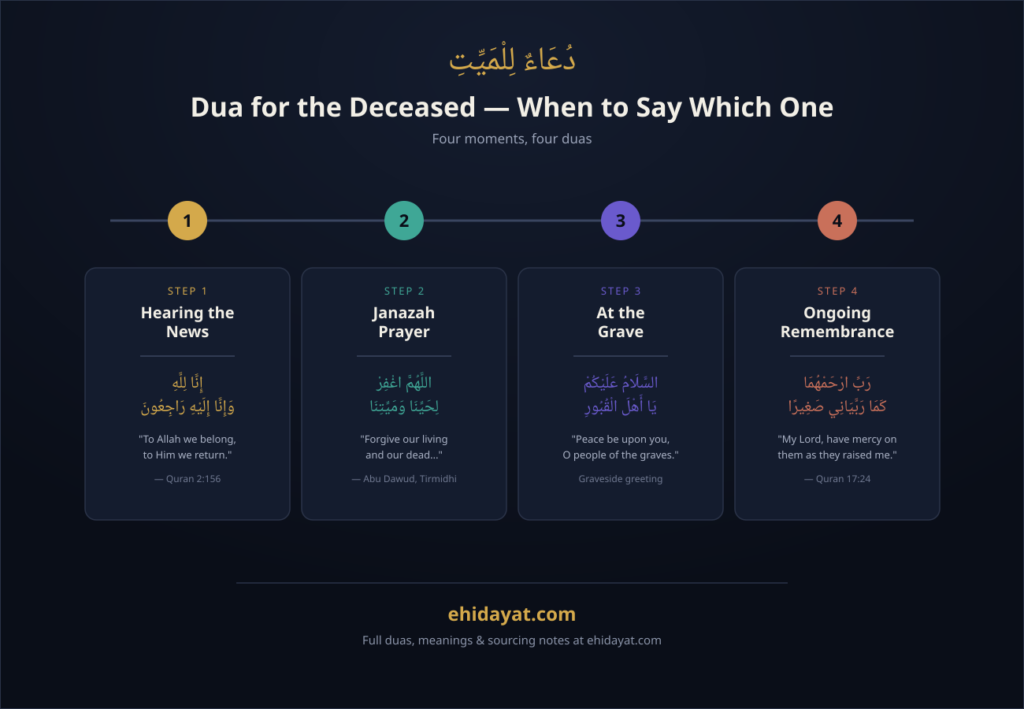
Different duas fit different moments, and knowing which one belongs where matters more than memorizing all of them at once. This guide is organized around four moments:
- Hearing the news — a short, immediate response
- Janazah (funeral) prayer — the formal supplication said in congregation
- At the grave — the greeting recited when visiting
- Ongoing remembrance — duas for daily life, especially for parents
Jump to whichever moment applies to you, or read through in order for the complete picture.
Dua to Say When You First Hear of a Death
The Quran itself teaches the first response:
Arabic: إِنَّا لِلَّهِ وَإِنَّا إِلَيْهِ رَاجِعُونَ Transliteration: Inna lillahi wa inna ilayhi raji’un Meaning: “Indeed, we belong to Allah, and indeed to Him we shall return.” (Surah Al-Baqarah, 2:156)
Follow it with the short forgiveness dua above, or the fuller version below if you have a moment. If the loss is personal — a close relative or friend — Islamic teaching also encourages asking for patience and a good outcome for yourself:
Arabic: اللَّهُمَّ أْجُرْنِي فِي مُصِيبَتِي وَأَخْلِفْ لِي خَيْرًا مِنْهَا Transliteration: Allahumma’jurni fi musibati wa akhlif li khayran minha Meaning: “O Allah, reward me in my affliction and replace it for me with something better.” (Sahih Muslim)
This one is for the living as much as the deceased — grief is real, and asking Allah for patience through it isn’t separate from praying for the person who has passed.
The Most Complete Dua for the Deceased (Sahih Muslim)
This is the fullest, most comprehensive dua for the deceased, narrated by the Companion ‘Awf ibn Malik, who described the Prophet ﷺ praying it during a funeral prayer:
Arabic: اللَّهُمَّ اغْفِرْ لَهُ وَارْحَمْهُ، وَعَافِهِ وَاعْفُ عَنْهُ، وَأَكْرِمْ نُزُلَهُ، وَوَسِّعْ مُدْخَلَهُ، وَاغْسِلْهُ بِالْمَاءِ وَالثَّلْجِ وَالْبَرَدِ، وَنَقِّهِ مِنَ الْخَطَايَا كَمَا نَقَّيْتَ الثَّوْبَ الأَبْيَضَ مِنَ الدَّنَسِ، وَأَبْدِلْهُ دَارًا خَيْرًا مِنْ دَارِهِ، وَأَهْلًا خَيْرًا مِنْ أَهْلِهِ، وَزَوْجًا خَيْرًا مِنْ زَوْجِهِ، وَأَدْخِلْهُ الْجَنَّةَ، وَأَعِذْهُ مِنْ عَذَابِ الْقَبْرِ وَمِنْ عَذَابِ النَّارِ
Transliteration: Allahumma ighfir lahu warhamhu, wa ‘aafihi wa’fu ‘anhu, wa akrim nuzulahu, wa wassi’ mudkhalahu, waghsilhu bil-ma’i wath-thalji wal-barad, wa naqqihi minal-khataya kama naqqayta ath-thawba al-abyada minad-danas, wa abdilhu daran khayran min darihi, wa ahlan khayran min ahlihi, wa zawjan khayran min zawjihi, wa adkhilhul-jannah, wa a’idhhu min ‘adhabil-qabri wa min ‘adhabin-nar.
Meaning: “O Allah, forgive him and have mercy on him, grant him well-being and pardon him. Make his reception honorable, expand his grave, and cleanse him with water, snow, and hail. Purify him of sin as a white garment is purified of dirt. Give him a home better than his home, a family better than his family, and a spouse better than his spouse. Admit him into Paradise and protect him from the punishment of the grave and the Fire.” — narrated by ‘Awf ibn Malik, Sahih Muslim
For a deceased woman, every hu ending becomes ha throughout — ighfir laha warhamha, wa ‘aafiha wa’fu ‘anha, and so on. If you’d like a full breakdown of this exact phrase word by word, see Allahummaghfirlahu Warhamhu — Arabic Text & Meaning.
Short Dua for the Deceased (Easy to Memorize)
Grief doesn’t always leave room to recall a long text. The short version below is the practical, easy-to-remember core of the fuller dua above:
Arabic: اللَّهُمَّ اغْفِرْ لَهُ وَارْحَمْهُ وَعَافِهِ وَاعْفُ عَنْهُ Transliteration: Allahumma ighfir lahu warhamhu wa ‘aafihi wa’fu ‘anhu Meaning: “O Allah, forgive him, have mercy on him, grant him well-being, and pardon him.”
This is the version worth memorizing first — it captures the core requests (forgiveness, mercy, wellbeing, pardon) in a single breath, and it’s exactly what most people mean when they search for “the” dua for the deceased.
Dua Recited During Janazah (Funeral) Prayer
The Janazah prayer is a communal obligation (Fard Kifayah) — if enough Muslims in the community perform it, the obligation is fulfilled for everyone else. The dua below is recited silently after the third of the prayer’s four takbirs:
Arabic: اللَّهُمَّ اغْفِرْ لِحَيِّنَا وَمَيِّتِنَا وَشَاهِدِنَا وَغَائِبِنَا وَصَغِيرِنَا وَكَبِيرِنَا وَذَكَرِنَا وَأُنْثَانَا Transliteration: Allahumma ighfir li-hayyina wa mayyitina, wa shahidina wa gha’ibina, wa sagheerina wa kabeerina, wa dhakarina wa unthana Meaning: “O Allah, forgive our living and our dead, those present and those absent, our young and our old, our males and our females.” — narrated by Abu Hurayrah, recorded in Abu Dawud, Tirmidhi, and al-Bayhaqi
This dua is deliberately inclusive — it doesn’t single out the one person being buried, but asks forgiveness for the whole community, living and dead alike. If you’re specifically looking for the Janazah dua as prayed for a woman, see Dua for Female Janaza for the full guide.
Dua for Deceased Parents
This one comes directly from the Quran, not a hadith — worth knowing, since it means there’s no question at all about its authenticity:
Arabic: رَبِّ ارْحَمْهُمَا كَمَا رَبَّيَانِي صَغِيرًا Transliteration: Rabbi irhamhuma kama rabbayani sagheera Meaning: “My Lord, have mercy upon them as they raised me when I was small.” (Surah Al-Isra, 17:24)
This dua works whether one or both parents have passed, and it’s commonly recited after the five daily prayers as an ongoing act of remembrance, not just at the time of death.
Dua When Visiting the Grave
Islamic teaching includes a specific greeting for entering a graveyard or standing before a grave:
Arabic: السَّلَامُ عَلَيْكُمْ يَا أَهْلَ الْقُبُورِ، يَغْفِرُ اللَّهُ لَنَا وَلَكُمْ Transliteration: As-salamu ‘alaykum ya ahlal-quboor, yaghfirullahu lana wa lakum Meaning: “Peace be upon you, O inhabitants of the graves. May Allah forgive us and you.”
A few points of etiquette go with this: face the Qiblah rather than the grave itself when making dua, avoid sitting directly on top of a grave, and if you’re walking on the soil between graves, remove your shoes where practical.
Which of These Duas Are Directly Sourced?
Worth being upfront about, since it’s easy to lose track once duas start circulating online: every dua in this guide traces to either the Quran directly or a specific hadith narration — the graveside greeting, the Janazah dua, the comprehensive ‘Awf ibn Malik dua, and the two Quranic duas above all have a named source you could look up yourself.
That’s not true of everything you’ll find searching this topic. Several widely shared “dua for the deceased” lists online include phrases like “O Allah, join him with the righteous” or “O Allah, accept his good deeds” presented as prophetic supplications without any hadith or Quran reference attached to them at all — not necessarily false in meaning, since asking Allah for those things is always appropriate, but not traceable to a specific narration the way the duas in this guide are. One popular list even includes a Quranic verse about steadfastness in battle (Surah Al-Baqarah, 2:250) filed under “duas for a dead person,” which isn’t what that verse is about.
None of this means unsourced duas are wrong to say — sincere supplication in your own words is always valid in Islam. It just means there’s a real difference between “this exact wording is what the Prophet ﷺ taught” and “this is a heartfelt prayer inspired by the same spirit,” and it’s worth knowing which one you’re reciting. For more on how hadith authenticity works, see What Is Hadith in Islam?.
Mayat Ki Maghfirat Ki Dua — Same Prayer, Different Name
If you grew up hearing “Mayat Ki Maghfirat Ki Dua” or searched for “death ki dua,” you’re not looking for something different from what’s already on this page — that’s simply the Urdu/South Asian name for the same Arabic duas above, most often referring to the short and comprehensive forgiveness duas.
For reference, here’s the short dua again with Roman Urdu alongside the Arabic and English:
Arabic: اللَّهُمَّ اغْفِرْ لَهُ وَارْحَمْهُ Roman Urdu: Allahumma ighfir lahu warhamhu Urdu meaning: اے اللہ! اس کی مغفرت فرما اور اس پر رحم فرما English: “O Allah, forgive him and have mercy on him.”
Whether you call it “dua for the deceased,” “maghfirat ki dua,” or “death ki dua,” the Arabic text and its meaning stay exactly the same.
What Else Benefits the Deceased Besides Dua?
Dua is powerful, but Islamic teaching describes it as one of three things that continue to reach a person after death:
“When a person dies, his deeds come to an end except for three: ongoing charity (Sadaqah Jariyah), knowledge that benefits others, or a righteous child who prays for him.” — Sahih Muslim 1631
That’s dua, but it’s also ongoing charity and beneficial knowledge left behind. If you’re looking for ways to give charity on behalf of someone who has passed, Sadaqah Meaning in Islam explains how Sadaqah Jariyah works and how to set it up as a lasting gift in their name. 5 duas to make when someone die
Etiquette of Making Dua for the Deceased
A few simple practices make dua for the deceased more complete:
- Face the Qiblah and raise your hands, as you would for any sincere dua.
- Begin with praise of Allah and send salawat (blessings) upon the Prophet ﷺ before making your specific requests.
- Mention the deceased by name, if you’re praying for someone specific rather than the deceased in general.
- Ask plainly — forgiveness, mercy, light in the grave, and admission to Paradise are the standard requests, and you don’t need elaborate language beyond that.
- Close with Ameen, and repeat salawat upon the Prophet ﷺ.
Frequently Asked Questions
What is the dua for the deceased in Arabic? The most commonly recited is “Allahumma ighfir lahu warhamhu” (اللَّهُمَّ اغْفِرْ لَهُ وَارْحَمْهُ) — “O Allah, forgive him and have mercy on him.” A longer, more complete version narrated by ‘Awf ibn Malik in Sahih Muslim adds requests for a spacious grave, purification from sin, and Paradise.
What do you say in Arabic when someone dies? “Inna lillahi wa inna ilayhi raji’un” (إِنَّا لِلَّهِ وَإِنَّا إِلَيْهِ رَاجِعُونَ) — “Indeed, we belong to Allah, and indeed to Him we shall return” (Quran 2:156). It’s the first response taught in Islamic tradition, said before any longer dua follows.
Is there a specific dua for a deceased parent? Yes — “Rabbi irhamhuma kama rabbayani sagheera” (رَبِّ ارْحَمْهُمَا كَمَا رَبَّيَانِي صَغِيرًا), meaning “My Lord, have mercy upon them as they raised me when I was small” (Surah Al-Isra, 17:24). It’s Quranic, and commonly recited as an ongoing dua, not just at the time of death.
What is Mayat Ki Maghfirat Ki Dua? It’s the Urdu name for the same Arabic dua for the deceased covered throughout this guide — most often referring to the short forgiveness dua, “Allahumma ighfir lahu warhamhu.” It isn’t a separate prayer from what’s taught in Arabic sources.
Can I make dua for the deceased in English instead of Arabic? Yes. Sincerity matters more than language, and Allah understands every language. Reciting the Arabic wording taught by the Prophet ﷺ carries additional reward and tradition, but praying in your own words and language is always valid.
How do I change the dua for a female? Swap the masculine endings for feminine ones: lahu becomes laha, warhamhu becomes warhamha, ‘aafihi becomes ‘aafiha, and so on throughout. The meaning and structure of the dua stay identical — only the pronoun changes.
Does the deceased actually hear or benefit from the dua? The majority of Islamic scholars hold that the deceased does benefit from the sincere dua of the living, based on hadith describing dua as one of the deeds that continues to reach a person after death (Sahih Muslim 1631). Whether or not the soul “hears” the words in a literal sense is a matter of scholarly discussion, but the benefit of the prayer itself is not in question.