
Hajj 2026 has already happened. If you’re searching for these dates now, you probably don’t need a prediction — you need the record. Hajj 2026 ran from Monday, 25 May to Saturday, 30 May 2026, corresponding to 8–13 Dhul Hijjah 1447 AH, following the Saudi Supreme Court’s official crescent-moon sighting announcement on 17 May 2026. The Day of Arafah fell on 26 May, and Eid al-Adha was marked on 27 May across most of the Muslim world.
Below is the full confirmed schedule, why these dates move every year, and — since the pattern is already knowable — a first look at when Hajj 2027 is expected to fall.
When Was Hajj 2026?
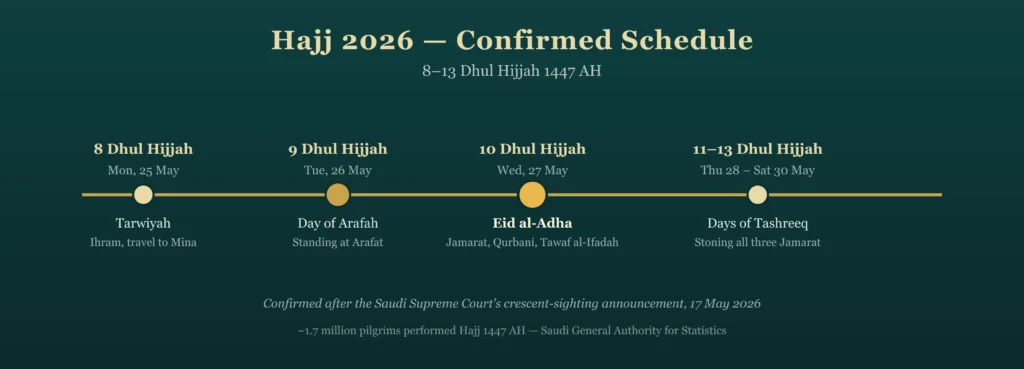
Hajj 2026 took place from 25–30 May 2026, spanning 8–13 Dhul Hijjah 1447 AH. This is no longer an estimate: it’s what actually happened, confirmed after Saudi Arabia’s Supreme Court announced the crescent-moon sighting that set Dhul Hijjah’s start for 18 May 2026, which in turn placed the Day of Arafah on 26 May and Eid al-Adha on 27 May.
Most pages you’ll find still describe these dates as “expected” or “predicted” — a leftover from articles written before the pilgrimage took place. By the time Hajj actually happens, the moon-sighting has settled everything, and there’s no reason left to hedge.
Hajj 2026 Day-by-Day Schedule
Each day of Hajj carries a specific ritual, and the sequence hasn’t changed in over a thousand years — only the Gregorian dates shift.
| Hijri Date | Gregorian Date | Day | What Happens |
|---|---|---|---|
| 8 Dhul Hijjah | Monday, 25 May | Yawm at-Tarwiyah | Pilgrims enter the state of Ihram and travel to Mina to spend the night in reflection |
| 9 Dhul Hijjah | Tuesday, 26 May | Day of Arafah | Pilgrims stand at Arafat in prayer from midday to sunset — the single most important rite of Hajj — then move to Muzdalifah overnight to gather pebbles |
| 10 Dhul Hijjah | Wednesday, 27 May | Eid al-Adha | Stoning of Jamarat al-Aqabah, the sacrifice (Qurbani), cutting or shaving hair, and Tawaf al-Ifadah |
| 11–13 Dhul Hijjah | Thu 28 – Sat 30 May | Days of Tashreeq | Stoning at all three Jamarat pillars over two or three days, before the farewell Tawaf in Makkah |
If you want the full walkthrough of what each of these rites means and how to perform them correctly, it’s worth reading a dedicated step-by-step Hajj rituals guide rather than trying to piece it together from a dates page.
How Many Pilgrims Performed Hajj 2026?
Around 1.7 million pilgrims completed Hajj 1447 AH, according to figures released by Saudi Arabia’s General Authority for Statistics after the season concluded. That’s a confirmed post-event count, not the pre-season estimate of “nearly two million” that circulated in the weeks before the pilgrimage — a useful reminder that early-season figures are always rough, and the real number only comes out once Hajj is over.
Why Do Hajj Dates Change Every Year?
Hajj always falls on the same days of the Islamic calendar — the 8th through 13th of Dhul Hijjah — but the Islamic calendar is lunar, and a lunar year is roughly 11 days shorter than the Gregorian solar year. So on the Gregorian calendar, Hajj drifts about 11 days earlier every year. Over a 33-year cycle, that drift is large enough for Hajj to fall twice within a single Gregorian year, something that last happened in 2006.
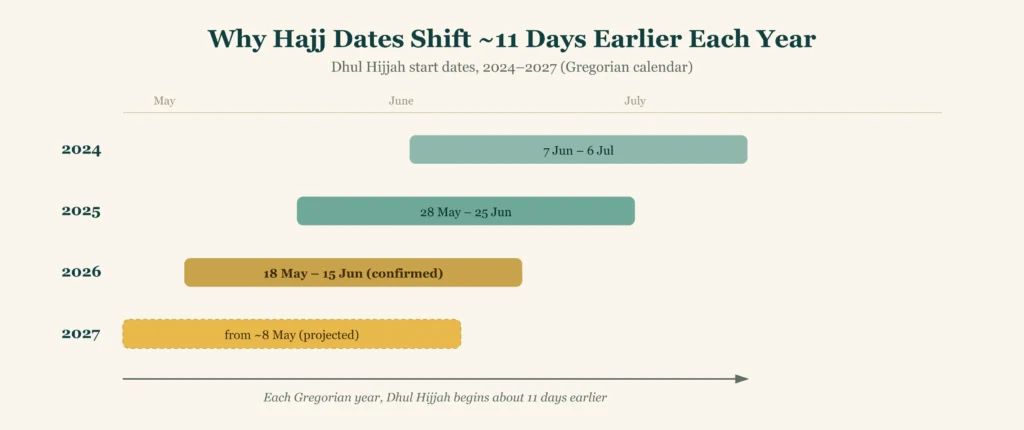
| Year (CE) | Dhul Hijjah (Gregorian) | Hijri Year |
|---|---|---|
| 2024 | 7 June – 6 July | 1445 AH |
| 2025 | 28 May – 25 June | 1446 AH |
| 2026 | 18 May – 15 June | 1447 AH |
| 2027 | From ~8 May | 1448 AH |
Laid out this way, the pattern is hard to miss — each year’s window starts about a week and a half earlier than the last.
When Is Hajj 2027?
Based on current projections, Dhul Hijjah 1448 AH is expected to begin around 7–8 May 2027, which would place the Day of Arafah around 15 May 2027 and Eid al-Adha around 16 May 2027. Unlike the 2026 dates above, these are still projections — they depend on the crescent-moon sighting in Saudi Arabia roughly a year from now, and could shift by a day in either direction. We’ll update this page with Hajj 2027 confirmed dates once the Supreme Court makes its announcement, so it’s worth bookmarking rather than searching again next spring.
Why Did Some Countries Celebrate Eid al-Adha a Day Later?
Because not every country uses Saudi Arabia’s moon sighting. More than 28 countries — including the UAE, Qatar, Kuwait, Egypt, Turkey, Jordan, and Muslim communities across the UK, US, and Europe — followed Saudi Arabia and marked Eid al-Adha on 27 May 2026. But countries that rely on local moon-sighting committees, including Pakistan, India, Bangladesh, South Africa, and Brunei, didn’t sight the crescent on the same night and observed Eid a day later, on 28 May. Both are considered valid — it comes down to whether a country’s religious authority follows global sighting reports or insists on a local sighting within its own borders.
What Are the Core Rites of Hajj?
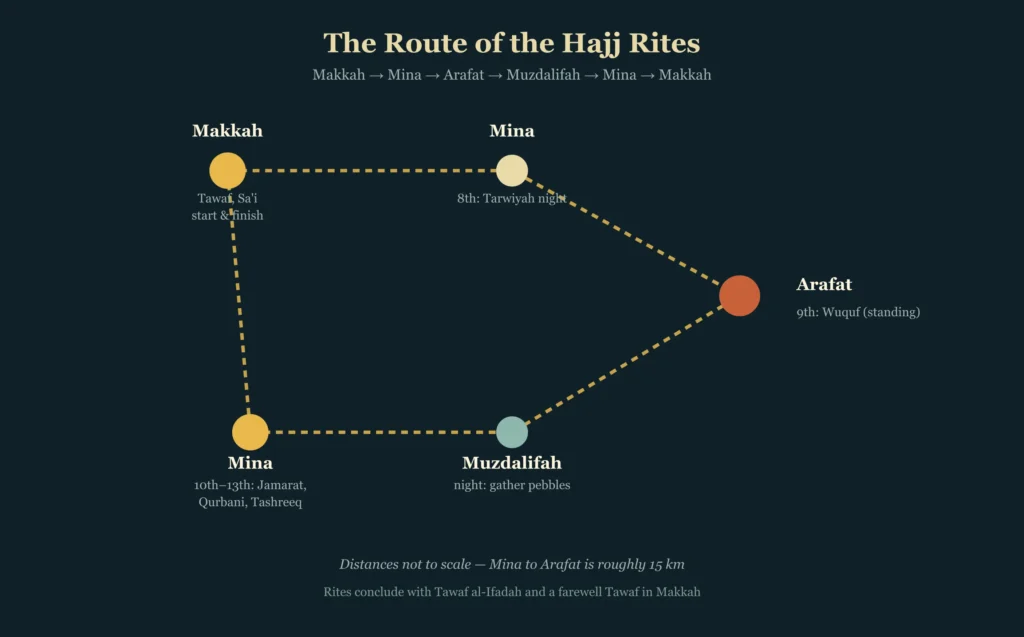
Every rite of Hajj retraces the story of Prophet Ibrahim (AS), his wife Hajar, and their son Isma’il, and each one has a specific physical and spiritual purpose:
- Ihram — pilgrims enter a sacred state, marked by simple white garments for men, and declare their intention to perform Hajj.
- Tawaf — circling the Kaaba seven times counter-clockwise, an act of devotion pilgrims perform at several points during the pilgrimage.
- Sa’i — walking seven times between the hills of Safa and Marwah, retracing Hajar’s search for water.
- Wuquf at Arafah — standing in prayer at Arafat on the 9th, considered the heart of Hajj; a Hajj without this is not valid.
- Muzdalifah — an overnight stay under the open sky, where pilgrims collect pebbles for the days ahead.
- Ramy al-Jamarat — stoning three pillars that represent the rejection of temptation.
- Qurbani — an animal sacrifice commemorating Ibrahim’s willingness to sacrifice his son for God.
- Tawaf al-Ifadah — a second Tawaf that formally completes the pilgrimage.
Many pilgrims also use these blessed days to increase their personal worship — reciting the Beautiful Names of Allah, or repeating Hasbunallahu wa ni’mal wakeel — “Allah is sufficient for us, and He is the best disposer of affairs” — as an expression of trust during the journey.
Should Non-Pilgrims Fast on the Day of Arafah?
Yes — fasting on the Day of Arafah is highly recommended for any Muslim not performing Hajj that year. The Prophet Muhammad (peace be upon him) said this fast expiates the sins of the past year and the year to come. Pilgrims actually standing at Arafat do not fast, since they need their strength for a long day of prayer in the heat. If you’re at home rather than in Makkah, the first ten days of Dhul Hijjah more broadly are considered some of the most rewarding of the entire Islamic calendar — a good time to add extra prayer, including Tahajjud, alongside fasting and charity.
Heat and Safety During Hajj 2026
Hajj in late May means standing outdoors, often for hours, during some of the hottest weeks of the Saudi calendar — a real concern given what happened during the 2024 season, when Saudi officials treated more than 2,000 pilgrims for heat stress, with over 1,300 reported deaths, many of them among unauthorized pilgrims without access to shaded rest areas. Saudi authorities have since expanded cooling infrastructure, misting stations, and shaded walkways across Mina and Arafat. If you’re planning a future Hajj, hydration, timing outdoor movement around the cooler parts of the day, and staying with a licensed operator that has proper medical support all matter more than most first-time pilgrims expect.
How Do I Register for Hajj?
Registration for a given year’s Hajj typically closes months before the pilgrimage, once a country’s quota is filled — so if you’re planning ahead for Hajj 2027, the process realistically starts now. Applications run through your national Hajj authority or licensed travel operators, in coordination with Saudi Arabia’s official Nusuk platform, which handles visa verification, accommodation, and country-specific quotas. Expect to need a valid passport, proof of vaccination per Saudi health requirements, and a confirmed package booking before a visa is issued.
FAQ
What were the Hajj 2026 dates? Hajj 2026 took place from Monday, 25 May to Saturday, 30 May 2026 (8–13 Dhul Hijjah 1447 AH), confirmed by Saudi Arabia’s Supreme Court after sighting the Dhul Hijjah crescent moon on 17 May 2026.
When was the Day of Arafah in 2026? The Day of Arafah fell on Tuesday, 26 May 2026 (9 Dhul Hijjah 1447 AH), when pilgrims stood in prayer on the plains of Arafat.
When was Eid al-Adha 2026? Eid al-Adha was celebrated on Wednesday, 27 May 2026 in Saudi Arabia and over 28 other countries. Countries using local moon-sighting, including Pakistan, India, and Bangladesh, observed it a day later, on 28 May.
How many people performed Hajj in 2026? Around 1.7 million pilgrims performed Hajj 1447 AH, according to Saudi Arabia’s General Authority for Statistics.
When is Hajj 2027 expected? Hajj 2027 is projected to begin around 14–15 May 2027, with Dhul Hijjah 1448 AH expected to start around 7–8 May 2027. These are estimates pending official moon-sighting confirmation closer to the time.
Why do Hajj dates change every year? The Islamic calendar is lunar and roughly 11 days shorter than the Gregorian solar year, so Hajj shifts about 11 days earlier each year on the Gregorian calendar.
Should I fast on the Day of Arafah if I’m not performing Hajj? Yes — it’s highly recommended, as the Prophet (peace be upon him) said this fast expiates the sins of the past year and the coming year. Pilgrims performing Hajj do not fast on this day.