
What Does “Allahummaghfirlahu Warhamhu Wa’afihi Wa’fu’anhu” Mean?
“Allahummaghfirlahu warhamhu wa’afihi wa’fu’anhu” means “O Allah, forgive him, have mercy on him, grant him well-being, and pardon him.” It’s a supplication the Prophet Muhammad ﷺ himself made while leading a funeral prayer, and it’s been repeated by Muslims at janazah prayers for over 1,400 years since.
The phrase is built around four short, back-to-back requests — forgiveness, mercy, well-being, pardon — made on behalf of someone who has died. “Lahu” at the end marks it as being said for a man; change that one syllable and the same dua works for a woman or for more than one person, which is exactly why you’ll come across three or four near-identical versions of it.
You’ll also see it spelled a dozen different ways online: “firlahu” instead of “ghfirlahu,” “wa’aafihi” with a doubled vowel, “wa’fu anhu” written as two words instead of one. They’re all pointing at the same four Arabic words — the ones laid out below.
Arabic Text and Transliteration
The Arabic text of the dua is:
اللَّهُمَّ اغْفِرْ لَهُ وَارْحَمْهُ وَعَافِهِ وَاعْفُ عَنْهُ
Read right to left, it’s most commonly transliterated as “Allahumma ighfir lahu warhamhu wa ‘afihi wa’fu ‘anhu” — though spelling in Latin letters varies constantly, since there’s no single official system for writing Arabic sounds in English.
| Arabic | Transliteration | Literal meaning |
|---|---|---|
| اللَّهُمَّ | Allahumma | O Allah |
| اغْفِرْ لَهُ | ighfir lahu | forgive him |
| وَارْحَمْهُ | warhamhu | and have mercy on him |
| وَعَافِهِ | wa’afihi | and grant him well-being |
| وَاعْفُ عَنْهُ | wa’fu ‘anhu | and pardon him |
Two sounds trip up most non-Arabic readers. The “gh” in “ighfir” is a soft, guttural sound with no clean English equivalent — closer to a French “r” than an English “g.” And the apostrophe in “‘afihi” and “‘anhu” represents the Arabic letter ayn, a tight catch in the throat rather than a pause or a glottal stop. Getting those two sounds close is what separates a recitation people recognize from one that just looks right on paper.
Word-by-Word Breakdown: Understanding Each Part of the Dua
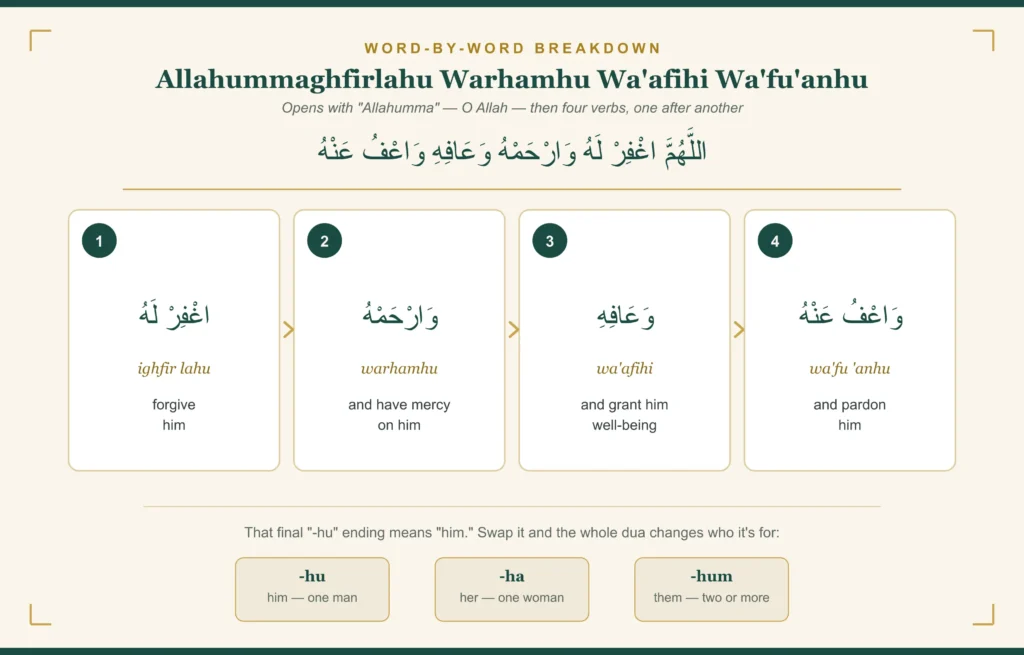
Every word in this dua is doing specific work, and once you see the four pieces separately, the whole phrase stops being one long string of sounds to memorize and starts being four small, connected requests.
It opens with “Allahumma” — a vocative form of Allah’s name, used only when addressing Him directly in dua, roughly equivalent to opening with “O Allah.” Everything after it is a verb in the imperative mood, stacked one after another:
Ighfir lahu — “forgive him” — from the root gh-f-r, the same root behind “maghfirah” (forgiveness) and one of Allah’s own names, Al-Ghafur. This is the request for sins to be covered over, not held against the deceased.
Warhamhu — “and have mercy on him” — from r-h-m, the root of “rahmah” (mercy) and “Ar-Rahman,” the Most Merciful. Where forgiveness asks for sins to be overlooked, mercy asks for active kindness in what comes next.
Wa’afihi — “and grant him well-being” — carrying the sense of safety and being spared from harm. Classical commentators generally read this as protection specifically from what comes after death — the questioning in the grave, its narrowness, its darkness.
Wa’fu ‘anhu — “and pardon him” — related to the same root as “ighfir,” but a step further: not just overlooking a fault, but erasing it entirely, as though it had never happened.
Four requests, each slightly different in scope, said one after another for someone who can no longer ask for any of it themselves.
Where This Dua Comes From: The Hadith Source
This dua comes from Sahih Muslim 963, narrated by the companion ‘Awf ibn Malik al-Ashja’i and graded Sahih (authentic) — one of the most rigorously authenticated hadith collections in Islam.
‘Awf ibn Malik reported that he stood behind the Prophet ﷺ during a funeral prayer and memorized the supplication as he heard it recited aloud. The hadith sits in the Book of Prayer – Funerals, in the chapter specifically on supplicating for the deceased, and the same wording is preserved independently in Sunan an-Nasa’i (1984) and Sunan Ibn Majah (1500) — three separate collections carrying essentially identical text, which is part of why the dua is considered so well-established.
There’s a detail in the hadith that rarely makes it into summaries of the dua. ‘Awf ibn Malik said that hearing the Prophet ﷺ pray this way for a man he didn’t personally know made him wish he had been the one being prayed over. It’s a small aside, but it says something about how this dua landed on the people who first heard it — not as a formula to get through, but as something worth wanting for yourself.
Some pages online attribute this dua to “a hadith” without saying which one, or use the wording with no citation at all. That’s worth flagging only because it means the source — collection, book, chapter, narrator — is easy to verify independently rather than take on faith, which is the entire point of hadith grading. For readers who want the complete text and chain of narration, sunnah.com hosts Sahih Muslim 963 in full. And if the term “Sahih” or hadith grading in general is unfamiliar, our guide to what hadith means in Islam covers how authenticity is established and why scholars weigh it the way they do.
The Full Prophetic Dua (Beyond the Short Phrase)
“Allahummaghfirlahu warhamhu wa’afihi wa’fu’anhu” isn’t the complete dua — it’s the opening line. In the actual hadith, ‘Awf ibn Malik continued reciting well past these four requests, and the fuller version is considerably longer.
Most pages online — including the highest-ranking ones for this exact phrase — present the short version as if it’s the whole prayer. That’s not wrong; scholars have long treated the short form as sufficient on its own. But it helps to know it’s an excerpt, the way “to be or not to be” is an excerpt of a much longer speech rather than a complete one.
The continuation, in paraphrase, asks Allah to honor the deceased’s arrival and widen his grave; cleanse him of sin the way a white garment is cleansed of a stain, using water, snow, and hail as the specific imagery; replace his home, family, and companion with better ones; and shelter him from the trial of the grave and the punishment of the Fire.
| Content | |
|---|---|
| Short phrase (most commonly recited and searched) | Forgive, have mercy, grant well-being, pardon |
| Full continuation (same hadith, Sahih Muslim 963) | + honor his arrival, widen his grave, cleanse him of sin, replace his home/family/companion, shelter him from the grave’s trial and the Fire |
The water-snow-hail imagery isn’t decorative. Classical commentators read it as invoking everything associated with coolness and relief in a hot climate, layered onto the cleansing metaphor of a white garment losing its stain — two images doing the same work of erasure from two different angles. Some regional traditions recite the short form in the funeral prayer itself for brevity and save the long form for private supplication when there’s more time; both come from the same authenticated hadith, just different lengths of the same original prayer.
Allahummaghfirlahu, Allahummaghfirlaha, Allahummaghfirlahum: Why the Ending Changes
The ending on “lahu” is an attached Arabic pronoun meaning “him.” Swap that one syllable and the entire dua shifts to a different person: “-ha” makes it “her,” and “-hum” makes it “them” (two or more).
This isn’t three separate duas to memorize — it’s one dua with a pronoun slot, the same way English doesn’t need a new verb for “forgive him” versus “forgive her.” Arabic just attaches the pronoun directly onto the end of the word instead of using a separate one after it.
| Form | Ending | Used for | Arabic |
|---|---|---|---|
| Allahummaghfirlahu warhamhu | -hu | One deceased man | اللَّهُمَّ اغْفِرْ لَهُ وَارْحَمْهُ |
| Allahummaghfirlaha warhamha | -ha | One deceased woman | اللَّهُمَّ اغْفِرْ لَهَا وَارْحَمْهَا |
| Allahummaghfirlahum warhamhum | -hum | Two or more deceased | اللَّهُمَّ اغْفِرْ لَهُمْ وَارْحَمْهُمْ |
Every other word in the dua shifts to match — “wa’afihi” becomes “wa’afiha” or “wa’afihim,” and so on down the line. It’s a consistent grammatical pattern, not three unrelated phrases that happen to look alike.
This same -hu/-ha/-hum pattern runs throughout Arabic, well beyond this one dua. It’s part of why you’ll see sites publish “the version for men” and “the version for women” as though they’re different prayers, when really it’s one grammatical structure doing what English does with three separate pronouns spelled three different ways.
One question that comes up often: what if you don’t know whether the deceased was male or female, or you’re praying in general terms? In that case, the masculine form (“-hu”) is traditionally used as the grammatically unmarked default — the same role it plays elsewhere in Arabic when gender is unspecified — though checking with whoever is leading the prayer is always the more reliable option in the moment.
If you’re specifically looking for the version recited for a woman, our full breakdown of Allahummaghfirlaha warhamha covers it with the same word-level detail as this page. And for more on the male form specifically, including fuller usage notes, see our dedicated guide to Allahummaghfirlahu warhamhu.
When and How This Dua Is Recited
This dua is recited silently during salat al-janazah, the Islamic funeral prayer, specifically after the third of the prayer’s four takbirs — the raised-hand declarations of “Allahu Akbar” that structure it.
Salat al-janazah has no bowing or prostration; it’s performed standing, in four segments marked off by takbirs. The first is followed by reciting Al-Fatihah, the second by sending blessings on the Prophet ﷺ, the third by this dua for the deceased, and the fourth by a final short supplication before the closing salam.
Beyond the funeral prayer itself, it’s also commonly recited standing at the graveside immediately after burial, during a visit to the grave afterward, or simply whenever someone wants to make dua for a Muslim who has died. Our roundup of complete graveside duas covers the fuller set typically recited at each of these moments.
One practical note: the imam typically recites it quietly enough that only those nearby can follow along, which is one reason the exact wording has historically spread more through memorization and word of mouth than through people reading it off a page — and part of why the spelling drifts as much as it does once it’s written down.
Common Spelling Variations You’ll See
If you’ve seen this dua spelled “allahumma firlahu warhamhu,” “allahummaghfirlahu warhamhu,” or “allahummaghfirlahu warhamhu wa’aafihi wa’fu’anhu,” you’re looking at the same Arabic phrase — just transliterated by different people using different, unofficial conventions.
Arabic doesn’t have one agreed-upon system for writing its sounds in Latin letters, so the same word ends up spelled several different ways depending on who’s typing it and which sounds they’re trying to approximate. A few variations you’ll run into with this specific dua:
- “Firlahu” vs. “ghfirlahu” — some transliterations drop the initial “gh” sound entirely, since it has no clean English equivalent and softens further in casual speech.
- “Wa’afihi” vs. “wa’aafihi” — the doubled “aa” is an attempt to mark a long vowel sound that shorter transliterations skip.
- “Wa’fu’anhu” vs. “wa’fu anhu” — written as one word or two; the apostrophe stands for the Arabic letter ayn either way.
- “Warhamhu” vs. less common vowel spellings — vowels vary most of all, since Arabic short vowels aren’t written with dedicated letters to begin with.
None of these change the meaning. They’re all pointing at the Arabic text further up this page — the one fixed reference point underneath all the spelling variation.
Is It Correct to Say This Outside of Funeral Prayer?
Yes — this dua can be said outside the funeral prayer, including on hearing news of a death, at a graveside visit, or simply in personal dua for someone who has passed, without needing the specific setting or sequence required inside salat al-janazah itself.
The wording doesn’t change; what changes is that outside the prayer, there’s no requirement around when in a sequence it’s said or who’s leading it. It’s commonly paired with “Inna lillahi wa inna ilayhi raji’un” (“indeed we belong to Allah, and to Him we return,” from Surah Al-Baqarah 2:156) when responding to news of a death — the two phrases together cover both the acknowledgment of loss and the prayer for the person who died.
Can You Recite It in English Instead of Arabic?
Reciting the meaning in English rather than the Arabic wording is generally considered a valid personal dua — Allah understands every language, and there’s no requirement that private supplication be in Arabic. What’s specifically prescribed in Arabic is the language of salah itself, including salat al-janazah; the wording recited inside that formal prayer follows the Arabic text scholars have preserved and transmitted.
In practice, that splits into two situations. If you’re leading or standing in a funeral prayer, the Arabic wording is what’s recited — that’s part of the prayer’s fixed structure. If you’re privately making dua for someone who has died, at home, at a graveside, in your own words, reciting the English meaning, or a mix of both, is a common and accepted way to do it. Plenty of people learn the Arabic gradually this way, pairing it with the English meaning each time rather than treating the two as separate choices to pick between.
Frequently Asked Questions
What does Allahummaghfirlahu warhamhu wa’afihi wa’fu’anhu mean? It means “O Allah, forgive him, have mercy on him, grant him well-being, and pardon him” — a Prophetic dua for a deceased Muslim man, most often recited during the funeral prayer.
Is this dua only recited for men? In this exact form, yes — “lahu” is the masculine ending. For a woman it becomes “Allahummaghfirlaha warhamha,” and for two or more deceased, “Allahummaghfirlahum warhamhum.”
What is the Arabic text of this dua? اللَّهُمَّ اغْفِرْ لَهُ وَارْحَمْهُ وَعَافِهِ وَاعْفُ عَنْهُ, commonly transliterated as “Allahumma ighfir lahu warhamhu wa ‘afihi wa’fu ‘anhu.”
When exactly is this dua recited in the funeral prayer? Silently, after the third of the four takbirs in salat al-janazah — right after sending blessings on the Prophet ﷺ and before the prayer’s closing supplication.
Which hadith is this dua taken from? Sahih Muslim 963, narrated by ‘Awf ibn Malik al-Ashja’i in the Book of Prayer – Funerals, and graded Sahih (authentic). The same wording also appears in Sunan an-Nasa’i and Sunan Ibn Majah.
Can this dua be recited outside the funeral prayer? Yes. It’s commonly said on hearing of a death, at a graveside visit, or simply in personal dua for someone who has passed — no specific setting is required outside of salat al-janazah itself.
The words themselves are simple enough to memorize in an afternoon. What takes longer is having them ready — not reaching for a phone at a funeral, not fumbling through a transliteration while everyone else has already moved to the fourth takbir. That’s really the only reason a page like this is worth bookmarking: not because the dua is complicated, but because the moment it’s needed rarely leaves room to look anything up. For a fuller set of duas for moments like this, our collection of prayers for the deceased is a good next stop.