
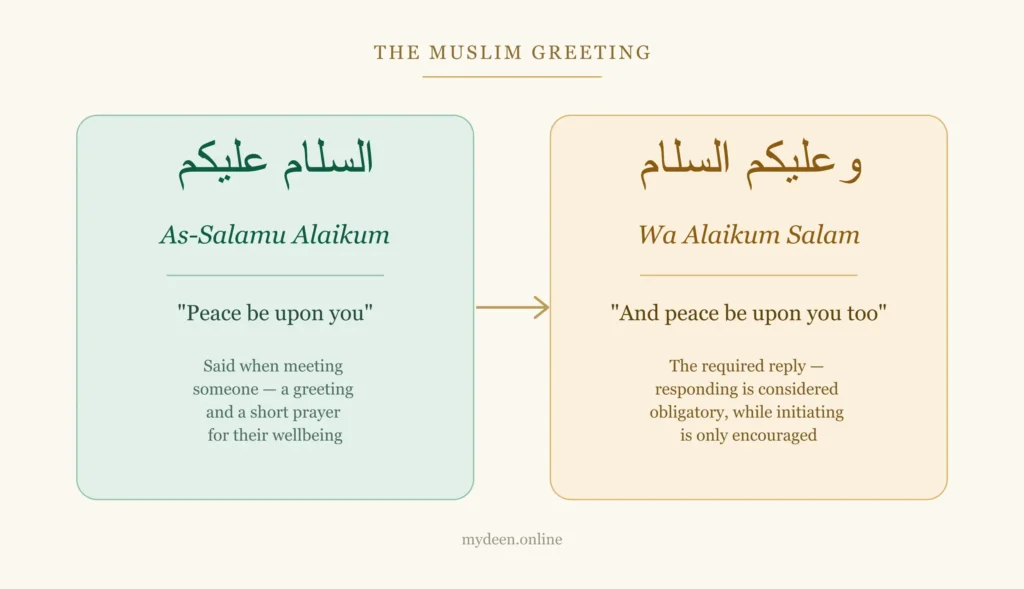
If you’ve ever wondered what the Muslim greeting actually means, the short answer is this: “As-Salamu Alaikum” is Arabic for “Peace be upon you,” and the person greeted answers with “Wa Alaikum Salam” — “And peace be upon you too.” It’s the single most common phrase you’ll hear exchanged between Muslims anywhere in the world, from a quiet hallway in Jakarta to a mosque courtyard in Lagos.
But it isn’t just a hello. It’s closer to a short prayer wrapped inside a greeting — a wish for the other person’s safety and wellbeing, spoken out loud rather than kept as a private thought. That’s part of why it carries more weight than “hi” does in English, and why there’s a real etiquette around how, when, and to whom it’s said.
What is the Muslim greeting?
The Muslim greeting is “As-Salamu Alaikum” (السلام عليكم), which translates literally to “Peace be upon you.” It’s said when meeting or approaching someone, and the expected reply is “Wa Alaikum Salam” (وعليكم السلام), “And peace be upon you too.” Muslims around the world use it interchangeably with — and usually instead of — a generic “hello,” in both casual and formal settings.
What sets it apart from an ordinary greeting is intention. Saying it isn’t meant as a reflex the way “hey, how’s it going” sometimes is. It’s meant as a genuine wish, spoken with the understanding that words carry weight.
What does “As-Salamu Alaikum” actually mean?
The word at the center of the phrase, salam, comes from an Arabic root tied to peace, safety, and wholeness. It’s the same root behind “Islam” itself and behind one of the names Muslims use for God, As-Salam — “The Source of Peace.” So when someone says “As-Salamu Alaikum,” they’re not inventing a nice sentiment on the spot; they’re invoking a concept that sits close to the center of the religion’s vocabulary.
The greeting itself is older than Islam — versions of “peace be upon you” show up in other Semitic languages going back many centuries. What Islam did was give it specific religious weight: according to hadith literature, the practice traces back to a story about Adam being taught to greet a gathering of angels with exactly this phrase, and being told it would become the greeting passed down through his descendants. That’s a big part of why Muslims treat it as more than etiquette — it’s framed as a practice with a spiritual lineage.
How do you respond to the Muslim greeting?
The correct response is “Wa Alaikum Salam” — “And peace be upon you too.” This isn’t optional the way starting the greeting is. Among the etiquette rules Islamic scholars have written about, one point comes up consistently: while initiating the greeting is encouraged, responding to it is treated as closer to a duty. If someone greets you with salam, etiquette calls for you to answer, audibly, so they actually hear it — mumbling or a half-hearted nod isn’t considered a proper response.
If someone extends the greeting with extra blessings (more on that below), it’s considered good form to match or exceed what they offered in your reply, rather than shortening it.
Short vs. full greeting: which should you use?
There isn’t just one version of the phrase. Muslims use three lengths depending on the setting, and Islamic tradition attaches an escalating reward to each one — the longer the greeting, the greater the stated reward, based on a hadith recorded in Sunan Abi Dawud.
| Greeting | Transliteration | Meaning | Reported reward |
|---|---|---|---|
| السلام عليكم | As-Salamu Alaikum | Peace be upon you | 10 |
| السلام عليكم ورحمة الله | As-Salamu Alaikum wa Rahmatullah | Peace be upon you, and the mercy of Allah | 20 |
| السلام عليكم ورحمة الله وبركاته | As-Salamu Alaikum wa Rahmatullahi wa Barakatuh | Peace be upon you, and the mercy of Allah, and His blessings | 30 |
In practice, the short form covers almost every everyday interaction — passing someone in a hallway, answering the phone, starting a text message. The fuller versions tend to come out in more formal or heartfelt moments: greeting an elder, reuniting with someone after a long time apart, or opening a speech at a religious gathering.
This escalating-reply idea also has a basis in the Quran itself. Surah An-Nisa 4:86 instructs that when someone offers you a greeting, you should return one that’s equal to it or better — which is essentially the scriptural root of the etiquette around matching or extending a greeting rather than shrinking it.
The etiquette rules: who greets first?
There’s a pecking order to who’s expected to initiate, and it runs opposite to what a lot of people assume. According to hadith attributed to the Prophet Muhammad, a person riding a mount should greet a person walking; someone walking should greet someone who’s seated; and a small group should greet a larger one. In a separate narration, younger people are expected to greet their elders first.
The logic isn’t about hierarchy — if anything it flips it. The person more likely to notice someone first, or the one in a position of relative advantage, is the one asked to make the first move. And if the person who’s “supposed” to greet first forgets or doesn’t notice you, that’s not treated as an excuse to stay silent. You’re expected to greet them anyway, even if you’re the one who technically didn’t have to go first.
Non-verbal etiquette: what to do with your hands
Words matter here, but so does what your body is doing while you say them. A handshake is the standard accompaniment between people of the same gender, often with the left hand placed over the heart as a warmer, more sincere version of the gesture. Between men and women who aren’t closely related, many Muslims skip the handshake altogether and greet with the hand-over-heart gesture on its own, paired with a smile and a respectful nod — this is generally seen as the more modest option rather than an awkward compromise.
There are two situations where a gesture is allowed to stand in for the words entirely: when there’s too much noise or distance for the greeting to actually be heard, and when the person being greeted is deaf. Outside of those cases, etiquette calls for saying the words clearly rather than just waving or nodding — a hand gesture isn’t considered a substitute for actually speaking the greeting when speaking is possible.
Can non-Muslims say As-Salamu Alaikum?
Yes. Using the greeting as a non-Muslim is widely seen as a respectful, welcome gesture — a way of showing you’re making an effort to connect, not an overstep. Muslims generally receive it warmly, the same way most people appreciate a foreigner attempting a local greeting while traveling.
There is a bit of scholarly nuance on the other side of the exchange — some traditional discussions address whether Muslims should be the ones to initiate the greeting toward non-Muslims first, versus simply responding warmly if greeted. But that nuance is about who starts the exchange between a Muslim and a non-Muslim, not about whether a non-Muslim is allowed to use the phrase. If you’re ever unsure of the pronunciation or the moment doesn’t feel right, a plain “hello” is always a safe fallback — the goodwill behind the gesture matters far more than getting every syllable perfect.
Greetings for special occasions
Beyond the everyday greeting, Islamic culture has its own set of occasion-specific phrases, most of which follow the same “greeting plus reply” structure.
| Occasion | Arabic phrase | Transliteration | Meaning | Typical reply |
|---|---|---|---|---|
| Friday | جمعة مباركة | Jummah Mubarak | Blessed Friday | Jummah Mubarak (said back) |
| Eid al-Fitr / Eid al-Adha | عيد مبارك | Eid Mubarak | Blessed festival | Eid Mubarak, or Khair Mubarak |
| Ramadan | رمضان مبارك | Ramadan Mubarak | Blessed Ramadan | Ramadan Mubarak, or Ramadan Kareem |
“Khair Mubarak,” used as a reply to either Jummah or Eid Mubarak, roughly means “may goodness and blessings be upon you too” — it’s a way of returning the sentiment without just repeating the same words back verbatim, similar to how “you too” works as a reply to “have a good one” in English.
How the greeting changes region to region
The core phrase stays remarkably stable across the Muslim world, but the way it’s spoken, shortened, or paired with local custom varies a lot more than most guides mention.
| Region / country | Local form or custom |
|---|---|
| Turkey | Often shortened to “Selamün aleyküm,” used interchangeably with a plain “hello” among more secular speakers |
| Bangladesh & South Asia | “Assalamu alaikum” is common even as a goodbye, and some greet elders by raising the right hand to the forehead |
| Senegal | Rendered in Wolof as “asalaa maalekum,” with the reply “maalekum salaam” |
| Xinjiang, China (Uyghur) | “Essalam eleykum,” answered with “we’eleykum essalam” |
| Egypt | Frequently shortened in everyday speech, often pronounced closer to “salaamu alaykum” with softer consonants |
There’s also a curious linguistic footnote: in Portugal, the word “salamaleque” — a distant echo of the same phrase — came to describe an exaggerated, theatrical bow, a nod to the elaborate greeting gestures Iberian Arabs were once associated with. It’s a small reminder of how far a single greeting phrase can travel and change shape.
For a closer look at the meaning and spiritual weight behind the core greeting itself, our full guide to Muslim greetings and responses goes deeper into the etiquette and scholarly commentary around it.
Saying salam in texts, emails, and group chats
Most greetings today don’t happen face to face — they happen in a text thread or the first line of an email. The good news is that typing the greeting is treated the same as saying it out loud; sending “Assalamu alaikum” to open a message is a normal, accepted way to spread the greeting, not a lesser substitute for it.
A few practical habits carry over well into digital spaces. Opening a new group chat with salam sets a respectful tone before the conversation gets into logistics. In a work email to a Muslim colleague or client, a short “As-salamu alaikum” before “Dear so-and-so” reads as thoughtful rather than overly formal. Shorthand like “AsA” or “salaam” is common and fine in casual texting between friends, but it’s worth writing the fuller phrase out in more formal correspondence, the same way you wouldn’t abbreviate “regards” in a cover letter.
The one thing worth watching for is sincerity creeping out of the habit. If salam becomes the equivalent of an autocomplete suggestion — typed without any thought behind it — it starts to lose the quality that makes it meaningful in the first place. A little intention goes a long way, even in a two-second text.
Quick answer: “Muslim greeting” crossword clue
If you landed here from a crossword rather than a curiosity about Islam, the answer you’re likely looking for is SALAAM (6 letters). It shows up under clues like “Muslim greeting,” “Islamic greeting,” or “Oriental greeting” in puzzles from The Guardian, The Times, and other British and American crosswords.
Frequently asked questions
What is the Muslim greeting? The Muslim greeting is “As-Salamu Alaikum,” Arabic for “Peace be upon you.” It’s said when meeting someone and is answered with “Wa Alaikum Salam,” “And peace be upon you too.” It functions as both a hello and a short prayer for the other person’s wellbeing.
How do you respond to As-Salamu Alaikum? Respond with “Wa Alaikum Salam.” If the greeting included extra blessings (“wa rahmatullahi wa barakatuh”), it’s encouraged, though not required, to include them in your reply too, matching or exceeding what was offered.
Can a non-Muslim say As-Salamu Alaikum? Yes. It’s generally seen as a respectful, welcome gesture regardless of the speaker’s faith. If you’re unsure of the pronunciation or context, a simple “hello” is always acceptable too.
What is the crossword answer for “Muslim greeting”? The most common crossword answer is SALAAM (6 letters), sometimes clued as “Oriental greeting” or “peaceful greeting” in British puzzles.
What’s the difference between “Salam” and the full greeting? “Salam” or “As-Salamu Alaikum” is the short form. Adding “wa rahmatullahi wa barakatuh” (and the mercy of Allah and His blessings) creates the fuller, more formal version, traditionally associated with a greater reported reward.
Do you say As-Salamu Alaikum to one person or a group? The wording adapts slightly: “as-salamu alayk” for one person, “as-salamu alaykuma” for two, and “as-salamu alaykum” for three or more, though the plural form has become common in everyday use even when greeting just one person.
Is it okay to text or type “As-Salamu Alaikum” instead of saying it aloud? Yes. Sending it by text, email, or in a group chat is accepted and encouraged as a way to spread the greeting, as long as it’s used sincerely rather than as an empty reflex.