
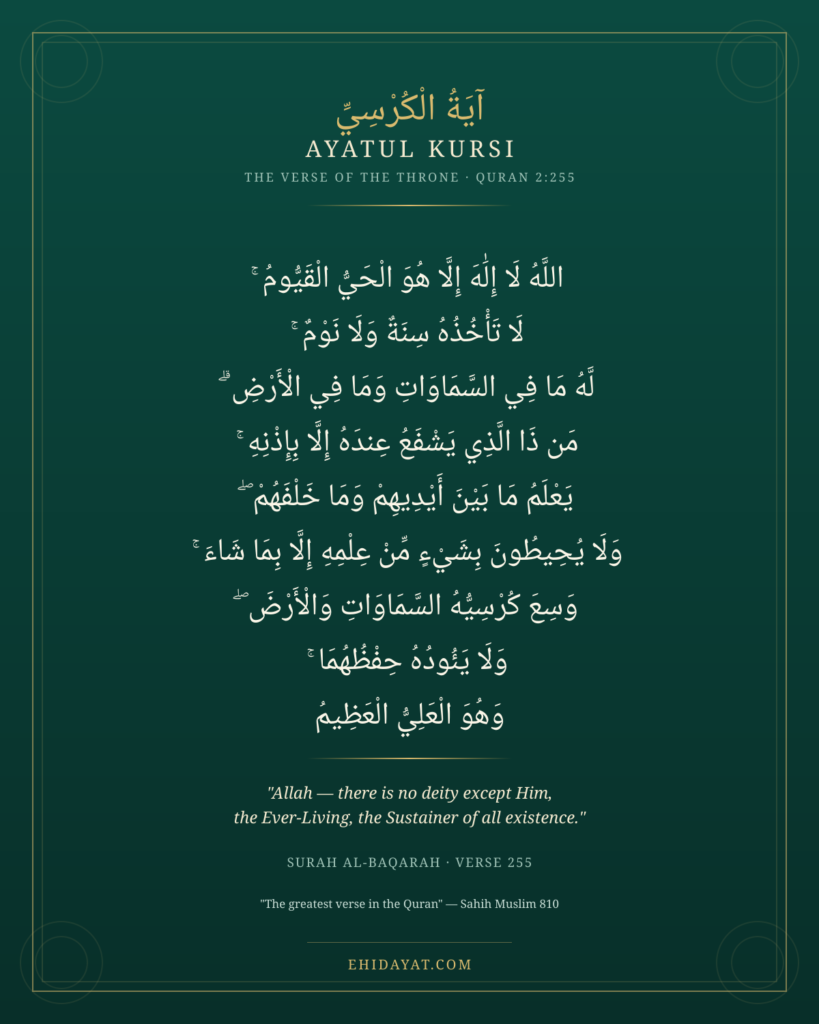
Ayatul Kursi is verse 255 of Surah Al-Baqarah — the single verse the Prophet Muhammad ﷺ identified by name as the greatest in the entire Quran. Below is the full Arabic text, a clause-by-clause transliteration, the English translation, and the authentic hadith behind its virtues, along with a few things about this verse that rarely get explained clearly online.
What Is Ayatul Kursi?
Ayatul Kursi (آية الكرسي, “the Verse of the Throne”) is verse 255 of Surah Al-Baqarah, sitting in the third Juz of the Quran. In an authentic hadith, the Prophet ﷺ told his companion Ubayy ibn Ka’b that it is the greatest verse in the Book of Allah (Sahih Muslim 810). In ten short clauses, it covers Allah’s oneness, His eternal nature, His total knowledge, and the vastness of His dominion — which is why scholars describe it as the most concentrated single statement of Islamic belief in the Quran.
Ayatul Kursi Full Arabic Text (Quran 2:255)
اللَّهُ لَا إِلَٰهَ إِلَّا هُوَ الْحَيُّ الْقَيُّومُ ۚ لَا تَأْخُذُهُ سِنَةٌ وَلَا نَوْمٌ ۚ لَّهُ مَا فِي السَّمَاوَاتِ وَمَا فِي الْأَرْضِ ۗ مَن ذَا الَّذِي يَشْفَعُ عِندَهُ إِلَّا بِإِذْنِهِ ۚ يَعْلَمُ مَا بَيْنَ أَيْدِيهِمْ وَمَا خَلْفَهُمْ ۖ وَلَا يُحِيطُونَ بِشَيْءٍ مِّنْ عِلْمِهِ إِلَّا بِمَا شَاءَ ۚ وَسِعَ كُرْسِيُّهُ السَّمَاوَاتِ وَالْأَرْضَ ۖ وَلَا يَئُودُهُ حِفْظُهُمَا ۚ وَهُوَ الْعَلِيُّ الْعَظِيمُ
The Arabic above follows the Uthmani script of the Mushaf, cross-checked against Quran.com’s 2:255 page. If you’re reading this on a device where the Arabic isn’t rendering cleanly, that page is a reliable place to view or listen to it directly.
Ayatul Kursi Transliteration
Reading in Roman script line by line, rather than as one dense block, makes it easier to follow along if you’re learning the verse for the first time:
Allahu la ilaha illa Huwa, Al-Hayyul-Qayyum. La ta’khuzuhu sinatun wa la nawm. Lahu ma fis-samawati wa ma fil-ard. Man zal-lazee yashfa’u ‘indahu illa bi-iznihi. Ya’lamu ma bayna aydeehim wa ma khalfahum. Wa la yuheetoona bi-shay’im-min ‘ilmihi illa bima sha’a. Wasi’a kursiyyuhus-samawati wal-ard. Wa la ya’ooduhu hifzuhuma. Wa Huwal-‘Aliyyul-‘Azeem.
Ayatul Kursi English Translation
The translation below follows Sahih International, the most commonly cited English rendering of the Quran online:
“Allah — there is no deity except Him, the Ever-Living, the Sustainer of [all] existence. Neither drowsiness overtakes Him nor sleep. To Him belongs whatever is in the heavens and whatever is on the earth. Who is it that can intercede with Him except by His permission? He knows what is [presently] before them and what will be after them, and they encompass not a thing of His knowledge except for what He wills. His Kursi extends over the heavens and the earth, and their preservation tires Him not. And He is the Most High, the Most Great.”
Other translators phrase a few clauses differently — Pickthall renders “Kursi” as “throne” rather than leaving it transliterated, for instance — but the meaning across major English translations is consistent.
Ayatul Kursi Word-by-Word Breakdown
Classical commentators, including Ibn Kathir, divide the verse into ten distinct clauses, each making its own standalone statement about Allah. Reading them one at a time is a faster way to absorb the verse than reading the full translation straight through.
| # | Arabic | Transliteration | Meaning |
|---|---|---|---|
| 1 | اللَّهُ لَا إِلَٰهَ إِلَّا هُوَ | Allahu la ilaha illa Huwa | Allah — there is no god but Him |
| 2 | الْحَيُّ الْقَيُّومُ | Al-Hayyul-Qayyum | The Ever-Living, the Sustainer of all existence |
| 3 | لَا تَأْخُذُهُ سِنَةٌ وَلَا نَوْمٌ | La ta’khuzuhu sinatun wa la nawm | Neither drowsiness nor sleep overtakes Him |
| 4 | لَّهُ مَا فِي السَّمَاوَاتِ وَمَا فِي الْأَرْضِ | Lahu ma fis-samawati wa ma fil-ard | Everything in the heavens and the earth belongs to Him |
| 5 | مَن ذَا الَّذِي يَشْفَعُ عِندَهُ إِلَّا بِإِذْنِهِ | Man zal-lazee yashfa’u ‘indahu illa bi-iznihi | No one can intercede with Him without His permission |
| 6 | يَعْلَمُ مَا بَيْنَ أَيْدِيهِمْ وَمَا خَلْفَهُمْ | Ya’lamu ma bayna aydeehim wa ma khalfahum | He knows what is ahead of creation and what is behind it |
| 7 | وَلَا يُحِيطُونَ بِشَيْءٍ مِّنْ عِلْمِهِ إِلَّا بِمَا شَاءَ | Wa la yuheetoona bi-shay’im-min ‘ilmihi illa bima sha’a | They grasp nothing of His knowledge except what He allows |
| 8 | وَسِعَ كُرْسِيُّهُ السَّمَاوَاتِ وَالْأَرْضَ | Wasi’a kursiyyuhus-samawati wal-ard | His Kursi extends over the heavens and the earth |
| 9 | وَلَا يَئُودُهُ حِفْظُهُمَا | Wa la ya’ooduhu hifzuhuma | Preserving both places no burden on Him |
| 10 | وَهُوَ الْعَلِيُّ الْعَظِيمُ | Wa Huwal-‘Aliyyul-‘Azeem | He is the Most High, the Most Great |
Clauses 1–2 establish who Allah is. Clauses 3–7 describe what sets Him apart from anything created — no fatigue, total ownership, unmatched knowledge. Clauses 8–10 close on the scale of His dominion. It’s a tight structure: nothing in the verse is decorative.
The 5 Names of Allah in Ayatul Kursi
Five of Allah’s names appear explicitly in the text: Allah, Al-Hayy (the Ever-Living), Al-Qayyum (the Self-Sustaining Sustainer), Al-Aliyy (the Most High), and Al-Adheem (the Most Great).
| Name | Meaning | Also appears in |
|---|---|---|
| Allah | The One True God | Used throughout the Quran — its most frequent name |
| Al-Hayy (الحَيّ) | The Ever-Living | Surah Aal-‘Imran 3:2, Surah Ta-Ha 20:111 |
| Al-Qayyum (القَيُّوم) | The Self-Sustaining Sustainer of All | Same two verses as Al-Hayy — the two are always paired |
| Al-Aliyy (العَلِيّ) | The Most High | Surah Al-Hajj 7:54, Surah Yunus 10:3, Surah Ar-Ra’d 13:2, Surah Ta-Ha 20:5, Surah Al-Furqan 25:59 |
| Al-Adheem (العَظِيم) | The Most Great | One of the 99 Names, appearing elsewhere across the Quran |
The Al-Hayy/Al-Qayyum pairing is worth pausing on. It shows up in only three places in the entire Quran — here, in 3:2, and in 20:111 — and several classical scholars, including Imam al-Qurtubi, held that it contains Allah’s Greatest Name (Ism al-A’zam), the one referenced in the hadith about a name that guarantees a response when Allah is called by it. That’s a large claim to rest on two words, but it’s part of why this particular verse, out of over 6,000 in the Quran, is the one singled out as the greatest.
If you want the fuller picture of all 99 names, including the four covered here, ehidayat.com’s guide to the 99 Names of Allah breaks each one down individually with its Quranic references.
What Does “Kursi” Mean? Kursi vs. Arsh
“Kursi” literally means footstool, chair, or seat — and it’s a separate creation from the Arsh, Allah’s Great Throne mentioned elsewhere in the Quran (7:54, 20:5).
Ibn Abbas (RA), one of the most learned companions and an early authority on Quranic interpretation, is reported in Tafsir Ibn Kathir to have described the Kursi as “the place of the two Feet,” while the Arsh is far greater still — its true scale known only to Allah. Some later scholars, including reports attributed to al-Hasan al-Basri, read the Kursi more symbolically, as representing Allah’s knowledge and authority rather than a physical object. Both readings agree on the point the verse is actually making: whichever way you take “Kursi,” its scale — encompassing the heavens and the earth without effort — is meant to communicate something about Allah’s dominion that’s simply beyond ordinary comparison.
Where Ayatul Kursi Sits in Surah Al-Baqarah
Ayatul Kursi is verse 255 — and only verse 255. The next verse, 2:256, opens with “There is no compulsion in religion” and is a separate ayah on a separate topic (freedom of belief). The two get run together on some sites, sometimes even presented as if one continuous translation, but they’re distinct verses addressing different things.
There is, however, a genuine and well-known link between Ayatul Kursi and the verses that close out the surah. A hadith narrated from Abu Mas’ud al-Ansari (Sahih al-Bukhari 4008, Sahih Muslim 807) recommends reciting the opening verses of Al-Baqarah, Ayatul Kursi, and the final three ayat of the surah together — a practice some scholars describe as offering protection through the night. If you’re building a nightly recitation routine around Ayatul Kursi, ehidayat.com’s piece on the last two ayat of Surah Al-Baqarah covers the other half of that pairing.
Virtues and Benefits of Ayatul Kursi (Authentic Hadith)
Reciting After Every Obligatory Prayer
An-Nasa’i recorded a narration stating that whoever recites Ayatul Kursi after every obligatory prayer will have nothing standing between them and entering Paradise except death — authenticated by Al-Albani and graded Sahih by Ibn Hibban. It’s one of the more frequently cited virtues of the verse, and it’s also one of the reasons it’s become a near-universal habit among practicing Muslims to recite it the moment the final salam of salah is given.
Protection Before Sleep
In Sahih al-Bukhari 2311, Abu Hurairah (RA) narrates a strange encounter: he caught someone stealing from the charity stores he was guarding, and in exchange for being let go, the thief told him that reciting Ayatul Kursi before bed would bring a guardian from Allah who would keep every devil away until morning. Abu Hurairah let him go — twice — before finally reporting the whole thing to the Prophet ﷺ. The Prophet’s response was memorable: the thief was Shaytan himself, who lies constantly, but on this one occasion, he’d told the truth.
The Greatest Verse in the Quran
The status of “greatest verse” isn’t a later scholarly opinion — it traces directly back to the Prophet ﷺ. In Sahih Muslim 810, he asked his companion Ubayy ibn Ka’b if he knew which verse in the Quran was the greatest. Ubayy recited Ayatul Kursi. The Prophet struck his chest gently and said, “May knowledge be a source of joy for you, O Abu al-Mundhir” — confirming the answer was correct.
Protection From Evil Eye and Black Magic
Ayatul Kursi is one of the verses commonly used in ruqyah — Islamic spiritual protection recited over oneself or someone else seeking relief from evil eye, black magic, or general unseen harm. It’s typically recited alongside Surah Al-Falaq and Surah An-Nas rather than on its own. For more on evil eye specifically and the duas associated with it, ehidayat.com’s guide to dua for evil eye and nazar goes into that practice in more depth.
Common Myths About Reciting Ayatul Kursi
A few claims about Ayatul Kursi circulate widely online without any traceable authentic source, and they’re worth addressing directly rather than repeating.
“Recite it 41 times for a specific outcome.” No authentic hadith ties Ayatul Kursi’s virtues to a repetition count like 41, or to guaranteed material outcomes. The sourced practices — after each prayer, before sleep — don’t specify a number beyond once.
“Recite it three times before leaving home for three angels; skip the count and none come.” This kind of precise, tiered claim doesn’t trace back to an authentic hadith either. It’s the sort of detail that sounds plausible because it’s specific, but specificity isn’t the same as sourcing.
“Ayatul Kursi Dua” implies it’s a composed supplication. It isn’t. Ayatul Kursi is revealed Quranic text — an ayah, not a dua someone wrote. It’s often searched and referred to as a “dua” because of how it’s used (for protection, like many duas are), but its wording is fixed scripture, not a formula that varies or that you’d adapt to your own words the way a personal dua might be.
When to Recite Ayatul Kursi
Based on the hadith already cited above, four occasions stand out:
- After each of the five daily obligatory prayers — the practice tied to the An-Nasa’i narration on entering Paradise.
- Before sleeping — the practice tied to the guardian-angel narration in Sahih al-Bukhari.
- As part of morning and evening adhkar — alongside the wider set of daily remembrances.
- When seeking protection — from evil eye, anxiety, or a sense of unease, as part of ruqyah practice.
Frequently Asked Questions
What is Ayatul Kursi? Ayatul Kursi is verse 255 of Surah Al-Baqarah, the second chapter of the Quran. The Prophet Muhammad ﷺ identified it as the greatest verse in the Quran (Sahih Muslim 810), since it describes Allah’s oneness, His eternal nature, and His absolute sovereignty over creation.
What are the 5 names of Allah mentioned in Ayatul Kursi? The verse explicitly names Allah, Al-Hayy (the Ever-Living), Al-Qayyum (the Self-Sustaining), Al-Aliyy (the Most High), and Al-Adheem (the Most Great). The Al-Hayy/Al-Qayyum pairing appears in only two other places in the Quran and is considered by several classical scholars to contain Allah’s Greatest Name.
Is verse 2:256 part of Ayatul Kursi? No. Ayatul Kursi is verse 255 only. Verse 2:256, which begins “There is no compulsion in religion,” is a separate verse that immediately follows it — sometimes the two are run together online, but they’re distinct ayat on different topics.
What is the difference between the Kursi and the Arsh? They’re two separate creations. Ibn Abbas (RA), as cited in Tafsir Ibn Kathir, described the Kursi as Allah’s footstool, encompassing the heavens and the earth, while the Arsh — the Great Throne — is described as greater still, with its full extent known only to Allah.
Do you have to recite Ayatul Kursi a specific number of times for it to work? No. The authentic hadith describe reciting it after each obligatory prayer and before sleeping, without specifying a repetition count — claims like “41 times” don’t trace back to an authentic source.
Is Ayatul Kursi a dua? Not technically. It’s a revealed verse of the Quran, not a composed supplication — though it’s often recited in the context of seeking protection, which is why some sites informally label it “Ayatul Kursi Dua.”
When should Ayatul Kursi be recited? After each of the five daily obligatory prayers, before sleeping, and as part of morning and evening adhkar. These occasions come directly from the authentic hadith on the verse rather than general custom.
Where is Ayatul Kursi located in the Quran? In Surah Al-Baqarah, the second and longest surah of the Quran, roughly at its midpoint — specifically verse 255, within the third Juz.