
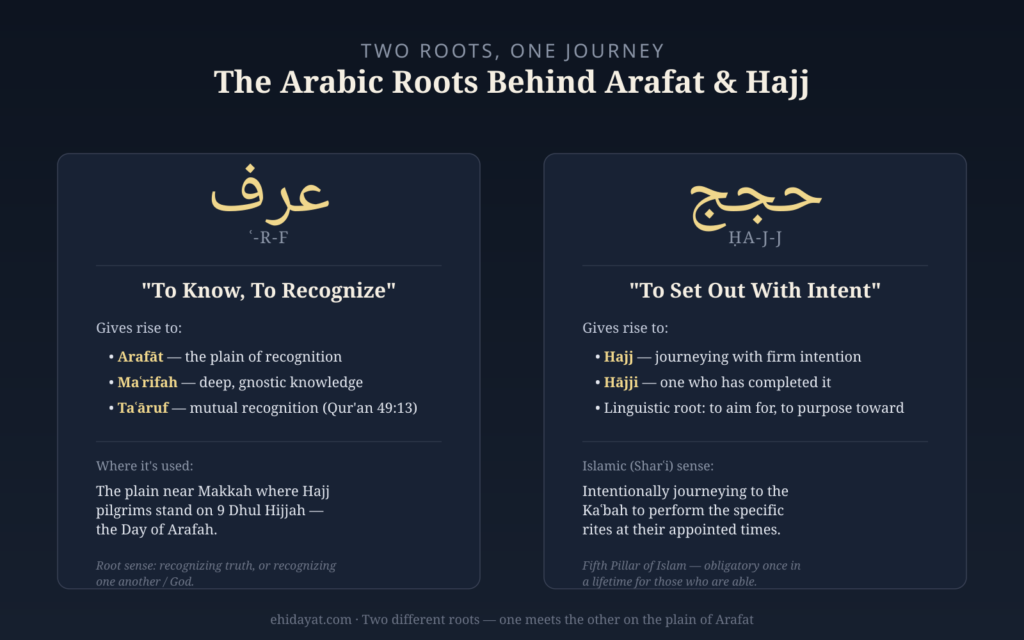
If you’ve landed here from two different directions — maybe you’re double-checking a baby name, maybe you’re trying to understand what actually happens on Hajj — you’re not alone. “Arafat” gets searched by both crowds, and it’s genuinely the same word doing double duty. Arafat (عرفات) is Arabic for “the plains of recognition,” from the root ʿarafa (ع-ر-ف), meaning “to know” or “to recognize.” It’s also the name of the vast plain near Makkah where Hajj pilgrims gather every year on the 9th of Dhul Hijjah — the single day the Prophet ﷺ called the essence of the entire pilgrimage.
That last point isn’t decoration. It’s the whole reason this word matters enough to have its own article.
What Does “Arafat” Mean?
Arafat means “the plains of recognition” or “the plains of knowing,” from the Arabic root ʿarafa (ع-ر-ف) — “to know” or “to recognize.” In Islamic tradition it’s the name of a plain roughly 20 kilometers southeast of Makkah, and it’s where pilgrims perform Wuquf, the central standing ritual of Hajj, on the 9th of Dhul Hijjah.
That’s the short answer. The longer one is more interesting, because the root this word comes from shows up all over Islamic vocabulary in ways most articles on this topic never mention.
The Arabic Root ع-ر-ف: Recognition, Not Just a Place Name
Classical Arabic lexicons — Ibn Sīda al-Mursī’s 11th-century dictionary al-Muḥkam wa-l-Muḥīṭ al-Aʿẓam is one of the sources cited by contemporary Arabic-language researchers — trace ʿarafa to “well-known” or “recognized.” “Arafat” is technically the plural form: the plains of recognition, plural, not singular.
Here’s the part that rarely makes it into an English explainer: this root doesn’t stop at one word. It’s a small family, and every member of it circles back to the same idea of knowing.
- Maʿrifah — deep, experiential knowledge, the kind Sufi writers use for gnosis rather than book-learning.
- Taʿāruf — mutual recognition, getting to know one another. It’s the word Allah uses in the Qur’an: “O mankind, indeed We have created you from male and female and made you peoples and tribes that you may know one another (litaʿārafū).” (Qur’an 49:13)
- ʿUrf — custom or common knowledge, a term that shows up constantly in Islamic legal reasoning.
So when a pilgrim stands on the plain of Arafat, the name itself is doing something. It’s not just a geographic label — it’s pointing at recognition: recognizing sin, recognizing mercy, and on a more literal reading of the old stories, recognizing another person after a long separation. Some early Islamic traditions hold that Arafat is where Adam (AS) and Hawwa (Eve) reunited after being sent down separately — though that particular account sits in classical historical literature rather than being confirmed in an authentic hadith, so it’s worth holding loosely.\
Arafat, Arafah, or Yasser Arafat? Clearing Up the Confusion
They’re related but not interchangeable. “Arafat” usually names the place — the plain — while “Arafah” more often names the day, the 9th of Dhul Hijjah. Yasser Arafat, the Palestinian leader, carried a surname built on the same root but has no ritual connection to either.
That mix-up isn’t hypothetical — it’s exactly what a search for “Arafat meaning” turns up in practice: half the results are about the pilgrimage site, half are dictionary entries built around the Palestinian statesman. A quick reference table settles it faster than a paragraph would:
| Term | What It Refers To | Root Connection |
|---|---|---|
| Arafat | The plain near Makkah (place) | Plural of ʿarafa, “recognized/known” |
| Arafah | The 9th of Dhul Hijjah (day) | Same root, used for the day itself |
| Yasser Arafat | Palestinian political leader (1929–2004), PLO chairman | Same root as a surname — no ritual link |
If you saw “Arafat” in a headline about Middle East politics, that’s the third row. If you saw it on a page about Hajj, it’s one of the first two — and honestly, most English writing doesn’t bother distinguishing “Arafat” from “Arafah” at all. Both spellings circulate for both meanings. Don’t lose sleep over which one you use; just know which thing you mean.
Where Is Mount Arafat? Quick Facts
| Fact | Detail |
|---|---|
| Location | ~20 km southeast of Makkah, Saudi Arabia |
| Also called | Jabal Arafat; Jabal al-Rahmah (“Mountain of Mercy”) |
| Terrain | A wide open plain with a small granite hill at its center — not a mountain in the dramatic sense the English name suggests |
| When it’s used | 9th of Dhul Hijjah, from noon (Zawal) until sunset |
| Who visits | Roughly 1.5–2 million Hajj pilgrims annually |
Why Is Arafat Central to Hajj? The Day of Arafah
Standing at Arafat isn’t one ritual among many during Hajj — it’s the one the entire pilgrimage hinges on. The Prophet ﷺ made this explicit: “Al-Hajj ʿArafah” — “Hajj is Arafah” (Jami’ at-Tirmidhi 889, graded Sahih; also recorded in Sunan Abi Dawud 1949). Miss the standing at Arafat, even unintentionally, and the Hajj isn’t valid. Every other rite — Tawaf, Safa and Marwah, the stoning at Jamarat — matters, but none of them carry that particular weight.
The day itself, the 9th of Dhul Hijjah, is called Yawm Arafah, the Day of Arafah. It’s the day before Eid al-Adha, and it sits at the historical intersection of two enormous moments: it’s widely reported to be the day Allah revealed “This day I have perfected for you your religion and completed My favor upon you and have approved for you Islam as religion” (Qur’an 5:3), and it’s the day the Prophet ﷺ delivered his Farewell Sermon nearby, addressing justice, equality, and the sanctity of life to more than 100,000 companions during his final Hajj.
Because the Islamic calendar is lunar, the Gregorian date for Arafah shifts by roughly 10–11 days every year — so if you’re trying to work out when it falls this year rather than which year it commemorates, check the current Hajj dates rather than relying on last year’s calendar.
What Happens on the Day of Arafah?
Three things, mainly, and none of them are complicated in form even though they carry enormous weight.
Wuquf — the standing itself. From noon until sunset, pilgrims remain within the boundaries of Arafat. They don’t have to stand literally; sitting or resting is fine. What matters is presence and intention, not posture.
Dua and dhikr. This stretch of the afternoon is considered the best time of the year for supplication. The Prophet ﷺ said, “The best supplication is the supplication on the Day of Arafah” (Jami’ at-Tirmidhi 3585, graded Hasan), and pilgrims spend the hours in personal dua, remembrance of Allah, and Qur’an recitation.
The khutbah at Masjid Namirah. A sermon delivered at the edge of the plain, echoing the themes of the Farewell Sermon — the purpose of Hajj, the importance of sincerity, core Islamic teachings — followed by the combined, shortened Dhuhr and Asr prayers.
None of this requires elaborate ritual objects or memorized formulas. That’s arguably the point: it’s the one day of Hajj built almost entirely around presence rather than performance.
Fasting on the Day of Arafah (For Those Not on Hajj)
Fasting on Arafah is one of the most rewarding voluntary fasts in the Islamic calendar — but only for people not actually performing Hajj that day. The Prophet ﷺ was asked about it directly and answered that it “expiates the sins of the preceding year and the coming year” (Sahih Muslim 1162, narrated by Abu Qatadah). Two years of sins, wiped by one day’s fast — that’s a striking claim, and it’s exactly why so many Muslims worldwide who aren’t on pilgrimage still mark this day.
Pilgrims themselves are a different case. They’re generally advised against fasting on this specific day, since Wuquf already demands real physical stamina — hours in the heat, standing or sitting through the hottest part of the day. The Prophet ﷺ himself didn’t fast while performing Hajj, for the same practical reason.
There’s a second hadith worth knowing alongside the fasting one, because it explains why the day carries this reward in the first place: “There is no day on which Allah frees more people from the Fire than the Day of Arafah” (Sahih Muslim 1348, narrated by Aisha, RA). The fasting isn’t the source of the mercy — it’s a way of positioning yourself to receive a mercy that’s already unusually concentrated on this particular day.
What Does “Hajj” Mean? Word Origin and Islamic Definition
Here’s where most Arafat-focused articles go quiet, because “Hajj” comes from an entirely different Arabic root than “Arafat” does — ح-ج-ج (ḥa-j-j), not ع-ر-ف. It’s a common mix-up, given how tightly the two words are linked in practice, but they’re not related etymologically at all.
Classical Arabic sources trace the root ح-ج-ج to the sense of “setting out with firm intention toward a specific objective” — proceeding somewhere on purpose, not wandering. Linguistically, that’s the whole word: intentional, purposeful travel. Islamic law narrows it considerably. Here’s the split laid out plainly:
| Linguistic Meaning | Islamic (Sharʿi) Meaning |
|---|---|
| To set out with firm intention toward a definite objective; purposeful travel | Intentionally journeying to the Kaʿbah to perform a specific set of rites, at specific times, in a specific state of consecration (Ihram) |
That second column is the fifth pillar of Islam. It’s not just “going to Mecca” — the technical definition bakes in the intention, the destination, the timing, and the ritual state, all four at once.
Hajj Meaning in Islam: Why It’s the Fifth Pillar
Hajj sits alongside Shahada, Salah, Zakat, and Sawm as one of the five foundational acts that structure a Muslim’s practice — and it’s the one with the most conditions attached. It’s commanded in the Qur’an: “And proclaim to the people the Hajj” (Qur’an 22:27), yet it’s only obligatory once in a lifetime, and only for someone who meets istitāʿah — the ability requirement, covering physical health, financial means, and reasonable safety of the journey.
That last part matters more than casual explanations usually let on. Someone who’s permanently unable to travel due to illness isn’t simply exempt and forgotten — Islamic scholarship allows for someone else to perform Hajj on their behalf, based on authentic hadith on the matter. The obligation bends around genuine incapacity; it doesn’t just disappear.
Is Arafat a Good Name to Give a Child?
Yes, and it’s a genuinely popular one — particularly in Bangladesh, Pakistan, and Malaysia, where “Arafat” has been trending upward as a boy’s name in recent years. The meaning carries real weight for parents who care about that kind of thing: “one who knows,” “one who recognizes truth,” tied directly to the holiest station of Hajj.
There’s a hadith that’s often cited alongside naming decisions: “On the Day of Resurrection you will be called by your names and by your father’s names, so give yourselves good names” (Sunan Abi Dawud 4948, narrated by Abu al-Darda). Arafat clears that bar comfortably — it’s a name with a real root, a real meaning, and a direct connection to one of the most sacred moments in the Islamic calendar, rather than a name that’s simply pleasant-sounding.
One caveat worth naming directly: because Yasser Arafat is such a globally recognized figure, some parents worry the name will read as political rather than spiritual, especially outside Muslim-majority contexts. That’s a real consideration, not a small one — but it doesn’t change what the word itself means. The political association is recent and incidental; the linguistic and spiritual meaning predates it by well over a millennium.
Frequently Asked Questions
What does Arafat mean in Arabic? Arafat (عرفات) comes from the Arabic root ʿarafa (ع-ر-ف), meaning “to know” or “to recognize.” It names the plain near Makkah where Hajj pilgrims gather on the 9th of Dhul Hijjah.
Is Arafat the same as Arafah? They share the same root and are often used interchangeably in English writing. “Arafat” more precisely refers to the place — the plain — while “Arafah” more often names the day itself.
What does Hajj literally mean? Hajj (ح-ج-ج) comes from a root meaning “to set out with firm intention toward a definite objective.” In Islamic law, it specifically means intentionally journeying to the Kaʿbah to perform the pilgrimage’s prescribed rites.
Why is Hajj called the fifth pillar of Islam? Hajj is one of five foundational acts of worship — alongside Shahada, Salah, Zakat, and Sawm — that structure a Muslim’s practice. It’s obligatory once in a lifetime for anyone who is physically, financially, and safely able to perform it.
Can non-pilgrims benefit from the Day of Arafah? Yes. Muslims not performing Hajj are strongly encouraged to fast on the Day of Arafah. According to Sahih Muslim 1162, this fast expiates the sins of the past year and the coming year.
Is Arafat a Quranic name? The place itself is connected to Hajj rulings in the Qur’an — 2:199 discusses departing from where the pilgrims depart, which classical commentators identify as Arafat — though the word “Arafat” doesn’t appear as a standalone Quranic term the way some other place names do.
When is the Day of Arafah this year? It always falls on the 9th of Dhul Hijjah, but because the Islamic calendar is lunar, the Gregorian date shifts by about 10–11 days annually. See this year’s exact Hajj dates →
Two roots, one plain, one day a year where they meet. “Arafat” and “Hajj” aren’t the same word wearing different clothes — they come from entirely different places in the language — but Islamic history tied them together so tightly that untangling one from the other, even just to explain what each actually means, takes more than a dictionary entry. That’s really the whole story here: a place named for recognition, standing at the exact center of a pilgrimage named for intention.