
There’s a moment right after you hear that a man you knew has passed — a father, a brother, a friend, a neighbor — when you want to say something, but the usual words feel too small. Islam gives you something better than a search for the right sentence: a specific dua the Prophet ﷺ himself used to recite over the deceased. It opens with Allahummaghfirlahu warhamhu — “O Allah, forgive him and have mercy on him.”
This guide walks through the short form and the full form, the Arabic text and what each clause actually means, when it’s recited during the funeral prayer, and a few close variants you may have seen online that aren’t quite the same wording.
What is the Allahummaghfirlahu Warhamhu dua?
Allahummaghfirlahu warhamhu is the opening line of a Sunnah supplication recited for a deceased Muslim man. It comes from Sahih Muslim 963, narrated by the companion Awf ibn Malik, who described hearing the Prophet ﷺ recite it during a funeral prayer and being so struck by its depth that he wished he had been the one being prayed over.
The suffix “-hu” in lahu, warhamhu, and the rest of the dua means “him” — it’s a pronoun built directly into the Arabic word, not a separate term. That’s the entire grammatical difference between this version and the one recited for a woman, which swaps “-hu” for “-ha” throughout. We’ll come back to that comparison in more detail further down.
Short form vs full form: which should you recite?
Not every occasion calls for the same length. The short form is what most people know and use outside of formal prayer; the full form is the complete Janazah supplication recited by the imam during Salat al-Janazah.
| Short form | Full Janazah form | |
|---|---|---|
| Arabic | اللَّهُمَّ اغْفِرْ لَهُ وَارْحَمْهُ وَعَافِهِ وَاعْفُ عَنْهُ | اللَّهُمَّ اغْفِرْ لَهُ وَارْحَمْهُ وَعَافِهِ وَاعْفُ عَنْهُ وَأَكْرِمْ نُزُلَهُ وَوَسِّعْ مُدْخَلَهُ وَاغْسِلْهُ بِالْمَاءِ وَالثَّلْجِ وَالْبَرَدِ… |
| Transliteration | Allahummaghfirlahu warhamhu wa’afihi wa’fu’anhu | Allahumma-ghfir lahu warhamhu, wa ‘afihi, wa’fu ‘anhu, wa akrim nuzulahu, wa wassi’ mudkhalahu, waghsilhu bil-ma’i wath-thalji wal-baradi… |
| Translation | “O Allah, forgive him, have mercy on him, grant him well-being, and pardon him.” | The above, continuing: “…and honor his resting place, widen his grave, wash him with water, snow, and hail…” through to admission into Paradise. |
| When to use | Condolence messages, personal dua, grave visits — anytime outside formal prayer | Recited specifically by the imam during Salat al-Janazah |
Most people encounter the short form first — it’s what shows up in condolence texts and social posts — without realizing it’s actually the opening quarter of a much longer prayer. For the fuller context of duas recited for someone who has passed, the complete guide to dua for the deceased covers the surrounding etiquette in more depth.
Allahummaghfirlahu warhamhu — Arabic text, transliteration & meaning
Here’s the dua as it appears in Sahih Muslim 963, in full:
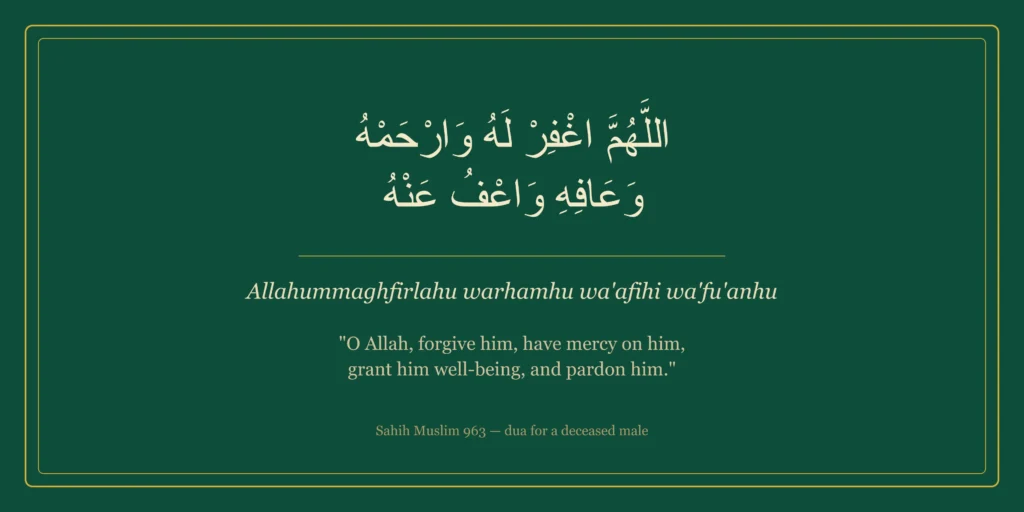
Arabic:
اللَّهُمَّ اغْفِرْ لَهُ وَارْحَمْهُ وَعَافِهِ وَاعْفُ عَنْهُ وَأَكْرِمْ نُزُلَهُ وَوَسِّعْ مُدْخَلَهُ وَاغْسِلْهُ بِالْمَاءِ وَالثَّلْجِ وَالْبَرَدِ وَنَقِّهِ مِنَ الْخَطَايَا كَمَا نَقَّيْتَ الثَّوْبَ الْأَبْيَضَ مِنَ الدَّنَسِ وَأَبْدِلْهُ دَارًا خَيْرًا مِنْ دَارِهِ وَأَهْلًا خَيْرًا مِنْ أَهْلِهِ وَزَوْجًا خَيْرًا مِنْ زَوْجِهِ وَأَدْخِلْهُ الْجَنَّةَ وَأَعِذْهُ مِنْ عَذَابِ الْقَبْرِ وَعَذَابِ النَّارِ
Transliteration: Allahumma-ghfir lahu warhamhu, wa ‘afihi, wa’fu ‘anhu, wa akrim nuzulahu, wa wassi’ mudkhalahu, waghsilhu bil-ma’i wath-thalji wal-baradi, wa naqqihi minal-khataya kama naqqayta ath-thawbal-abyada minad-danasi, wa abdilhu daran khayran min darihi, wa ahlan khayran min ahlihi, wa zawjan khayran min zawjihi, wa adkhilhul-jannata, wa a’idhhu min ‘adhabil-qabri wa ‘adhabin-nar.
Here’s what each part is asking for:
| Clause | Arabic (key words) | Meaning |
|---|---|---|
| 1 | اغْفِرْ لَهُ | Forgive him |
| 2 | وَارْحَمْهُ | And have mercy on him |
| 3 | وَعَافِهِ | Grant him well-being |
| 4 | وَاعْفُ عَنْهُ | And pardon him |
| 5 | وَأَكْرِمْ نُزُلَهُ | Honor his resting place |
| 6 | وَوَسِّعْ مُدْخَلَهُ | Widen his grave for him |
| 7 | وَاغْسِلْهُ بِالْمَاءِ وَالثَّلْجِ وَالْبَرَدِ | Wash him with water, snow, and hail |
| 8 | وَنَقِّهِ مِنَ الْخَطَايَا | Cleanse him of sins |
| 9 | كَمَا نَقَّيْتَ الثَّوْبَ الْأَبْيَضَ مِنَ الدَّنَسِ | As a white garment is cleansed of dirt |
| 10 | وَأَبْدِلْهُ دَارًا خَيْرًا مِنْ دَارِهِ | Give him a home better than his home |
| 11 | وَأَهْلًا خَيْرًا مِنْ أَهْلِهِ وَزَوْجًا خَيْرًا مِنْ زَوْجِهِ | And family and companions better than his own |
| 12 | وَأَدْخِلْهُ الْجَنَّةَ | Admit him into Paradise |
| 13 | وَأَعِذْهُ مِنْ عَذَابِ الْقَبْرِ وَعَذَابِ النَّارِ | And protect him from the punishment of the grave and of the Fire |
Thirteen requests, moving from forgiveness to comfort to an entirely renewed life in the next world. Nothing about it is generic — it’s specific about what a person in the grave actually needs.
What does “Allahummaghfirlahu” actually mean? — word-by-word breakdown
The word “Allahummaghfirlahu” is really four pieces fused together, and breaking it apart by root letters shows why the vocabulary here isn’t arbitrary.
| Arabic word | Transliteration | Root letters | Meaning |
|---|---|---|---|
| اَللّٰهُمَّ | Allahumma | — | “O Allah” (a vocative form of address) |
| اغْفِرْ | ighfir | غ-ف-ر (gh-f-r) | “Forgive” — a command form |
| لَهُ | lahu | — | “For him” |
| وَ | wa | — | “And” |
| ارْحَمْهُ | warhamhu | ر-ح-م (r-h-m) | “Have mercy on him” |
The root gh-f-r is the same root behind Al-Ghafoor, one of the names of Allah meaning “The All-Forgiving.” The root r-h-m is the same root behind Ar-Rahman and Ar-Raheem — the two names that open nearly every surah in the Quran. In other words, this isn’t a generic plea for kindness. The dua is invoking Allah by the specific attributes He describes Himself with, which is part of why it’s structured the way it is rather than phrased more loosely.
Allahummaghfirlahu vs Allahummaghfirlaha: what’s the difference?
The two versions differ by exactly one letter, repeated consistently through the entire dua.
| For a male deceased | For a female deceased | |
|---|---|---|
| Short Arabic | اللَّهُمَّ اغْفِرْ لَهُ وَارْحَمْهُ | اللَّهُمَّ اغْفِرْ لَهَا وَارْحَمْهَا |
| Short Latin | Allahummaghfirlahu warhamhu | Allahummaghfirlaha warhamha |
| Opening line means | “O Allah, forgive him and have mercy on him” | “O Allah, forgive her and have mercy on her” |
That “-hu” to “-ha” swap happens eight separate times across the full-length version of the dua — every pronoun referring to the deceased changes, not just the first one. Get one instance right and forget to change the rest, and the dua reads as grammatically inconsistent, so it’s worth reciting slowly rather than from memory if you’re not fully confident. For the female version in full, including its own word-by-word breakdown, see the dua for a deceased woman; the complete female Janazah prayer guide covers the surrounding funeral-prayer procedure for that case specifically.
Variations of the dua — singular, dual, and plural
The pronoun suffix also changes depending on how many people you’re praying for, and whether they’re male or female. This part gets left out of most explanations, but it matters if you’re praying for more than one person at once — say, a family lost together.
| Number / gender | Arabic ending | Transliteration | Used for |
|---|---|---|---|
| Singular male | ـهُ | -hu | One deceased man |
| Singular female | ـهَا | -ha | One deceased woman |
| Dual (any gender) | ـهُمَا | -huma | Two deceased people |
| Plural male | ـهُمْ | -hum | A group of deceased men |
| Plural female | ـهُنَّ | -hunna | A group of deceased women |
So “Allahummaghfirlahum warhamhum” would be the correct form for a group of men, and “Allahummaghfirlahuma warhamhuma” for two people regardless of gender. The logic is the same standard Arabic pronoun pattern used elsewhere in the language — it isn’t a special exception built just for this dua.
“Wa sakkinhu fil jannah” and other variant endings — what’s the difference?
If you’ve searched around for this dua, you’ve likely come across the phrase “wa sakkinhu fil jannah” — “and settle him in Paradise” — sometimes attached to the end of it, especially in social media captions and condolence graphics. It’s worth being precise here: that phrase is not part of the Sahih Muslim 963 text quoted above. The hadith’s actual closing line asks Allah to admit him into Paradise and protect him from the punishment of the grave and the Fire — different wording, same general request.
“Wa sakkinhu fil jannah,” along with the closely related “wa adkhilhu fil jannah” (“and admit him into Paradise”), comes from a separate, shorter supplication that scholars have confirmed is also acceptable to recite: “Allahumma ighfir lahu warhamhu wa adkhilhu fil jannah.” So if you’ve seen this ending attached to the dua, it isn’t a misquote or a corrupted version of the hadith — it’s a different, equally valid dua that circulates alongside it, and the two get blended together informally online.
When is this dua recited in the Janazah prayer?
Salat al-Janazah follows a fixed structure of four Takbirs, and this dua has a specific place within it.
| Takbir | What is recited | Notes |
|---|---|---|
| 1st | Surah al-Fatiha | Said silently |
| 2nd | Durood Ibrahim (salutations on the Prophet ﷺ) | The same salutation recited in the final sitting of regular Salah |
| 3rd | The dua for the deceased (Allahummaghfirlahu warhamhu, full form) | This is where today’s dua is placed |
| 4th | A brief dua for the congregation and the deceased | Followed by Salam to close the prayer |
One detail that rarely makes it into general explanations of Salat al-Janazah: where the imam stands changes depending on whether the deceased is male or female. For a man, the imam stands level with the head or chest. For a woman, the imam stands level with the middle of the body. This is consistent across the major schools of thought and is one of the few visible differences between the two versions of the funeral prayer, beyond the dua’s wording itself. If you’re building out a broader picture of how the five daily prayers and other Sunnah prayers are structured, how to pray Tahajjud covers a different but related piece of that picture.
Can you recite this dua outside the funeral prayer?
Yes, and in practice this is how most people encounter it. A few common occasions:
- At the graveside, right after burial. It’s Sunnah to stand by the grave briefly after burial and ask for the deceased’s forgiveness and steadfastness, since this is understood to be a moment when the questioning in the grave is about to begin.
- During grave visits. Whether it’s been a week or twenty years, there’s no expiration date on making dua for someone who has passed. Many people recite it quietly on visits to the cemetery.
- After daily Salah, as part of personal supplication for a parent, sibling, or friend who has died.
- As a condolence message. The short form has become common as a message sent to grieving families — not liturgically required, but a genuine and widely used way of extending sympathy that also happens to be an actual act of worship rather than just a phrase of comfort.
It’s often recited alongside other short supplications for hardship and loss — the last two ayat of Surah al-Baqarah and Hasbunallahu wa ni’mal wakeel are two that frequently come up in the same context.
Frequently asked questions
What does Allahummaghfirlahu Warhamhu mean? It means “O Allah, forgive him and have mercy on him.” These are the opening words of the Prophetic supplication recited for a deceased Muslim man, drawn from Sahih Muslim 963. The full version continues by asking Allah to cleanse him of sin, grant him a better home and companions, and admit him into Paradise.
What is the difference between Allahummaghfirlahu and Allahummaghfirlaha? The only difference is the pronoun suffix: “-hu” (him) is used for a deceased man, “-ha” (her) for a deceased woman. This single-letter change repeats throughout the entire dua, not just in the opening word, and applies consistently across the short and full forms.
What does “wa sakkinhu fil jannah” mean, and is it part of this dua? It means “and settle him in Paradise.” It’s a popular variant ending that circulates widely online, but it isn’t part of the original Sahih Muslim 963 wording — it’s a separate, also-acceptable supplication (“Allahumma ighfir lahu warhamhu wa adkhilhu fil jannah”) rather than an alternate version of the same hadith text.
When is Allahummaghfirlahu Warhamhu recited in Salat al-Janazah? It’s recited silently after the third Takbir. The four-Takbir sequence runs: Surah al-Fatiha (1st), Durood Ibrahim (2nd), the dua for the deceased (3rd), and a brief dua for the congregation (4th), followed by Salam.
Is there a shorter version of this dua? Yes. The short form — Allahummaghfirlahu warhamhu wa’afihi wa’fu’anhu — covers the first four requests (forgiveness, mercy, well-being, pardon) and is the version most commonly used in condolence messages and personal supplication outside the funeral prayer.
Can this dua be recited for a father, brother, or friend who passed away years ago? Yes. There’s no time limit on making dua for a deceased Muslim. It can be recited at any point — during grave visits, after daily Salah, or simply whenever the person comes to mind — regardless of how long ago they passed away.
What is the hadith source for this dua? It’s recorded in Sahih Muslim (Hadith 963), narrated by Awf ibn Malik, who said he memorized the Prophet’s ﷺ supplication during a funeral prayer and wished he himself had been the deceased, given how comprehensive the prayer was.
Sources: Sahih Muslim 963 (sunnah.com); root analysis via the Quranic Arabic Corpus (corpus.quran.com); ruling on variant supplications via IslamQA/AskImam