
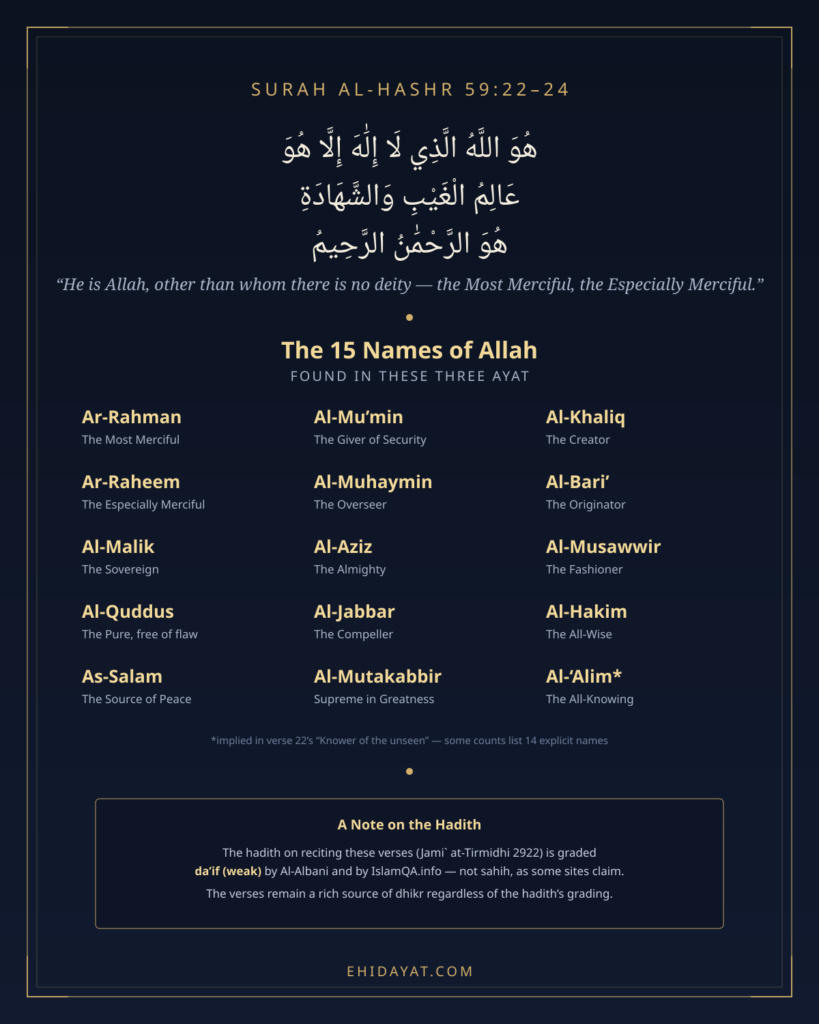
The last three ayat of Surah Hashr — verses 22 to 24 of chapter 59 — are among the most recited closing passages in the Quran, and for good reason: in three sentences, they move from Allah’s mercy to His sovereignty to His role as Creator, stacking name after name of His attributes. Muslims recite them after Fajr, before sleeping, or simply as a standalone dhikr. Fewer sources, though, actually get straight about where the popular hadith on their virtue stands authenticity-wise. This one does.
What Are the Last Three Ayat of Surah Al-Hashr?
Surah Al-Hashr (“The Exile”) is the 59th chapter of the Quran, a Madinan surah of 24 verses sitting in Juz 28. Most of the surah deals with the expulsion of the Banu Nadir tribe from Madinah after they broke their treaty with the Prophet ﷺ — matters of war, property, and the division of spoils. Then, in its final three verses, the tone shifts entirely. The surah closes not with history but with theology: a dense, beautiful run through Allah’s names, ending the chapter the way it opened — in praise.
Surah Hashr 59:22–24: Arabic, Transliteration, and Translation
Here’s the passage in full, verse by verse.
| Ayah | Arabic | Transliteration | Translation |
|---|---|---|---|
| 22 | هُوَ اللَّهُ الَّذِي لَا إِلَٰهَ إِلَّا هُوَ ۖ عَالِمُ الْغَيْبِ وَالشَّهَادَةِ ۖ هُوَ الرَّحْمَٰنُ الرَّحِيمُ | Huwallahu allathi la ilaha illa huwa, ‘alimul-ghaybi wash-shahadah, huwar-rahmanur-rahim | He is Allah, other than whom there is no deity — Knower of the unseen and the witnessed. He is the Most Merciful, the Especially Merciful. |
| 23 | هُوَ اللَّهُ الَّذِي لَا إِلَٰهَ إِلَّا هُوَ الْمَلِكُ الْقُدُّوسُ السَّلَامُ الْمُؤْمِنُ الْمُهَيْمِنُ الْعَزِيزُ الْجَبَّارُ الْمُتَكَبِّرُ ۚ سُبْحَانَ اللَّهِ عَمَّا يُشْرِكُونَ | Huwallahu allathi la ilaha illa huwa, al-malikul-quddus, as-salamul-mu’minul-muhayminul-‘azizul-jabbarul-mutakabbir, subhanallahi ‘amma yushrikun | He is Allah, other than whom there is no deity — the Sovereign, the Pure, the Source of Peace, the Giver of Security, the Overseer, the Almighty, the Compeller, the Supreme in Greatness. Exalted is Allah above whatever they associate with Him. |
| 24 | هُوَ اللَّهُ الْخَالِقُ الْبَارِئُ الْمُصَوِّرُ ۖ لَهُ الْأَسْمَاءُ الْحُسْنَىٰ ۚ يُسَبِّحُ لَهُ مَا فِي السَّمَاوَاتِ وَالْأَرْضِ ۖ وَهُوَ الْعَزِيزُ الْحَكِيمُ | Huwallahul-khaliqul-bari’ul-musawwir, lahul-asma’ul-husna, yusabbihu lahu ma fis-samawati wal-ard, wahuwal-‘azizul-hakim | He is Allah — the Creator, the Originator, the Fashioner. To Him belong the most beautiful names. Whatever is in the heavens and earth glorifies Him, and He is the Almighty, the All-Wise. |
What Do These Verses Mean? A Verse-by-Verse Look
Verse 22: Tawheed first
Everything else in the passage rests on this opening line. Before any list of names, the surah establishes the point of the list: la ilaha illa huwa — there is no god but Him. Pairing “Knower of the unseen and the witnessed” with “the Most Merciful, the Especially Merciful” isn’t accidental. Allah knows what’s hidden in a person’s heart and still chooses mercy. That’s the pairing worth sitting with, not skimming past.
Verse 23: Eight names, one warning
Verse 23 is the densest line in the passage — eight of Allah’s names back to back, then a sharp turn: “Exalted is Allah above whatever they associate with Him.” Al-Malik (the Sovereign) and Al-Jabbar (the Compeller) sit next to As-Salam (the Source of Peace) and Al-Mu’min (the Giver of Security), which is the point. Power and gentleness aren’t in tension here; they’re the same attribute looked at from two directions. The closing rebuke of shirk isn’t a throwaway line either — it’s the reason the whole list exists, to correct anyone tempted to split these qualities between Allah and something else.
Verse 24: Creation, then glorification
The surah ends where creation begins. Al-Khaliq, Al-Bari’, Al-Musawwir — Creator, Originator, Fashioner — describe three distinct stages of making something: deciding it exists, bringing it into being, then giving it its specific form. Then the verse pulls back to the widest possible frame: everything in the heavens and earth glorifies Him. Not just people. Everything.
The 15 Names of Allah in These Three Ayat
Between verses 22 and 24, these three ayat pack in roughly fifteen of Allah’s ninety-nine names — the count depends slightly on whether you treat “Knower of the unseen” in verse 22 as invoking Al-‘Alim explicitly or not, so you’ll see both 14 and 15 cited around the internet. Either way, it’s an unusually dense concentration for three verses.
| Name | Meaning |
|---|---|
| Ar-Rahman | The Most Merciful |
| Ar-Raheem | The Especially Merciful |
| Al-‘Alim (implied) | The All-Knowing |
| Al-Malik | The Sovereign |
| Al-Quddus | The Pure, free of any flaw |
| As-Salam | The Source of Peace |
| Al-Mu’min | The Giver of Security |
| Al-Muhaymin | The Overseer, the Guardian |
| Al-Aziz | The Almighty |
| Al-Jabbar | The Compeller |
| Al-Mutakabbir | The Supreme in Greatness |
| Al-Khaliq | The Creator |
| Al-Bari’ | The Originator |
| Al-Musawwir | The Fashioner |
| Al-Hakim | The All-Wise |
If you want the full list of all 99 names with their meanings rather than just the ones in this passage, ehidayat’s 99 Names of Allah guide covers each one individually, with a downloadable reference sheet.
Is the Hadith About Reciting These Verses Authentic?
Most articles on this topic quote a hadith about 70,000 angels and then either call it “sahih” or quietly avoid the question. Neither is accurate. Here’s what the hadith actually says, where it comes from, and what its grading actually is.
The hadith, narrated by Ma’qil bin Yasar, appears in Jami` at-Tirmidhi, Hadith 2922, Book 45 (“Chapters on the Virtues of the Qur’an”):
Whoever says three times when he gets up in the morning, “A’udhu billahis-sami’il-‘alimi min ash-shaytanir-rajim,” and recites the last three ayat of Surah Al-Hashr — Allah appoints seventy thousand angels who send blessings on him until evening. If he dies that day, he dies a martyr. Whoever recites it in the evening holds the same status.
That’s the text. Now the grading: this hadith is classed as da’if (weak), not sahih. IslamQA.info’s fatwa committee confirms the weak grading directly, and independent hadith-checking references cite the same classification from Da’if Tirmidhi 2922. Some competitor articles on this exact keyword state the opposite — labeling it “sahih” — which is simply wrong and worth correcting.
Where scholars differ is on what to do with a weak hadith like this one. Some Hanafi scholars, working from the classical principle of fada’il al-a’mal (acting on weak narrations when they describe the virtue of a good deed, rather than a legal ruling or a matter of belief), consider it acceptable to recite these verses on the strength of this narration — a position reflected in fatwas from Hanafi hadith-answer services. Other scholars, more cautious about circulating weak narrations regardless of the topic, would rather Muslims recite these ayat on the basis of their own meaning and the general, well-established virtue of reciting the Quran — which needs no weak hadith to justify it — rather than on a specific unverified promise. Both positions are defensible; what isn’t defensible is calling the hadith sahih when it isn’t.
When and How to Recite the Last 3 Ayat of Surah Hashr
The hadith above describes a specific practice, not a vague “recite whenever” suggestion. It has two parts, done at two set times:
- Say “A’udhu billahis-sami’il-‘alimi min ash-shaytanir-rajim” three times.
- Recite Surah Hashr 59:22–24.
Do this once after waking, and again in the evening — the hadith describes morning and evening as two separate, equivalent occasions, not one recitation covering the whole day. Outside of that specific narrated routine, there’s no restriction on reciting these verses at any other time — after any prayer, before sleeping, or simply when you want to sit with what they say about Allah.
Benefits Muslims Associate With Reciting These Verses
Given the hadith’s weak grading, it’s worth framing these carefully — as what tradition and popular practice associate with the verses, not as guaranteed outcomes:
- A sense of protection. The 70,000-angels narration, even weak, is widely cited as the reason many Muslims recite this passage as part of morning and evening adhkar.
- A concentrated reminder of Allah’s names. Regardless of the hadith’s status, reciting fifteen of Allah’s names in three verses is, on its own terms, a dense act of dhikr.
- Grounding before sleep or before the day starts. Several Islamic scholars separately recommend Surah Al-Hashr’s closing verses as part of a general night or morning routine, independent of the specific 70,000-angels narration.
- A corrective against shirk. Verse 23’s closing line — “Exalted is Allah above whatever they associate with Him” — makes this passage as much a statement of belief as a source of comfort.
How These Verses Compare to Other End-of-Surah Protective Verses
Surah Hashr’s last three ayat aren’t the only closing passage Muslims turn to regularly. Here’s how they stack up against three other commonly recited verses.
| Verses | Core Theme | Primary Association |
|---|---|---|
| Surah Hashr 59:22–24 | Allah’s names and attributes | Dhikr, morning/evening recitation |
| Surah Baqarah 2:285–286 | Faith, submission, forgiveness | Night recitation, protection (this one’s hadith is authentically graded in Sahih al-Bukhari) |
| Surah Qalam 68:51–52 | Protection from the evil eye | Recited against envy/nazar |
| Ayatul Kursi (2:255) | Allah’s power and dominion over creation | The single most-cited protective verse in the Quran |
The distinction worth remembering: Baqarah’s last two ayat and Ayatul Kursi both carry authentically graded hadith about their virtue. Surah Hashr’s last three ayat carry a weak one — which doesn’t make the verses themselves any less meaningful, just means the specific promise attached to them rests on softer ground.
3 Ayat Terakhir Surat Al-Hasyr (Ringkasan Bahasa Indonesia)
Bagi pembaca yang mencari 3 ayat terakhir Surat Al-Hasyr dalam Bahasa Indonesia: ayat 22–24 dari Surat Al-Hasyr (surah ke-59) berbunyi sebagai berikut —
“Dialah Allah Yang tiada Tuhan selain Dia, Yang Mengetahui yang gaib dan yang nyata. Dialah Yang Maha Pemurah lagi Maha Penyayang. Dialah Allah Yang tiada Tuhan selain Dia, Raja, Yang Mahasuci, Yang Mahasejahtera, Yang Mengaruniakan keamanan, Yang Maha Memelihara, Yang Mahaperkasa, Yang Mahakuasa, Yang Memiliki segala Keagungan, Mahasuci Allah dari apa yang mereka persekutukan. Dialah Allah Yang Menciptakan, Yang Mengadakan, Yang Membentuk Rupa, Yang mempunyai nama-nama yang paling baik. Bertasbih kepada-Nya apa yang ada di langit dan di bumi. Dan Dialah Yang Mahaperkasa lagi Mahabijaksana.” (QS. Al-Hasyr: 22–24)
Perlu dicatat: hadits tentang 70.000 malaikat yang sering dikaitkan dengan ayat ini dinilai dhaif (lemah) oleh sebagian ulama hadits, termasuk dalam penilaian Al-Albani. Ayat-ayat ini tetap sangat dianjurkan untuk dibaca karena kandungan maknanya tentang sifat-sifat Allah, terlepas dari status hadits tersebut.
FAQs
What are the last 3 ayat of Surah Hashr? Verses 22–24 of Surah Al-Hashr (chapter 59), which describe Allah’s names and attributes and close out the surah.
Is the hadith about reciting these verses authentic? No — it’s graded weak (da’if) by Al-Albani and confirmed weak by IslamQA.info, though some scholars still permit acting on it under the classical principle of fada’il al-a’mal (virtues of deeds).
How many names of Allah appear in the last 3 ayat of Surah Hashr? Commonly counted as 15, though the exact number depends on whether “the Knower of the unseen” in verse 22 is counted as invoking the name Al-‘Alim alongside the 14 explicitly stated attributes in verses 23–24.
When should I recite the last 3 ayat of Surah Hashr? The hadith describes reciting them in the morning after saying “A’udhu billahis-sami’il-‘alim min ash-shaytanir-rajim” three times, and again in the evening — as two separate occasions rather than one recitation covering the day.
What’s the difference between Surah Hashr’s last 2 and last 3 ayat? “Last 3 ayat” (22–24) is the version most commonly cited and recited; “last 2 ayat” usually refers to 23–24 alone, dropping the tawhid-focused opening of verse 22.
Who narrated the hadith about these verses? Ma’qil bin Yasar, recorded in Jami` at-Tirmidhi, Book 45 (Chapters on the Virtues of the Qur’an), Hadith 2922.
Apa arti 3 ayat terakhir Surat Al-Hasyr? Ayat 22–24 Surat Al-Hasyr menjelaskan nama dan sifat-sifat Allah, termasuk Ar-Rahman, Al-Malik, dan Al-Khaliq, sebagai penutup surat