
Eid prayer, or Eid Salah, is a two-rakah congregational prayer offered twice a year, on the mornings of Eid al-Fitr and Eid al-Adha. It’s shorter than it looks and easy to get right once you know the sequence — this guide walks through the timing, the preparation, the rakah-by-rakah steps, the takbir counts by madhhab, the duas to recite, and what to do if you arrive late or miss it altogether.
What Is Eid Prayer (Salat al-Eid)?
Eid prayer, also called Salat al-Eid, is a special two-rakah prayer performed only twice a year: on Eid al-Fitr, marking the end of Ramadan, and Eid al-Adha, during the days of Hajj. It differs from the five daily prayers in three ways — there’s no Adhan or Iqamah before it starts, it includes several extra takbirs (“Allahu Akbar”) in each rakah, and the khutbah (sermon) comes after the prayer instead of before it.
Both Eids share the same prayer structure. What changes between them is the mood and the acts that surround the prayer — Zakat al-Fitr and breaking a month of fasting for Eid al-Fitr; the story of Ibrahim’s sacrifice and the days of Hajj for Eid al-Adha.
When Is Eid Prayer Performed?
Eid prayer is performed in the morning, after the sun has fully risen but before zawal — the point when the sun reaches its highest point in the sky, roughly solar noon. In practice, that gives a window of about mid-morning, and local mosques set the exact time and announce it in advance.
There’s a small timing difference between the two Eids. Eid al-Fitr prayer is often held a little later in the morning to leave time for Zakat al-Fitr to reach those in need before the prayer begins. Eid al-Adha prayer, by contrast, is usually hastened, since the day’s sacrifice (Qurbani) follows the prayer and people are eager to begin.
If you’re trying to work out when the next Eid falls, keep in mind that both Eid al-Fitr and Eid al-Adha follow the Islamic lunar calendar, so each one lands about 10–11 days earlier each Gregorian year and the exact date is only confirmed by moon sighting close to the time — treat any date you see months in advance as an estimate, and check with a local mosque or a full guide to Hajj season and Eid al-Adha dates as the date approaches.
Is Eid Prayer Obligatory? Comparing the Madhhabs
Whether Eid prayer is obligatory depends on which madhhab you follow, and scholars have held three broad positions on it.
| Madhhab | Ruling | What This Means |
|---|---|---|
| Hanafi | Wajib (obligatory) | Skipping it without a valid excuse is considered sinful for men |
| Hanbali | Fard Kifayah (communal obligation) | If enough people in the community perform it, the rest are absolved |
| Maliki & Shafi’i | Sunnah Mu’akkadah (confirmed Sunnah) | Strongly recommended and consistently practiced by the Prophet ﷺ, but not mandatory |
Whichever view you follow, scholars agree Eid prayer carries immense reward, and it’s one of the few times a year the whole community — men, women, and children — gathers for a single prayer together.<sup>[1]</sup>
How to Prepare for Eid Prayer
A handful of Sunnah acts traditionally come before the prayer itself:
- Perform ghusl (a full ritual bath) before getting dressed.
- Wear your best clothes. New or freshly cleaned clothing is preferred, as a sign of celebration.
- Eat something before Eid al-Fitr prayer — traditionally an odd number of dates. On Eid al-Adha, it’s the opposite: it’s recommended to wait and eat afterward, ideally from the meat of the sacrifice.
- Recite the Takbir on your way to the prayer, softly, from the moment you leave your house until the imam begins.
- Pay Zakat al-Fitr before the Eid al-Fitr prayer begins, if you haven’t already — it’s meant to reach those in need before the celebration starts, and giving it after the prayer counts as ordinary charity rather than Zakat al-Fitr.
How to Pray Eid Salah: Step-by-Step (Rakah by Rakah)
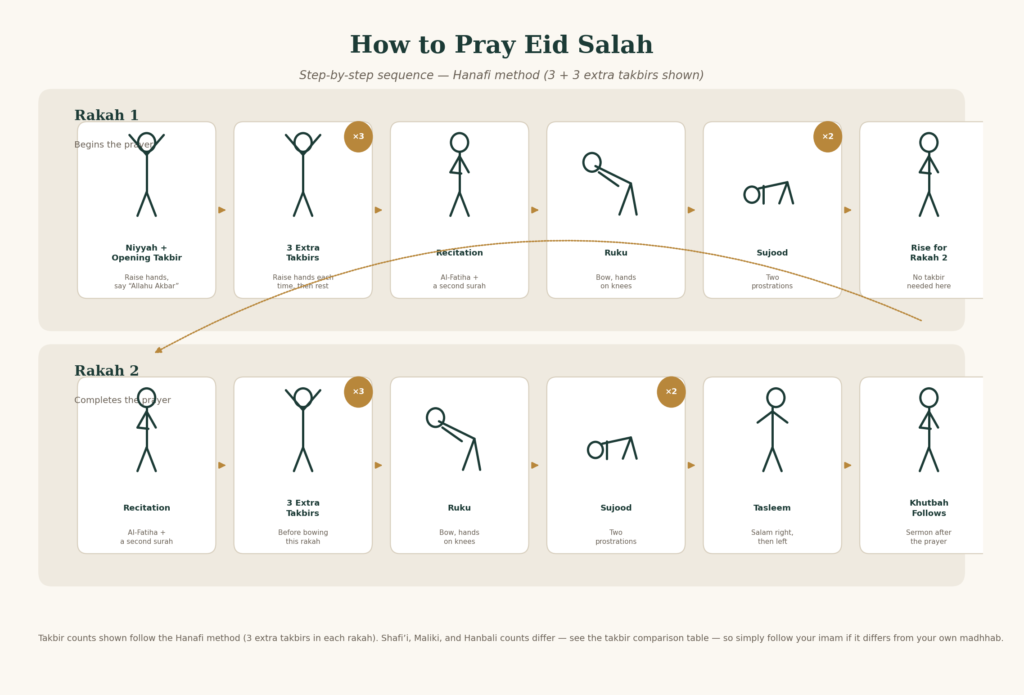
Here’s the full sequence, shown above following the Hanafi method (3 extra takbirs in each rakah — see the comparison table below if you follow a different madhhab).
Rakah 1
- Make your intention (niyyah) to pray two rakahs of Eid Salah.
- Say the opening takbir, “Allahu Akbar,” raising your hands to your ears (or shoulders, for women), then fold them as usual.
- Say three additional takbirs, raising your hands each time and resting them at your sides between each one.
- Listen as Surah al-Fatiha is recited, followed by a second surah.
- Perform ruku (bowing) and two sajdahs (prostrations) as in a normal prayer.
- Rise for the second rakah.
Rakah 2
- Listen as Surah al-Fatiha is recited again, followed by a second surah.
- Say three additional takbirs before going into ruku.
- Perform ruku and two sajdahs as normal.
- Complete the prayer with the tasleem — turning to say “Assalamu alaikum wa rahmatullah” to the right, then the left.
That’s the entire prayer. There’s no khutbah attendance required to complete it — the sermon that follows is recommended to stay for, but the prayer itself is already finished at the tasleem.
Takbir Count by Madhhab: Hanafi, Shafi’i, Maliki, and Hanbali Compared
The number of extra takbirs is the main practical difference between madhhabs in Eid prayer — everything else about the prayer stays the same. If you’re praying behind an imam from a different madhhab than your own, simply follow him; you don’t need to make up any takbir you miss, since they’re Sunnah rather than an essential pillar of the prayer.
| Madhhab | Extra Takbirs, 1st Rakah | Extra Takbirs, 2nd Rakah | Placement |
|---|---|---|---|
| Hanafi | 3 | 3 | 1st rakah: before recitation. 2nd rakah: after recitation, before ruku |
| Shafi’i | 7 | 5 | Before recitation in both rakahs |
| Maliki | 6 | 5 | Before recitation in both rakahs |
| Hanbali | 6 | 5 | Before recitation in both rakahs |
Once you’re at your local mosque, it’s worth confirming what madhhab your mosque’s Eid prayer follows and its exact prayer time ahead of the day, especially if you’re new to the community — timing and takbir counts can both vary slightly by masjid. (Link this phrase to mydeen.online’s own prayer-times or mosque-finder page — swap in the real URL before publishing.)
Dua to Recite Before, During, and After Eid Prayer
The Takbir itself. This is the phrase recited on the way to the prayer and between the extra takbirs:
Allahu Akbar, Allahu Akbar, La ilaha illa Allah, Wallahu Akbar, Allahu Akbar, wa Lillahil Hamd.
“Allah is the Greatest, Allah is the Greatest. There is no god but Allah. Allah is the Greatest, Allah is the Greatest, and to Allah belongs all praise.”
The opening dua (thana). After the opening takbir and before the extra takbirs, it’s recommended to recite the same opening supplication used to begin any prayer, praising Allah quietly before continuing.
The greeting after the prayer. Once the prayer and khutbah are finished, Muslims traditionally greet one another with:
“Taqabbal Allahu minna wa minkum” — “May Allah accept [this worship] from us and from you” — often alongside the simpler “Eid Mubarak.” If you’d like a fuller rundown of greetings for this and other occasions, this guide to Muslim greetings covers the wording and etiquette in more depth.
What to Do If You Join Eid Prayer Late or Miss It
If you join late. Whatever portion of the prayer you catch with the imam counts as the beginning of your own prayer. Once the imam finishes, stand and complete whatever rakahs or takbirs you missed on your own, in the same order they’d normally come. If you catch the imam already in ruku, that rakah still counts — join him there and continue.
If you miss the whole prayer. Most scholars — including Imam Malik, Ash-Shafi’i, and Ahmad — hold that it’s recommended to make it up by praying two rakahs on your own, without a khutbah afterward, since the sermon is only delivered to those who attended the congregational prayer.<sup>[2]</sup> Imam Bukhari even dedicated a chapter heading in his Sahih to this exact scenario, instructing that whoever misses the Eid prayer should pray two rakahs.
Either way, missing or being late to Eid prayer doesn’t affect the validity of your Ramadan fast or your Zakat al-Fitr — those stand on their own.
Can You Pray Eid Salah at Home?
Yes, in most madhhabs. The Hanbali, Shafi’i, and Maliki schools generally permit praying Eid Salah at home, either alone or in a small congregation with your family, if you’re unable to reach a mosque or open prayer ground. The Hanafi view treats Eid prayer more like Friday prayer, which isn’t generally recommended to be performed individually outside of real necessity.
If you do pray at home, the steps are identical to the congregational prayer above — the only difference is there’s no khutbah afterward.
Eid Prayer vs. Friday Prayer vs. Daily Salah: What’s Different?
Eid prayer stands apart from both Friday (Jumu’ah) prayer and the five daily prayers in a few specific ways:
| Feature | Eid Prayer | Friday (Jumu’ah) | Daily Salah |
|---|---|---|---|
| Adhan / Iqamah | Neither is called | Both are called | Both are called |
| Extra takbirs | Yes (count varies by madhhab) | No | No |
| Khutbah timing | After the prayer | Before the prayer | None |
| Number of rakahs | 2 | 2 | 2, 3, or 4 depending on the prayer |
| Frequency | Twice a year | Weekly | Five times daily |
Do Children Need to Pray Eid Salah?
Eid prayer isn’t obligatory on children before puberty in any madhhab, but bringing them along is strongly encouraged. The Prophet ﷺ specifically called for even young children to be present for the Eid gathering, alongside women and the elderly. In practice, a child doesn’t need to perform every takbir or movement perfectly — standing alongside a parent and following along is enough, and it’s often how children first learn the prayer.
After the Prayer: Khutbah, Greetings, and Sunnah Acts
Once the tasleem is complete, the imam delivers the khutbah. Staying to listen is recommended but not obligatory — unlike the Friday khutbah, you’re free to leave once the prayer itself has ended, though it’s considered good manners to stay quiet if you do leave while others are listening.
After the khutbah, it’s customary to greet those around you, embrace family and friends, and visit relatives through the day. One small Sunnah worth knowing: it’s recommended to take a different route home from the one you took to the prayer ground.
Common Mistakes to Avoid in Eid Salah
- Skipping the opening takbir. It’s easy to miss if you arrive right as the imam begins — try to be in place a few minutes early.
- Talking or getting distracted during the extra takbirs, since they come in a cluster that’s easy to lose count of if your attention drifts.
- Rushing in late and skipping straight to ruku without saying the takbir upright first — the opening takbir for a missed rakah must be said standing, not while bending down.
- Leaving before or talking during the khutbah in a way that disturbs others nearby who are listening.
- Forgetting Zakat al-Fitr before Eid al-Fitr prayer — it needs to be given before the prayer to count as Zakat al-Fitr rather than general charity.
FAQ
How many rakats is Eid prayer? Eid prayer (Salat al-Eid) consists of two rakahs. The main difference from daily prayers is a set of extra takbirs — additional “Allahu Akbar” recitations — performed before the recitation in each rakah, with the exact count varying by madhhab.
Is Eid prayer obligatory? It depends on the madhhab you follow. Hanafi scholars generally classify it as Wajib (obligatory), Hanbali scholars as Fard Kifayah (a communal obligation), and Maliki and Shafi’i scholars as Sunnah Mu’akkadah (strongly confirmed but not mandatory).
What time is Eid prayer performed? Eid prayer is performed in the morning, after sunrise but before zawal (solar noon). Eid al-Fitr prayer is often held slightly later to allow time for Zakat al-Fitr distribution, while Eid al-Adha prayer is often hastened.
Can I pray Eid salah at home? Yes, according to the Hanbali, Shafi’i, and Maliki schools, whether alone or with family in congregation. The Hanafi view generally treats it more like a Friday prayer that isn’t recommended to perform individually at home outside genuine necessity. There’s no khutbah when praying at home.
What happens if I join Eid prayer late? Whatever portion of the prayer you catch with the imam counts as the start of your prayer; you complete whatever you missed on your own once the imam finishes, following the same order of takbirs and recitation.
What if I miss Eid prayer entirely? Most scholars recommend praying two rakahs on your own to make it up, without a khutbah afterward, since the khutbah is only delivered to those present for the congregational prayer.
Do children have to pray Eid salah? Eid prayer isn’t obligatory on children before puberty, but attending is encouraged — the Prophet ﷺ called for even young children to be present for the day’s blessings, and they can stand alongside a parent without needing to perform every takbir perfectly.
What do you say after Eid prayer? The traditional greeting is “Taqabbal Allahu minna wa minkum” (May Allah accept [this worship] from us and from you), often alongside the simpler “Eid Mubarak.”
[1] For the fuller scholarly discussion of the Wajib / Fard Kifayah / Sunnah Mu’akkadah classification, see Is ‘Eid Prayer Obligatory? — Islam Question & Answer.
[2] For the fuller ruling on making up a missed Eid prayer, see What Happens If You Miss ‘Eid Prayer? — Islam Question & Answer