
Surah Alam Nashrah — also known as Surah Al-Inshirah and Surah Ash-Sharh — is one of the shortest chapters in the Qur’an, yet it’s quoted almost daily by Muslims dealing with stress, grief, or a hard season of life. Search “surah alam nashrah benefits” and you’ll find dozens of pages listing virtues: relief from anxiety, increased wealth, protection while travelling, even claims about martyrdom. Some of that is well grounded. A fair amount of it isn’t. This guide walks through the surah itself, what it actually says, and — just as importantly — which of the popular claims about it hold up to scrutiny and which don’t.
What Is Surah Alam Nashrah?
Surah Alam Nashrah is the 94th chapter of the Qur’an, revealed in Makkah, and made up of just eight verses. It sits in the 30th Juz, alongside the shortest and most frequently memorized surahs in the Mushaf. Its two other common names — Al-Inshirah and Ash-Sharh — both come from the same root as its opening word, nashrah, meaning “to open” or “to expand.”
According to a report from Abdullah ibn Abbas, this surah was revealed together with the surah before it, Surah Ad-Duha. Both address the Prophet Muhammad ﷺ personally, during a period when he was facing rejection from his own community and carrying the weight of an enormous, newly assigned mission. Where Ad-Duha reassures him that he hasn’t been abandoned, Alam Nashrah goes a step further: it reminds him of specific blessings already given, and promises that whatever difficulty he’s in the middle of will not last.
Surah Alam Nashrah — Arabic Text, Transliteration & Translation

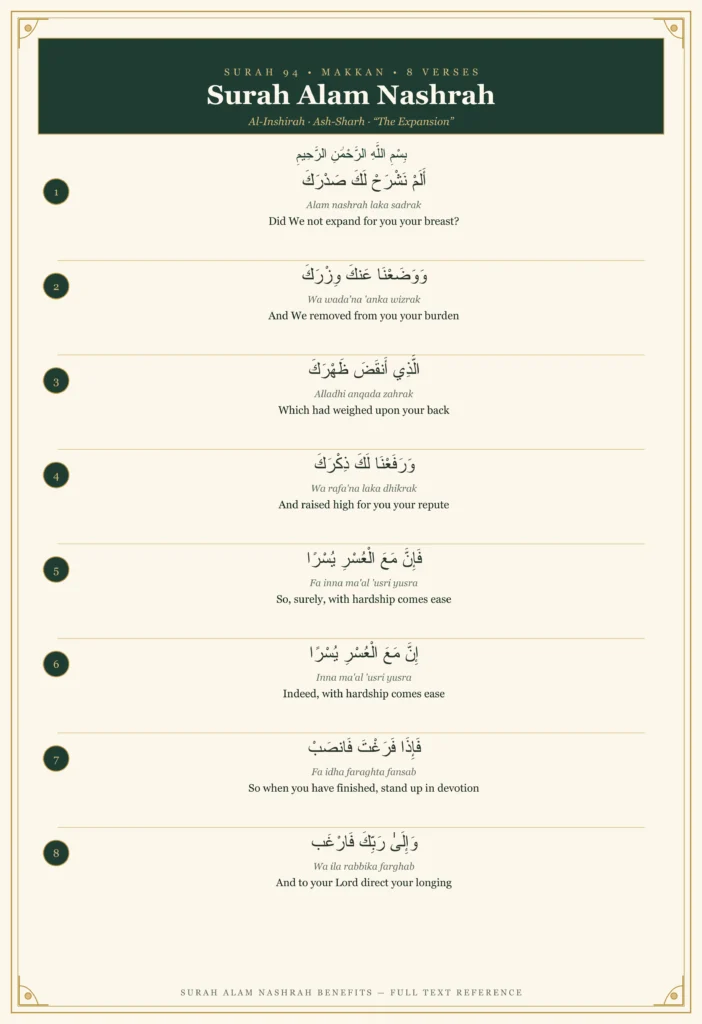
بِسْمِ اللَّهِ الرَّحْمَٰنِ الرَّحِيمِ In the name of Allah, the Most Gracious, the Most Merciful.
1. أَلَمْ نَشْرَحْ لَكَ صَدْرَكَ Alam nashrah laka sadrak Did We not expand for you your breast?
2. وَوَضَعْنَا عَنكَ وِزْرَكَ Wa wada’na ‘anka wizrak And We removed from you your burden
3. الَّذِي أَنقَضَ ظَهْرَكَ Alladhi anqada zahrak Which had weighed upon your back
4. وَرَفَعْنَا لَكَ ذِكْرَكَ Wa rafa’na laka dhikrak And raised high for you your repute
5. فَإِنَّ مَعَ الْعُسْرِ يُسْرًا Fa inna ma’al ‘usri yusra So, surely, with hardship comes ease
6. إِنَّ مَعَ الْعُسْرِ يُسْرًا Inna ma’al ‘usri yusra Indeed, with hardship comes ease
7. فَإِذَا فَرَغْتَ فَانصَبْ Fa idha faraghta fansab So when you have finished, stand up [in devotion]
8. وَإِلَىٰ رَبِّكَ فَارْغَب Wa ila rabbika farghab And to your Lord direct your longing
The Three-Part Structure of the Surah
Short as it is, the surah has a clear shape, and understanding that shape makes the rest of this article easier to follow.
The first two-and-a-half verses list three specific blessings given to the Prophet ﷺ: his chest was expanded, his burden was lifted, and his name was raised in honor. The middle section — verses 5 and 6 — delivers the surah’s central message, repeated twice: hardship comes with ease. The final two verses shift from reassurance to instruction: once one task is done, don’t stop; turn to more devotion, and direct your hopes toward Allah rather than toward the outcome of the struggle itself.
That structure — blessing, promise, instruction — is why so many people come back to this surah specifically. It doesn’t just console; it tells you what to do next.
Why Is “Ease” Mentioned Twice? The Grammar Behind the Promise
The ease repeats because it’s grammatically a different promise each time, not a repeated one. Arabic grammar draws a real distinction here that most translations flatten out.
In verse 5, “hardship” (al-‘usr) carries the definite article — “the” hardship. In verse 6, “hardship” is repeated with the same definite article, so classical commentators read it as referring back to that same, single hardship. “Ease” (yusr), by contrast, appears both times without a definite article — indefinite. When a noun is repeated indefinitely like this, it’s generally read as referring to something new each time, not a repeat of the same instance.
The upshot, as summarized in the tafsir tradition attributed to Ibn Abbas, is that one specific hardship is met with two separate instances of ease — or, more loosely, “manifold” ease. As it’s often put: one hardship cannot overcome two eases. That’s also why most translators render the verse “with hardship comes ease” rather than “after hardship comes ease” — the wording in Arabic places the ease alongside the hardship, concurrent with it, not waiting somewhere down the line once the hardship is over.
| Verse | Arabic term | Definite or indefinite | What it refers to |
|---|---|---|---|
| 94:5 | al-‘usr (hardship) | Definite | The specific hardship being addressed |
| 94:5 | yusr (ease) | Indefinite | One instance of ease |
| 94:6 | al-‘usr (hardship) | Definite (same word repeated) | The same hardship as verse 5 |
| 94:6 | yusr (ease) | Indefinite (new instance) | A second, distinct instance of ease |
There’s a reasonable, non-religious parallel worth naming honestly: repeating a reassuring statement isn’t just rhetorical flourish. Some research on repeated affirming statements suggests that repetition can make a message easier to process cognitively and can support how people cope with stress — which doesn’t explain away the verse, but does help explain why repeating it twice, out loud, tends to land differently than reading it once.
Does “Opening the Chest” Mean a Literal Miracle or a Metaphor?
Scholars hold two distinct readings of verse 1, and both are considered legitimate — they aren’t in conflict so much as answering different questions.
The first reading points to specific, authentically transmitted hadith describing an actual physical event: as a young child, the Prophet ﷺ was found by his foster family after two men in white had laid him down, opened his chest, and removed something described as a dark clot before washing his heart with water from a golden basin and restoring it. A related account places a similar event just before the night journey of Isra and Mi’raj. These narrations are recorded, among other places, in Sahih Muslim.
The second, and more commonly held, reading treats verse 1 as speaking about something else entirely — a spiritual and psychological expansion, not a surgical one. Commentators like Ibn Kathir and the authors of Maarif-ul-Quran note that the verse describes the Prophet’s chest being made spacious enough to carry the burden of prophethood: wisdom, patience, and the emotional weight of an entire mission, without being crushed by it. On this reading, connecting the ayah directly to the physical hadith is considered a weaker interpretive move, since the surah’s own context — a message of reassurance during hardship — doesn’t naturally lead into a childhood surgical event.
In practice, you don’t have to pick a side to benefit from the surah. Believing the hadith about the physical event and reading this particular ayah as a metaphor for spiritual capacity are both positions held within mainstream scholarship, and one doesn’t require rejecting the other.
If you want to go deeper on how hadith are evaluated in the first place — why some are treated as historically reliable and others aren’t — it’s worth reading up on what hadith actually means in Islam before working through the authenticity section further down this page.
Spiritual and Emotional Benefits of Reciting Surah Alam Nashrah
Set aside the disputed claims for a moment — the surah’s plain meaning already does a lot of work. People turn to it, generation after generation, for a fairly consistent set of reasons:
- Relief from grief and anxiety. The surah directly addresses someone under real pressure, which is part of why it resonates with anyone carrying a heavy emotional load.
- Renewed hope. The twice-repeated promise of ease is, functionally, a repeated reminder that the current difficulty isn’t permanent.
- A more active form of patience. Verses 7 and 8 don’t tell the reader to simply wait it out — they command action: finish the task in front of you, then turn toward more devotion. That reframes patience as something you do, not something you passively endure.
- Deepened trust in Allah (tawakkul). Directing your “longing” toward your Lord rather than toward a specific outcome is, in effect, an instruction to hold your hopes loosely.
None of this requires believing in the more elaborate worldly-benefit claims discussed below — the emotional and spiritual weight of the surah stands on its own. If patience is a theme you want to sit with further, the meaning of “Allah is with those who are patient” is a natural next read, since it’s built around the same idea this surah closes with.
Worldly Benefits Commonly Cited
Alongside the spiritual themes, a long list of worldly benefits circulates in devotional literature and informal teaching. Commonly repeated claims include:
- Relief from chest and heart pain
- Increase in sustenance or wealth
- Protection while travelling, particularly by sea
- Ease during childbirth
It’s worth being upfront here: these specific claims come largely from fada’il al-Qur’an literature — devotional writing about the merits of particular chapters — rather than from rigorously authenticated hadith attached to this surah specifically. That doesn’t make them worthless, but it does mean they should be held more loosely than the surah’s actual text and its well-supported meaning. The next section goes through exactly which claims fall into which category.
Which of These Benefits Are Authentically Confirmed?
This is the question almost nobody writing about this surah actually answers directly, so here it is plainly: most of the specific virtue-claims attached to Surah Alam Nashrah are not backed by strong hadith. A few examples that circulate widely:
- Reciting it guarantees dying as a martyr. This claim traces back to narrations frequently cited from sources like Majma al-Bayan and Thawab al-‘Amal — respected within certain scholarly traditions, but the specific virtue-claim attached to this surah is not something mainstream hadith scholarship treats as strongly established.
- The body’s parts will testify in the reciter’s favor on Judgment Day. Same category — a devotional narration, not a widely authenticated hadith tied specifically to this surah.
- Reciting it cures blindness. This appears in some collections but is explicitly graded weak (da’if) by hadith scholars who have examined it.
- Reciting it 17 times and drinking water blown over it improves memory, or reciting it 41 times over water helps break a habit of cursing. These are folk wazifa practices passed down in devotional manuals rather than hadith at all.
- Water recited over cures kidney stones. Also a folk practice, with no hadith basis.
| Claimed benefit | Commonly cited source | Authenticity note |
|---|---|---|
| Dying as a martyr on repeated recitation | Majma al-Bayan / Thawab al-‘Amal (Shia devotional sources) | Not established by mainstream hadith criticism |
| Body parts testify on Judgment Day | Thawab al-‘Amal | Devotional narration, not broadly authenticated |
| Cures blindness | Various fada’il collections | Explicitly graded weak (da’if) |
| Memory boost via 17x recitation + water | Folk wazifa manuals | No hadith basis; cultural practice |
| Cure for kidney stones via recited water | Folk wazifa manuals | No hadith basis; cultural practice |
| General reward for reciting the Qur’an | Broadly established across hadith literature | Well supported — applies to any portion of the Qur’an, this surah included |
The pattern across almost every “surah benefits” article — for this surah and plenty of others — is that specific, narrow promises (a particular illness cured, a particular number of repetitions, a particular outcome guaranteed) tend to come from fada’il literature that hadith scholars evaluate by a more lenient standard than they’d apply to matters of belief or law, and even by that lower bar, a large share of these narrations don’t hold up. What’s genuinely well established, without any dispute, is the broader principle that reciting any part of the Qur’an — with understanding and sincerity — carries real reward. If you want to see how scholars actually go about grading a narration like this, how scholars grade hadith authenticity is a useful starting point.
None of this is meant to discourage reciting the surah — quite the opposite. It’s meant to put the emphasis back where it belongs: on the surah’s actual, confirmed meaning, rather than on a list of specific promises that may not hold up under examination.
A Simple Daily Routine to Recite Surah Alam Nashrah
There’s no single prescribed method here, but a few practices are both well attested and genuinely usable:
- Recite it after Fajr or before sleep. Both are quiet points in the day well suited to a short surah like this one.
- Pair it with Surah Ad-Duha, as many scholars believe was the intended order, given the report that both were revealed together.
- Pause after verses 5 and 6 rather than moving straight through them. Reading “with hardship comes ease” once and reading it twice, deliberately, with a short pause in between, are different experiences.
- Follow it with a short, personal dua — naming the specific hardship you’re carrying and asking, plainly, for the ease the surah promises.
If you’re building this into a fuller nightly routine, the benefits of praying Tahajjud pairs naturally with this kind of short-surah recitation habit.
Surah Alam Nashrah and Surah Ad-Duha — Why They’re Read Together
Ibn Abbas’s report that these two surahs were revealed together has led many scholars to treat them as a linked pair rather than two separate chapters. Some go as far as reciting them back-to-back in voluntary prayer, treating the reassurance in Ad-Duha and the promise of ease in Alam Nashrah as a single continuous message. If you’re already building a habit of reciting shorter surahs at set points in your day, reading Surah Al-Mulk before sleep is a common addition alongside this pairing.
FAQs
What is Surah Alam Nashrah also called? It is also known as Surah Al-Inshirah and Surah Ash-Sharh (“The Expansion”). All three names refer to the same 94th chapter of the Qur’an, which has 8 verses and was revealed in Makkah.
Is it true that reciting Surah Alam Nashrah guarantees dying as a martyr? That specific claim comes from a narration many hadith scholars don’t treat as strongly established. The surah’s confirmed value lies in its meaning and the general reward for reciting the Qur’an, not in that particular unverified promise.
Does “opening the chest” refer to a real historical event? Scholars hold two views: some authentic hadith describe a literal event in the Prophet’s childhood, while most classical commentators read the verse itself as a metaphor for spiritual capacity. Both views are accepted; they aren’t seen as contradicting each other.
Why is “with hardship comes ease” repeated twice in the surah? Classical grammarians note that “hardship” is repeated with the definite article (referring to the same hardship) while “ease” is repeated without it (referring to a new instance each time) — hence the well-known summary that one hardship is met with two, or manifold, eases.
Can Surah Alam Nashrah be recited for anxiety or stress? Many Muslims recite it for exactly this reason, reflecting on its message that ease accompanies hardship. This is a matter of personal devotional practice rather than a medical claim, and it can sit alongside — not replace — professional support when needed.
When is the best time to recite Surah Alam Nashrah? There’s no single prescribed time. Common practice includes reciting it after Fajr, before sleep, or paired with Surah Ad-Duha, which many scholars believe was revealed alongside it.
How many verses does Surah Alam Nashrah have? Eight verses. It’s one of the shortest surahs in the Qur’an, found in the 30th Juz.