
If you’ve searched “inna ma’al usri yusra in arabic,” you’ve probably already felt the weight this verse is meant to answer. It’s the line Muslims reach for in a hospital waiting room, before an exam they didn’t prepare enough for, or in the quiet after bad news. Below is the Arabic text, the transliteration, what it actually means in English and Urdu — and a few points about it that most pages online get slightly wrong.
Inna Ma’al Usri Yusra Written in Arabic
Indeed, with hardship comes ease — that’s the verse, written twice, back to back, in Surah Ash-Sharh:
فَإِنَّ مَعَ الْعُسْرِ يُسْرًا إِنَّ مَعَ الْعُسْرِ يُسْرًا
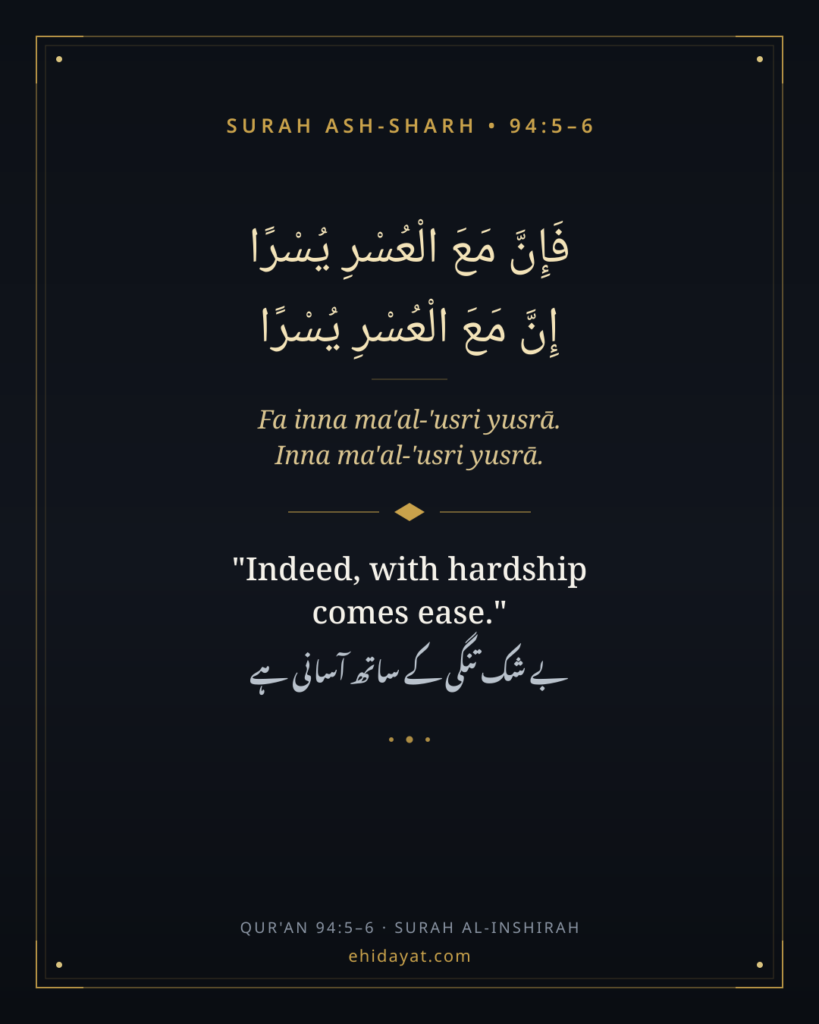
| Ayah | Arabic | Transliteration | “Fa” present? |
|---|---|---|---|
| 94:5 | فَإِنَّ مَعَ الْعُسْرِ يُسْرًا | Fa inna ma’al-‘usri yusrā | Yes |
| 94:6 | إِنَّ مَعَ الْعُسْرِ يُسْرًا | Inna ma’al-‘usri yusrā | No |
Notice the two ayahs are nearly identical. The only difference is the fa (فَ) at the start of the first one — a small connector usually translated as “so” or “for” — which drops away in the second repetition. That’s not a copy error in the Mushaf; it’s deliberate, and it’s part of why the verse is repeated at all. More on that below.
What Does “Inna Ma’al Usri Yusra” Mean?
“Inna ma’al usri yusra” means “Indeed, with hardship comes ease” — a promise, stated in Surah Ash-Sharh (94:6), that relief accompanies difficulty rather than simply following it once the difficulty is over.
That’s the core of it. But translators don’t all land on the same English wording, and the differences are worth seeing side by side rather than picking just one.
English Translation Comparison
| Translator | Rendering |
|---|---|
| Sahih International | “Indeed, with hardship [will be] ease.” |
| Abdullah Yusuf Ali | “Verily, with every difficulty there is relief.” |
| Muhammad Pickthall | “Lo! with hardship goeth ease.” |
| Hilali & Muhsin Khan | “Verily, with the hardship, there is relief.” |
None of these contradict each other — they’re just different English handles on the same Arabic promise. Sahih International and Pickthall stay close to the literal “with” (ma’a); Yusuf Ali and Hilali-Khan lean toward “relief” instead of “ease.” If you’re quoting the verse in English, any of these is defensible; just don’t mix phrasing from two translations into one “quote.”
Urdu Meaning
بے شک تنگی کے ساتھ آسانی ہے۔
“Indeed, with hardship comes ease” — recited the same way in Urdu-speaking households as it is everywhere else: as a line you say out loud when you need to hear it, not just read it.
Fa Inna Ma’al Usri Yusra vs. Inna Ma’al Usri Yusra — Why Is It Repeated?
Repeating a promise twice, in almost the same breath, isn’t an accident in the Qur’an — it’s a known rhetorical device (tawkid) used for emphasis. Saying it once could be heard as a general statement. Saying it again, immediately, with the connector stripped away the second time, reads more like someone leaning in and repeating themselves because they need you to actually believe it.
| Feature | Ayah 5 (Fa inna…) | Ayah 6 (Inna…) |
|---|---|---|
| Arabic | فَإِنَّ مَعَ الْعُسْرِ يُسْرًا | إِنَّ مَعَ الْعُسْرِ يُسْرًا |
| Opens with “Fa” (so/for) | Yes — connects back to the earlier verses about the Prophet’s ﷺ burdens being lifted | No — stands alone, more emphatic |
| Function | Sets up the promise as a consequence of what came before | Restates it as a flat, unconditional fact |
There’s also a grammar detail classical commentators point to: in Arabic, al-‘usr (“the hardship”) carries the definite article — it’s one specific, named hardship. Yusran (“ease”) appears without it, both times — indefinite, open-ended. Grammatically, when an indefinite noun repeats like that, it’s understood as referring to more than one instance, not the same single thing twice. That’s the basis for the line often summarized as “one hardship cannot overcome two eases.” It’s a real observation about the Arabic, and it’s recorded across classical tafsir literature — including Ibn Kathir’s commentary on this surah. It is worth being precise about what it is, though, which is the next section.
“Innamal Usri Yusra” — Is This the Same Verse?
Yes, if you’re searching “innamal usri yusra,” you’re almost certainly looking for the same verse — it’s just a squeezed-together, informal spelling of inna ma’al usri yusra (إِنَّ مَعَ الْعُسْرِ يُسْرًا).
Worth flagging, though: don’t confuse it with innamā (إِنَّمَا), a completely different Arabic word that means “only” or “certainly” and shows up elsewhere in the Qur’an (as in innamal a’malu bin-niyyat, “actions are only by intentions”). They sound close when typed out in English letters — “innamal” vs. “innama” — but inna ma’a (إِنَّ مَعَ, “indeed with”) and innamā (إِنَّمَا, “only”) are unrelated words with different grammar behind them. If you typed “innamal usri yusra” looking for this verse, you found the right one; just don’t carry that spelling over when you’re searching for something with innamā in it later.
Which Surah Is This Verse From?
| Surah Name | Number | Verses | Revelation Period |
|---|---|---|---|
| Ash-Sharh (also called Al-Inshirah) | 94 | 8 total; this verse is 5–6 | Makkan |
Surah Ash-Sharh — “The Relief,” sometimes rendered “The Expansion” — was revealed in Makkah, during the years when the Prophet ﷺ and the small early Muslim community were facing open hostility from the Quraysh: mockery, social boycott, and no clear end in sight. The surah opens by reminding him of favors already given — “Did We not expand for you your chest?” and “We removed from you your burden” — before landing on this promise of ease, twice. It wasn’t written for a comfortable moment. It was sent into one of the hardest stretches of the Prophet’s ﷺ mission, which is part of why it still lands the way it does for people reading it under their own pressure fourteen centuries later.
What “One Hardship, Two Eases” Really Means
Here’s where it’s worth slowing down, because a few sites repeat this next to a claim that isn’t quite accurate: the “one hardship cannot overcome two eases” idea is not a hadith of the Prophet ﷺ with its own chain of narration. It’s a linguistic and exegetical observation — about the definite al-‘usr against the indefinite yusran — that classical commentators, including Ibn Kathir, recorded and discussed as part of their tafsir on this surah. That distinction matters: a saying attributed directly to the Prophet ﷺ carries a different weight, and a different evidentiary standard, than a grammatical insight scholars derived from the text.
None of that makes the observation less real or less useful — the grammar point stands on its own. It just shouldn’t be quoted as something the Prophet ﷺ personally said, because that’s not what the sources show. If you’re looking for an authentic hadith on the theme of hardship and relief to sit alongside this verse, check a primary hadith reference like Sunnah.com and cite the specific book and number rather than repeating an unsourced “the Prophet once said” line — that habit is common on Islamic content sites, and it’s worth not passing along.
How to Apply This Verse in Daily Life
You don’t need a system or a “protocol” to make use of this verse — the tradition already has the vocabulary for it:
- Sabr (patience). Not passivity — sabr is closer to holding your composure and your faith while you’re still in the difficulty, not after it’s resolved.
- Tawakkul (trust in Allah). Doing what’s within your control, then actually letting go of the part that isn’t, instead of white-knuckling the outcome.
- Shukr (gratitude). Looking for the “yusra” that’s already present — a person who showed up for you, a body that’s still functioning, a lesson you wouldn’t have without the hard part — rather than waiting for gratitude until the hardship is fully over.
In practice, that’s why this verse shows up before exams, in hospital corridors, at the start of a hard conversation, and in ordinary daily dhikr — not because it’s a magic formula, but because repeating a true thing out loud is one of the more reliable ways to actually believe it under pressure.
Related Verses on Patience and Relief
This isn’t the only place the Qur’an makes this kind of promise. A few others worth knowing:
- “Indeed, Allah is with the patient.” (Al-Baqarah 2:153) — ties sabr directly to Allah’s companionship, not just His eventual reward.
- “Allah does not burden a soul beyond that it can bear.” (Al-Baqarah 2:286) — a fairness guarantee that pairs naturally with the ease-alongside-hardship promise in Ash-Sharh.
- “Whoever fears Allah — He will make for him a way out.” (At-Talaq 65:2–3) — extends the same idea into unexpected, specific relief rather than vague comfort.
If this theme is what you’re after, innallaha ma’as-sabireen — “Allah is with the patient” — is another short Qur’anic phrase built around the same promise, worth reading alongside this one. For the fuller scholarly picture, including several classical tafsir works side by side, Quran.com’s page for Surah Ash-Sharh 94:5–6 is a solid next stop.
FAQ
What does “inna ma’al usri yusra” mean in English? It means “Indeed, with hardship comes ease” — a promise from Surah Ash-Sharh (94:6) that relief accompanies every difficulty, not that it arrives only once the difficulty ends.
Which surah and verse number is this from? It’s from Surah Ash-Sharh (also called Al-Inshirah), the 94th chapter of the Qur’an — verse 6, with verse 5 stating the same promise as “Fa inna ma’al ‘usri yusra.”
Why is the verse repeated twice in a row? Repetition in the Qur’an is a rhetorical device used for emphasis; here it reinforces the certainty of the promise, and classical commentators note that “hardship” is grammatically definite (one) while “ease” is indefinite (open-ended).
Is “one hardship, two eases” a hadith of the Prophet ﷺ? No — it’s a linguistic observation from classical tafsir about Arabic grammar, not a hadith with its own chain of narration, so it shouldn’t be quoted as something the Prophet ﷺ said.
Is “innamal usri yusra” the same phrase, just spelled differently? Yes, when it’s used as an informal romanization of inna ma’al usri yusra — but don’t confuse it with innamā (إِنَّمَا), an unrelated Arabic word meaning “only” or “certainly.”
Does the ease come after the hardship, or alongside it? Alongside it — the Arabic word used is ma’a (“with”), not ba’da (“after”), so relief is understood to exist together with the difficulty rather than strictly following it.
Can this verse be recited as a dua? It’s a Qur’anic verse rather than a prescribed prophetic dua with a fixed narration, but reciting Qur’anic verses for reflection, comfort, and dhikr is permissible and widely practiced