
Mahr — also written mehr, meher, or haq mehar — is the amount of money or property a groom is obligated to give his bride when they marry. Not a gift he can choose to skip. Not something her family owes him. It belongs to her, outright, the moment the marriage contract is signed, and no one else has a claim on it.
Most couples get the definition right and the calculation wrong. They know mahr is required. What trips people up is everything after that: how much, in what form, split which way, and — for a huge share of Muslim families outside the Arab world — what actually happens if it never gets written down properly in the first place.

What Is Mahr (Haq Mehar) in Islam?
Mahr is the mandatory payment a husband owes his wife as part of the Islamic marriage contract (nikah). Allah commands it directly in the Quran: “And give the women their mahr as a willing gift” (Surah An-Nisa, 4:4). It becomes her exclusive property the instant the nikah is concluded — she can spend it, save it, invest it, or give it away, and neither her husband nor her own parents have any say in how.
That last point is where a lot of confusion starts, because in everyday South Asian usage “haq mehar” and “mahr” are the same thing, just different transliterations of the same Arabic word (مهر) filtered through Urdu, Bengali, or Persian pronunciation. If you’ve seen it written as mehr, meher, or mahar, that’s this.
It also isn’t dowry. Dowry runs in the opposite direction — from the bride’s family to the groom’s — and Islam doesn’t require it at all. Mahr runs from groom to bride. Getting these two backwards is probably the single most common mistake in how people talk about Muslim weddings, and it’s worth being precise about before going any further.
Mahr’s Other Names in the Quran: Sadaq, Nihlah, Faridah
The Quran doesn’t use one fixed word for mahr — it uses several, and each carries its own shade of meaning.
- Nihlah (نِحْلَةً) — the word used in 4:4 itself, meaning a gift given freely and without reluctance. Not a grudging obligation, a genuine gift.
- Sadaq (صَدُقَاتِهِنَّ) — also from 4:4, the term most directly tied to mahr as a woman’s due. It shares a root with sadaqah, the general Arabic word for charity, but the two aren’t interchangeable — sadaqah is a voluntary act of giving to anyone in need; sadaq/mahr is a specific, mandatory right owed by a husband to his wife alone. If you want the fuller picture of how sadaqah works as a separate concept, what sadaqah means in Islam covers that ground.
- Faridah (فَرِيضَةً) — used in Al-Baqarah 2:236-237, in the context of divorce before consummation, where it’s treated as a fixed obligation rather than a negotiable gift.
None of this changes what mahr is. But it explains why you’ll see it rendered so many different ways across translations, and why South Asian usage settled on “haq” (right) + “mehar” — haq mehar, literally “the right of mehar” — as a way of underlining that this is a claim, not a courtesy.
Is Mahr Compulsory? What the Four Schools Say
Yes. Every major school of Sunni jurisprudence — Hanafi, Maliki, Shafi’i, and Hanbali — agrees mahr is wajib, obligatory, on the husband. There’s no scholarly dispute on this point; the disagreement is only ever about amount and form, never about whether it’s owed.
Here’s the part people miss, though: a marriage doesn’t become invalid just because no mahr was named at the time of nikah. If the couple never specified an amount — or specified one that later turns out to be void — the marriage still stands, and the wife automatically becomes entitled to mahr al-mithl, an amount matching what women of comparable standing in her family typically receive. Silence on mahr isn’t the same as waiving it. It just shifts which calculation method applies.
Types of Mahr
Mahr al-Musamma vs. Mahr al-Mithl
Mahr al-musamma is the specified mahr — a figure or item both sides agree on and name in the contract. This is the standard, preferred form, and it’s what almost every couple ends up with. Mahr al-mithl, the “equivalent” mahr described above, only comes into play as a fallback.
Prompt (Muqaddam) vs. Deferred (Mu’akhar)
Within a specified mahr, the total can be split into two timing categories. Muqaddam is paid at or immediately after the nikah — the wife can decline to consummate the marriage until she’s received it, and that’s her right, not a power play. Mu’akhar is deferred to a later date: a specific anniversary, or more commonly, whenever the marriage ends through divorce or the husband’s death. Deferred mahr doesn’t evaporate with time. It sits on the books as a debt the husband owes until it’s paid.
How Much Should Mahr Be? The Minimum and the Ceiling
There’s no upper limit, full stop — all four schools agree on this by consensus. What there is, is disagreement about the floor.
The Hanafi school — dominant across Pakistan, India, and Bangladesh — sets the minimum at 10 dirhams, roughly 30.6 grams of silver by weight. The Maliki school goes lower, at 3 dirhams (about 9.2 grams of silver). Shafi’i and Hanbali jurists don’t fix a minimum at all: technically, anything with genuine monetary value qualifies, down to an iron ring, which is exactly the example the Prophet ﷺ gave.
That example comes from an authentic hadith in Sahih al-Bukhari: a man had nothing to offer as mahr, and the Prophet ﷺ told him three times to go home and look again, “even if it be an iron ring” — before eventually accepting the man’s knowledge of a few Quranic surahs as the mahr instead (Sahih al-Bukhari 5135). The point of the story was never that an iron ring is the recommended amount. It was that the form of mahr matters less than the fact that it’s real, agreed-upon, and within reach.
How to Calculate Mahr: 5 Methods Compared
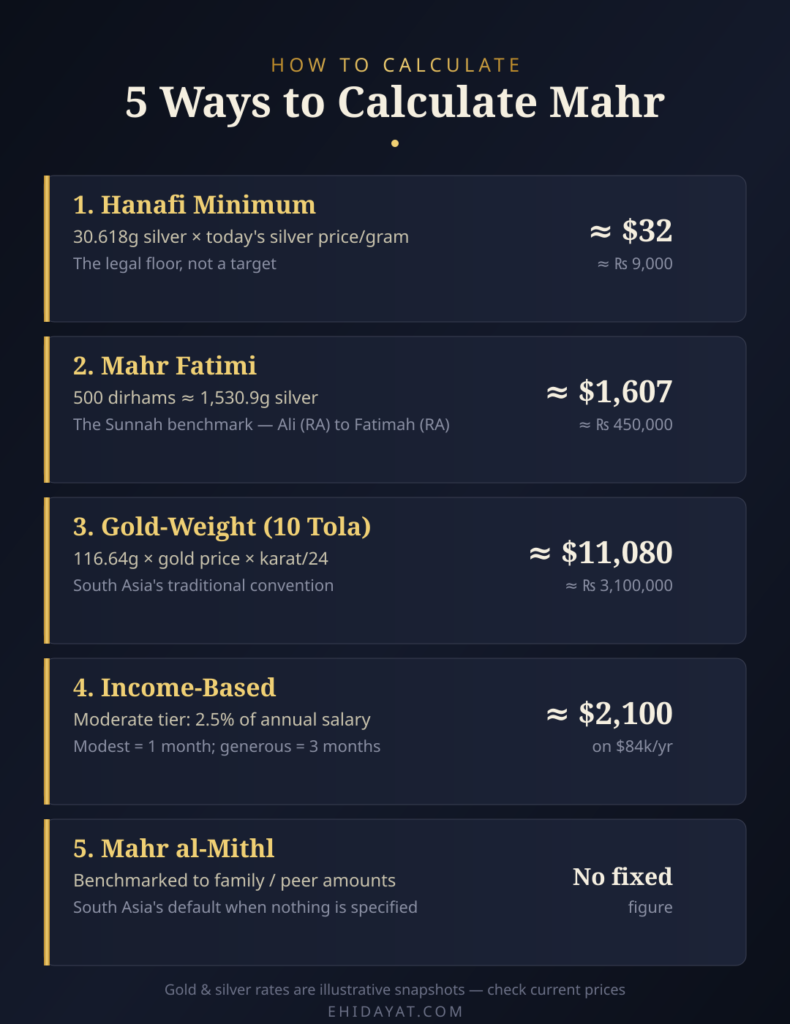
This is the question that actually brings most people to this page — not “what is mahr” but “how much, and how do I land on a number.” There’s no single correct method. What follows are the five approaches Islamic scholars and modern practitioners actually use, each with the math worked through.
1. Hanafi minimum (silver-weight floor). Multiply 30.618 grams by the current price of silver per gram. At a representative silver price of roughly $1.05/gram, that’s about $32 — a legal floor, not a target. Practically nobody stops here; it exists mainly so couples know where the absolute bottom sits.
2. Mahr Fatimi (the Sunnah standard). Named after the mahr Ali (RA) gave Fatimah (RA) — his armor, or shield by some narrations (Abu Dawud 2125, An-Nasa’i 3375, graded authentic by Al-Albani) — this is calculated as 500 dirhams, or about 1,530.9 grams of silver. At $1.05/gram that’s roughly $1,607. Many scholars treat this as the single most meaningful benchmark, since it’s directly tied to the Prophet’s ﷺ own household rather than an arbitrary modern figure.
3. Gold-weight method. Common across South Asia, where mahr is traditionally quoted in tola rather than currency. Ten tola of gold — 116.64 grams — at, say, $95/gram for 22-karat gold works out to roughly $11,080. The formula for any karat purity is weight × 24-karat price × (karat/24).
4. Income-based. The husband’s income sets the scale rather than a fixed weight of precious metal. A modest approach uses one month’s gross salary; a moderate approach uses roughly 2.5% of annual income (the same rate as zakat, which is where that figure comes from); a generous approach uses three months’ salary. For someone earning $7,000/month, that’s a $7,000 / $2,100 / $21,000 range depending on which tier the couple picks.
5. Mahr al-mithl (family benchmark). What women of comparable education, family standing, and background actually received — an older sister, a cousin, a family friend. This is the traditional method in much of South Asia and the default the law falls back on when nothing else was specified (more on that below).
| Method | Basis / Formula | Worked Example (USD) | Worked Example (PKR, approx.) |
|---|---|---|---|
| Hanafi minimum | 30.618g silver × price/gram | ≈ $32 | ≈ ₨ 9,000 |
| Mahr Fatimi | 1,530.9g silver × price/gram | ≈ $1,607 | ≈ ₨ 450,000 |
| Gold-weight (10 tola) | 116.64g × gold price × karat/24 | ≈ $11,080 | ≈ ₨ 3,100,000 |
| Income-based (moderate) | 2.5% of annual salary | ≈ $2,100 (on $84k/yr) | varies with local salary |
| Mahr al-mithl | Benchmarked to family/peer amounts | No fixed figure — set by comparison | No fixed figure — set by comparison |
Gold and silver prices move daily — the figures above are illustrative snapshots, not live rates. Check a current bullion price before finalizing an actual amount, and treat the PKR column as a rough order of magnitude rather than an exact conversion. IslamQA’s breakdown of the silver-weight calculation walks through the dirham-to-gram conversion in more depth if you want the full scholarly working.
Prompt vs. Deferred: How to Split the Payment
Most families split the total rather than paying it all at once — a 50/50 division is common, though any ratio both sides agree to is valid. There’s no religious requirement to split it any particular way; the only requirement is that both the amount and the split are clearly stated, ideally in writing, before the marriage is consummated.
Haq Mehar and the Nikahnama: What Pakistani/South Asian Law Says
This is the part almost nothing written on the topic actually explains, and it matters more than the fiqh discussion for anyone marrying in — or under the family law of — Pakistan, India, or Bangladesh.
Where Mahr Is Recorded in the Nikahnama
In Pakistan, every Muslim marriage has to be registered through a Nikahnama with the local Union Council, and the Nikah Registrar is legally required to fill in every column accurately at the time of the ceremony. The columns dealing with dower — numbered 13 through 16 in the standard form, per a 2020 Lahore High Court ruling, though the exact numbering can shift slightly depending on the version of the form in use — are where the amount, the split between prompt and deferred, and any special conditions get written down.
If the Nikahnama Doesn’t Specify How Mahr Is Paid
This is the detail that trips families up most often. Section 10 of the Muslim Family Laws Ordinance, 1961 states it plainly: “Where no details about the mode of payment of dower are specified in the nikahnama or the marriage contract, the entire amount of the dower shall be presumed to be payable on demand.” In other words, if the couple names an amount but never says whether it’s prompt or deferred, the law doesn’t split the difference — it treats the whole thing as due immediately, on the wife’s demand. Leaving that column vague isn’t a neutral choice. It has a legal default, and the default favors the wife.
How a Wife Recovers Unpaid Mahr
Mahr is a legally enforceable debt, not a moral obligation the courts stay out of. If a husband doesn’t pay, his wife can bring a recovery suit through the Family Courts, and if he dies first, her claim against the deferred portion attaches to his estate before anything is distributed to his heirs. An unregistered nikah is still religiously valid — but it makes proving the terms of the mahr agreement in a civil court considerably harder, which is the practical reason registration matters even when a couple sees it as paperwork. None of this is a substitute for an actual family-law consultation if there’s a real dispute; the mechanics above are the general framework, not case-specific advice.
Can the Wife Waive Her Mahr?
Yes — but only if she does it willingly. The Quran addresses this directly in the same verse that establishes mahr in the first place: “But if they give up willingly to you anything of it, then take it in satisfaction and ease” (4:4). The word that matters is willingly. A waiver given under any form of pressure isn’t a waiver in the eyes of the law or the religion — the mahr remains owed regardless of what was said in the moment.
Can Family Pressure a Bride to Waive Her Mahr?
No, not validly. It happens anyway — often enough that it’s worth naming directly: mothers, grandmothers, aunts, and older sisters sometimes push a bride to forgive her mahr, framing it as generosity or as proof she isn’t “money-minded.” That framing doesn’t hold up against the actual ruling. Since 4:4 makes willingness the condition for a valid waiver, forgiveness extracted through family pressure — however gently applied — simply doesn’t discharge the husband’s obligation. He still owes it. The fact that a bride felt she couldn’t refuse doesn’t change the underlying right, even if it changes what happened in practice.
Mahr in Divorce and Death
Divorce Before vs. After Consummation
If a divorce happens before the marriage is consummated, the wife is entitled to half the specified mahr (Al-Baqarah 2:237). If it happens after consummation, she’s entitled to the full amount, no reduction. If no mahr was ever specified and the couple divorces before consummation, she instead receives mut’ah — a reasonable gift scaled to the husband’s means, in place of a fixed mahr figure.
If the Husband Dies Before Paying
Unpaid mahr — especially the deferred portion — becomes a debt against the husband’s estate. Debts are settled before an estate is divided among heirs, so a widow’s mahr claim is paid out ahead of inheritance distribution, not folded into it or treated as just another bequest.
Common Mistakes When Setting Mahr
A few patterns show up again and again, and they’re worth naming plainly rather than glossing over:
- Setting a token $1 or $5 “just to make it official.” The marriage stays technically valid, but this misreads what mahr is for — it’s a meaningful financial right, not a formality to check off.
- Confusing mahr with dowry. Mahr comes from the groom to the bride. Dowry, where it exists culturally, comes from the bride’s family to the groom’s — and Islam doesn’t require or endorse it.
- Fixing an enormous deferred amount nobody actually expects to pay. Some families agree on a large number — tens of thousands of dollars, or the local currency equivalent — with an unspoken understanding it will never really change hands. That’s not generosity. It converts a real obligation into a hollow promise, and more than a few scholars consider it ethically problematic for exactly that reason.
Frequently Asked Questions
What is the minimum mahr in Islam? It depends on the school of thought. Hanafi jurists set it at 10 dirhams, roughly 30.6 grams of silver — a few dollars at current prices. Maliki jurists set a lower floor of 3 dirhams. Shafi’i and Hanbali scholars don’t fix a minimum at all, so long as whatever is given has genuine value.
Is haq mehar the same as mahr? Yes. Haq mehar is the South Asian Urdu/Hindi rendering of the same Arabic word — haq means “right,” underscoring that it’s the bride’s due rather than a gift she should feel grateful for. Mehr, meher, and mahar are all the same term in different transliterations.
Can mahr be paid in installments? Yes, as long as both parties agree and the payment schedule is clearly written into the marriage contract rather than left as a verbal understanding.
Is a very high mahr better in Islam? Not automatically. An authentic hadith reports the Prophet ﷺ saying the best mahr is the one that’s easiest to fulfill (Sahih Ibn Hibban 4163, graded sahih by Al-Albani). A mahr set so high it becomes a source of resentment or is never realistically payable works against the spirit of the obligation, not in favor of it.
What happens if mahr isn’t paid before the husband dies? It becomes a debt against his estate and is settled before any inheritance is distributed to his heirs — the widow’s claim comes first, not last.
Where is mahr recorded in a Nikahnama, and what if it’s left blank? It’s recorded in the dower-related columns of the Nikahnama, filled in by the Nikah Registrar at the time of the ceremony. If the entry doesn’t specify prompt or deferred, Pakistani law (Section 10, MFLO 1961) presumes the entire amount is payable on demand — leaving it blank doesn’t reduce the obligation, it just defaults to the version that favors the wife.
Can gold jewelry be counted as mahr? Yes, provided the weight and value are clearly agreed upon by both sides at the time of the contract