
Your father calls to say the flight boards in twenty minutes. Before he hangs up, he doesn’t say “bye” — he says “Fi Amanillah.” You’ve heard it a hundred times. But if someone asked you to actually write it in Urdu, or explain why he said that instead of the usual “Allah Hafiz,” you’d probably hesitate.
Quick Answer — What Does Fi Amanillah Mean in Urdu?
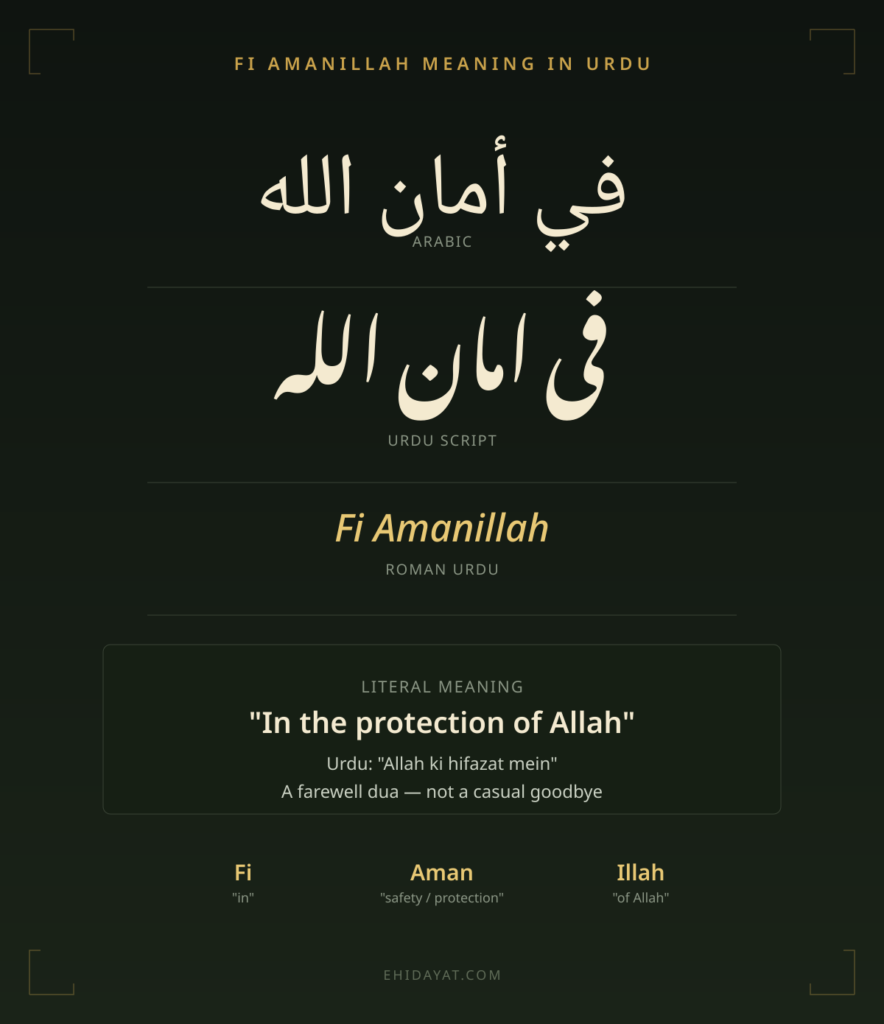
Fi Amanillah (فی امان اللہ) means “Allah ki hifazat mein” — “in Allah’s protection,” or “may Allah protect you.” It’s a farewell dua said at partings that actually matter: before travel, a long separation, or anything genuinely uncertain. Not a stand-in for an everyday “bye.”
You’ll find the English gloss written differently depending on which site you land on. Some dictionaries render it as “May Allah Protect You.” Others just say “Farewell” or “Goodbye.” These aren’t rival translations fighting over which is correct — they’re the same phrase described two ways. One is literal (in Allah’s protection). One is functional (what the phrase does — it says goodbye). If you want the actual meaning of the words rather than a paraphrase of their function, the literal version is the one to hold onto.
Fi Amanillah in Urdu Script — فی امان اللہ
Urdu borrows its script directly from Arabic and Persian, so the phrase looks identical whether it’s sitting in an Arabic sentence or an Urdu one — no transliteration into a different alphabet required, unlike English.
| Form | Script | Notes |
|---|---|---|
| Arabic | في أمان الله | Original form |
| Urdu | فی امان اللہ | Same script, same spelling — Urdu doesn’t alter it |
| Roman Urdu | Fi amanillah / Fee amanillah | Phonetic spelling used for texting and typing |
Word for word, it breaks into three pieces: Fi (“in”), Aman (“safety” or “protection” — sharing a root with iman, faith, and amin, trustworthy), and Illah, a contracted form of Allah. Strung together, it reads “in the safekeeping of Allah.”
If you’ve come across “Fee Amanillah,” “Fi Aman Allah,” or “Fii Amanillah,” you were reading the same phrase. None of these spellings is more correct in Arabic — they’re just different attempts to squeeze an Arabic sound into Roman letters, the same way “Ramadan” and “Ramzan” both point at the same month.
Is “Fi Amanillah” an Urdu Phrase, or Borrowed from Arabic?
It’s classical Arabic — used in Urdu-speaking communities as a borrowed, somewhat more formal alternative to the homegrown phrase “Allah Hafiz.” It isn’t a native Urdu coinage the way “Allah Hafiz” or “Khuda Hafiz” are.
That distinction matters more than it sounds like it should. “Allah Hafiz” combines the Arabic name Allah with the Persian/Urdu word hafiz (guardian) — a phrase built specifically for South Asian Muslim speech. “Fi Amanillah” is fully Arabic, imported wholesale, the way English speakers use “adieu” or “au revoir” without those being English words. You’ll hear it in Urdu-speaking households and mosques, especially among people with some Arabic-language exposure — Hajj and Umrah travelers, Quran students, families who’ve spent time in the Gulf — but it sits alongside Allah Hafiz rather than replacing it.
How to Pronounce Fi Amanillah for Urdu Speakers
Said aloud, it comes out as fee-a-MAA-nil-LAAH, with the weight landing on “maa” and the final “laah.”
Most of the sounds are already familiar from Urdu — the long “ee,” the rolled “n,” the soft “l.” The one that trips people up is the run-together amani-llah: in fast speech, the “i” at the end of amani slides directly into the doubled “l” of “Allah” instead of staying separate, so it comes out closer to “amanil-laah” than “amani-illah.” Slow it down the first few times and the rhythm settles on its own.
Fi Amanillah vs. Allah Hafiz vs. Khuda Hafiz — Which Do Urdu Speakers Actually Say?
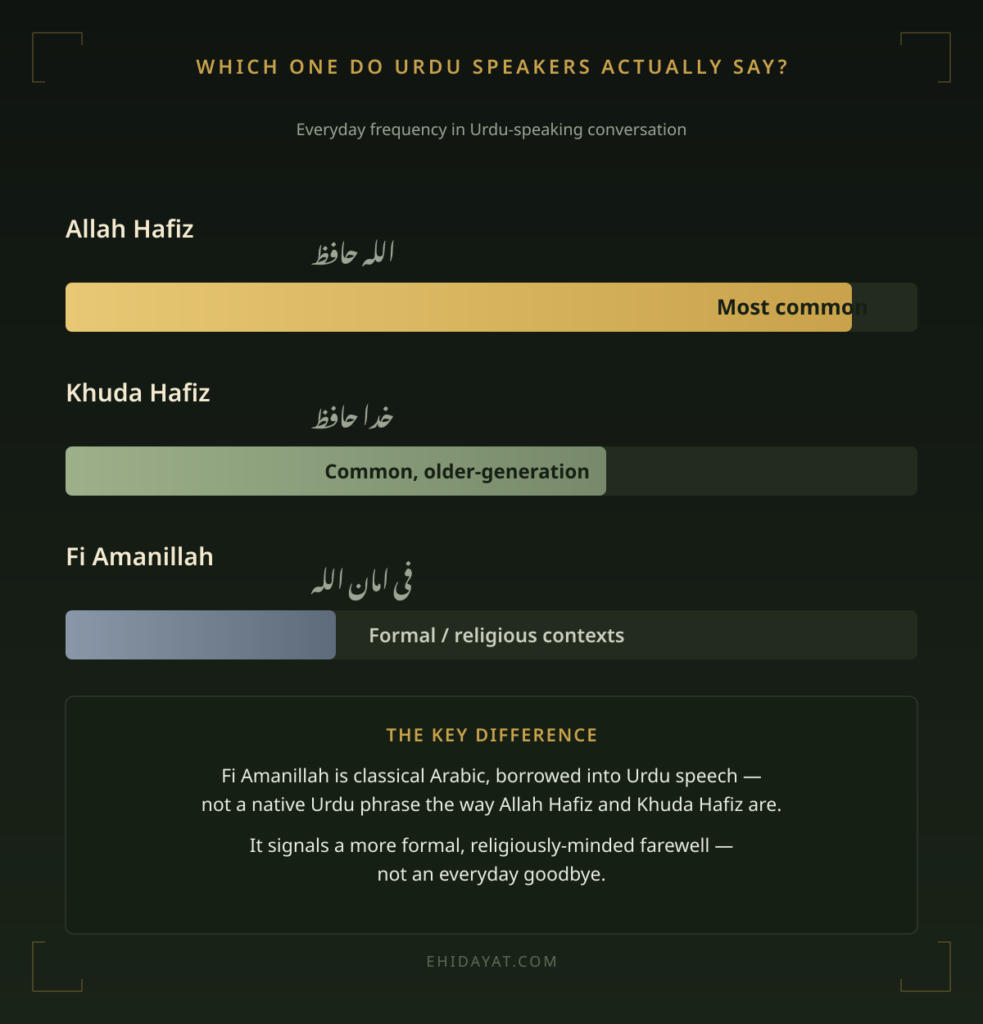
In everyday Urdu conversation, Allah Hafiz is by far the more common farewell — Fi Amanillah shows up in more formal, religious, or Arabic-influenced speech, not casual goodbyes. A dictionary comparison of the three phrases misses this, because on paper they all mean roughly the same thing. In practice, they don’t get used the same way.
| Phrase | Script | Literal Meaning | How Common in Everyday Urdu |
|---|---|---|---|
| Allah Hafiz | اللہ حافظ | May Allah be your guardian | Most common — the default, casual Urdu farewell |
| Khuda Hafiz | خدا حافظ | May God be your guardian | Older, Persian-rooted form — still widely used, especially by older generations |
| Fi Amanillah | فی امان اللہ | In the protection of Allah | Less common day-to-day — reserved for weightier partings or more religiously-minded speakers |
Khuda Hafiz is the oldest of the three, and it’s Persian rather than Arabic — some scholars in the subcontinent have pushed Allah Hafiz instead, specifically to use Allah’s own name rather than the Persian word for God, though that’s a preference rather than a ruling, and Khuda Hafiz remains everywhere from Bollywood dialogue to grandparents’ phone calls. Fi Amanillah is the newcomer to Urdu-speaking spaces, and it tends to signal something: that the speaker wants the farewell to carry a bit more religious weight than routine small talk does.
How to Reply to Fi Amanillah in Urdu
The natural Urdu-language reply is “Allah aap ki hifazat kare” — “May Allah protect you [too].” You’ll also hear the shorter “Allah hifazat kare” in more casual speech.
If you’d rather reply in the same register as the original Arabic phrase, mirroring it back works too — either the full “Wa anta fi amanillah” (to a man) or “Wa anti fi amanillah” (to a woman), both meaning “and you too, in Allah’s protection.” Neither reply is more correct than the other; picking Urdu over Arabic (or the reverse) is really about matching the tone of the person you’re speaking to. Replying to a dua for your safety with a dua for theirs also isn’t just custom — it reflects the Quran’s own instruction in Surah An-Nisa (4:86) to return a greeting with one equal to it or better.
Fi Amanillah in Urdu Poetry and Everyday Speech
Most explanations of this phrase treat it purely as a religious formula. It’s also, quietly, part of Urdu’s literary vocabulary. Classical Urdu poets — writing ghazals in the same tradition as Mirza Ghalib and his contemporaries — used “fi-amanillah” in verses about parting, sometimes pairing it against the more secular “Khuda Hafiz” for contrast within a single couplet, since both phrases scan naturally in Urdu meter and both carry the weight of a real goodbye rather than a passing one. That kind of usage shows up in 19th- and early 20th-century Urdu shayari archived in dedicated Urdu-language dictionaries — a detail that rarely makes it into English-language explanations of the phrase, which tend to treat it as purely a modern devotional habit rather than something with roots in the language’s poetic tradition too.
Is There a Fixed Number of Times to Recite Fi Amanillah?
No — there’s no authentically sourced count for how many times to say Fi Amanillah. It’s a sincere parting dua said once, in the moment, not a wazifa with a prescribed repetition.
You’ll find specific numbers circulating online — some sources say recite it three to seven times before a journey, others say forty-one times before sleeping, often paired with a suggestion to follow it with a short surah. Neither of those counts is backed by a hadith reference, and the two claims don’t even agree with each other, which is usually a sign that a number got attached to a real dua without any actual source behind it. Treat Fi Amanillah as what the Sunnah actually supports: a genuine farewell prayer, said with intention, not a formula with a required repeat count.
When to Say Fi Amanillah
It belongs at partings that carry real weight — someone leaving on a trip, a long separation, or a moment of genuine uncertainty — not at the end of a five-minute phone call or a meeting you’ll be back at within the hour. For the fuller picture of when it fits (and a few situations people get wrong), the complete breakdown of Fi Amanillah’s meaning, etiquette, and Quran/Hadith background covers that in more depth than a single section here can.
Quranic and Hadith Roots
The exact phrase “Fi Amanillah” isn’t a direct quote from the Quran or a specific hadith, but the idea behind it — entrusting someone to Allah’s care before a parting — is well-grounded in the Sunnah. The Prophet Muhammad ﷺ used a longer, more formal version of the same idea when bidding farewell to travelers, recorded in a narration from Ibn ‘Umar: “I entrust to Allah your religion, your trust, and the last of your deeds.” This is recorded in Jami’ at-Tirmidhi 3443, graded hasan sahih by Imam Tirmidhi.
The underlying principle also connects to Surah Al-Ahzab (33:17), where the Quran asks who could protect anyone from Allah if He intended otherwise — a rhetorical question that leaves no answer but Allah Himself. Fi Amanillah is a short, everyday expression of that same idea: admitting you can’t watch over someone yourself, so you’re asking the One who can.
Frequently Asked Questions
Fi Amanillah meaning in Urdu? Fi Amanillah (فی امان اللہ) means “Allah ki hifazat mein” — “in Allah’s protection” or “may Allah protect you.” It’s a farewell dua, not a casual goodbye, used when parting before travel or a long separation.
Is Fi Amanillah an Urdu word? No — it’s classical Arabic. It’s used in Urdu-speaking communities, but the more distinctly Urdu/South Asian equivalent for the same sentiment is “Allah Hafiz.”
How do you write Fi Amanillah in Urdu script? It’s written فی امان اللہ, using the same Arabic-derived script Urdu shares with Arabic and Persian — no separate Urdu spelling exists for it.
What is the Urdu reply to Fi Amanillah? A natural Urdu-language reply is “Allah aap ki hifazat kare” (“May Allah protect you too”), or the Arabic mirror-reply “Fi Amanillah” / “Wa anta fi amanillah” said back.
Is Fi Amanillah the same as Allah Hafiz? They carry the same core meaning — asking for Allah’s protection at parting — but Fi Amanillah is Arabic and more formal, while Allah Hafiz is the more commonly used everyday South Asian equivalent.
How many times should Fi Amanillah be recited? There’s no fixed, authentically sourced count. It’s said sincerely once at the moment of parting, not as a repeated wazifa with a prescribed number.
Does Fi Amanillah only apply to travel? Its main use is farewells before travel or long separation, but it’s also said to someone facing hardship, illness, or an uncertain situation.
Pre-publication citation check: Quran 33:17 (Surah Al-Ahzab) and Tirmidhi 3443 (graded hasan sahih) should be verified against the linked Sunnah.com reference before publishing. The “3-7 times” and “41 times” wazifa claims are deliberately presented as unsourced competitor claims, not endorsed — do not strengthen this into a specific recommended count during editing