
You’ve made a decision before, prayed on it, and still felt unsure — that’s usually the moment someone starts searching for the dua for istikhara. It’s the supplication the Prophet ﷺ taught his companions to recite after two rak’ahs of voluntary prayer, whenever they faced a choice they couldn’t be certain about. Below you’ll find the full Arabic text, transliteration, and English meaning, plus how to pray it correctly, what it isn’t, and how to phrase it for your own situation.
What Is Istikhara?
Istikhara means “seeking what is good.” It’s the third step in a simple decision-making process the early Muslims followed: first you do your own research and weigh the situation, then you ask someone experienced for advice (this second step is called istishara), and only after that do you turn to Allah and ask Him to steer you toward whichever option is genuinely good for you — even if it isn’t the one you were leaning toward. That order matters. Istikhara was never meant to replace thinking things through; it comes after you’ve already done the thinking.
Salat al-istikhara is the two-rak’ah prayer that goes with it. People tend to reach for it before big decisions — marriage, a job change, buying a house — but the sahaba were taught to use it for small matters too, the same way the Prophet ﷺ taught them individual surahs of the Qur’an.
The Dua of Istikhara in Arabic, Transliteration & English
Once you’ve finished the two rak’ahs and said your tasleem, this is the dua to recite.
Arabic:
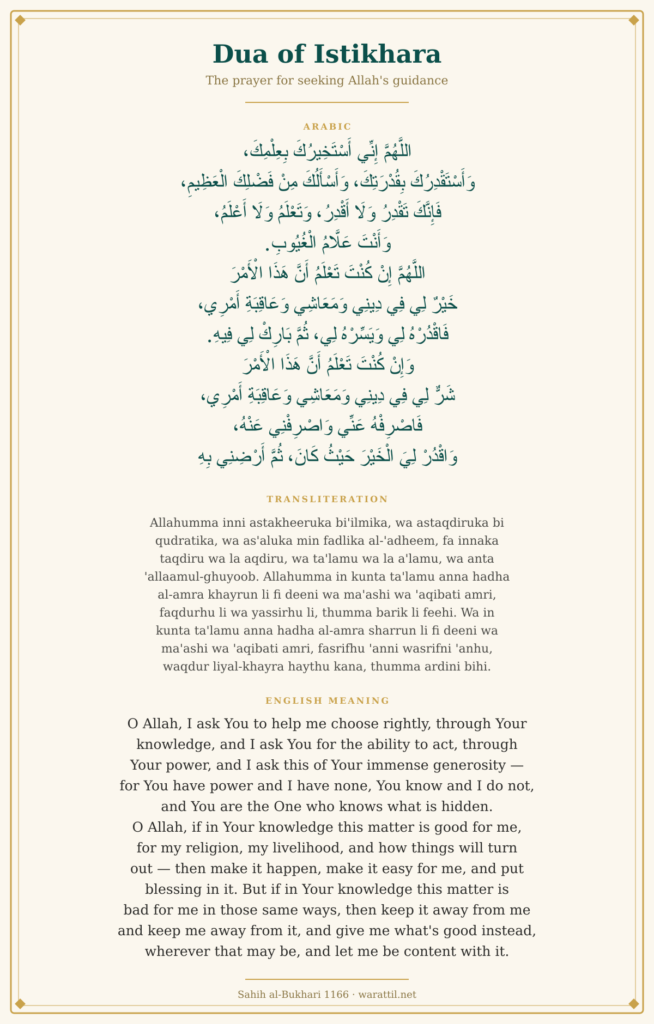
اللَّهُمَّ إِنِّي أَسْتَخِيرُكَ بِعِلْمِكَ، وَأَسْتَقْدِرُكَ بِقُدْرَتِكَ، وَأَسْأَلُكَ مِنْ فَضْلِكَ الْعَظِيمِ، فَإِنَّكَ تَقْدِرُ وَلَا أَقْدِرُ، وَتَعْلَمُ وَلَا أَعْلَمُ، وَأَنْتَ عَلَّامُ الْغُيُوبِ. اللَّهُمَّ إِنْ كُنْتَ تَعْلَمُ أَنَّ هَذَا الْأَمْرَ خَيْرٌ لِي فِي دِينِي وَمَعَاشِي وَعَاقِبَةِ أَمْرِي، فَاقْدُرْهُ لِي وَيَسِّرْهُ لِي، ثُمَّ بَارِكْ لِي فِيهِ. وَإِنْ كُنْتَ تَعْلَمُ أَنَّ هَذَا الْأَمْرَ شَرٌّ لِي فِي دِينِي وَمَعَاشِي وَعَاقِبَةِ أَمْرِي، فَاصْرِفْهُ عَنِّي وَاصْرِفْنِي عَنْهُ، وَاقْدُرْ لِيَ الْخَيْرَ حَيْثُ كَانَ، ثُمَّ أَرْضِنِي بِهِ
Transliteration:
Allahumma inni astakheeruka bi’ilmika, wa astaqdiruka bi qudratika, wa as’aluka min fadlika al-‘adheem, fa innaka taqdiru wa la aqdiru, wa ta’lamu wa la a’lamu, wa anta ‘allaamul-ghuyoob. Allahumma in kunta ta’lamu anna hadha al-amra khayrun li fi deeni wa ma’ashi wa ‘aqibati amri, faqdurhu li wa yassirhu li, thumma barik li feehi. Wa in kunta ta’lamu anna hadha al-amra sharrun li fi deeni wa ma’ashi wa ‘aqibati amri, fasrifhu ‘anni wasrifni ‘anhu, waqdur liyal-khayra haythu kana, thumma ardini bihi.
English meaning:
“O Allah, I ask You to help me choose rightly, through Your knowledge, and I ask You for the ability to act, through Your power, and I ask this of Your immense generosity — for You have power and I have none, You know and I do not, and You are the One who knows what is hidden. O Allah, if in Your knowledge this matter is good for me, for my religion, my livelihood, and how things will turn out — then make it happen, make it easy for me, and put blessing in it. But if in Your knowledge this matter is bad for me in those same ways, then keep it away from me and keep me away from it, and give me what’s good instead, wherever that may be, and let me be content with it.”
[🖼️ Insert graphic here: a clean, screenshot-friendly card stacking the Arabic, transliteration, and English translation above, in that order. Alt text: “Dua of istikhara in Arabic with transliteration and English translation.”]
Where you see “this matter,” you’re meant to silently bring your specific decision to mind — you don’t insert it into the Arabic recitation itself. For the exact hadith wording and its authenticity grading, see Sahih al-Bukhari 1166 on Sunnah.com.
How to Pray Istikhara Step by Step
Praying istikhara doesn’t require anything beyond what you already do for any voluntary prayer:
- Make wudu.
- Form the intention to pray two rak’ahs specifically for istikhara.
- Pray the two rak’ahs like any other nafl prayer — Surah al-Fatihah plus any surah you choose in each rak’ah.
- Finish with tasleem, the same way you’d end any prayer.
- Recite the dua of istikhara above, bringing your specific decision to mind as you say “this matter.”
- Go ahead and act — you don’t need to wait for a sign before moving forward.
That’s the whole method. Some people fold these two rak’ahs into prayers they’re already doing, like the sunnah before Fajr or after Maghrib; others pray them separately whenever a decision comes up. Either way is fine — there’s no special extra requirement layered on top of an ordinary prayer.
[🔗 Internal link: “how the two rak’ahs of tahajjud are prayed” → link to your existing tahajjud guide here. Istikhara and tahajjud are both non-obligatory two-rak’ah prayers, so this is a natural, topically relevant cross-link.]
When Is the Best Time to Pray Istikhara?
Any time outside the windows when prayer is disliked — right after Fajr and in the stretch just before sunset are the two to avoid. Beyond that, there’s flexibility. Many people simply add the two rak’ahs onto sunnah prayers they’re already praying that day. Others prefer praying it at night, in the last third of the night, when things are quieter and it’s easier to focus. Neither is required — it’s a matter of what actually helps you concentrate.
Istikhara vs. Salat al-Hajah: What’s the Difference?
Istikhara is for choosing between options; salat al-hajah is for asking Allah for something specific. They’re easy to mix up, and mixing them up is often why istikhara feels like it “didn’t work” — the prayer was never designed to answer the kind of request being made of it.
| Aspect | Salat al-Istikhara | Salat al-Hajah |
|---|---|---|
| Purpose | Choosing between two or more options | Asking Allah for something you need |
| When to use it | You’re unsure which path is genuinely better for you | You have a specific need and want to bring it directly to Allah |
| What you ask for | Guidance toward whichever option is good, and to be turned away from the one that isn’t | The thing itself — healing, provision, a resolved situation |
| Can be repeated? | Yes, as many times as needed | Yes, as many times as needed |
If you’ve been praying istikhara over something that isn’t really a choice between options — it’s just something you want — salat al-hajah is the more fitting prayer.
Common Myths About Istikhara (And What the Hadith Actually Says)
A few practices have attached themselves to istikhara over time that don’t actually come from the sunnah:
“The answer comes through a dream.” Not necessarily. The hadith describes three sources of dreams — from Allah, from your own thoughts, and from Shaytan (Sahih Muslim 2263) — so a dream about your decision may just be your mind replaying something you’re already preoccupied with, not a divine sign.
Writing “yes” and “no” on paper and picking one at random. This isn’t from the sunnah at all; it’s closer to a coin flip than a supplication, and there’s no basis for it in the hadith.
Asking someone “more pious” to pray istikhara on your behalf and report back a dream. Istikhara is personal — it’s your own decision, so it has to be your own prayer. There’s no precedent for delegating it, even to someone you trust and even if money changes hands for the “service,” which unfortunately does happen.
Needing a special bath, a specific number of repetitions, or some other extra ritual. The hadith doesn’t attach any of that. Same wudu, same two rak’ahs, same dua — istikhara isn’t more complicated than any other voluntary prayer.
How to Phrase the Dua for a Specific Decision (Marriage, a Job, Moving)
The wording “this matter” in the dua is a placeholder — you hold your actual situation in mind as you say it, rather than reciting the details out loud in Arabic. A few examples of what that looks like in practice:
| Situation | What you hold in mind at “this matter” |
|---|---|
| Considering a marriage proposal | “This marriage to [name]” |
| Deciding on a job offer | “This job offer at [company]” |
| Weighing a move to a new city | “This move to [city]” |
You’re not changing the Arabic recitation itself — you’re simply being specific in your own head and heart about what you’re asking Allah to guide you on. The more precisely you know what you’re deciding between, the more useful the prayer becomes, since vague istikhara (“should my life go well?”) doesn’t give you much to act on afterward.
How Long Does It Take to Get an Answer? Can You Repeat Istikhara?
There’s no fixed timeframe, and no hadith sets a limit on how many times you can repeat it. Umar ibn al-Khattab is reported to have prayed istikhara for roughly a month before deciding to move forward with compiling the Qur’an into a single mushaf — a genuinely major decision that he didn’t rush, even as a companion who’d learned istikhara directly from that generation. If a month wasn’t excessive for a decision of that scale, there’s no reason to feel like you’re doing something wrong by praying it more than once over a smaller one.
What Happens After Istikhara? Signs, Feelings, and What to Do Next
Most of the time, the “answer” shows up as a sense of ease or clarity about one option, or as things becoming noticeably harder or more complicated if you push toward the other. It’s not usually dramatic. If nothing feels clear afterward, that’s not a failure — repeat the prayer, keep talking to people whose judgment you trust (istishara), and go with whichever path currently feels more workable. Istikhara was never meant to remove your responsibility to actually decide; it’s meant to put Allah’s blessing behind the decision you do make.
FAQ
What is the dua for istikhara in English? It translates as: “O Allah, I ask You to help me choose rightly, through Your knowledge, and I ask You for the ability to act, through Your power, and I ask this of Your immense generosity…” It goes on to ask Allah to bring the matter about and bless it if it’s good, or turn it away if it isn’t. The full Arabic, transliteration, and translation are above.
Can I recite the istikhara dua without praying two rak’ahs? Yes. Praying two rak’ahs first is the sunnah method, but reciting just the dua is sufficient if you’re pressed for time or unable to pray — during menstruation, for example.
How many times can I repeat istikhara for the same decision? There’s no limit set in the hadith. Umar ibn al-Khattab reportedly prayed istikhara for about a month before deciding to compile the Qur’an, so repeating it over days or weeks is entirely normal.
Does Allah answer istikhara through dreams? Not necessarily. The hadith names three sources of dreams — from Allah, from your own thoughts, or from Shaytan — so a dream about a decision may just reflect what’s already on your mind, not an answer.
Can someone else pray istikhara on my behalf? No. It’s a personal prayer about your own decision, and there’s no basis in the sunnah for delegating it to someone else, however pious they may be.
What’s the difference between istikhara and salat al-hajah? Istikhara is for choosing between options. Salat al-hajah is for bringing a specific need to Allah — it isn’t for weighing a decision.
When is the best time to pray istikhara? Any time outside the disliked windows, such as right after Fajr or just before sunset. Many people simply add it onto sunnah prayers they’re already praying that day.
What if I don’t feel anything after praying istikhara? That’s common. You can repeat the prayer, keep consulting people you trust, and move ahead with whichever option feels more workable, trusting the outcome to Allah
You’ve made a decision before, prayed on it, and still felt unsure — that’s usually the moment someone starts searching for the dua for istikhara. It’s the supplication the Prophet ﷺ taught his companions to recite after two rak’ahs of voluntary prayer, whenever they faced a choice they couldn’t be certain about. Below you’ll find the full Arabic text, transliteration, and English meaning, plus how to pray it correctly, what it isn’t, and how to phrase it for your own situation.
What Is Istikhara?
Istikhara means “seeking what is good.” It’s the third step in a simple decision-making process the early Muslims followed: first you do your own research and weigh the situation, then you ask someone experienced for advice (this second step is called istishara), and only after that do you turn to Allah and ask Him to steer you toward whichever option is genuinely good for you — even if it isn’t the one you were leaning toward. That order matters. Istikhara was never meant to replace thinking things through; it comes after you’ve already done the thinking.
Salat al-istikhara is the two-rak’ah prayer that goes with it. People tend to reach for it before big decisions — marriage, a job change, buying a house — but the sahaba were taught to use it for small matters too, the same way the Prophet ﷺ taught them individual surahs of the Qur’an.
The Dua of Istikhara in Arabic, Transliteration & English
Once you’ve finished the two rak’ahs and said your tasleem, this is the dua to recite.
Arabic:
اللَّهُمَّ إِنِّي أَسْتَخِيرُكَ بِعِلْمِكَ، وَأَسْتَقْدِرُكَ بِقُدْرَتِكَ، وَأَسْأَلُكَ مِنْ فَضْلِكَ الْعَظِيمِ، فَإِنَّكَ تَقْدِرُ وَلَا أَقْدِرُ، وَتَعْلَمُ وَلَا أَعْلَمُ، وَأَنْتَ عَلَّامُ الْغُيُوبِ. اللَّهُمَّ إِنْ كُنْتَ تَعْلَمُ أَنَّ هَذَا الْأَمْرَ خَيْرٌ لِي فِي دِينِي وَمَعَاشِي وَعَاقِبَةِ أَمْرِي، فَاقْدُرْهُ لِي وَيَسِّرْهُ لِي، ثُمَّ بَارِكْ لِي فِيهِ. وَإِنْ كُنْتَ تَعْلَمُ أَنَّ هَذَا الْأَمْرَ شَرٌّ لِي فِي دِينِي وَمَعَاشِي وَعَاقِبَةِ أَمْرِي، فَاصْرِفْهُ عَنِّي وَاصْرِفْنِي عَنْهُ، وَاقْدُرْ لِيَ الْخَيْرَ حَيْثُ كَانَ، ثُمَّ أَرْضِنِي بِهِ
Transliteration:
Allahumma inni astakheeruka bi’ilmika, wa astaqdiruka bi qudratika, wa as’aluka min fadlika al-‘adheem, fa innaka taqdiru wa la aqdiru, wa ta’lamu wa la a’lamu, wa anta ‘allaamul-ghuyoob. Allahumma in kunta ta’lamu anna hadha al-amra khayrun li fi deeni wa ma’ashi wa ‘aqibati amri, faqdurhu li wa yassirhu li, thumma barik li feehi. Wa in kunta ta’lamu anna hadha al-amra sharrun li fi deeni wa ma’ashi wa ‘aqibati amri, fasrifhu ‘anni wasrifni ‘anhu, waqdur liyal-khayra haythu kana, thumma ardini bihi.
English meaning:
“O Allah, I ask You to help me choose rightly, through Your knowledge, and I ask You for the ability to act, through Your power, and I ask this of Your immense generosity — for You have power and I have none, You know and I do not, and You are the One who knows what is hidden. O Allah, if in Your knowledge this matter is good for me, for my religion, my livelihood, and how things will turn out — then make it happen, make it easy for me, and put blessing in it. But if in Your knowledge this matter is bad for me in those same ways, then keep it away from me and keep me away from it, and give me what’s good instead, wherever that may be, and let me be content with it.”
[🖼️ Insert graphic here: a clean, screenshot-friendly card stacking the Arabic, transliteration, and English translation above, in that order. Alt text: “Dua of istikhara in Arabic with transliteration and English translation.”]
Where you see “this matter,” you’re meant to silently bring your specific decision to mind — you don’t insert it into the Arabic recitation itself. For the exact hadith wording and its authenticity grading, see Sahih al-Bukhari 1166 on Sunnah.com.
How to Pray Istikhara Step by Step
Praying istikhara doesn’t require anything beyond what you already do for any voluntary prayer:
- Make wudu.
- Form the intention to pray two rak’ahs specifically for istikhara.
- Pray the two rak’ahs like any other nafl prayer — Surah al-Fatihah plus any surah you choose in each rak’ah.
- Finish with tasleem, the same way you’d end any prayer.
- Recite the dua of istikhara above, bringing your specific decision to mind as you say “this matter.”
- Go ahead and act — you don’t need to wait for a sign before moving forward.
That’s the whole method. Some people fold these two rak’ahs into prayers they’re already doing, like the sunnah before Fajr or after Maghrib; others pray them separately whenever a decision comes up. Either way is fine — there’s no special extra requirement layered on top of an ordinary prayer.
[🔗 Internal link: “how the two rak’ahs of tahajjud are prayed” → link to your existing tahajjud guide here. Istikhara and tahajjud are both non-obligatory two-rak’ah prayers, so this is a natural, topically relevant cross-link.]
When Is the Best Time to Pray Istikhara?
Any time outside the windows when prayer is disliked — right after Fajr and in the stretch just before sunset are the two to avoid. Beyond that, there’s flexibility. Many people simply add the two rak’ahs onto sunnah prayers they’re already praying that day. Others prefer praying it at night, in the last third of the night, when things are quieter and it’s easier to focus. Neither is required — it’s a matter of what actually helps you concentrate.
Istikhara vs. Salat al-Hajah: What’s the Difference?
Istikhara is for choosing between options; salat al-hajah is for asking Allah for something specific. They’re easy to mix up, and mixing them up is often why istikhara feels like it “didn’t work” — the prayer was never designed to answer the kind of request being made of it.
| Aspect | Salat al-Istikhara | Salat al-Hajah |
|---|---|---|
| Purpose | Choosing between two or more options | Asking Allah for something you need |
| When to use it | You’re unsure which path is genuinely better for you | You have a specific need and want to bring it directly to Allah |
| What you ask for | Guidance toward whichever option is good, and to be turned away from the one that isn’t | The thing itself — healing, provision, a resolved situation |
| Can be repeated? | Yes, as many times as needed | Yes, as many times as needed |
If you’ve been praying istikhara over something that isn’t really a choice between options — it’s just something you want — salat al-hajah is the more fitting prayer.
Common Myths About Istikhara (And What the Hadith Actually Says)
A few practices have attached themselves to istikhara over time that don’t actually come from the sunnah:
“The answer comes through a dream.” Not necessarily. The hadith describes three sources of dreams — from Allah, from your own thoughts, and from Shaytan (Sahih Muslim 2263) — so a dream about your decision may just be your mind replaying something you’re already preoccupied with, not a divine sign.
Writing “yes” and “no” on paper and picking one at random. This isn’t from the sunnah at all; it’s closer to a coin flip than a supplication, and there’s no basis for it in the hadith.
Asking someone “more pious” to pray istikhara on your behalf and report back a dream. Istikhara is personal — it’s your own decision, so it has to be your own prayer. There’s no precedent for delegating it, even to someone you trust and even if money changes hands for the “service,” which unfortunately does happen.
Needing a special bath, a specific number of repetitions, or some other extra ritual. The hadith doesn’t attach any of that. Same wudu, same two rak’ahs, same dua — istikhara isn’t more complicated than any other voluntary prayer.
How to Phrase the Dua for a Specific Decision (Marriage, a Job, Moving)
The wording “this matter” in the dua is a placeholder — you hold your actual situation in mind as you say it, rather than reciting the details out loud in Arabic. A few examples of what that looks like in practice:
| Situation | What you hold in mind at “this matter” |
|---|---|
| Considering a marriage proposal | “This marriage to [name]” |
| Deciding on a job offer | “This job offer at [company]” |
| Weighing a move to a new city | “This move to [city]” |
You’re not changing the Arabic recitation itself — you’re simply being specific in your own head and heart about what you’re asking Allah to guide you on. The more precisely you know what you’re deciding between, the more useful the prayer becomes, since vague istikhara (“should my life go well?”) doesn’t give you much to act on afterward.
How Long Does It Take to Get an Answer? Can You Repeat Istikhara?
There’s no fixed timeframe, and no hadith sets a limit on how many times you can repeat it. Umar ibn al-Khattab is reported to have prayed istikhara for roughly a month before deciding to move forward with compiling the Qur’an into a single mushaf — a genuinely major decision that he didn’t rush, even as a companion who’d learned istikhara directly from that generation. If a month wasn’t excessive for a decision of that scale, there’s no reason to feel like you’re doing something wrong by praying it more than once over a smaller one.
What Happens After Istikhara? Signs, Feelings, and What to Do Next
Most of the time, the “answer” shows up as a sense of ease or clarity about one option, or as things becoming noticeably harder or more complicated if you push toward the other. It’s not usually dramatic. If nothing feels clear afterward, that’s not a failure — repeat the prayer, keep talking to people whose judgment you trust (istishara), and go with whichever path currently feels more workable. Istikhara was never meant to remove your responsibility to actually decide; it’s meant to put Allah’s blessing behind the decision you do make.
FAQ
What is the dua for istikhara in English? It translates as: “O Allah, I ask You to help me choose rightly, through Your knowledge, and I ask You for the ability to act, through Your power, and I ask this of Your immense generosity…” It goes on to ask Allah to bring the matter about and bless it if it’s good, or turn it away if it isn’t. The full Arabic, transliteration, and translation are above.
Can I recite the istikhara dua without praying two rak’ahs? Yes. Praying two rak’ahs first is the sunnah method, but reciting just the dua is sufficient if you’re pressed for time or unable to pray — during menstruation, for example.
How many times can I repeat istikhara for the same decision? There’s no limit set in the hadith. Umar ibn al-Khattab reportedly prayed istikhara for about a month before deciding to compile the Qur’an, so repeating it over days or weeks is entirely normal.
Does Allah answer istikhara through dreams? Not necessarily. The hadith names three sources of dreams — from Allah, from your own thoughts, or from Shaytan — so a dream about a decision may just reflect what’s already on your mind, not an answer.
Can someone else pray istikhara on my behalf? No. It’s a personal prayer about your own decision, and there’s no basis in the sunnah for delegating it to someone else, however pious they may be.
What’s the difference between istikhara and salat al-hajah? Istikhara is for choosing between options. Salat al-hajah is for bringing a specific need to Allah — it isn’t for weighing a decision.
When is the best time to pray istikhara? Any time outside the disliked windows, such as right after Fajr or just before sunset. Many people simply add it onto sunnah prayers they’re already praying that day.
What if I don’t feel anything after praying istikhara? That’s common. You can repeat the prayer, keep consulting people you trust, and move ahead with whichever option feels more workable, trusting the outcome to Allah.