
Islam is the world’s second-largest religion, with roughly 2 billion followers. Ask most people what represents it visually, though, and you’ll get the same answer almost every time: the crescent moon and star. That answer isn’t wrong, exactly. It’s also not the whole story, and in some ways it’s not even the right story.
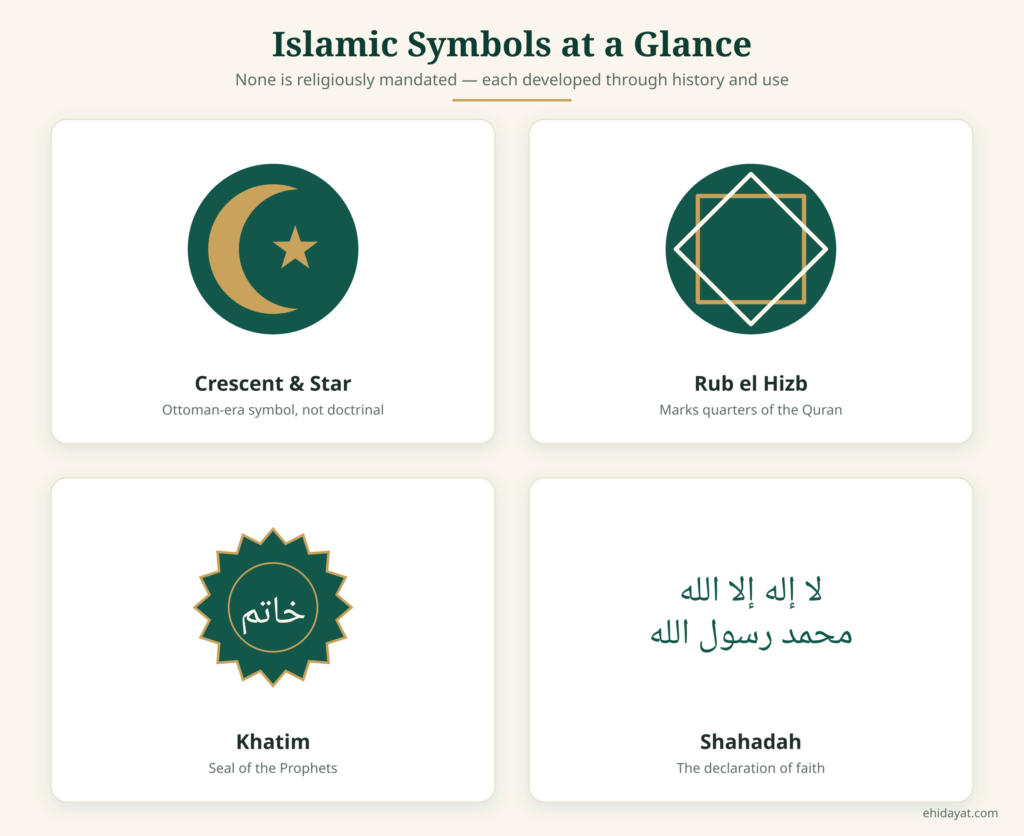
Quick answer: Islam has no single official symbol. Nothing in the Quran or the Sunnah prescribes one. The crescent and star, Arabic calligraphy — especially the word Allah and the Shahadah — and geometric patterns like the Rub el Hizb are the three most widely recognized, but all three developed through history and culture rather than religious mandate.
Does Islam Have an Official Symbol?
No. There’s no verse, no hadith, no ruling from any major school of jurisprudence that assigns Islam an official emblem the way, say, the cross represents Christianity or the Star of David represents Judaism.
That’s not an accident or an oversight. Early Islamic scholarship was cautious — sometimes explicitly hostile — toward religious imagery, out of concern that a physical symbol could slide into idolatry (shirk), the one thing the Quran treats as unforgivable if unrepented. So instead of a mandated icon, what developed was something looser: a handful of visual motifs Muslims across different eras and regions gravitated toward, mostly because they were useful (a flag needs some design), decorative (calligraphy is genuinely beautiful), or functional (a mark showing where to pause during Quran recitation solves a real problem).
None of that makes these symbols meaningless. It just means they’re closer to tradition than doctrine — which, if anything, makes their staying power more interesting, not less.
The Crescent and Star
Origins Before Islam
The crescent moon predates Islam by centuries. It shows up on coins from the Sassanid Persian Empire, and it was already the civic emblem of Byzantine Constantinople — the city the Ottomans would eventually conquer — long before any Muslim army marched near it.
How the Ottomans Made It “Islamic”
After Sultan Mehmed II took Constantinople in 1453, the Ottomans kept the city’s existing crescent on their flags and coinage. Over the following four centuries, as Ottoman power spread across North Africa, the Levant, and the Balkans, the crescent traveled with it. By the time the empire dissolved in the early 20th century, “crescent equals Islam” had become a kind of visual shorthand in the wider world — not because a caliph or council decreed it, but because one very large, very long-lived empire happened to fly it.
Why Some Muslims Reject It
Not every Muslim accepts the crescent as representative. A number of scholars and fatwa bodies — this position is argued at length on sites like IslamQA — point out that the symbol has no basis in the Quran or Sunnah, and object to its use specifically as a religious marker, as opposed to a cultural or national one. It’s a minority position, but not a fringe one, and it’s part of why “the crescent is Islam’s symbol” is a harder claim to defend than it first appears.
On National Flags Today
Where the crescent really lives now is on flags. After the Ottoman Empire’s collapse in 1922, several of its former territories carried the symbol into their own national identities.
| Country | Flag Design | Symbolic Meaning |
|---|---|---|
| Turkey | White crescent and star on red | Continuation of late-Ottoman flag design |
| Pakistan | White crescent and star on green | Adopted at independence, 1947; green and white also represent the country’s majority and minority communities |
| Libya | Crescent and star, readopted 2011 | Ties to the 1951 Kingdom of Libya flag and the story of the Hijra |
| Algeria | Red crescent and star, centered on green-and-white | National liberation-era symbolism, formalized 1962 |
| Tunisia | Red crescent and star inside a white disc | Ottoman-derived design, retained since 1831 |
Calligraphy as Symbol
If any visual tradition in Islam comes close to being universally embraced, it’s calligraphy — not an image of anything, but the word itself, rendered beautifully.
Allah in Arabic Script
The word for God in Arabic is الله (transliterated Allāh). It’s the single most reproduced piece of calligraphy in the Muslim world, appearing on mosque domes, manuscript borders, and modern wall art alike. Part of the appeal is practical: since Islam avoids figurative religious imagery, calligraphy became the outlet for the same artistic energy that, in other traditions, went into painting or sculpture.
The Shahadah
The Shahadah — the declaration of faith, and one of the Five Pillars of Islam — is the second calligraphic staple:
أَشْهَدُ أَنْ لَا إِلَٰهَ إِلَّا اللَّٰهُ وَأَشْهَدُ أَنَّ مُحَمَّدًا رَسُولُ اللَّٰهِ Ash-hadu an lā ilāha illā Llāh, wa ash-hadu anna Muḥammadan rasūlu Llāh “I bear witness that there is no deity but Allah, and I bear witness that Muhammad is the Messenger of Allah.”
It’s recited in the call to prayer five times a day, and it’s the sentence a person says to formally enter Islam. Rendered in calligraphy, it stops being just a spoken formula and becomes something closer to a portable creed — abbreviated versions of it show up on flags, jewelry, and building facades throughout the Muslim world. For more on the word “Allah” itself, the 99 Names of Allah is a natural next stop.
Allahu Akbar and Other Phrases
Allahu Akbar (الله أكبر, “Allah is greater”) is the third recurring phrase — used in the call to prayer and during the prayer itself, and, thanks to unrelated political events over the past few decades, now a phrase many non-Muslims recognize without necessarily knowing how routinely it’s used in ordinary daily worship.
The Rub el Hizb and Geometric Symbols
What It Marks in the Quran
The Rub el Hizb — an eight-pointed star formed by two overlapping squares — isn’t decorative in origin. It’s a navigation tool. The Quran is traditionally divided into 30 sections (juz’) for a month of Ramadan recitation, and each juz’ splits into two hizb, each of which breaks into quarters. The Rub el Hizb marks those quarter-points in the margin, so a reader can track progress through a recitation schedule without losing their place.
Where You’ll See It
What started as a margin note became a design motif. The Seljuks used an eight-pointed variant so often it’s sometimes called the Seljuk Star, and it appears on the emblem of the Marinid Sultanate and, more recently, on the flags of Uzbekistan and Turkmenistan. It’s a good example of how a purely functional Quranic tool can drift into decorative and even national symbolism over a few centuries — the same pattern that shaped the crescent’s story, just starting from a different place. For more on how the Quran is structured and cited, see our Quran quotes collection.
Khatim — The Seal of the Prophet
Khatim means “seal” in Arabic, and it refers to two connected things: a physical signet ring the Prophet Muhammad ﷺ reportedly used to seal official letters, and the broader theological title Khātam an-Nabiyyīn — “Seal of the Prophets.”
That title isn’t folklore. It comes directly from the Quran: “Muhammad is not the father of [any] one of your men, but [he is] the Messenger of Allah and last of the prophets” (Quran 33:40). It’s the scriptural basis for the belief — held across Sunni, Shia, and the broader mainstream of Islam — that Muhammad ﷺ was the final prophet, and that no one after him carries that role. Details about the physical seal itself, and much of what’s known about the Prophet’s daily life more broadly, come down through hadith literature rather than the Quran directly. If that distinction is new to you, our guide to what hadith actually is is worth reading alongside this section.
Sacred Colors in Islam
Green
Green is the color most consistently tied to Islam, and unlike the crescent, it has a real textual basis. The Quran describes paradise (Jannah) using green imagery twice — its inhabitants reclining on green cushions (Quran 55:76) and wearing fine green silk garments (Quran 76:21). That’s a stronger scriptural anchor than most Islamic symbols get.
The popular claim that green was the Prophet Muhammad’s ﷺ personal favorite color rests on weaker ground. It traces to a single narration recorded in al-Tabarani’s al-Mu’jam al-Awsat, not to one of the six major hadith collections, and it gets repeated online far more confidently than its sourcing actually supports. Worth knowing if you’re citing it — “it is reported that…” is the honest framing, not flat fact.
White and Black
White carries associations with purity, and some historical accounts describe it as the color of one of the Prophet’s ﷺ banners. Black has a heavier history: it’s tied to the Black Standard flown in early Islamic conflicts, and separately, to Jahannam (hell) in popular religious imagery. Even Wikipedia’s own sourcing on the “black banners from the East” hadith tradition — often linked to end-times prophecy about the Mahdi — flags that specific hadith set as da’if (weak), a grading almost nobody repeats when the claim gets recycled across blogs and symbol-meaning sites. Small detail. It’s also the kind of detail that separates a sourced article from one that’s just confidently guessing.
Red and the Pan-Arab Colors
Red shows up tied to courage and sacrifice in some traditions; yellow occasionally appears linked to prosperity. Both are looser associations than green’s. Where color symbolism gets more concrete is in the Pan-Arab colors — white, black, green, and red together — which appear across much of the Arab world’s flags and trace to 20th-century Arab nationalist movements, not to religious scripture at all. Worth separating the two: Pan-Arab symbolism is a political and cultural story, not an Islamic one, even though the two get conflated constantly.
| Color | Symbolic Meaning | Source |
|---|---|---|
| Green | Paradise, fine garments and furnishings | Quran 55:76, 76:21 |
| White | Purity; associated with one of the Prophet’s ﷺ banners | Historical accounts, varying reliability |
| Black | Jahannam (hell); the Black Standard | Popular tradition; some related hadith graded weak |
| Red | Courage, sacrifice | Cultural association, weak textual basis |
Sunni and Shia Symbols — Where They Differ
Most of what’s covered so far — the crescent, calligraphy, the Rub el Hizb — is shared across Sunni and Shia Islam without much dispute. A few symbols aren’t.
The clearest example is the Zulfiqar, the bifurcated sword traditionally attributed to Ali ibn Abi Talib — the Prophet’s ﷺ cousin and son-in-law, and the fourth Rashidun caliph in Sunni tradition, or, in Shia belief, the first rightful successor to Muhammad ﷺ. Ali holds a far more central devotional place in Shia Islam, and the Zulfiqar reflects that: it’s a recurring motif in Shia iconography, on everything from flags to jewelry to Ashura-related imagery. It also turns up historically on Ottoman Janissary banners — a reminder that symbol use doesn’t always track theology cleanly.
The Lion and Sun is a sharper case. It became closely tied to Safavid Iran after the dynasty’s founding in 1501, when Twelver Shia Islam was established as the state religion, and it remained in use as an Iranian national emblem for centuries afterward, well outside any purely Sunni context.
| Symbol | Sunni Association | Shia Association |
|---|---|---|
| Zulfiqar (Ali’s sword) | Present on some historical Ottoman banners | Strong — central devotional motif |
| Lion and Sun | Largely absent | Strong — tied to Safavid Iran, 1501 onward |
| Crescent and star | Widely used | Widely used |
| Rub el Hizb, calligraphy | Shared | Shared |
Cultural and Folk Symbols: Hamsa, Evil Eye, and the Scholarly View
The Hamsa — a palm-shaped amulet, sometimes called the Hand of Fatima in Islamic contexts — is one of the most commonly sold “Islamic” symbols in gift shops and jewelry stores. Whether it’s actually an Islamic symbol, in a religious sense, is genuinely contested.
Belief in the evil eye itself isn’t contested — it has real textual support. The Prophet ﷺ is reported to have said: “The influence of an evil eye is a fact” (Sahih Muslim 2188, graded authentic). What’s debated is the remedy. Mainstream scholarship supports ruqyah — protection through specific Quranic recitation and dua, like Surah al-Falaq and Surah an-Nas — over a worn object. Wearing a physical amulet for protection edges into territory some scholars flag as a concern for tawakkul, reliance on Allah rather than an object; that argument is laid out at length on sites like SeekersGuidance. For the textually-supported route, our dua for evil eye and nazar page has the specific recitations.
Is the Nation of Islam Flag the Same as Islam’s Symbol?
No — and this is worth being precise about, because the shared name invites confusion. The Nation of Islam is a distinct American religious and political movement, founded in Detroit in 1930 by Wallace Fard Muhammad and later led by Elijah Muhammad. It has its own flag: a red field with a white crescent and star, sometimes carrying the letters J-E-F-I for Justice, Equality, Freedom, and Islam.
Organizationally and theologically, the Nation of Islam sits apart from mainstream Sunni and Shia Islam — its early teachings diverged from orthodox Islamic doctrine in ways most Islamic scholarship doesn’t recognize as part of the mainstream tradition. Its flag is that movement’s own emblem. It isn’t a symbol of Islam in the broader, global sense this article is about.
Common Misconceptions About Islamic Symbols
A few misunderstandings come up often enough to address directly.
Islam doesn’t have a “logo.” There’s no single mark that functions the way a corporate or national emblem does — everything covered in this article developed gradually, through history and use, not through any official design process.
The hijab and the sword are not symbols Muslims use to represent their own faith, despite showing up that way in Western media shorthand. Neither carries that meaning within Islamic tradition or practice — the hijab is a matter of personal religious dress, and the sword has no devotional status at all outside a couple of specific historical and Shia contexts, like the Zulfiqar covered above.
And the crescent and star, worth repeating once more: it predates Islam by centuries, it isn’t accepted by every Muslim as representative, and its spread had more to do with Ottoman political reach than with religious doctrine.
FAQ
What is the symbol of Islam called? There’s no single official name, because there’s no single official symbol. The crescent and star is the most commonly recognized visual, but it’s a cultural and historical association, not a religiously designated emblem.
Does Islam have an official logo? No. Islam has no governing body that could issue one, and nothing in the Quran or Sunnah assigns the religion a formal visual mark.
What are the 3 main symbols of Islam? Most commonly cited: the crescent and star, Arabic calligraphy (particularly the word Allah and the Shahadah), and geometric patterns like the Rub el Hizb. None of the three is religiously mandated.
Is the crescent moon religiously required in Islam? No. It has pre-Islamic origins in Byzantine and Sassanid symbolism and became associated with Islam mainly through Ottoman use after 1453. Some scholars reject it as having no basis in Quran or Sunnah.
Is the Nation of Islam flag the same as the symbol of Islam? No. The Nation of Islam is a distinct movement founded in 1930, with its own flag — a red field, white crescent and star. It’s organizationally and theologically separate from mainstream Islam.
Do Sunni and Shia Muslims use different symbols? Some, yes. The Zulfiqar (Ali’s sword) and the Lion and Sun are both strongly associated with Shia Islam specifically. Most other symbols — the crescent and star, calligraphy, the Rub el Hizb — are shared across both branches.
What does the color green mean in Islam? Green is tied to descriptions of paradise in the Quran (55:76, 76:21), making it one of the few colors with direct textual backing rather than just tradition.
Is wearing an evil eye or Hamsa symbol allowed in Islam? It’s debated. The reality of the evil eye is textually supported (Sahih Muslim 2188), but the recommended protection is dua and Quranic recitation, not a worn object. Some scholars view amulets as a concern for tawakkul (trust in Allah) rather than a straightforward religious accessory.
The Bottom Line
Islam’s relationship with symbolism isn’t an absence — it’s a choice. The caution around images wasn’t a gap waiting to be filled; it pushed Muslim artistic energy somewhere else entirely, into calligraphy, geometry, and pattern, which is arguably why Islamic visual art ended up as distinctive as it did. The crescent and star get the recognition because one empire flew them for four centuries. The word Allah, rendered beautifully, has arguably done more work as an actual symbol of the faith the entire time