
A newborn arrives, and somewhere between the exhaustion and the joy, a new Muslim parent starts hearing the word Aqiqah. Someone’s grandmother asks when it’s happening. A cousin asks how many goats. And underneath the logistics sits a quieter question: what is this ritual actually for, and are we doing it right?
Aqiqah is the Sunnah of sacrificing an animal to mark a child’s birth — a practice the Prophet Muhammad ﷺ performed himself, for his own grandsons. It is not obligatory, but it carries real weight in Islamic tradition, and it comes with specific rulings on timing, numbers, and the ceremony around it. This guide walks through all of it: the fiqh, the hadith it rests on, and — a piece most guides skip — what actually happens on the day.
What Is Aqiqah?
Aqiqah is the Islamic practice of sacrificing an animal, along with shaving the newborn’s hair and announcing their name, as an act of gratitude to Allah for a child’s birth. All three pieces — the sacrifice, the hair-shaving, and the naming — are traditionally treated as one connected ritual, not three separate events.
The word itself comes from an Arabic root meaning “to cut,” referring both to the act of slaughter and to the symbolic cutting of the baby’s hair. Most families perform it on the seventh day after birth, though Islamic law allows more flexibility than that timeline suggests.
Aqiqah, Aqeeqah, Akika, Hakika — Are They the Same Ritual?
Yes. Aqiqah, aqeeqah, akika, and hakika all refer to the same ritual — they’re different transliterations of the Arabic word عقيقة, shaped by how it’s pronounced and spelled across regions.
“Aqeeqah” and “aqiqah” are just alternate English renderings of the same Arabic term. “Akika” (sometimes “akikah”) is the spelling more commonly seen in Indonesian and Malay usage, reflecting how the word is pronounced locally. “Hakika” shows up in some East African and Swahili-influenced contexts. None of these are separate rituals or different schools of practice — if you’ve seen any of these spellings, you’re reading about the same Sunnah.
Is Aqiqah Obligatory in Islam?
No. Aqiqah is a confirmed Sunnah (sunnah mu’akkadah) — strongly recommended and carrying real reward, but not obligatory (wajib). A family that genuinely cannot afford it is not sinning by skipping it.
That said, scholars across the four major schools differ slightly in how strongly they frame the recommendation.
What the Four Madhhabs Say
| Madhhab | Ruling |
|---|---|
| Hanafi | Mustahab (recommended) |
| Shafi’i | Highly recommended, not obligatory |
| Hanbali | Highly recommended, not obligatory |
| Maliki | Recommended, emphasizing the gratitude and charity involved |
None of the four schools treat it as wajib. The practical difference between “mustahab” and “highly recommended” is mostly one of emphasis, not obligation — every school agrees a family that skips Aqiqah due to genuine hardship carries no sin.
The Hadith Evidence for Aqiqah
Aqiqah isn’t a cultural add-on to Islam — it rests on specific, graded hadith. Three are worth knowing, because they’re the ones scholars actually cite when explaining the ruling.
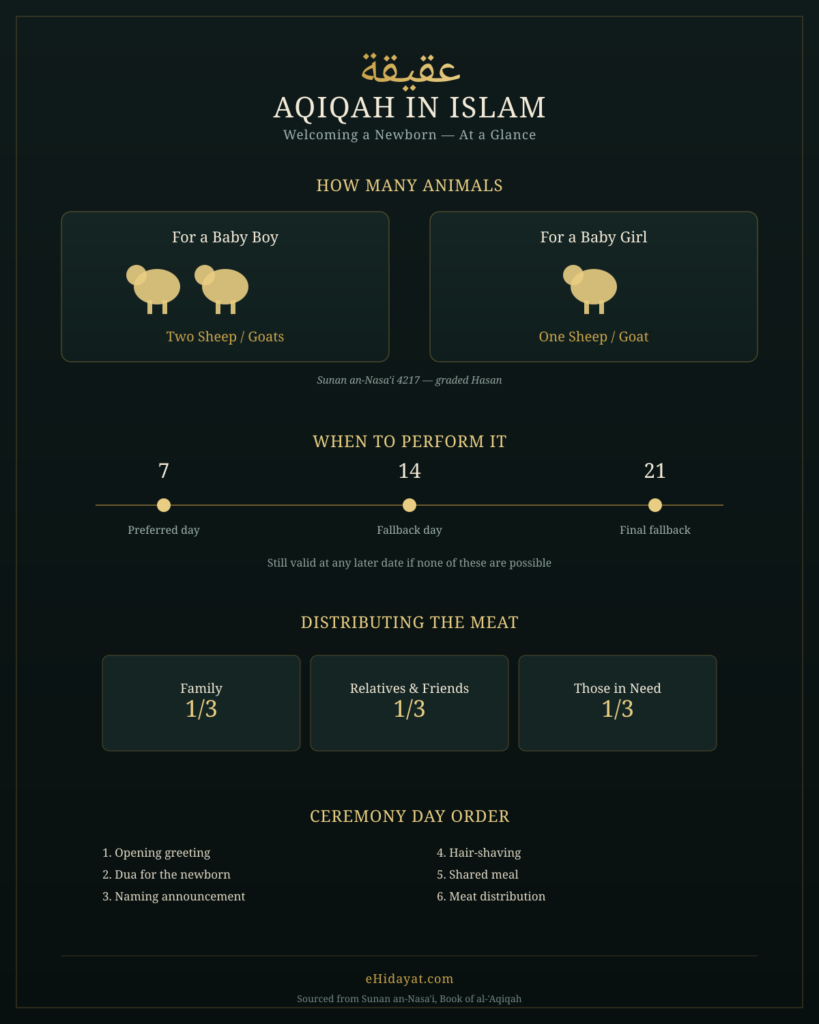
The Prophet ﷺ said, regarding a newborn boy, that blood should be shed for him and harm removed from him — a hadith recorded in Sunan an-Nasa’i (4214) and graded Sahih by Darussalam. On the specific numbers, the Prophet ﷺ was reported by Umm Kurz to have said two sheep are due for a boy and one for a girl (Sunan an-Nasa’i 4217, graded Hasan). And on timing, a hadith from Samurah ibn Jundab states that a child is “in pledge” for their Aqiqah, to be slaughtered on the seventh day, with the head shaved and a name given (Sunan an-Nasa’i 4220, graded Hasan).
Taken together, these three hadith are the backbone of nearly every ruling in this article — the animal count, the seventh-day timing, and the fact that hair-shaving and naming are bundled with the sacrifice rather than separate events. Anyone writing or teaching on this topic should verify the wording directly against Sunan an-Nasa’i, Book of al-‘Aqiqah before citing it, since hadith numbering can shift slightly between print editions.
The Wisdom Behind Aqiqah
Scholars point to a few reasons this Sunnah carries the weight it does. The most obvious is gratitude — a tangible way of thanking Allah for a child, rather than just feeling grateful privately. There’s also a protective dimension: many scholars describe Aqiqah as a means of shielding the newborn from harm, a theme that echoes the broader Islamic emphasis on protecting children from the evil eye and other harm.
There’s a third layer that’s easy to miss: Aqiqah echoes Prophet Ibrahim’s (AS) willingness to sacrifice for his son Ismail. Reading about that episode in the lives of the prophets makes the connection clearer — Aqiqah isn’t just a checklist item, it’s a small, deliberate echo of one of the most tested moments of submission in the Quran.
When Should Aqiqah Be Performed?
The seventh day after birth is preferred. Most jurists count the day of birth itself as day one, so for a baby born on a Monday, the seventh day lands the following Sunday — though Maliki jurists more often start counting from the day after birth, which shifts things by a day.
If the seventh day isn’t possible, the fourteenth or twenty-first day is the accepted fallback. And if none of those work — because of cost, travel, or circumstance — Aqiqah can still be performed later. There’s no expiry on the Sunnah, even if the earliest date carries more reward.
Can Aqiqah Be Delayed or Done as an Adult?
Yes. If a family couldn’t perform Aqiqah when a child was born — for financial or other reasons — it remains valid to do it years later, and several scholars explicitly permit an adult to perform their own Aqiqah if it was never done for them as an infant. This comes up often among converts and reverts to Islam, who sometimes choose to fulfill it themselves once they learn of the practice.
How Many Animals for Aqiqah — Boy vs. Girl
Two sheep or goats for a boy, one for a girl. This is the standard ruling, based directly on the Umm Kurz hadith cited above, and it’s followed by the overwhelming majority of scholars across all four madhhabs.
Aqiqah for a Baby Boy
The Sunnah for a boy is two sheep or goats, ideally similar in age and slaughtered around the same time. That said, this isn’t rigid: a report in Sunan Abi Dawud (2842), graded hasan by Shaykh al-Albani, has the Prophet ﷺ leaving room for a family to offer just one sheep for a boy if that’s what circumstances allow — the sacrifice still counts, it simply carries a smaller reward than the fuller two-sheep Sunnah.
Aqiqah in Islam for a Baby Girl
The Sunnah for a girl is one sheep or goat. It’s worth being direct about something new parents sometimes worry over: the difference in numbers is a matter of proportion in fiqh reasoning, not a statement about a daughter’s worth or welcome. The hadith itself — “it does not matter if they are male or female,” referring to the sheep, not the child — comes from the same narration that sets the one-sheep ruling for girls (Sunan an-Nasa’i 4217–4218, graded Hasan). Islam’s broader teaching on daughters, well-documented elsewhere in the Sunnah, treats their birth as every bit the occasion for celebration that a son’s is.
Animal Requirements
| Animal | Minimum Age | Condition |
|---|---|---|
| Goat | 1 full year | Free of illness, blindness, or broken limbs |
| Sheep | 6 full months | Free of illness, blindness, or broken limbs |
| Cattle | 2 full years | Same health conditions as above |
| Camel | 5 full years | Same health conditions as above |
These match the same conditions applied to Qurbani animals during Eid al-Adha — no coincidence, since both rulings draw on overlapping fiqh around what counts as an acceptable sacrificial animal.
How to Perform the Aqiqah: Step by Step
The Intention (Niyyah) — Is There a Specific Dua?
There’s no single dua the Prophet ﷺ is authentically reported to have prescribed for the moment of slaughter — what matters most is the intention (niyyah) that the sacrifice is being offered specifically for this child. Some families do recite a short line along these lines: “In the name of Allah, this is the Aqiqah of [child’s name],” said just before slaughter. That’s a widely used form rather than a fixed liturgical text, so treat it as a helpful convention, not a requirement you’d be lacking in worship without.
Shaving the Baby’s Hair and Naming Day
It’s Sunnah to shave the newborn’s head on the same day as the sacrifice and to formally announce the child’s name. Many families weigh the shaved hair and give its equivalent weight in silver (or the current cash value) as charity — a small, tactile way of tying the ritual to giving, not just ceremony.
Distributing the Meat
The Sunnah pattern is a three-way split: a portion kept for the immediate family, a portion for relatives and friends, and a portion given to those in need. There’s no rigid formula mandating exact thirds — some households cook and serve everything at a shared meal instead of dividing raw meat, and both approaches are accepted.
The Aqiqah Ceremony: What Actually Happens on the Day
This is the part most guides skip entirely, jumping straight from “sacrifice the animal” to “distribute the meat” without describing the actual event families gather for.
A Typical Aqiqah Program Order
Most Aqiqah gatherings, whether held at home, a mosque hall, or a rented function room, follow a loose but recognizable sequence:
- A brief opening greeting as guests arrive.
- A short dua for the newborn’s health, faith, and future.
- Formal announcement of the baby’s name.
- Hair-shaving (often done quietly, away from the main crowd, then the family rejoins the gathering).
- A short reminder or reflection — sometimes just a few words from an elder or imam.
- A shared meal.
- Distribution of meat or prepared food to those who couldn’t attend.
Families adapt this freely. Some skip the reflection entirely; others fold Aqiqah into a slightly larger event with more guests.
Hosting Etiquette Families Should Know
A few habits keep the day feeling like an act of worship rather than a competitive event. Modesty matters on both fronts that tend to get overlooked — dress and spending. Several scholars explicitly caution against turning Aqiqah into an occasion for extravagance or loud entertainment; the emphasis stays on gratitude and charity, not display. On the practical side, a simple RSVP request helps hosts plan portions without wasting food, and it’s worth being deliberate about privacy when announcing the baby’s name or photos publicly — not every family wants a newborn’s details circulating widely online.
Common Ceremony Questions
Aqiqah doesn’t need to happen at a mosque — a home gathering is just as valid, and in many communities more common. It’s also perfectly acceptable to fold the meal into a broader welcome-the-baby gathering (sometimes called a walimah in casual usage, though that term technically belongs to weddings). And yes, sharing cooked meals or portions with non-Muslim neighbors is a widely practiced, welcomed gesture of goodwill — there’s no restriction against it.
Aqiqah vs. Qurbani vs. Sadaqah
These three get conflated often enough that it’s worth laying them out side by side.
| Aspect | Aqiqah | Qurbani (Udhiyah) | Sadaqah Alone |
|---|---|---|---|
| Occasion | Birth of a child | Eid al-Adha | Any time, any reason |
| Obligation | Sunnah mu’akkadah (not wajib) | Wajib for those meeting the nisab threshold | Voluntary |
| Timing | 7th day preferred; valid any time after | 10th–13th of Dhul Hijjah only | No fixed window |
| Can it substitute for the others? | No — Aqiqah has its own distinct intention | No — cannot be replaced by Aqiqah or general charity | Encouraged alongside Aqiqah, not instead of it |
The practical takeaway sits in that last row: giving charity is always good, but it doesn’t fulfill the specific Sunnah of Aqiqah, and Aqiqah doesn’t fulfill the obligation of Qurbani. Each has its own intention attached, and Islamic law treats intention as central enough that swapping one act for another isn’t considered a like-for-like replacement.
How Much Does Aqiqah Cost?
Costs vary enormously by country and by whether a family sources the animal directly or pays a charity to handle the sacrifice on their behalf. In the United States, aid organizations report a typical range of roughly $150–200 per sheep or goat, depending on location and market conditions.
One pattern worth knowing if timing is flexible: livestock prices tend to climb in the weeks around Eid al-Adha, simply because Qurbani demand for the same animals spikes at once — Pakistani market reporting around Eid al-Adha 2026 showed goat prices moving from roughly Rs150,000 to Rs160,000 for premium animals in that window alone. A family performing Aqiqah outside that seasonal crunch, where the date allows it, will often find better prices and more available stock. Because livestock markets shift quickly and vary by city, it’s worth getting a current quote from a local supplier rather than relying on a fixed number from an article.
Frequently Asked Questions
Is Aqiqah compulsory in Islam? No. It is a confirmed Sunnah (sunnah mu’akkadah) — strongly recommended, but not obligatory. A family that cannot afford it carries no sin for not performing it.
How many animals are sacrificed for Aqiqah? Two sheep or goats for a boy and one for a girl, based on hadith graded Sahih and Hasan in Sunan an-Nasa’i. Some scholars permit one animal for a boy where two aren’t affordable.
What is the best day to perform Aqiqah? The seventh day after birth is preferred, based on the hadith describing a child as “in pledge for his Aqiqah… slaughtered on the seventh day” (Sunan an-Nasa’i 4220, graded Hasan). The 14th or 21st day, or any later date, is also valid.
Can Aqiqah be done for an adult who never had one as a child? Yes. Several scholars permit an adult, including a revert to Islam, to perform Aqiqah on their own behalf if it was never done for them.
Can Aqiqah meat be given to non-Muslim neighbors? Yes. There’s no restriction on sharing Aqiqah meat or meals with non-Muslim neighbors as a gesture of goodwill.
What’s the difference between Aqiqah and Qurbani? Aqiqah marks a child’s birth and can be performed anytime from the seventh day onward. Qurbani is tied specifically to Eid al-Adha, is obligatory for those who meet the nisab threshold, and cannot be replaced by Aqiqah or vice versa.
A note on sources: the hadith citations in this article (Sunan an-Nasa’i 4214, 4217, and 4220, and Sunan Abi Dawud 2842) were checked directly against sunnah.com and cross-referenced with fiqh rulings on IslamQA at the time of writing. Hadith numbering can vary slightly between print editions and digital collections — anyone citing these rulings elsewhere should verify the reference directly before publishing.