
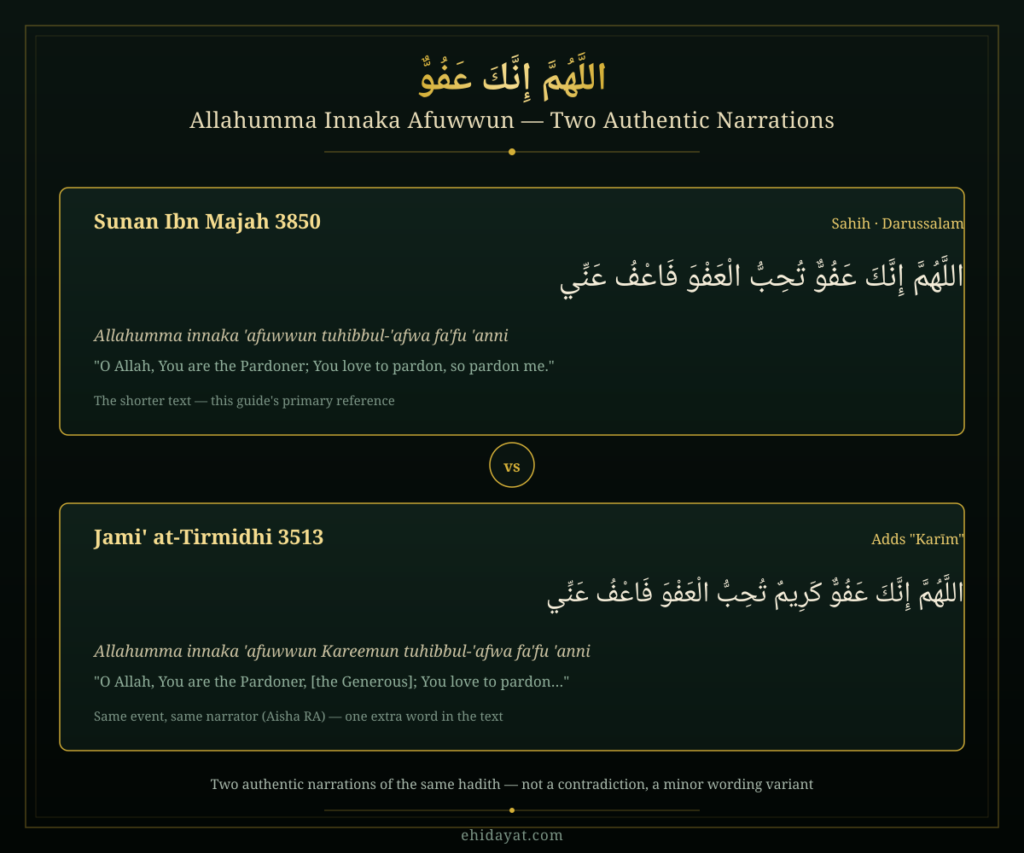
Allahumma innaka ‘afuwwun tuhibbul-‘afwa fa’fu ‘anni — means “O Allah, You are the Pardoner; You love to pardon, so pardon me.” It’s the dua the Prophet ﷺ taught his wife Aisha (RA) when she asked what to say if she ever recognized Laylatul Qadr, and it’s remained one of the most recited supplications during Ramadan’s final nights ever since. Here’s the Arabic text, where it comes from, and what to know before you recite it.
What Does Allahumma Innaka Afuwwun Mean?
Broken down, the dua reads almost like a small argument: it names one of Allah’s attributes, states what that attribute implies, then asks for exactly that.
| Arabic Word | Transliteration | Literal Meaning |
|---|---|---|
| اللَّهُمَّ | Allahumma | O Allah |
| إِنَّكَ | Innaka | Indeed, You |
| عَفُوٌّ | ‘Afuwwun | The Pardoner |
| تُحِبُّ | Tuhibbu | You love |
| الْعَفْوَ | Al-‘Afw | pardon |
| فَاعْفُ عَنِّي | Fa’fu ‘anni | so pardon me |
Nothing in that structure is wasted. First you address Allah by name — ‘Afuwwun, the Pardoner. Then you state something true about that name — He loves to pardon. Only then do you ask. It’s a small pattern, but it shows up again and again across the Quran and Sunnah: approach Allah through what you already know of Him, not just through what you need.
There’s also something worth sitting with in tuhibbu — “You love.” Not “You accept” or “You permit.” The dua doesn’t just say Allah is willing to pardon if asked correctly; it says pardoning is something He loves doing. That’s a different posture for the person making the request. You’re not trying to talk a reluctant judge into leniency. You’re asking for something the One you’re asking already wants to give.
Allahumma Innaka Afuwwun Dua in Arabic Text
اللَّهُمَّ إِنَّكَ عَفُوٌّ تُحِبُّ الْعَفْوَ فَاعْفُ عَنِّي
Allahumma innaka ‘afuwwun tuhibbul-‘afwa fa’fu ‘anni
“O Allah, You are the Pardoner; You love to pardon, so pardon me.”
Six words in Arabic, memorized in minutes, and short enough that a child or a new Muslim can hold onto it after hearing it once or twice.
The Hadith Behind This Dua — And Why the Wording Isn’t Identical Everywhere
Aisha (RA) once asked the Prophet ﷺ a direct, practical question: “O Messenger of Allah, what do you think I should say if I come upon Laylatul-Qadr?” His answer wasn’t long. He didn’t give her a lengthy prayer to memorize or a list of things to ask for. He told her to say exactly this — six words, addressed to one of Allah’s names, asking for the deepest form of forgiveness there is. That exchange is recorded in Sunan Ibn Majah, hadith 3850:
“It was narrated from Aishah that she said: ‘O Messenger of Allah, what do you think I should say in my supplication, if I come upon Laylatul-Qadr?’ He said: ‘Say: Allahumma innaka ‘afuwwun tuhibbul-‘afwa, fa’fu ‘anni.'”
This narration is graded Sahih by Darussalam — about as solid a footing as a hadith citation gets.
Here’s something worth knowing if you’ve come across slightly different versions of this dua online: the wording isn’t perfectly identical across every hadith collection that records it. Ibn Majah’s narration gives the shorter text above. Jami’ at-Tirmidhi’s version of the same event — hadith 3513 — includes one extra word in its transmitted text: Kareem (“Generous”), making it Allahumma innaka ‘afuwwun Kareemun tuhibbul-‘afwa fa’fu ‘anni. That’s not a typo floating around the internet and it’s not a mistake either version made up. Both are genuine narrations of the same moment between Aisha (RA) and the Prophet ﷺ, passed down through different chains of narrators, with one collection preserving a slightly fuller wording than the other. This kind of minor variation between authentic narrations of the same event is normal in hadith literature — it doesn’t mean one version is right and the other wrong.
Because Ibn Majah’s version carries a clean, uncomplicated Sahih grading, it’s the one this guide anchors on as the primary text. Tirmidhi’s version isn’t weaker or wrong — it’s simply a closely related narration worth knowing about rather than treating as an identical copy. If you’ve memorized the shorter version and heard someone recite it with “Kareem” added, you haven’t misremembered anything, and either version is fine to recite.
‘Afw vs Maghfirah — Why the Prophet ﷺ Chose This Exact Dua
Arabic has more than one word for forgiveness, and they don’t mean quite the same thing. Maghfirah — the more common one, the root behind Astaghfirullah — carries the sense of covering a sin. Allah shields it, spares the punishment for it, but the record of it still exists somewhere. Picture a fault that’s been forgiven but not forgotten — the relationship is intact, but the history is still there if anyone looked. ‘Afw goes a step further. It means erasure — wiping the sin out entirely, as though it had never been committed at all. Nothing left to look for.
That’s the specific request in this dua. Not “cover my sin,” but “erase it.” And it’s not a random word choice — it’s tied directly to one of Allah’s own names, Al-‘Afuww (The Pardoner), one of His 99 Names. The Quran itself pairs the idea with Allah’s acceptance of repentance directly: “And it is He who accepts repentance from His servants and pardons misdeeds” (Quran 42:25). Asking specifically for ‘afw, rather than the more general maghfirah, is asking by name for exactly what that verse describes.
Understanding what the name Al-‘Afuww means is part of understanding why this particular dua carries the weight it does. Every one of Allah’s 99 Names works this way — each one is both a description and, when you call on Him by it, a specific kind of request. ehidayat.com’s guide to the 99 Names of Allah covers Al-‘Afuww alongside the rest, if you want the fuller picture of what each name asks of you when you call on it.
When to Recite Allahumma Innaka Afuwwun
The obvious answer is Laylatul Qadr — that’s what the hadith is actually about. It falls somewhere in the last ten nights of Ramadan, most likely on one of the odd nights: the 21st, 23rd, 25th, 27th, or 29th, with many scholars leaning toward the 27th specifically. Surah Al-Qadr describes that single night as better than a thousand months — a little over 83 years — which is part of why Aisha (RA) wanted to know exactly what to say if she caught it.
But the dua isn’t fenced off to one night a year. It fits naturally into the last third of any night, when the Prophet ﷺ described Allah as drawing especially near to those who call on Him. It fits during sujud too, since that’s the position in which a servant is described as closest to their Lord. And it fits right after each of the five daily prayers, when a short, sincere line is often easier to hold onto than a long one. The hadith itself is about what to say if you recognize Laylatul Qadr — it doesn’t say the words lose their meaning the other 355 nights of the year.
How Many Times Should You Recite It?
There’s no fixed count anywhere in the hadith. Saying it once, meant sincerely, fulfills exactly what the Prophet ﷺ taught Aisha (RA) to do. Reciting it more than once — ten times, a hundred times, through the whole night — is a personal addition many people find meaningful, not a number that was ever prescribed. If you see a specific repetition count attached to this dua somewhere, treat it as someone’s personal practice rather than a hadith requirement, because that’s exactly what it is.
What actually matters more than a count, based on the hadith itself, is presence — saying the words while genuinely meaning them rather than rushing through a target number. A single unhurried recitation, said while actually thinking about what “erase this sin completely” means, does more than a hundred repetitions said on autopilot while the mind is somewhere else entirely.
Pairing This Dua With Other Forgiveness Duas
Allahumma innaka afuwwun works well on its own, but it also pairs naturally with other short istighfar duas for a fuller nightly practice — especially in the last third of the night, when several forgiveness-focused supplications tend to cluster together anyway. If you’re building out that habit, ehidayat.com’s guide to Astaghfirullah is a natural next stop — another short, memorable dua suited to the exact same moments: after prayer, before sleep, or whenever the last third of the night finds you awake.
FAQ
What does Allahumma innaka afuwwun mean? It means “O Allah, indeed You are the Pardoner (Al-‘Afuww); You love to pardon, so pardon me.” It addresses Allah by name before making the request — a structure common to many prophetic duas.
Where does this dua come from? It’s recorded in Sunan Ibn Majah (3850), graded Sahih by Darussalam. The Prophet ﷺ taught it to his wife Aisha (RA) after she asked what to say if she recognized Laylatul Qadr.
Is the Arabic text the same in every hadith collection? Almost — Ibn Majah 3850 gives the shorter text, while Jami’ at-Tirmidhi’s version (3513) includes the additional word “Kareem” (“Generous”). Both are authentic narrations of the same event with a minor wording difference, not a contradiction.
When should this dua be recited? Primarily during the last ten odd nights of Ramadan (21st, 23rd, 25th, 27th, 29th), with many scholars favoring the 27th. It’s also recited in the last third of any night, in sujud, and after the five daily prayers, and isn’t restricted to Ramadan alone.
What’s the difference between ‘afw and maghfirah? Maghfirah means Allah covers a sin and spares the punishment, while the sin stays on record. ‘Afw goes further — it asks Allah to erase the sin as though it never happened, which is why this dua specifically asks for ‘afw rather than maghfirah.
How many times should I say it? There’s no fixed number in the hadith. Saying it once with sincere presence of heart fulfills the Sunnah; reciting it repeatedly through the night is a personal practice many people add, not a prescribed count