
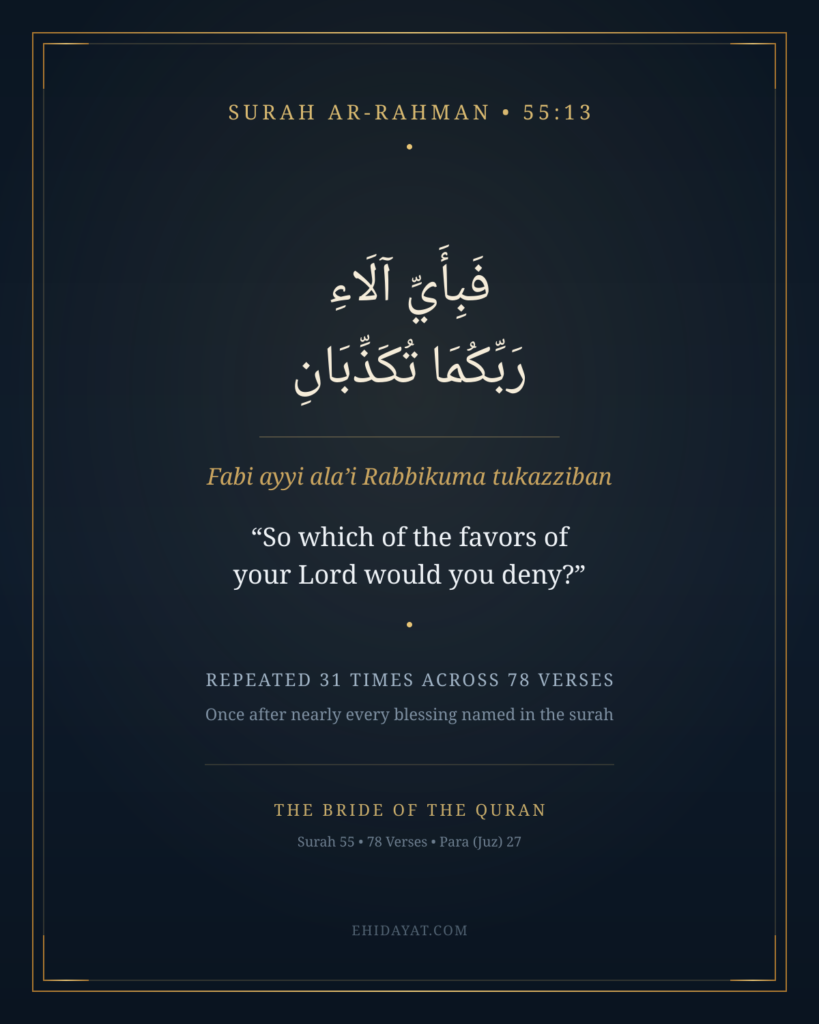
Surah Rahman is the 55th chapter of the Quran, made up of 78 verses, and it sits in Para (Juz) 27. Below you’ll find the complete Arabic text with transliteration and English translation, plus answers to the questions people actually search for: which para it’s in, whether the “Bride of the Quran” title comes from an authentic hadith, and what its famous repeated refrain actually means.
Which Para (Juz) Is Surah Rahman In?
Surah Rahman is in Para (Juz) 27. That juz begins partway through Surah Adh-Dhariyat (51:31) and runs through the end of Surah Al-Hadid (57:29), so Surah Rahman sits roughly in the middle of it, following Surah Al-Qamar and coming right before Surah Al-Waqiah. If you’re using a physical mushaf, that’s the para you’d flip to.
Surah Rahman at a Glance
| Detail | Information |
|---|---|
| Surah Number | 55 |
| Total Verses | 78 |
| Para (Juz) | 27 |
| Meccan or Medinan | Meccan, per majority scholarly opinion |
| Meaning of Name | The Most Merciful |
| Refrain | “Which of the favors of your Lord will you deny?” repeated 31 times |
| Also Known As | The Bride of the Quran |
Full Arabic Text of Surah Rahman with Translation (Verses 1 to 78)
The surah divides naturally into six movements: Allah’s blessings on creation, the meeting of the two seas, the fact that everything perishes except Allah, a warning to jinn and mankind, and finally two separate descriptions of Paradise for two different ranks of believers. Reading it section by section makes the structure click in a way that scrolling straight through 78 verses doesn’t.
Verses 1-16: The Blessings of Creation
1 الرَّحْمَٰنُ Ar-Rahman. The Most Merciful.
2 عَلَّمَ الْقُرْآنَ ‘Allamal-Qur’an. He taught the Quran.
3 خَلَقَ الْإِنسَانَ Khalaqal-insan. He created man.
4 عَلَّمَهُ الْبَيَانَ ‘Allamahul-bayan. He taught him eloquence.
5 الشَّمْسُ وَالْقَمَرُ بِحُسْبَانٍ Ash-shamsu wal-qamaru bi-husban. The sun and the moon move by precise calculation.
6 وَالنَّجْمُ وَالشَّجَرُ يَسْجُدَانِ Wan-najmu wash-shajaru yasjudan. And the stars and the trees prostrate.
7 وَالسَّمَاءَ رَفَعَهَا وَوَضَعَ الْمِيزَانَ Was-sama’a rafa’aha wa wada’al-mizan. And the heaven He raised, and He imposed the balance.
8 أَلَّا تَطْغَوْا فِي الْمِيزَانِ Alla tatghaw fil-mizan. So that you do not transgress within the balance.
9 وَأَقِيمُوا الْوَزْنَ بِالْقِسْطِ وَلَا تُخْسِرُوا الْمِيزَانَ Wa aqimul-wazna bil-qisti wa la tukhsirul-mizan. And establish weight in justice, and do not make the balance deficient.
10 وَالْأَرْضَ وَضَعَهَا لِلْأَنَامِ Wal-arda wada’aha lil-anam. And the earth He laid out for all living creatures.
11 فِيهَا فَاكِهَةٌ وَالنَّخْلُ ذَاتُ الْأَكْمَامِ Fiha fakihatun wan-nakhlu dhatul-akmam. Therein is fruit and palm trees having sheaths.
12 وَالْحَبُّ ذُو الْعَصْفِ وَالرَّيْحَانُ Wal-habbu dhul-‘asfi war-rayhan. And grain having husks, and scented plants.
13 فَبِأَيِّ آلَاءِ رَبِّكُمَا تُكَذِّبَانِ Fabi ayyi ala’i Rabbikuma tukazziban. So which of the favors of your Lord would you deny?
14 خَلَقَ الْإِنسَانَ مِن صَلْصَالٍ كَالْفَخَّارِ Khalaqal-insana min salsalin kal-fakhkhar. He created man from clay like that of pottery.
15 وَخَلَقَ الْجَانَّ مِن مَّارِجٍ مِّن نَّارٍ Wa khalaqal-janna mim-marijim-min nar. And He created the jinn from a smokeless flame of fire.
16 فَبِأَيِّ آلَاءِ رَبِّكُمَا تُكَذِّبَانِ Fabi ayyi ala’i Rabbikuma tukazziban. So which of the favors of your Lord would you deny?
Verses 17-25: The Two Seas
17 رَبُّ الْمَشْرِقَيْنِ وَرَبُّ الْمَغْرِبَيْنِ Rabbul-mashriqayni wa Rabbul-maghribayn. Lord of the two sunrises and Lord of the two sunsets.
18 فَبِأَيِّ آلَاءِ رَبِّكُمَا تُكَذِّبَانِ Fabi ayyi ala’i Rabbikuma tukazziban. So which of the favors of your Lord would you deny?
19 مَرَجَ الْبَحْرَيْنِ يَلْتَقِيَانِ Marajal-bahrayni yaltaqiyan. He released the two seas, meeting side by side.
20 بَيْنَهُمَا بَرْزَخٌ لَّا يَبْغِيَانِ Baynahuma barzakhul-la yabghiyan. Between them is a barrier, so neither of them transgresses.
21 فَبِأَيِّ آلَاءِ رَبِّكُمَا تُكَذِّبَانِ Fabi ayyi ala’i Rabbikuma tukazziban. So which of the favors of your Lord would you deny?
22 يَخْرُجُ مِنْهُمَا اللُّؤْلُؤُ وَالْمَرْجَانُ Yakhruju minhumal-lu’lu’u wal-marjan. From both of them emerge pearl and coral.
23 فَبِأَيِّ آلَاءِ رَبِّكُمَا تُكَذِّبَانِ Fabi ayyi ala’i Rabbikuma tukazziban. So which of the favors of your Lord would you deny?
24 وَلَهُ الْجَوَارِ الْمُنشَآتُ فِي الْبَحْرِ كَالْأَعْلَامِ Wa lahul-jawaril-munsha’atu fil-bahri kal-a’lam. And to Him belong the ships with sails raised up in the sea like mountains.
25 فَبِأَيِّ آلَاءِ رَبِّكُمَا تُكَذِّبَانِ Fabi ayyi ala’i Rabbikuma tukazziban. So which of the favors of your Lord would you deny?
Verses 26-30: What Remains When Everything Else Is Gone
26 كُلُّ مَنْ عَلَيْهَا فَانٍ Kullu man ‘alayha fan. Everyone upon the earth will perish.
27 وَيَبْقَىٰ وَجْهُ رَبِّكَ ذُو الْجَلَالِ وَالْإِكْرَامِ Wa yabqa wajhu Rabbika dhul-jalali wal-ikram. And there will remain the Face of your Lord, Owner of Majesty and Honor.
28 فَبِأَيِّ آلَاءِ رَبِّكُمَا تُكَذِّبَانِ Fabi ayyi ala’i Rabbikuma tukazziban. So which of the favors of your Lord would you deny?
29 يَسْأَلُهُ مَن فِي السَّمَاوَاتِ وَالْأَرْضِ كُلَّ يَوْمٍ هُوَ فِي شَأْنٍ Yas’aluhu man fis-samawati wal-ard, kulla yawmin huwa fi sha’n. Whoever is within the heavens and earth asks Him. Every day He is bringing about a matter.
30 فَبِأَيِّ آلَاءِ رَبِّكُمَا تُكَذِّبَانِ Fabi ayyi ala’i Rabbikuma tukazziban. So which of the favors of your Lord would you deny?
Verses 31-45: A Warning to Jinn and Mankind
31 سَنَفْرُغُ لَكُمْ أَيُّهَ الثَّقَلَانِ Sanafrughu lakum ayyuhas-saqalan. We will attend to you, O prominent beings.
32 فَبِأَيِّ آلَاءِ رَبِّكُمَا تُكَذِّبَانِ Fabi ayyi ala’i Rabbikuma tukazziban. So which of the favors of your Lord would you deny?
33 يَا مَعْشَرَ الْجِنِّ وَالْإِنسِ إِنِ اسْتَطَعْتُمْ أَن تَنفُذُوا مِنْ أَقْطَارِ السَّمَاوَاتِ وَالْأَرْضِ فَانفُذُوا لَا تَنفُذُونَ إِلَّا بِسُلْطَانٍ Ya ma’sharal-jinni wal-insi inis-tata’tum an tanfudhu min aqtaris-samawati wal-ardi fanfudhu, la tanfudhuna illa bi-sultan. O company of jinn and mankind, if you are able to pass beyond the regions of the heavens and the earth, then pass. You will not pass except by authority from Allah.
34 فَبِأَيِّ آلَاءِ رَبِّكُمَا تُكَذِّبَانِ Fabi ayyi ala’i Rabbikuma tukazziban. So which of the favors of your Lord would you deny?
35 يُرْسَلُ عَلَيْكُمَا شُوَاظٌ مِّن نَّارٍ وَنُحَاسٌ فَلَا تَنتَصِرَانِ Yursalu ‘alaykuma shuwadhum-min nariw-wa nuhasun fala tantasiran. There will be sent upon you a flame of fire and smoke, and you will not be able to defend yourselves.
36 فَبِأَيِّ آلَاءِ رَبِّكُمَا تُكَذِّبَانِ Fabi ayyi ala’i Rabbikuma tukazziban. So which of the favors of your Lord would you deny?
37 فَإِذَا انشَقَّتِ السَّمَاءُ فَكَانَتْ وَرْدَةً كَالدِّهَانِ Fa idhan-shaqqatis-sama’u fakanat wardatan kad-dihan. And when the heaven is split open and becomes rose colored like oil.
38 فَبِأَيِّ آلَاءِ رَبِّكُمَا تُكَذِّبَانِ Fabi ayyi ala’i Rabbikuma tukazziban. So which of the favors of your Lord would you deny?
39 فَيَوْمَئِذٍ لَّا يُسْأَلُ عَن ذَنبِهِ إِنسٌ وَلَا جَانٌّ Fa yawma’idhil-la yus’alu ‘an dhanbihi insun wa la jann. Then on that Day none will be asked about his sin, neither man nor jinn.
40 فَبِأَيِّ آلَاءِ رَبِّكُمَا تُكَذِّبَانِ Fabi ayyi ala’i Rabbikuma tukazziban. So which of the favors of your Lord would you deny?
41 يُعْرَفُ الْمُجْرِمُونَ بِسِيمَاهُمْ فَيُؤْخَذُ بِالنَّوَاصِي وَالْأَقْدَامِ Yu’raful-mujrimuna bi-simahum fa yu’khadhu bin-nawasi wal-aqdam. The criminals will be known by their marks, and they will be seized by the forelocks and the feet.
42 فَبِأَيِّ آلَاءِ رَبِّكُمَا تُكَذِّبَانِ Fabi ayyi ala’i Rabbikuma tukazziban. So which of the favors of your Lord would you deny?
43 هَٰذِهِ جَهَنَّمُ الَّتِي يُكَذِّبُ بِهَا الْمُجْرِمُونَ Hadhihi jahannamul-lati yukadhdhibu bihal-mujrimun. This is Hell, which the criminals deny.
44 يَطُوفُونَ بَيْنَهَا وَبَيْنَ حَمِيمٍ آنٍ Yatufuna baynaha wa bayna hamimin an. They will circulate between it and scalding water, heated to the utmost degree.
45 فَبِأَيِّ آلَاءِ رَبِّكُمَا تُكَذِّبَانِ Fabi ayyi ala’i Rabbikuma tukazziban. So which of the favors of your Lord would you deny?
Verses 46-61: The First Two Gardens
46 وَلِمَنْ خَافَ مَقَامَ رَبِّهِ جَنَّتَانِ Wa liman khafa maqama Rabbihi jannatan. But for he who has feared the position of his Lord are two gardens.
47 فَبِأَيِّ آلَاءِ رَبِّكُمَا تُكَذِّبَانِ Fabi ayyi ala’i Rabbikuma tukazziban. So which of the favors of your Lord would you deny?
48 ذَوَاتَا أَفْنَانٍ Dhawata afnan. Having spreading branches.
49 فَبِأَيِّ آلَاءِ رَبِّكُمَا تُكَذِّبَانِ Fabi ayyi ala’i Rabbikuma tukazziban. So which of the favors of your Lord would you deny?
50 فِيهِمَا عَيْنَانِ تَجْرِيَانِ Fihima ‘aynani tajriyan. In both of them are two springs, flowing.
51 فَبِأَيِّ آلَاءِ رَبِّكُمَا تُكَذِّبَانِ Fabi ayyi ala’i Rabbikuma tukazziban. So which of the favors of your Lord would you deny?
52 فِيهِمَا مِن كُلِّ فَاكِهَةٍ زَوْجَانِ Fihima min kulli fakihatin zawjan. In both of them are two kinds of every fruit.
53 فَبِأَيِّ آلَاءِ رَبِّكُمَا تُكَذِّبَانِ Fabi ayyi ala’i Rabbikuma tukazziban. So which of the favors of your Lord would you deny?
54 مُتَّكِئِينَ عَلَىٰ فُرُشٍ بَطَائِنُهَا مِنْ إِسْتَبْرَقٍ وَجَنَى الْجَنَّتَيْنِ دَانٍ Muttaki’ina ‘ala furushim bata’inuha min istabraq, wa janal-jannatayni dan. Reclining on beds whose linings are of silk brocade, and the fruit of the two gardens is hanging low.
55 فَبِأَيِّ آلَاءِ رَبِّكُمَا تُكَذِّبَانِ Fabi ayyi ala’i Rabbikuma tukazziban. So which of the favors of your Lord would you deny?
56 فِيهِنَّ قَاصِرَاتُ الطَّرْفِ لَمْ يَطْمِثْهُنَّ إِنسٌ قَبْلَهُمْ وَلَا جَانٌّ Fihinna qasiratut-tarfi lam yatmithhunna insun qablahum wa la jann. In them are women limiting their glances, untouched before them by man or jinni.
57 فَبِأَيِّ آلَاءِ رَبِّكُمَا تُكَذِّبَانِ Fabi ayyi ala’i Rabbikuma tukazziban. So which of the favors of your Lord would you deny?
58 كَأَنَّهُنَّ الْيَاقُوتُ وَالْمَرْجَانُ Ka’annahunnal-yaqutu wal-marjan. As if they were rubies and coral.
59 فَبِأَيِّ آلَاءِ رَبِّكُمَا تُكَذِّبَانِ Fabi ayyi ala’i Rabbikuma tukazziban. So which of the favors of your Lord would you deny?
60 هَلْ جَزَاءُ الْإِحْسَانِ إِلَّا الْإِحْسَانُ Hal jaza’ul-ihsani illal-ihsan. Is the reward for good anything but good?
61 فَبِأَيِّ آلَاءِ رَبِّكُمَا تُكَذِّبَانِ Fabi ayyi ala’i Rabbikuma tukazziban. So which of the favors of your Lord would you deny?
Verses 62-78: The Second Two Gardens
62 وَمِن دُونِهِمَا جَنَّتَانِ Wa min dunihima jannatan. And below them both are two other gardens.
63 فَبِأَيِّ آلَاءِ رَبِّكُمَا تُكَذِّبَانِ Fabi ayyi ala’i Rabbikuma tukazziban. So which of the favors of your Lord would you deny?
64 مُدْهَامَّتَانِ Mudhammataan. Dark green in color.
65 فَبِأَيِّ آلَاءِ رَبِّكُمَا تُكَذِّبَانِ Fabi ayyi ala’i Rabbikuma tukazziban. So which of the favors of your Lord would you deny?
66 فِيهِمَا عَيْنَانِ نَضَّاخَتَانِ Fihima ‘aynani naddakhataan. In both of them are two springs, spouting.
67 فَبِأَيِّ آلَاءِ رَبِّكُمَا تُكَذِّبَانِ Fabi ayyi ala’i Rabbikuma tukazziban. So which of the favors of your Lord would you deny?
68 فِيهِمَا فَاكِهَةٌ وَنَخْلٌ وَرُمَّانٌ Fihima fakihatun wa nakhlun wa rumman. In both of them are fruit, palm trees, and pomegranates.
69 فَبِأَيِّ آلَاءِ رَبِّكُمَا تُكَذِّبَانِ Fabi ayyi ala’i Rabbikuma tukazziban. So which of the favors of your Lord would you deny?
70 فِيهِنَّ خَيْرَاتٌ حِسَانٌ Fihinna khayratun hisan. In them are good and beautiful women.
71 فَبِأَيِّ آلَاءِ رَبِّكُمَا تُكَذِّبَانِ Fabi ayyi ala’i Rabbikuma tukazziban. So which of the favors of your Lord would you deny?
72 حُورٌ مَّقْصُورَاتٌ فِي الْخِيَامِ Hurum-maqsuratun fil-khiyam. Fair ones reserved in pavilions.
73 فَبِأَيِّ آلَاءِ رَبِّكُمَا تُكَذِّبَانِ Fabi ayyi ala’i Rabbikuma tukazziban. So which of the favors of your Lord would you deny?
74 لَمْ يَطْمِثْهُنَّ إِنسٌ قَبْلَهُمْ وَلَا جَانٌّ Lam yatmithhunna insun qablahum wa la jann. Untouched before them by man or jinni.
75 فَبِأَيِّ آلَاءِ رَبِّكُمَا تُكَذِّبَانِ Fabi ayyi ala’i Rabbikuma tukazziban. So which of the favors of your Lord would you deny?
76 مُتَّكِئِينَ عَلَىٰ رَفْرَفٍ خُضْرٍ وَعَبْقَرِيٍّ حِسَانٍ Muttaki’ina ‘ala rafrafin khudriw-wa ‘abqariyyin hisan. Reclining on green cushions and beautiful fine carpets.
77 فَبِأَيِّ آلَاءِ رَبِّكُمَا تُكَذِّبَانِ Fabi ayyi ala’i Rabbikuma tukazziban. So which of the favors of your Lord would you deny?
78 تَبَارَكَ اسْمُ رَبِّكَ ذِي الْجَلَالِ وَالْإِكْرَامِ Tabarakasmu Rabbika dhil-jalali wal-ikram. Blessed is the name of your Lord, Owner of Majesty and Honor.
Is Surah Rahman Meccan or Medinan?
Meccan. That’s the majority position, and it’s not a close call among classical scholars. Ibn Ashur summed up the scholarly consensus plainly in al-Tahrir wal-Tanwir, describing it as agreed upon by the majority. Companions who reported on it directly, including Ibn Abbas and Ibn Mas’ud, along with early scholars like Mujahid and Ata, held the same view.
You’ll still see pages online (including some that rank well) describe it as majority-Medinan. That’s backwards. The confusion seems to trace back to a handful of weak narrations, plus the fact that verse 43 is sometimes singled out as a possible later addition. But the surah as a whole, its short punchy verses, the poetic rhythm, the address to jinn alongside mankind, reads like classic Meccan revelation, and that’s how the people closest to the source described it.
Fact-Check: Is the “Bride of the Quran” Hadith Authentic?
No, not in the form it’s usually repeated. The narration attributed to Sayyiduna Ali (may Allah be pleased with him), “Everything has a bride, and the bride of the Quran is Surah Ar-Rahman,” was recorded by Imam Bayhaqi in Shu’ab al-Iman, hadith number 2265. It gets quoted constantly online as if that settles the matter.
It doesn’t. Sheikh Al-Albani examined the chain and graded it munkar, meaning odd or rejected, in Silsilat al-Ahaadeeth ad-Da’ifah, hadith 1350. That’s not a borderline “weak but usable” grading. It’s a narration the science of hadith says shouldn’t be attributed to the Prophet ﷺ at all. Ibn al-Qayyim went further in Al-Manar al-Munif, stating he found no reliable evidence establishing any specific virtue tied to reciting this particular surah.
So where does that leave the nickname? Honestly, still in wide use, and there’s nothing wrong with that. The surah’s beauty, its rhythm, its vivid description of Paradise, all of that is real and doesn’t need a shaky hadith to justify it. What matters is not repeating the line as though the Prophet ﷺ said it. If you’re writing or teaching about Surah Rahman, “it’s popularly known as the Bride of the Quran” is accurate. “The Prophet ﷺ called it the Bride of the Quran” isn’t, at least not on evidence that holds up. For a fuller breakdown of how hadith grading works and why it matters here, IslamQA has a solid explainer that covers this exact narration.
The Refrain: “Which of the Favors of Your Lord Will You Deny?”
Fabi ayyi ala’i Rabbikuma tukazziban shows up 31 times across the surah’s 78 verses. That’s not incidental repetition. Each time, it follows directly after a specific blessing gets named: the Quran itself, the balance of the cosmos, the two seas, the gardens of Paradise, even the description of Hellfire. The effect builds. By the time you’re a third of the way through, denying even one of these favors starts to feel absurd, and that’s the point.
Notice the dual form too. Rabbikuma, “your Lord” (dual), addresses two groups at once, humans and jinn, which lines up with the earlier verse naming both directly (“O company of jinn and mankind”). Surah Rahman is the only chapter in the Quran that speaks to both audiences this explicitly, verse after verse.
What Does Ar-Rahman Mean?
Ar-Rahman means “The Most Merciful.” It’s one of Allah’s 99 Beautiful Names, and it’s significant enough that it opens nearly every surah in the Quran as part of the Bismillah. If you want to see how it fits alongside the other 98 names, along with their meanings, we’ve put together a full breakdown here.
Unlike Ar-Raheem, which is often described as mercy specifically for believers, Ar-Rahman is understood as mercy that extends to all of creation, believer and disbeliever alike, in this world. That distinction is actually reflected in how the surah reads: it opens by listing blessings given to everyone (the sun, the moon, speech, sustenance) before narrowing later to what’s reserved specifically for the righteous.
Themes and Structure of Surah Rahman
| Verse Range | Theme |
|---|---|
| 1-16 | Allah’s blessings on creation: the Quran, speech, the cosmos, the earth’s provisions |
| 17-25 | Signs in nature: the two seas that meet without merging, pearls, coral, ships |
| 26-30 | Everyone perishes; only Allah’s Face remains |
| 31-45 | A direct warning to jinn and mankind, plus a description of Hellfire |
| 46-61 | The first two gardens of Paradise, for those who feared standing before their Lord |
| 62-78 | The second two gardens, described in slightly less grandeur than the first |
That last detail is worth pausing on. Most readers assume all four gardens described in verses 46 through 78 are identical. They’re not. Classical commentators note the first pair (verses 46-61) is described with richer, more elaborate language than the second pair (verses 62-78), reflecting two distinct ranks among the righteous rather than one uniform reward.
Benefits of Reading Surah Rahman: What’s Verified and What Isn’t
Some benefits here are solidly grounded. Others aren’t, and it’s worth knowing the difference before you repeat either.
What holds up:
- The general reward for reciting any portion of the Quran applies here. The well-known hadith that each letter recited earns a multiplied reward covers Surah Rahman like any other surah.
- The surah’s structure, blessing after blessing followed by the same rhetorical challenge, makes it genuinely effective for cultivating gratitude. You don’t need a special hadith to explain why; the repetition does the work on its own.
- Its extended, vivid description of Paradise is one of the most detailed in the entire Quran, which makes it a natural surah to turn to for reflection on the Hereafter.
What doesn’t:
- Claims that reciting Surah Rahman has specific healing effects on physical illness, cancer and diabetes are two you’ll actually find floating around online, have no hadith backing them. None. If a page presents this as established fact, it’s repeating a folk claim, not an authenticated teaching.
- Specific numbered rewards attached to reciting it at particular times (“recite it once and receive X”) almost always trace back to the same weak or fabricated narrations discussed in the fact-check section above.
If you’re memorizing it, one practical tip: because the refrain repeats so often, break the surah into its six thematic sections rather than memorizing straight through. It’s far easier to lock in “the two gardens” as a block than to memorize 78 individual verse numbers.
When to Read Surah Rahman
There’s no fabricated-hadith shortcut here, just general practice grounded in how Muslims commonly approach Quran recitation. Many read it after Fajr, when the house is quiet and there’s a natural moment for reflection before the day picks up. Friday recitation is common too, though that’s tied to the general Sunnah of increased Quran reading on Jumu’ah rather than anything specific to this surah. Beyond that, it’s a surah people naturally return to during hard stretches, not because of a promised reward, but because dwelling on 31 reminders of what you’ve been given tends to reset your perspective regardless of the day of the week.
Frequently Asked Questions
Which para (Juz) is Surah Rahman in? Surah Rahman is in Para (Juz) 27, which spans from Surah Adh-Dhariyat (51:31) through the end of Surah Al-Hadid (57:29).
Is the “Bride of the Quran” hadith about Surah Rahman authentic? No. The narration was graded munkar (odd, rejected) by Al-Albani in Silsilat al-Ahaadeeth ad-Da’ifah, hadith 1350. The title is widely used but shouldn’t be attributed to the Prophet ﷺ as an authenticated statement.
Is Surah Rahman Meccan or Medinan? Meccan, per the majority of classical scholars, including Ibn Abbas and Ibn Mas’ud. Some sources online claim the majority view is Medinan; that’s inaccurate.
How many times is the refrain repeated in Surah Rahman? 31 times. The phrase is “Fabi ayyi ala’i Rabbikuma tukazziban,” meaning “So which of the favors of your Lord would you deny?”
How many verses (ayat) does Surah Rahman have? 78 verses.
What does “Ar-Rahman” mean? “The Most Merciful.” It’s one of Allah’s 99 Beautiful Names and describes mercy extended to all of creation, not just believers.
When is the best time to read Surah Rahman? There’s no specific hadith mandating a particular time. Common practice includes after Fajr and on Fridays, though these are general habits rather than requirements tied to this specific surah.
Does Surah Rahman cure diseases like cancer or diabetes? No authentic hadith makes this claim. It’s a folk belief that circulates online without any grounding in the Sunnah, and it shouldn’t be presented as established fact.
For more on the surahs that pair well with daily reflection, Ayatul Kursi is another verse worth having memorized alongside this one