
Surah Duha with Urdu Translation and Benefits (Surah 93)
Surah Duha is one of the shortest chapters in the Quran, just 11 ayat, and also one of the most personal. It wasn’t revealed to teach a law or settle a dispute. It was revealed to comfort one grieving man. Below you’ll find the full Arabic text with Urdu translation, the authentic hadith background behind it, and its real, hadith-grounded benefits — along with a plain look at which popular “wazifa” claims about this surah actually hold up.
Surah Duha Kya Hai? (Quick Overview)
Surah Duha (“The Morning Brightness”) is the 93rd surah of the Quran, revealed in Makkah, and it takes its name from the very first word — ad-duha, the forenoon light. It sits in Juz 30, the last part of the Quran, and it’s almost always mentioned in the same breath as the surah right after it, Surah Alam Nashrah — more on why below.
| Attribute | Detail |
|---|---|
| Name meaning | “The Morning Brightness” / Chasht ka waqt |
| Classification | Makki (revealed in Makkah) |
| Position | Surah 93, Juz 30 |
| No. of verses | 11 |
| Often paired with | Surah Alam Nashrah (94) |
Eleven ayat, forty-odd words in Arabic — short enough to memorize in a sitting, but the weight of it comes from what was happening when it came down.
Shan-e-Nuzool — Surah Duha Kab Aur Kyun Nazil Hui?
For a stretch of time early in his mission, the Prophet ﷺ stopped receiving revelation. Not for a symbolic day or two in the retellings — long enough that he began to worry something was wrong. Jibril, who used to come regularly, simply didn’t come. Scholars call this period Fatrat al-Wahy, the pause in revelation.
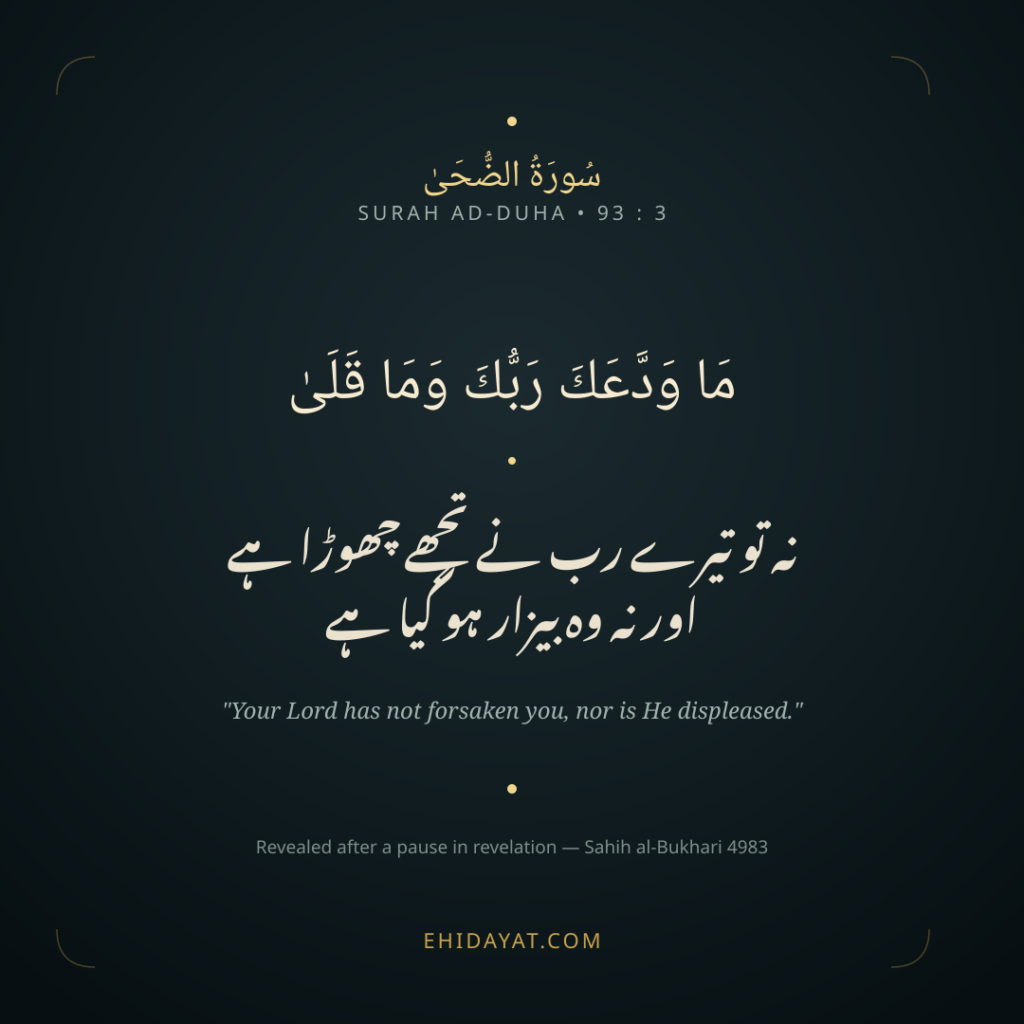
The disbelievers in Makkah noticed. And they didn’t miss the opportunity. According to the hadith narrated by Jundub, the Prophet ﷺ had also fallen ill during this stretch and was unable to rise for a night or two of prayer. A woman came to him and said, “O Muhammad, I don’t see anything except that your Satan has left you” — meaning she believed the silence was rejection, not a pause. Commentary identifies her as Umm Jamil, the wife of Abu Lahab. This full account is recorded in Sahih al-Bukhari 4983, and it’s worth reading directly rather than taking secondhand — it names the narrator, the circumstance, and the exact wording of the taunt.
That’s the moment Surah Duha answers. Not with a lecture. With a direct, almost tender correction: your Lord has not forsaken you. The first two ayat swear by the morning light and the settling night — day and darkness, both under Allah’s control, both temporary in their own way. Then comes the reassurance itself, and after it, a promise: what comes next will be better than what came before.
There’s a detail worth sitting with here. Allah didn’t just deny the accusation. He answered it by reminding the Prophet ﷺ of three concrete things already true in his life — an orphan given shelter, a wanderer given guidance, a poor man made self-sufficient. The response to “you’ve been abandoned” wasn’t an abstract promise. It was a receipt.
Surah Duha Arabic Text with Urdu Translation (Ayat by Ayat)
Here’s the full surah, Arabic alongside Urdu. Translation below is Muhammad Junagarhi’s — one of the more widely used Urdu renderings, so you can cross-check it against a mushaf you already trust.
| Ayat | Arabic Text | Urdu Translation |
|---|---|---|
| 1 | وَٱلضُّحَىٰ | قسم ہے چاشت کے وقت کی |
| 2 | وَٱلَّيْلِ إِذَا سَجَىٰ | اور قسم ہے رات کی جب چھا جائے |
| 3 | مَا وَدَّعَكَ رَبُّكَ وَمَا قَلَىٰ | نہ تو تیرے رب نے تجھے چھوڑا ہے اور نہ وہ بیزار ہو گیا ہے |
| 4 | وَلَلْآخِرَةُ خَيْرٌ لَّكَ مِنَ ٱلْأُولَىٰ | یقیناً تیرے لئے انجام آغاز سے بہتر ہوگا |
| 5 | وَلَسَوْفَ يُعْطِيكَ رَبُّكَ فَتَرْضَىٰ | تجھے تیرا رب بہت جلد (انعام) دے گا اور تو راضی ہو جائے گا |
| 6 | أَلَمْ يَجِدْكَ يَتِيمًا فَآوَىٰ | کیا اس نے تجھے یتیم پا کر جگہ نہیں دی |
| 7 | وَوَجَدَكَ ضَالًّا فَهَدَىٰ | اور تجھے راہ بھولا پا کر ہدایت نہیں دی |
| 8 | وَوَجَدَكَ عَائِلًا فَأَغْنَىٰ | اور تجھے نادار پاکر تونگر نہیں بنا دیا |
| 9 | فَأَمَّا ٱلْيَتِيمَ فَلَا تَقْهَرْ | پس یتیم پر تو بھی سختی نہ کیا کر |
| 10 | وَأَمَّا ٱلسَّآئِلَ فَلَا تَنْهَرْ | اور نہ سوال کرنے والے کو ڈانٹ ڈپٹ |
| 11 | وَأَمَّا بِنِعْمَةِ رَبِّكَ فَحَدِّثْ | اور اپنے پروردگار کی نعمتوں کا بیان کرتے رہنا |
Notice the shape of it. Ayat 1–5 are Allah speaking directly to the Prophet ﷺ — reassurance, then promise. Ayat 6–8 are evidence, three past favors laid out one after another. Ayat 9–11 flip the direction entirely: now it’s the Prophet ﷺ being told what to do with all of that — be gentle with orphans, don’t turn away the one who asks, and talk about what Allah has given you rather than staying quiet about it.
Surah Duha Ke Fazail Aur Fawaid (Real, Hadith-Grounded Benefits)
A lot of what circulates online about this surah’s “benefits” is disconnected from the actual verses. Here’s what the surah itself — read plainly, ayat by ayat — actually offers.
Ummeed Aur Sukoon Ka Paighaam (Hope and Comfort)
Ayat 3 to 5 exist for exactly one situation: the moment you start believing that silence from Allah means you’ve been written off. That belief is common — after an unanswered dua, a long stretch of hardship, a prayer that seems to go nowhere. Surah Duha’s answer isn’t “be patient” in the abstract. It’s a direct statement: you have not been abandoned, and what’s ahead is better than what’s behind. Reciting or reflecting on these three ayat specifically during a hard stretch isn’t a folk remedy — it’s applying the verse to the exact situation it was revealed for.
Allah Ki Nemuton Ka Shukr (Gratitude for Allah’s Past Favors)
Ayat 6 to 8 do something easy to miss on a fast read: they don’t ask the Prophet ﷺ to imagine future blessings, they point backward. You were an orphan and given shelter. You were lost and given direction. You were poor and made self-sufficient. The benefit here is a practical one — it’s a template for gratitude that starts by naming specific things, not vague thankfulness. Try the same exercise with your own life before moving past this section: name three concrete things, not a general “alhamdulillah for everything.”
Yateemon Aur Zaroratmandon Ka Khayal (Care for Orphans and the Needy)
The last three ayat turn outward. Because you were shown mercy, don’t be harsh with the orphan. Because you were once in need, don’t turn away the one who asks. This is the part of the surah that gets skipped most often in “benefits” lists, probably because it’s not about the reader’s own comfort — it’s an instruction. But it’s arguably the most concrete, actionable part of the whole surah: specific behavior, tied directly to a specific personal history.
Wazifa Ki Riwayat Aur Un Ki Haqiqat
You’ll find claims across the internet that reciting Surah Duha a set number of times after Fajr guarantees increased rizq, resolves marriage difficulties, or protects against illness. None of that comes with a hadith attached — and after checking, none of the widely repeated versions of these claims trace back to Sahih al-Bukhari, Sahih Muslim, or any of the other major collections.
That doesn’t mean the surah has no virtue. It means the virtue is in the message, not in a numbered ritual. Scholars who’ve written on this surah point to what it actually says — the reassurance, the gratitude, the instruction to care for orphans and beggars — as the substance of its benefit. Turning it into a formula (“recite three times for financial relief”) swaps a meaning-based practice for a superstition-shaped one, and that’s worth being honest about rather than repeating uncritically.
If you’re going through a hard time, reciting Surah Duha with the intent of reflecting on ayat 3–5 is grounded in what the surah is actually saying. Reciting it a specific number of times expecting a specific worldly outcome isn’t — and treating the two as equivalent does a disservice to the surah’s actual message.
Surah Duha Aur Surah Alam Nashrah Ka Talluq
Surah Duha almost never appears alone in classical commentary — it’s read alongside the surah that immediately follows it, Surah Alam Nashrah. Some scholars have gone as far as treating them as a single continuous unit, occasionally recited without the bismillah separating them, because the second surah picks up exactly where the first leaves off: after establishing that hardship isn’t abandonment, Surah Alam Nashrah delivers the line that’s become one of the most quoted in the entire Quran — that with hardship comes ease.
Many people recite the two together in salah for this reason. If Surah Duha is the reassurance, Surah Alam Nashrah is the follow-through — worth reading immediately after, rather than treating this surah as complete on its own.
Surah Duha Kab Aur Kaise Parhein?
There’s no obligatory time attached to this surah — no hadith says it must be recited at a specific hour for it to count. What’s actually recommended is simpler: read it in salah, particularly in the sunnah or nafl rakat where shorter surahs are common, and read it whenever you need the reminder it was revealed to give. Some people keep it in rotation during Witr or after Fajr; others turn to it specifically on the days it feels most relevant — after a setback, during a long wait for something to change.
The one thing worth avoiding is turning “when to read it” into a rulebook. Read it with the meaning in mind, and the timing takes care of itself.
FAQs
Surah Duha kis Para mein hai? Surah Duha Quran ke 30th Para (Juz Amma) mein hai. Yeh Quran ki 93rd surah hai aur ismein 11 ayat hain.
Surah Duha mein kitni ayat hain? Surah Duha mein total 11 ayat hain, aur yeh ek Makki surah hai.
Surah Duha kab aur kyun nazil hui thi? Surah Duha us waqt nazil hui jab Nabi ﷺ par revelation kuch waqt ke liye ruk gayi thi aur aap ﷺ ko taklif thi. Sahih al-Bukhari (4983) ke mutabiq, ek aurat ke taane ke jawab mein Allah ne yeh surah nazil farmayi, yeh yaqeen dilate hue ke Allah ne apne Nabi ko nahi chhoda.
Surah Duha ka tarjuma kya hai? Surah Duha mein Allah subah ki roshni aur raat ki qasam khakar Nabi ﷺ ko yaqeen dilate hain ke unhein chhoda nahi gaya, aur aage aane wala waqt pehle se behtar hoga.
Kya Surah Duha parhne se rizq mein izafa hota hai? Iske liye koi sahih hadith mojood nahi jo ek mukarrar tadaad ya guaranteed dunyavi natija bataye. Surah ka asal paigham sabr, shukr aur Allah par bharosa hai — isi ko buniyad banakar padhna chahiye, na ke ek formula ki tarah.
Surah Duha aur Surah Alam Nashrah mein kya talluq hai? Dono surahein aksar sath parhi jati hain aur ek hi paigham ko continue karti hain — mushkil ke baad asaani. Surah Alam Nashrah ke fawaid yahan padhein.
Surah Duha kis waqt parhna behtar hai? Koi mukarrar waqt farz nahi, lekin ise roz salah mein ya subah ke waqt parhna aam practice hai, khaas taur par jab dil ko sukoon ki zaroorat ho.
Surah Duha ka doosra naam kya hai? Isay Ad-Duha bhi kaha jata hai, jiska matlab hai “Chasht ka waqt” ya “The Morning Brightness.