
Have you ever been in a moment so heavy that you didn’t even have the words to pray properly — just a short phrase that came out on its own? For most Muslims, that phrase is la hawla wala quwwata illa billah. It’s six words, said in a breath, and it carries centuries of scholars, companions, and ordinary people leaning on it in exactly that kind of moment.
This page covers the full meaning of la hawla wala quwwata illa billah in Urdu and English, its Arabic word-by-word breakdown, the hadith it comes from, and — since the two are often searched together and just as often confused — how it’s different from the related phrase Mashallah la quwwata illa billah.
What Does “La Hawla Wala Quwwata Illa Billah” Mean?
La hawla wala quwwata illa billah means “There is no power and no strength except with Allah.” It’s a declaration that a person cannot avoid harm, and cannot do good, except through Allah’s help — a short admission of complete dependence on Him.
Arabic Text, Transliteration & Word-by-Word Meaning
Short form: لَا حَوْلَ وَلَا قُوَّةَ إِلَّا بِاللَّهِ Lā ḥawla wa lā quwwata illā billāh
Extended form (adding two of Allah’s names): لَا حَوْلَ وَلَا قُوَّةَ إِلَّا بِاللَّهِ الْعَلِيِّ الْعَظِيمِ Lā ḥawla wa lā quwwata illā billāhil-ʿAliyyil-ʿAẓīm — “There is no power and no strength except with Allah, the Most High, the Most Great.”
| Arabic Word | Transliteration | Meaning |
|---|---|---|
| لَا | Lā | No |
| حَوْلَ | Ḥawl | Power to change or move from one state to another |
| وَلَا | Wa lā | And no |
| قُوَّةَ | Quwwah | Strength, ability |
| إِلَّا | Illā | Except |
| بِاللَّهِ | Billāh | With / through Allah |
The word ḥawl is worth sitting with. Its root doesn’t just mean “power” in a static sense — it carries the idea of transformation, of moving from one condition to another. So la hawla isn’t only “I have no strength,” it’s closer to “I have no ability, on my own, to change my situation.” Quwwah (from the root q-w-y) is the more general word for strength or capacity. Put together, the phrase denies both: neither the ability to shift your circumstances, nor the raw strength to act, exists without Allah behind it.
La Hawla Wala Quwwata Illa Billah — Meaning in Urdu (ترجمہ)
اردو ترجمہ (مختصر): “نہ گناہ سے بچنے کی طاقت ہے اور نہ نیکی کرنے کی قوت، مگر اللہ کی مدد سے۔”
اردو ترجمہ (طویل صورت): “نہ کوئی طاقت ہے اور نہ کوئی قوت، سوائے اللہ کے، جو سب سے بلند اور سب سے عظیم ہے۔”
| Arabic Word | Urdu Meaning |
|---|---|
| لَا | نہیں |
| حَوْلَ | طاقت، تبدیلی کی قدرت |
| وَلَا | اور نہ |
| قُوَّةَ | قوت |
| إِلَّا | مگر / سوائے |
| بِاللَّهِ | اللہ کے ساتھ |
In simple words: a bandah (بندہ) is admitting here that he has no power, on his own, to stay away from sin or to do good — every bit of ability comes from Allah’s tawfeeq (توفیق).
Meaning in English (Short & Extended Form)
The short form translates as “There is no power and no strength except with Allah.” The extended form adds two of Allah’s names — al-‘Aliyy (the Most High) and al-‘Azim (the Most Great) — making it “There is no power and no strength except with Allah, the Most High, the Most Great.”
One nuance worth keeping: translating hawl as simply “power” slightly undersells it. The Arabic sense includes the power to change something — so the phrase is really saying no one can shift their own state, for better or worse, without Allah’s will behind it.
Common Spelling Variations of This Phrase
If you searched for lahaula walakuata illabillah, lahola walaquwata illabillah, or la haula walakuata illabillah — you’re in the right place. These are all the same Arabic phrase, لَا حَوْلَ وَلَا قُوَّةَ إِلَّا بِاللَّهِ, written differently because Arabic sounds don’t map cleanly onto a single standard English or Urdu spelling. Common variants include:
- La hawla wala quwwata illa billah
- Lahaula walakuata illabillah
- Lahola walaquwata illabillah
- La haula walakuata illabillah
- La howla wa la quwwata illa billah
Whichever spelling you’ve seen it in, the meaning and the Arabic behind it are identical.
Where This Dhikr Comes From (Hadith Evidence)
La hawla wala quwwata illa billah isn’t a Quranic verse — it’s an authentic hadith, and one the Prophet ﷺ specifically singled out for its reward.
Abu Musa al-Ash’ari (RA) narrated that while travelling with the Prophet ﷺ, he quietly said la hawla wala quwwata illa billah to himself. The Prophet ﷺ heard him and said: “O Abdullah ibn Qais! Shall I not tell you of a word which is one of the treasures of Paradise? Say: La hawla wa la quwwata illa billah.” 📚 Sahih al-Bukhari 6409
The same narration, through a different chain, is also recorded in Sunan Ibn Majah 3824, graded Sahih by Darussalam. A second, separate narration has the Prophet ﷺ telling Abu Dharr al-Ghifari (RA) the same thing almost word for word — Sunan Ibn Majah 3825.
The phrase also appears in the Adhan response taught by the Prophet ﷺ: when the mu’adhdhin calls “Hayya ‘ala-s-Salah” and “Hayya ‘ala-l-Falah,” the listener responds with la hawla wala quwwata illa billah instead of repeating those two lines — recorded from Mu’awiyah (RA) in Sunan an-Nasa’i 677, graded Sahih.
(Pre-publication note: the citations above were checked directly against Sunnah.com before publishing. Some sites attribute this hadith to Sahih Muslim as well — Riyad as-Salihin 1443 tags the narration “Al-Bukhari and Muslim” — but no specific Muslim hadith number could be independently confirmed here, so only the verified Bukhari and Ibn Majah numbers are cited above.)
When to Recite La Hawla Wala Quwwata Illa Billah
| Occasion | Why |
|---|---|
| After every Salah | Closes the prayer by handing all strength and ability back to Allah |
| During the Adhan | Said in place of repeating “Hayya ‘ala-s-Salah” / “Hayya ‘ala-l-Falah” |
| When leaving the house | Part of a protection dua — “Bismillah, tawakkaltu ‘ala Allah, wa la hawla wa la quwwata illa billah” (Anas, RA — Riyad as-Salihin 83, graded Hasan by At-Tirmidhi) |
| In hardship or fatigue | Said whenever a matter feels too heavy to carry alone |
Benefits of La Hawla Wala Quwwata Illa Billah
- A treasure of Paradise. The Prophet ﷺ described it this way directly — not a metaphor added later, but his own words in the hadith above.
- Relief in hardship. Because the phrase hands the weight of a difficulty over to Allah, reciting it with real understanding — not just moving the tongue — is a genuine act of tawakkul (reliance on Allah).
- A shield in daily life. It’s built into the Adhan response and the leaving-the-house dua specifically because those are moments of transition, where a person is stepping into the unknown and needs the reminder that they’re not doing so on their own strength.
- Consistency over quantity. There’s no fixed count attached to it in the authentic hadith — the emphasis in the narrations is on saying it often and meaning it, not reaching a specific number.
La Hawla Wala Quwwata Illa Billah vs Mashallah La Quwwata Illa Billah — What’s the Difference?
These two phrases share the words la quwwata illa billah (“there is no power except with Allah”), which is exactly why they get searched together and mixed up. But they’re said in opposite moments:
- La hawla wala quwwata illa billah is said when facing hardship, difficulty, or fatigue — it’s a request for strength.
- Mashallah la quwwata illa billah is said when seeing a blessing — yours or someone else’s — as an acknowledgment that the blessing came from Allah, not your own effort, and as protection from pride and the evil eye (nazar).
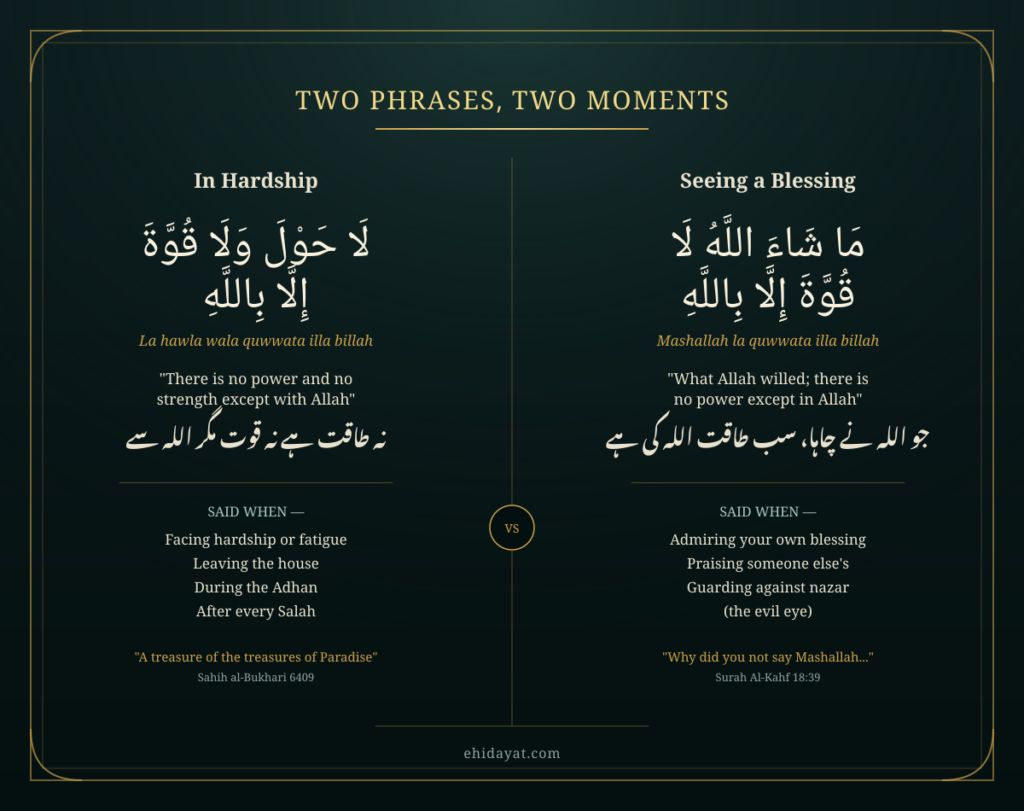
| Phrase | Literal Meaning | When to Say It | Source |
|---|---|---|---|
| La hawla wala quwwata illa billah | There is no power and no strength except with Allah | Hardship, difficulty, leaving the house, after Salah, during the Adhan | Hadith — Sahih al-Bukhari 6409, Sunan Ibn Majah 3824/3825 |
| Mashallah la quwwata illa billah | What Allah willed; there is no power except with Allah | Seeing a blessing (yours or someone else’s), guarding against the evil eye | Quran — Surah Al-Kahf 18:39 |
The second phrase traces back to a story in the Quran: a man with two lush gardens grew proud of what he owned and forgot to credit Allah for it. Allah tells us he should have said, on entering his garden, “This is what Allah has willed — there is no power except with Allah.” Shortly after, the story recounts his gardens being destroyed. Scholars have long drawn a simple lesson from this: name Allah as the source of a blessing before pride, or the evil eye, gets a foothold.
Mashallah La Quwwata Illa Billah — Meaning, Urdu, and Benefits
Arabic: مَا شَاءَ اللَّهُ لَا قُوَّةَ إِلَّا بِاللَّهِ Transliteration: Mā shā’a Allāh, lā quwwata illā billāh Meaning: “What Allah has willed [has occurred]; there is no power except with Allah.” Urdu: “جو اللہ نے چاہا وہی ہوا، طاقت صرف اللہ ہی کی مدد سے ہے۔”
| Arabic Word | Transliteration | Meaning |
|---|---|---|
| مَا شَاءَ اللَّهُ | Mā shā’a Allāh | What Allah willed |
| لَا قُوَّةَ | Lā quwwata | No power |
| إِلَّا بِاللَّهِ | Illā billāh | Except with Allah |
This phrase is drawn from Surah Al-Kahf, verse 39, where it’s the line the proud garden-owner should have said. Two benefits stand out:
- Protection for what you have. Saying it when admiring your own success, health, or possessions is a way of acknowledging Allah as the source before pride creeps in.
- Protection from the evil eye (nazar). Saying it when you admire something of someone else’s — a friend’s new home, a child’s good health — is a way of guarding them from the harm that can come with an admiring but unguarded glance. For a deeper look at evil eye protection specifically, see our guide on dua for evil eye and nazar.
There’s no fixed count for this one either — it’s said whenever a blessing catches your attention, in whichever moment it happens.
Frequently Asked Questions
What does La hawla wala quwwata illa billah mean? There is no power and no strength except with Allah. It’s a declaration that a person cannot avoid harm or do good except through Allah’s help and permission.
What is La hawla wala quwwata illa billah in Urdu? “نہ گناہ سے بچنے کی طاقت ہے اور نہ نیکی کرنے کی قوت، مگر اللہ کی مدد سے” — meaning that avoiding sin and doing good are both only possible with Allah’s help, similar to how Innallaha Ma Sabireen is explained in Urdu as another short Quranic phrase of reliance on Allah.
Is La hawla wala quwwata illa billah from the Quran or a Hadith? It’s an authentic Hadith — the Prophet ﷺ called it a treasure of Paradise in Sahih al-Bukhari 6409. A closely related phrase, “la quwwata illa billah,” does appear in the Quran, in Surah Al-Kahf (18:39), which is the basis of the separate Mashallah phrase.
What’s the difference between La hawla wala quwwata illa billah and Mashallah la quwwata illa billah? La hawla wala quwwata illa billah is said when facing hardship, asking for strength. Mashallah la quwwata illa billah is said when seeing a blessing, as gratitude and protection from the evil eye.
Are lahaula walakuata illabillah and la hawla wala quwwata illa billah the same phrase? Yes. These are phonetic spelling variations of the same Arabic phrase, لَا حَوْلَ وَلَا قُوَّةَ إِلَّا بِاللَّهِ, spelled differently because Arabic sounds don’t map onto one standard English or Urdu transliteration.
When should Muslims say this phrase? Common times include after every Salah, during the Adhan (in place of repeating “Hayya ‘ala-s-Salah”), when leaving the house, and whenever facing hardship, stress, or fatigue.
What are the main benefits of reciting it? Hadith describe it as a treasure of Paradise (Sahih al-Bukhari 6409), and reciting it with understanding is a genuine act of tawakkul — placing a difficulty in Allah’s hands rather than carrying it alone.
La hawla wala quwwata illa billah is short enough to say without thinking — which is exactly the point. It’s meant to be close at hand for the moment life gets heavy, so that the first thing on your tongue is a reminder of where real strength comes from