
Astaghfirullah Meaning: I Seek Forgiveness From Allah
Astaghfirullah (أَسْتَغْفِرُ اللَّهَ) means “I seek forgiveness from Allah.” It’s built from the Arabic root غفر (ghafara) — to cover, forgive, protect from punishment. So when a Muslim says it, they’re not just apologizing. They’re asking Allah to cover the sin, forgive it, and shield them from what it deserves.
Most people learn the phrase long before they learn what’s actually packed inside it. That’s what this guide is for: the word-by-word meaning, the Urdu and Hindi translations, the al-Azeem form, and the actual hadith — by name and number — behind why Muslims say it so often.
What Does Astaghfirullah Mean?
The short answer is above. The longer answer starts with what the root word is doing.
غفر (ghafara) doesn’t just mean “forgive” the way English uses the word. It means to cover something up so it can’t cause harm — like a soldier’s shield. Scholars point out that when Allah forgives (yaghfir), the sin isn’t just excused, it’s concealed. That’s a meaningfully different picture than “forgiveness” in the everyday English sense, and it’s why so many explanations of the word lean on the image of covering a stain rather than erasing a debt.
Word-by-Word Breakdown of Astaghfirullah
A common mistake — repeated on more than one Islamic site — is splitting the phrase into three parts: “Astaghfir,” “Al,” and “Allah,” as if “Al” were a separate word meaning “the.” It isn’t. There’s no independent article here. The phrase is two words that fuse together in speech: Astaghfiru + Allah, with the final vowel of the first word contracting into the second.
| Arabic | Transliteration | Meaning |
|---|---|---|
| أَسْتَغْفِرُ | Astaghfiru | I seek forgiveness |
| اللَّهَ | Allah | Allah |
Break the first word down further and you get the root غ-ف-ر (gha-fa-ra), which carries all three senses — to cover, to forgive, to protect — at once. That’s the whole phrase, in two words, doing three jobs.
Astaghfirullah Meaning in Urdu and Hindi
In Urdu, Astaghfirullah is written اَستَغفِرُاللّٰہ and means “میں اللہ سے معافی مانگتا ہوں” — “I ask forgiveness from Allah.” In Hindi, it’s written अस्तग़फिरुल्लाह, meaning “मैं अल्लाह से माफी माँगता हूँ” — the exact same sentence, just in a different script.
| Language | Script | Transliteration | Meaning |
|---|---|---|---|
| Arabic | أَسْتَغْفِرُ اللَّهَ | Astaghfirullah | I seek forgiveness from Allah |
| Urdu | اَستَغفِرُاللّٰہ | Astaghfirullah | میں اللہ سے معافی مانگتا ہوں |
| Hindi | अस्तग़फिरुल्लाह | Astaghfirullah | मैं अल्लाह से माफी माँगता हूँ |
If you can’t read either script, the phonetic version is the same either way: as-tagh-fi-rul-lah. For readers exploring related duas, istighfar meaning in Urdu covers the wider family of forgiveness phrases this one belongs to.
Astaghfirullah al-Azeem Meaning
Astaghfirullah al-Azeem means “I seek forgiveness from Allah, the Most Great.” Al-Azeem isn’t decoration — it’s one of Allah’s names, meaning “The Magnificent.” Adding it changes who you’re addressing the plea to: not just a forgiver, but the greatest one there is.
There’s a reason this specific form gets its own name recognition among scholars. According to Jami` at-Tirmidhi 3577, saying the full extended version brings forgiveness “even if you fled from the battlefield” — a striking line, given that fleeing was itself considered a major offense. It’s the clearest example in the hadith literature of how far this particular phrase reaches.
The Family of Istighfar Duas: Short to Long Form
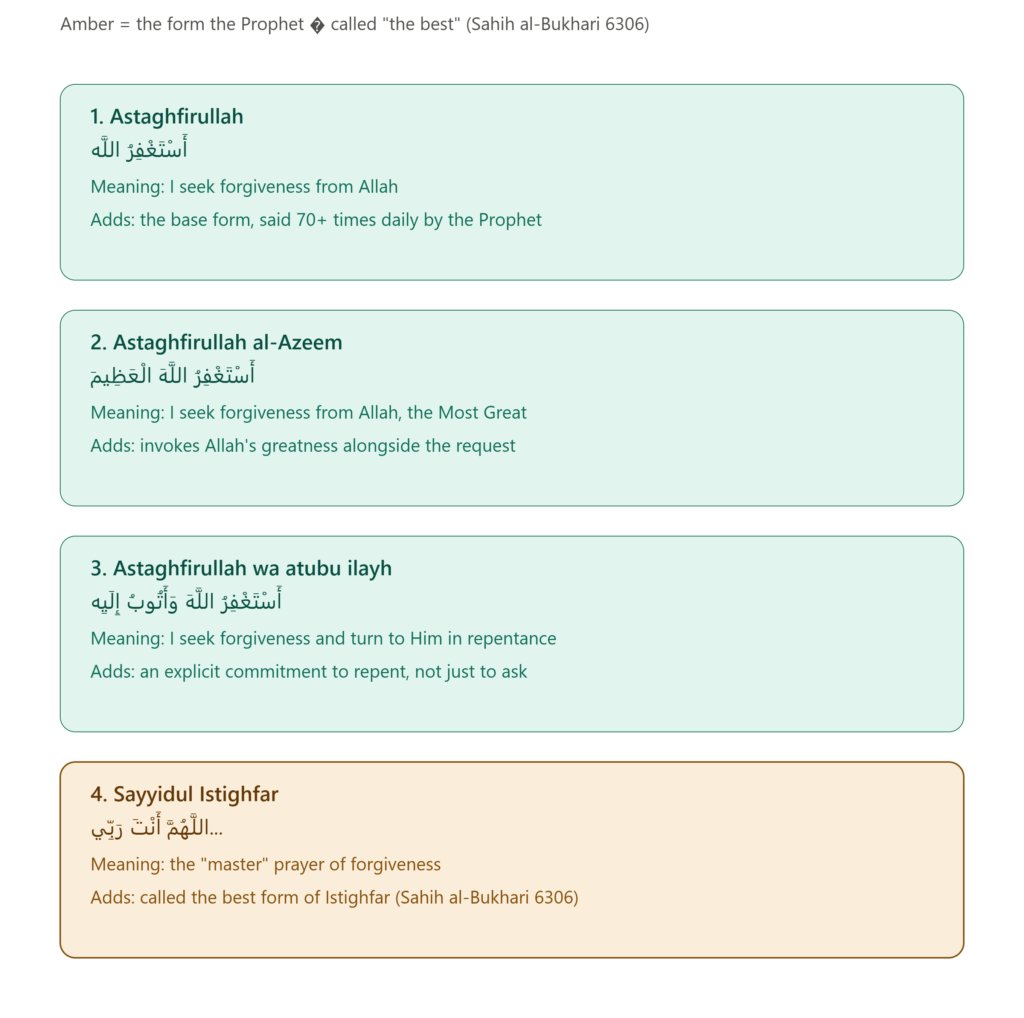
Astaghfirullah isn’t a single fixed phrase — it’s a starting point that gets extended depending on the moment. Here’s the ladder, shortest to longest:
| Form | Arabic | Meaning | What It Adds |
|---|---|---|---|
| Astaghfirullah | أَسْتَغْفِرُ اللَّه | I seek forgiveness from Allah | The base form — short, constant, said 70+ times a day by the Prophet ﷺ |
| Astaghfirullah al-Azeem | أَسْتَغْفِرُ اللَّهَ الْعَظِيمَ | I seek forgiveness from Allah, the Most Great | Invokes Allah’s greatness alongside the request |
| Astaghfirullah wa atubu ilayh | أَسْتَغْفِرُ اللَّهَ وَأَتُوبُ إِلَيْه | I seek forgiveness from Allah and turn to Him in repentance | Adds an explicit commitment to repent, not just to ask |
| Sayyidul Istighfar | اللَّهُمَّ أَنْتَ رَبِّي… | The “master” prayer of forgiveness | The Prophet ﷺ called this the best form (Sahih al-Bukhari 6306) — a full paragraph acknowledging Allah as Lord, admitting the sin, and asking for pardon |
[IMAGE: styled comparison table for the four forms above, matching the site’s calligraphy aesthetic — placed here, functional]
Most people only ever learn the first one. Worth knowing the rest exist, even if you don’t memorize all four.
Istighfar vs Tawbah — What’s the Difference?
Istighfar is saying the words. Tawbah is doing the work. Istighfar — reciting “Astaghfirullah” — is the first step. Tawbah is complete repentance, and it requires three things: genuine regret over the sin, stopping it immediately, and a firm resolve never to return to it.
Say Astaghfirullah for a habit you have no intention of quitting, and you’ve done Istighfar without Tawbah. The words alone aren’t nothing — but scholars are consistent that the real transformation happens when the saying is backed by the stopping.
Why Do Muslims Say Astaghfirullah 70–100 Times a Day?
Because the Prophet ﷺ did. Abu Hurayrah reported him saying he asked Allah’s forgiveness more than seventy times a day (Sahih al-Bukhari 6307). Al-Agharr al-Muzani reported a separate hadith in which the Prophet ﷺ said he sought forgiveness a hundred times a day, describing a kind of “shade” that would come over his heart (Sahih Muslim 2702a).
He was, by Islamic belief, already free of sin. He did it anyway — as a habit, not a correction.
There’s an old story about Imam Ahmad ibn Hanbal that gets told alongside this hadith more than most. Traveling once, he arrived at a masjid too late and the guard, not recognizing him, refused him entry — twice, then dragged him out when he tried to wait in the courtyard. A baker nearby saw the whole thing and took the elderly scholar in for the night. While Imam Ahmad rested, the baker kept working, and the scholar noticed he never stopped repeating “Astaghfirullah” under his breath, even mid-task. Asked about it later, the baker said it was just a habit he’d picked up — and that every dua he’d made since seemed to come true. Imam Ahmad reportedly said that was the real reason he’d ended up locked out of the masjid that night: to hear that story.
Can Istighfar Bring Rizq and Blessings?
Yes — and the Quran makes the connection directly, not as folklore. Surah Nuh (71:10–12) has the prophet Nuh telling his people: seek your Lord’s forgiveness, and He will send rain, wealth, and children in return. It’s laid out as cause and effect, not metaphor.
Istighfar → Allah’s Mercy → Opportunities → Provision. That’s the shape scholars draw from this passage: forgiveness-seeking isn’t a spiritual side effect that happens to also help your circumstances — the Quran presents the circumstances as a direct result. For a deeper look at how the full surah frames this, see the Surah Nuh full meaning and tafsir.
Astaghfirullah and the Fajr Dhikr
Astaghfirullah also shows up as the closing line of a well-known post-prayer dhikr: “Subhanallahi wa bihamdihi, Subhanallahil Azeem, Astaghfirullah” — often recited 100 times between the sunnah and fard rak’ahs of Fajr. If that combined phrase is what brought you here, the full breakdown is in Subhanallahi wa bihamdihi subhanallahil azeem meaning — this page focuses specifically on the Astaghfirullah part on its own.
Astaghfirullah Pronunciation
As-tagh-fi-rul-lah. The “gh” sound sits in the throat — closer to a soft gargle than the hard English “g.” Say it slowly the first few times: as-tagh (throat sound) fi-rul-lah. Sincerity matters more than getting the throat sound perfect, but it’s worth practicing once or twice out loud.
Can a Non-Muslim Say Astaghfirullah?
Yes. “Allah” is simply the Arabic word for God — used by Arabic-speaking Christians and Jews long before Islam and long after. There’s no ownership on asking for mercy. If someone outside the faith says it sincerely, wanting forgiveness from the one God, it’s a respected act, not an appropriation of one.
FAQs About Astaghfirullah
What does Astaghfirullah mean in English? Astaghfirullah means “I seek forgiveness from Allah.” It comes from the Arabic root غفر (ghafara), meaning to cover, forgive, or protect from punishment — so the phrase is both a request for pardon and for Allah’s protection from a sin’s consequences.
What is Astaghfirullah meaning in Urdu? In Urdu, Astaghfirullah (اَستَغفِرُاللّٰہ) means “میں اللہ سے معافی مانگتا ہوں” — “I seek forgiveness from Allah.” Muslims say it after realizing a mistake, large or small.
What is Astaghfirullah meaning in Hindi? In Hindi, Astaghfirullah is written as अस्तग़फिरुल्लाह, meaning “मैं अल्लाह से माफी माँगता हूँ” — “I ask forgiveness from Allah.” The meaning is identical to the Urdu and Arabic forms.
What does Astaghfirullah al-Azeem mean? Astaghfirullah al-Azeem means “I seek forgiveness from Allah, the Most Great.” Adding al-Azeem — one of Allah’s names — gives the request extra weight; Jami` at-Tirmidhi 3577 states this form brings forgiveness even for major sins.
How many times should you say Astaghfirullah a day? There’s no fixed limit, but the Prophet ﷺ said it more than 70 times a day (Sahih al-Bukhari 6307) and, in another narration, 100 times a day (Sahih Muslim 2702a). Many Muslims recite it 100 times after Fajr as a daily habit.
What is the difference between Istighfar and Astaghfirullah? Istighfar is the general act of seeking Allah’s forgiveness; Astaghfirullah is the specific phrase used to do it. Istighfar can also include other duas of repentance, while Astaghfirullah is the single most common one.
Can Istighfar increase rizq (provision)? Yes. Surah Nuh (71:10–12) links seeking forgiveness directly to rain, wealth, and children, showing sincere Istighfar is connected to Allah’s material blessings, not only spiritual forgiveness.
Can a non-Muslim say Astaghfirullah? Yes. “Allah” is simply the Arabic word for God, and there’s no restriction on anyone sincerely asking for mercy. Saying it with genuine intent is a respected act of humility, regardless of faith background.