
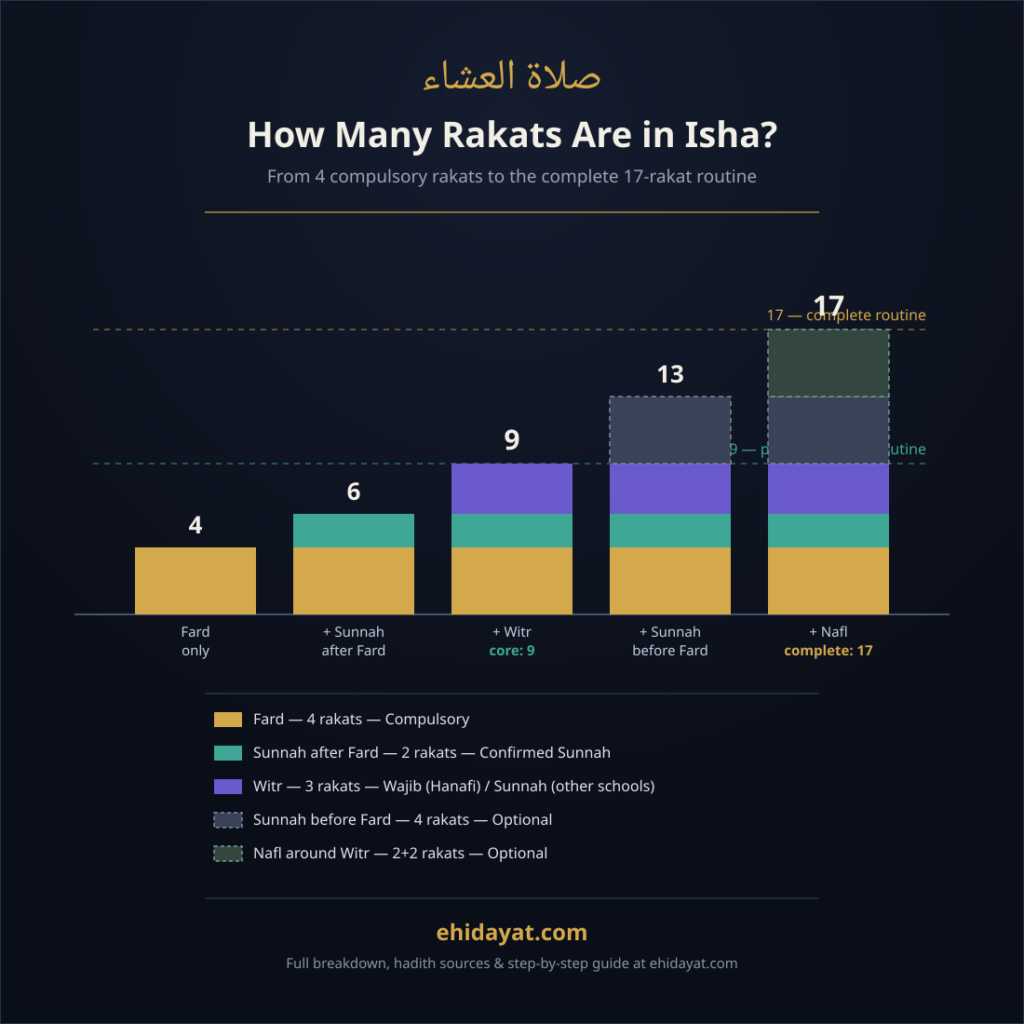
Isha has 4 Fard (compulsory) rakats — that’s the one number every Islamic school agrees on without exception. Most Muslims also pray 2 Sunnah Mu’akkadah rakats right after those, plus 3 Witr rakats before sleeping, which brings the practical nightly total to 9. Add the optional Sunnah rakats before the Fard and the optional Nafl rakats around Witr, and the count taught in many Hanafi communities reaches 17. Every one of these numbers is correct — they’re just counting different layers stacked on top of the same core prayer.
Isha Rakats at a Glance
Here’s the full structure in one place, from the compulsory core out to the complete optional routine.
| Category | Rakats | Status | When Prayed |
|---|---|---|---|
| Sunnah (Ghair Mu’akkadah) | 4 | Optional | Before the Fard |
| Fard | 4 | Compulsory | The core obligation |
| Sunnah (Mu’akkadah) | 2 | Strongly recommended | Right after the Fard |
| Nafl | 2 | Optional | After the Sunnah |
| Witr | 3 (commonly; can be 1) | Wajib in Hanafi fiqh, confirmed Sunnah elsewhere | After Isha, before Fajr |
| Nafl | 2 | Optional | After Witr |
Read top to bottom and the numbers stack: 4 gets you the obligation, 9 gets you the commonly-taught practical routine (Fard + Sunnah after + Witr), and 17 gets you every layer. Nobody is required to pray all 17 — most of what’s above the 4 Fard rakats is reward-earning but optional.
Why Is Isha Sometimes Called 4, 7, 9, or 17 Rakats?
Because each number answers a slightly different question. “4” answers “what’s obligatory?” “7” is what a Hanafi Muslim who treats Witr as necessary would count as their practical minimum (4 Fard + 3 Witr). “9” is the commonly cited standard routine — Fard, the Sunnah after it, and Witr. “17” is the complete routine including every optional Sunnah and Nafl rakat available around Isha.
None of these totals contradict each other. They’re not competing claims about “the real number” — they’re different stopping points on the same list, and a page (or a person) that says “9” isn’t disagreeing with one that says “17.” This is the single most common point of confusion in how this topic gets searched, and it’s worth being explicit about before going any further.
The 4 Fard Rakats — What’s Actually Compulsory
The 4 Fard rakats are the Isha obligation, full stop. Every adult Muslim capable of prayer must complete them within the Isha time window, which begins once twilight fully disappears and extends toward midnight or, per some scholarly views, until Fajr. Each rakat follows the standard structure — standing (Qiyam), bowing (Ruku), and two prostrations (Sujood) — with Surah Al-Fatiha recited in every rakat and an additional short surah added in the first two.
Deliberately skipping these four rakats invalidates the Isha obligation for that night; there’s no substitute or shortcut around them outside of the specific travel and illness accommodations covered further down. Everything else in this guide — Sunnah, Nafl, Witr — sits on top of this core, not in place of it.
Sunnah and Nafl Rakats in Isha
Beyond the 4 Fard rakats, Isha carries several layers of non-obligatory prayer, each with a different level of emphasis:
- 4 Sunnah Ghair Mu’akkadah (before Fard) — optional, not something the Prophet ﷺ performed with strict regularity. Rewarding to pray, not sinful to skip.
- 2 Sunnah Mu’akkadah (after Fard) — a confirmed, regularly-practiced Sunnah. This is the pair most consistently included whenever a source cites a “9-rakat” Isha.
- 2 Nafl — fully voluntary rakats some Muslims add for extra devotion, typically prayed either before Witr or split around it.
The practical distinction that matters: Sunnah Mu’akkadah rakats carry real weight (habitually abandoning them is discouraged), while Ghair Mu’akkadah and Nafl rakats are closer to bonus worship — valuable, but with no equivalent expectation attached. If you’re building a nightly habit, the Tahajjud prayer is the natural next layer of voluntary night prayer once Isha’s own Sunnah and Nafl rakats feel established.
Witr — Is It Part of Isha?
Not technically. Witr is its own prayer — sometimes called Salatul-Layl — performed after Isha and before Fajr, which is exactly why it gets folded into “Isha rakat” totals even though it isn’t one of Isha’s own units.
The Prophet ﷺ was reported to have instructed making Witr the last prayer of the night, and to have described night prayer generally as offered two rakats at a time, closed out with a single odd rakat if dawn is approaching (Sahih al-Bukhari 998 and 990). That flexibility is why Witr can be prayed as 1, 3, 5, or up to 11 rakats depending on how much voluntary night prayer precedes it — though 3 rakats, closed with Dua-e-Qunoot in the final one, is the most commonly taught method, particularly in Hanafi practice.
On its ruling: the Hanafi school treats Witr as Wajib — necessary, though one rank below Fard — while the Shafi’i, Maliki, and Hanbali schools treat it as Sunnah Mu’akkadah, a strongly emphasized but not obligatory practice. Across all four, the guidance converges on the same point: don’t make a habit of skipping it.
Is the 17-Rakat Count Actually Hadith-Based?
Partly, and it’s worth being specific about which part.
The 2 Sunnah rakats prayed after the Fard rest on solid ground — Ibn ‘Umar’s report of the Prophet ﷺ regularly praying two rakats after ‘Isha at home is recorded in Sahih al-Bukhari 1180–1181, agreed upon between Bukhari and Muslim. That’s about as strong as a hadith citation gets. Witr’s role as the closing prayer of the night is similarly well attested (Sahih al-Bukhari 998 and 990, discussed above). Read about Zuhr rakat
The weaker link in the chain is the 4 Sunnah rakats prayed before the Fard. Hadith commentary on this specific practice generally treats it as falling under the Prophet’s ﷺ broader principle that voluntary prayer is welcome “between every two adhans,” rather than as a named, confirmed rātibah tied specifically to Isha — a distinction scholars draw explicitly when discussing which pre-Fard Sunnah prayers are Mu’akkadah and which aren’t. The 2-plus-2 Nafl rakats sometimes prayed around Witr sit in a similar place: they’re legitimate voluntary night prayer (Qiyam al-Layl), but they’re not attested as a specific “Isha sequence” in one unified narration.
None of this means the fuller counts are invented — every individual layer traces back to a real, recognized category of prayer. What it means is that “17 rakats for Isha” is a teaching aggregate that combines several separately-sourced practices into one commonly repeated total, not a figure that comes from a single hadith listing all 17 in order. If you’re teaching this to someone new to hadith terminology, that distinction — strongly attested core vs. combined optional layers — is more useful than the raw number itself.
Isha Rakats: Hanafi vs Ahl-e-Hadith Practice
If you grew up in a South Asian Muslim household, you’ve probably heard this exact disagreement discussed in more specific terms than “the four madhhabs” — usually as Hanafi practice versus Ahl-e-Hadith (or Salafi) practice. Both sides agree completely on the 4 Fard rakats; the differences sit entirely in the optional and Witr layers.
| Practice Point | Hanafi | Ahl-e-Hadith / Other Sunni |
|---|---|---|
| Sunnah before Fard | 4 (Ghair Mu’akkadah) | Usually not fixed at a set number |
| Witr rakat count | Typically 3, one salam, Dua-e-Qunoot in the third | Often prayed in pairs with separate salams, closed with a single rakat — anywhere from 1 to 11 |
| Witr ruling | Wajib (necessary) | Sunnah Mu’akkadah (strongly recommended, not obligatory) |
| Typical nightly total taught | Often presented as 17 | Often presented closer to 8–11 |
Neither approach is being presented here as “the correct one” — this is a description of practice, not a fatwa. If your family or local masjid follows a particular method, that’s the one worth continuing; the differences above explain why you might hear different totals from different corners of the same community rather than one side being mistaken.
How Many Rakats Should You Actually Pray Tonight?
If you only have a few minutes: pray the 4 Fard rakats. That fulfills the obligation completely — nothing else on this page is required to make your Isha valid.
If you’re building a consistent nightly routine: 9 rakats (4 Fard, 2 Sunnah after, 3 Witr) is the practical standard most commonly taught, and it covers the obligation plus the most emphasized voluntary layers.
If you want the complete routine: 17 rakats adds the Sunnah before the Fard and the Nafl rakats around Witr — worthwhile, but genuinely optional, and not something to feel you’re falling short by skipping on a tired night.
There’s no ranking system where more rakats automatically means a “better” Isha. Consistency with the 4 Fard rakats, prayed with focus, outweighs an occasional full 17-rakat night followed by several missed ones.
Step-by-Step: How to Pray the 4 Fard Rakats of Isha
- Make Wudu and face the Qiblah. Ensure clean clothing and a clean prayer space.
- Make the intention (Niyyah) in your heart to pray 4 Fard rakats of Isha for Allah — it doesn’t need to be spoken aloud.
- Say the opening Takbir (“Allahu Akbar”) and place your hands in the standing prayer position.
- First and second rakats: recite Surah Al-Fatiha followed by a short additional surah in each, then complete Ruku and two Sujood in the usual manner.
- Sit for the first Tashahhud after the second rakat, then stand for the third.
- Third and fourth rakats: recite Surah Al-Fatiha only — no additional surah is required in the third or fourth rakat of a Fard prayer.
- Sit for the final Tashahhud, add Salawat upon the Prophet ﷺ and a closing dua, then finish with Salam — turning right, then left, saying “Assalamu Alaikum wa Rahmatullah” each time.
When prayed in congregation, the imam recites the first two rakats aloud and the last two silently; praying alone, either is acceptable.
How to Pray Witr After Isha (3 Rakats with Dua-e-Qunoot)
- Make the intention to pray 3 rakats of Witr.
- Pray the first two rakats normally — Surah Al-Fatiha plus a short surah in each, with the usual Ruku and Sujood.
- Sit for Tashahhud after the second rakat, then stand for the third without ending the prayer.
- In the third rakat, recite Surah Al-Fatiha and a short surah, then raise your hands and recite Dua-e-Qunoot before going into Ruku.
- Complete Ruku and Sujood as usual, then finish with the final Tashahhud, Salawat, and Salam.
If Dua-e-Qunoot isn’t memorized yet, a shorter Dua Masura is an accepted substitute while it’s being learned.
Isha Rakats While Traveling or Ill
Two different accommodations apply here, and it’s worth keeping them separate since they work differently:
Traveling (Qasr): a qualifying traveler may shorten the 4 Fard rakats of Isha to 2. This applies specifically to the Fard rakats — the Sunnah, Nafl, and Witr rakats aren’t shortened by this rule, and many travelers simply leave the optional layers for a less demanding night.
Illness: being unwell does not reduce the number of rakats. Someone unable to stand may pray sitting, and someone unable to sit upright may pray lying down, following the standing sequence as closely as their condition allows — but the rakat count itself stays the same as it would be prayed standing. Illness changes how the rakats are performed, not how many there are.
Rakats in All Five Daily Prayers
For context, here’s where Isha sits alongside the other four obligatory prayers, combining the Fard rakats with the confirmed Sunnah Mu’akkadah rakats most commonly prayed alongside each:
| Prayer | Fard | Sunnah Mu’akkadah | Typical Total Prayed |
|---|---|---|---|
| Fajr | 2 | 2 (before) | 4 |
| Dhuhr | 4 | 4 (before) + 2 (after) | 10 |
| Asr | 4 | — | 4 |
| Maghrib | 3 | 2 (after) | 5 |
| Isha | 4 | 2 (after) | 6 (9 including Witr) |
Add Witr’s 3 rakats to Isha and the five-prayer day totals around 32 rakats of Fard-plus-confirmed-Sunnah prayer — before counting any additional Nafl.
Frequently Asked Questions
Is Isha 9 rakats or 17 rakats? Both, depending on what’s counted. 9 rakats covers the Fard, the Sunnah after it, and Witr — the commonly taught practical routine. 17 adds the optional Sunnah before the Fard and the Nafl rakats around Witr. Neither figure is wrong; they’re different stopping points on the same list.
How many rakats are compulsory (Fard) in Isha? 4 rakats. This is the one number every Islamic school agrees on without exception, and it’s the minimum required to fulfill the Isha obligation.
Is Witr part of Isha prayer? Not technically — Witr is its own prayer, performed after Isha and before Fajr. It’s commonly folded into “Isha rakat” totals because it’s prayed at the same time of night, immediately following Isha for most people.
Can I pray Isha with just the 4 Fard rakats? Yes. The 4 Fard rakats fulfill the Isha obligation completely. Everything beyond them — Sunnah, Nafl, Witr — is recommended but not required to make the prayer valid.
Is the 17-rakat Isha count based on a single hadith? No single hadith lists all 17 rakats together in one place. The 2 Sunnah rakats after the Fard and Witr’s role as the night’s closing prayer are both individually well-attested in hadith. The Sunnah rakats before the Fard rest on a more general principle about voluntary prayer rather than a rakat count specific to Isha.
How many rakats does the Hanafi school pray for Isha? Hanafi practice commonly totals 17 when every layer is included: 4 Sunnah before, 4 Fard, 2 Sunnah after, 2 Nafl, 3 Witr (treated as Wajib), and 2 further Nafl. The practical minimum most Hanafi Muslims aim for nightly is 9.
How many total rakats are there across all five daily prayers? Counting Fard rakats plus the confirmed Sunnah Mu’akkadah rakats typically prayed alongside them, the day totals around 32 rakats, plus Witr’s 3 after Isha — before any additional optional Nafl prayers.
What if I missed Isha — do I still pray Witr when making it up? Practice varies by school. In Hanafi fiqh, the usual approach is to make up both the 4 Fard rakats and the 3 Witr rakats; the optional Sunnah and Nafl rakats generally don’t need to be made up. If you’re unsure which approach your school follows, a local scholar or trusted teacher is the best source to confirm