
Sadaqah is one of the most talked-about words in everyday Muslim life, yet most people only ever hear it used loosely — “give some sadaqah,” “that’s a nice sadaqah” — without ever pinning down what it actually means, where it comes from, or how it differs from Zakat. This guide answers all of that directly, with the hadith and Quranic references behind each point.
What Does Sadaqah Mean?
Sadaqah literally means “righteousness.” It comes from the Arabic root sidq, which means sincerity or truthfulness — a reminder that the word itself is tied to the honesty of the heart behind the act, not the size of the act. In Islamic terms, sadaqah refers to any voluntary act of charity or kindness done for the sake of Allah, without expecting anything back from the recipient.
That voluntary nature is the key thing to hold onto. Sadaqah isn’t limited to money, isn’t owed to anyone, and isn’t tracked against a set formula. It sits alongside other categories of Islamic giving, like Aqiqah — the sacrifice offered for a newborn child — as one of several acts of worship built around generosity rather than obligation.
Sadaqah, Sadqa, or Sadka — Same Word, Different Spelling
If you’ve seen “sadaqah” written as “sadqa” or “sadka,” you haven’t stumbled onto a different concept — they’re the same Arabic word (صدقة), just transliterated into English differently. Regional spelling habits and phonetic preferences account for the variation, not any difference in meaning or ruling. Whichever spelling you’ve come across, the definition, the rules around it, and the rewards attached to it are identical.
Is Sadaqah the Same as Zakat?
No — sadaqah is voluntary, while Zakat is an obligatory annual payment owed by every Muslim who meets a minimum wealth threshold. That’s the core distinction, though the two terms have overlapped historically. At the time the Quran was being revealed, “sadaqah” was sometimes used to describe what later became formalized as Zakat, and the two words are still occasionally used interchangeably in classical texts. Over time, common usage settled into the split most Muslims recognize today: Zakat as a fixed, obligatory pillar of Islam, and sadaqah as an open-ended, voluntary act of generosity.
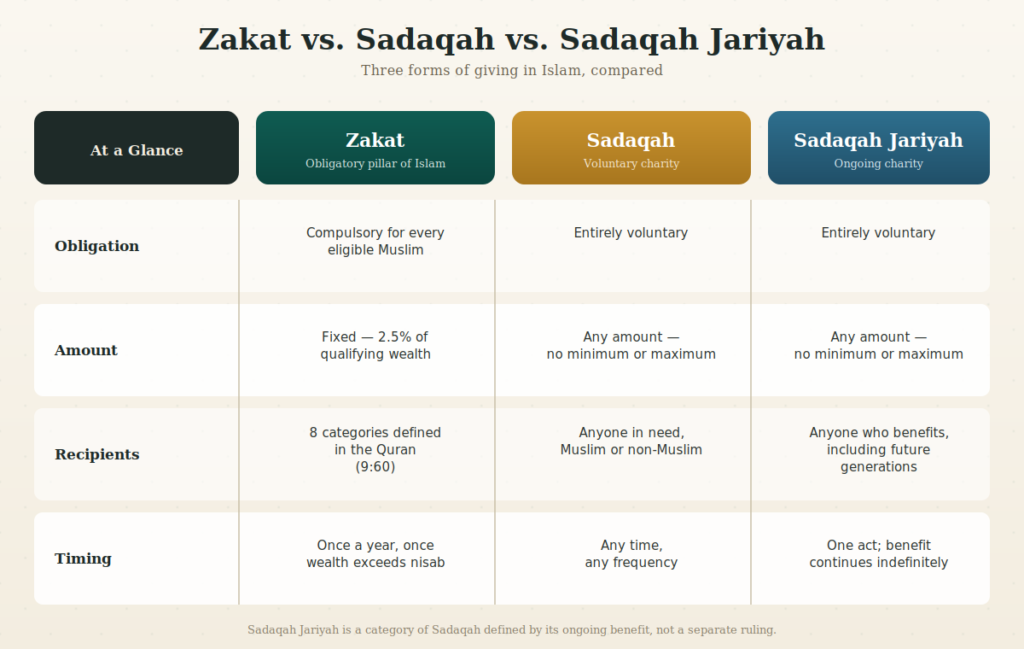
Sadaqah Jariyah adds a third category worth separating out, since it’s really a type of sadaqah rather than a competing term — one defined by an ongoing benefit rather than a one-time act.
| Zakat | Sadaqah | Sadaqah Jariyah | |
|---|---|---|---|
| Obligation | Compulsory for eligible Muslims | Entirely voluntary | Entirely voluntary |
| Amount | Fixed — 2.5% of qualifying wealth | Any amount | Any amount |
| Recipients | Eight specific categories defined in the Quran | Anyone in need, Muslim or non-Muslim | Anyone who benefits, including future generations |
| Timing | Once a year, when wealth exceeds the nisab threshold | Any time, any frequency | A single act whose benefit continues indefinitely |
What Counts as Sadaqah?
Sadaqah splits naturally into two broad categories: financial and non-financial. Financial sadaqah is the form most people picture first — cash, food, clothing, or other tangible aid given directly to someone in need or channeled through a trusted organization. It’s the most visible form, and the easiest to measure, which is probably why it dominates how the word gets used in everyday conversation.
Non-financial sadaqah is where the concept becomes far more interesting, and far more accessible to people who don’t have money to spare. According to hadith recorded in Sahih al-Bukhari, a genuine smile toward another person counts as sadaqah — as does removing something harmful, like a rock or a fallen branch, from a path where it could hurt someone. Other examples drawn from hadith include:
- Offering sincere advice or teaching someone something useful
- Giving water to a person, animal, or plant
- Speaking a kind word
- Being patient with someone difficult
- Settling a dispute between two people
- Praying (making dua) for someone else, whether family or a stranger
The common thread across all of these is intention. None of them require wealth. What they require is a sincere motive to help, which is exactly what the root word sidq points back to.
What Is Sadaqah Jariyah?
Sadaqah jariyah is ongoing charity — an act whose benefit, and reward, continues long after the person who gave it has died. The concept traces back to a well-known hadith stating that when a person dies, their deeds come to an end except for three things: an ongoing charity, knowledge that continues to benefit others, and a righteous child who prays for them. Sadaqah jariyah is that first category in action.
In practice, this looks like anything built to keep serving people over time rather than solving a single, one-off need:
- Digging or funding a water well
- Building or contributing to a mosque, school, or hospital
- Planting trees
- Sponsoring a child’s education on an ongoing basis
- Publishing or distributing beneficial religious knowledge
What separates sadaqah jariyah from a regular act of sadaqah isn’t the size of the gift — it’s the shelf life. A one-time meal helps someone today. A well helps a village for years, and every person who drinks from it adds to the giver’s reward, even after the giver has passed away.
How Much Should You Give in Sadaqah?
There’s no fixed minimum or maximum for sadaqah — even a very small amount given sincerely counts, with one hadith going as far as saying a person can save themselves from the Fire by giving even half of a date in charity. So the honest answer to “how much should I give” is: whatever you can, without it becoming a burden.
That said, most people find it easier to give consistently with some kind of personal benchmark rather than an open-ended “as much as possible.” Scholars commonly suggest setting aside somewhere between 1% and 10% of income, adjusted to your own financial situation, once essential living costs are already covered. The exact number matters far less than the discipline. Islam consistently favors small, regular giving over sporadic large donations — a habit of setting aside something every week or month builds sincerity in a way a single big gift, given once and then forgotten, doesn’t. Whatever figure you land on, the one hard rule is that sadaqah should never come at the expense of your own or your dependents’ basic needs.
Do You Need to Say a Dua When Giving Sadaqah?
No — there’s no fixed dua required from the Sunnah before or while giving sadaqah. The intention, or niyyah, is a matter of the heart rather than a spoken formula, and the Prophet ﷺ isn’t reported to have recited a specific set phrase every time he gave charity.
That doesn’t mean words are discouraged. It’s entirely permissible, and common practice, to quietly ask Allah to accept the charity and to make it beneficial for both the giver and the receiver. Some people prefer to say this intention out loud before giving; others simply hold it in their heart. Both are valid — what matters is sincerity, not the presence or absence of a specific phrase.
Is There a Best Time to Give Sadaqah?
Sadaqah can be given at any time of the year — there’s no restriction tying it to a particular date. That said, two periods are especially associated with increased giving. The Prophet ﷺ was known to be generous year-round but noticeably increased his charity during Ramadan, and Friday (Jummah) is widely regarded by scholars as a favored day for extra giving, given its general status as the best day of the week in Islamic tradition. Neither of these makes sadaqah given at any other time less valid — they’re simply windows many Muslims choose to lean into a little harder.
Who Can Give and Receive Sadaqah?
Anyone can give sadaqah, regardless of how much wealth they have. Unlike Zakat, which only becomes owed once a person’s wealth crosses the nisab threshold, sadaqah has no entry requirement — someone with very little can still give, and the reward is judged by sincerity and effort relative to what they have, not by the absolute amount.
The same openness applies on the receiving end. Sadaqah isn’t restricted to the eight categories of Zakat recipients defined in the Quran; it can go to anyone genuinely in need, including non-Muslims. Islamic teaching does encourage prioritizing needy relatives first, since supporting family carries the double reward of charity and maintaining family ties, but beyond that starting point, the pool of eligible recipients is wide open — neighbors, strangers, travelers, or an organization working on someone’s behalf.
Why Is Sadaqah Important in Islam?
The importance of sadaqah shows up across three overlapping layers of benefit: spiritual, social, and personal.
Spiritually, sadaqah is described in hadith as extinguishing sin the way water extinguishes fire, and it’s framed as a way of drawing closer to Allah and purifying one’s wealth of any negativity attached to how it was earned or held onto. The Quran reinforces this with the parable in Surah al-Baqarah (2:261), comparing charitable spending to a single seed that grows into seven ears, each holding a hundred grains — a multiplication of reward the giver doesn’t get to see directly but is promised nonetheless.
Socially, sadaqah functions as a quiet redistribution mechanism. Wealth that might otherwise sit idle gets moved toward people who need it, which narrows the practical gap between rich and poor and strengthens the sense of community responsibility that runs through Islamic teaching more broadly.
Personally, sadaqah is described as a source of protection — a shield against calamity and hardship, which is part of why many Muslims choose to give specifically during difficult periods, whether that’s illness, uncertainty, or loss. It’s also framed as a habit that builds humility and gratitude in the giver, independent of whatever it does for the person receiving it.
FAQ
What does sadaqah mean in Islam? Sadaqah literally means “righteousness” and comes from the Arabic root sidq (“sincerity”). In Islam, it refers to any voluntary act of charity or kindness given for Allah’s sake, with no expectation of return — monetary or otherwise.
What is the difference between sadaqah and sadqa? There is no difference — “sadaqah” and “sadqa” (and “sadka”) are simply different English transliterations of the same Arabic word, صدقة. All three refer to the identical concept of voluntary charity.
What is the difference between Zakat and Sadaqah? Zakat is an obligatory annual payment of 2.5% of qualifying wealth, owed by eligible Muslims to specific categories of recipients. Sadaqah is entirely voluntary, can be given in any amount, at any time, to anyone in need.
Does sadaqah have to be money? No. Sadaqah can be non-monetary — a smile, a kind word, offering advice, removing something harmful from a road, or even planting a tree are all considered forms of sadaqah in hadith.
How much sadaqah should I give? There’s no fixed minimum or maximum. Scholars commonly suggest giving what’s sustainable, often cited as roughly 1–10% of income once essential needs are met, without causing yourself financial hardship.
What is sadaqah jariyah? Sadaqah jariyah is ongoing charity whose benefit continues after the giver’s death, such as funding a well, school, or orphan’s education — the reward keeps accruing for as long as people benefit from it.
Is there a specific dua to say when giving sadaqah? No fixed dua is required in the Sunnah. The intention (niyyah) is a matter of the heart, though it’s permissible to ask Allah to accept the charity.
Can sadaqah be given to non-Muslims? Yes. Unlike Zakat, which has defined eligible categories, sadaqah can be given to anyone in need regardless of faith, though Islamic teaching encourages prioritizing needy relatives first.
Related reading: Aqiqah in Islam
Source cited: hadith on smiling and removing harm from a path as forms of sadaqah — Sahih al-Bukhari, via Sunnah.com