
Illness has a way of stripping everything else away. The Prophet Muhammad ﷺ knew this too, which is why he left behind specific words — not vague reassurances, but exact wording — for exactly this moment. A dua for shifa is a supplication asking Allah for healing, and the Sunnah preserves several of them, each tied to a real hadith and a real situation: your own pain, someone else’s illness, a bedside visit, a sickness that won’t lift. This guide walks through the authentic ones, in Arabic, transliteration, and translation, along with when each is actually meant to be used.
Shifa and afiyah get used almost interchangeably in everyday speech, but they’re not quite the same request. That distinction matters enough to sort out before anything else.
What Does “Shifa” Mean in Islam?
Shifa (شفاء) means healing — the actual cure, not just relief from symptoms. When a believer asks Allah for shifa, they’re asking for the disease itself to be lifted: body, mind, or heart, depending on what’s afflicted.
Afiyah is the wider term. It covers ongoing wellbeing — protection from illness before it ever arrives, plus safety, peace, and soundness in every part of life. Think of shifa as the dua you reach for once something has already gone wrong, and afiyah as the one you recite as a standing request for things to stay right. Both matter, and both show up in this guide, since searches for “dua for shifa” and “dua for good health” are really asking for the same thing from two different angles.
The Prophet’s Dua for Shifa (Allahumma Rabban-naas)
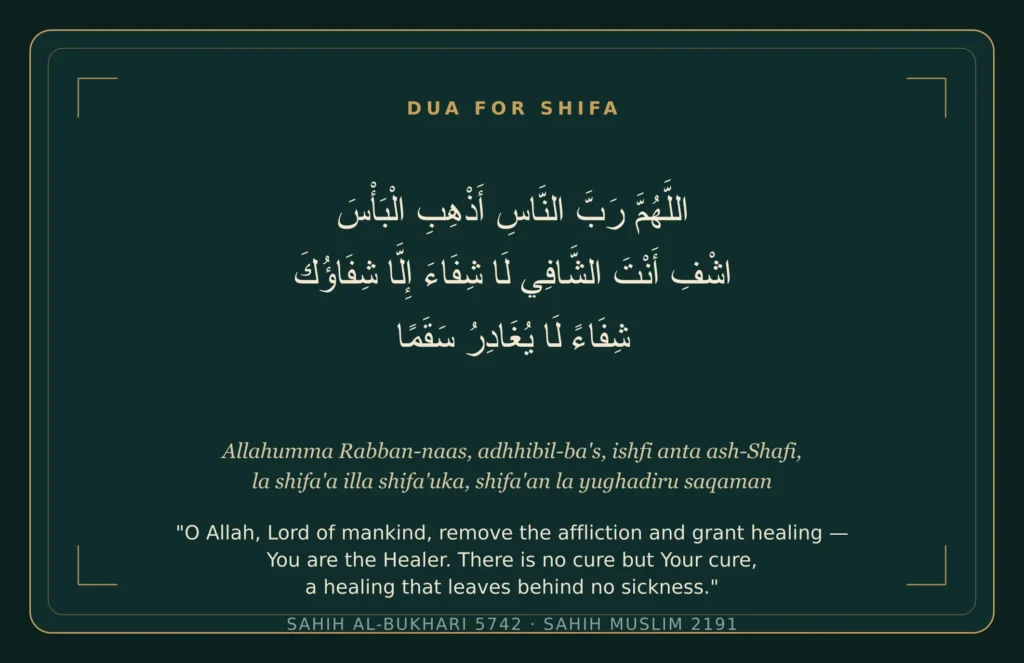
Arabic: اللَّهُمَّ رَبَّ النَّاسِ، أَذْهِبِ الْبَأْسَ، اشْفِ أَنْتَ الشَّافِي، لَا شِفَاءَ إِلَّا شِفَاؤُكَ، شِفَاءً لَا يُغَادِرُ سَقَمًا
Transliteration: Allahumma Rabban-naas, adhhibil-ba’s, ishfi anta ash-Shafi, la shifa’a illa shifa’uka, shifa’an la yughadiru saqaman.
Translation: “O Allah, Lord of mankind, remove the affliction and grant healing — You are the Healer. There is no cure but Your cure, a healing that leaves behind no sickness.”
This is the one. Aisha (RA) narrated that whenever anyone in the Prophet’s ﷺ household fell ill, he would recite this while wiping over them with his right hand — the full text and its grading are recorded on Sahih al-Bukhari 5742 on Sunnah.com, alongside Sahih Muslim 2191. Scholars don’t dispute the wording. It opens by naming Allah as Rabb an-naas, the Lord of all people, then makes the claim at the center of the whole dua: there is no real cure except His.
The method is simple and doesn’t require any special conditions. Place your right hand on the affected area — your own, or the person you’re praying for — and recite it, with no fixed count attached in the hadith itself. A few scholars suggest three or seven repetitions, but the emphasis in the narration is on sincerity, not tally.
Dua for Good Health (Allahumma ‘Afini fi Badani)
Arabic: اللَّهُمَّ عَافِنِي فِي بَدَنِي، اللَّهُمَّ عَافِنِي فِي سَمْعِي، اللَّهُمَّ عَافِنِي فِي بَصَرِي، لَا إِلَهَ إِلَّا أَنْتَ
Transliteration: Allahumma ‘afini fi badani, Allahumma ‘afini fi sam’i, Allahumma ‘afini fi basari, la ilaha illa Anta.
Translation: “O Allah, grant me well-being in my body. O Allah, grant me well-being in my hearing. O Allah, grant me well-being in my sight. There is no god but You.”
This is the dua for good health people usually mean when they ask for a dua for better health that isn’t tied to any specific ailment — it’s preventive rather than reactive. Recorded in Sunan Abi Dawud 5090 on the authority of Abu Bakra (RA) and graded Hasan, it names three specific blessings — the body, hearing, and sight — that are easy to take for granted until one of them weakens.
The Prophet ﷺ recited it three times each morning and three times each evening as part of his regular adhkar. That rhythm is worth keeping: a standing request for health, made daily, rather than something reached for only once illness has already set in.
Which Dua for Shifa Should You Recite? A Quick-Reference Table
Most guides list every dua one after another and leave you to guess which applies to your situation. Here’s the shortcut:
| Situation | Recommended Dua | Arabic Source | Reference |
|---|---|---|---|
| Reciting for your own pain (headache, body ache) | Bismillah 3x + A’udhu bi’izzati Allah 7x | أَعُوذُ بِعِزَّةِ اللَّهِ وَقُدْرَتِهِ | Sahih Muslim 2202 |
| Reciting for someone else who is sick | Allahumma Rabban-naas, adhhibil-ba’s… | اللَّهُمَّ رَبَّ النَّاسِ | Bukhari 5742, Muslim 2191 |
| Visiting a sick person at their bedside | As’alullah al-‘Azim… (7 times) | أَسْأَلُ اللَّهَ الْعَظِيمَ | Abu Dawud 3106 |
| Prolonged or chronic illness | Rabbi inni massaniya-d-durru… | رَبِّ إِنِّي مَسَّنِيَ الضُّرُّ | Quran 21:83 |
| Evil eye or suspected black magic | Bismillahi arqika… | بِاسْمِ اللَّهِ أَرْقِيكَ | Sahih Muslim 2186 |
| General daily protection (no illness yet) | Allahumma ‘afini fi badani… | اللَّهُمَّ عَافِنِي فِي بَدَنِي | Abu Dawud 5090 |
If you’re only going to memorize one, make it Allahumma Rabban-naas — it’s the most flexible, works for yourself or anyone else, and carries the strongest chain of narration of the group.
Dua for Pain and Localized Illness
Arabic: أَعُوذُ بِعِزَّةِ اللَّهِ وَقُدْرَتِهِ مِنْ شَرِّ مَا أَجِدُ وَأُحَاذِرُ
Transliteration: A’udhu bi’izzati Allahi wa qudratihi min sharri ma ajidu wa uhadhir.
Translation: “I seek refuge in the might and power of Allah from the evil of what I find and what I fear.”
Uthman ibn Abi al-‘As al-Thaqafi (RA) once told the Prophet ﷺ about a pain that had bothered him since he’d become Muslim. The instruction he was given was oddly specific: place your hand directly on the spot that hurts, say Bismillah three times, then recite this dua seven times. Uthman tried it, and reported the pain gone. Sahih Muslim 2202 preserves the exchange. Unlike the other duas here, this one comes with a precise procedure — hand placement, then the count — which makes it the go-to for something localized: a headache, a joint that’s flaring up, a specific point of pain rather than general illness.
Dua When Visiting a Sick Person
Arabic: أَسْأَلُ اللَّهَ الْعَظِيمَ رَبَّ الْعَرْشِ الْعَظِيمِ أَنْ يَشْفِيَكَ
Transliteration: As’alullah al-‘Azima Rabbal-‘Arshil-‘Azimi an yashfiyak.
Translation: “I ask Allah the Magnificent, Lord of the Magnificent Throne, to heal you.”
Abu Dawud 3106 records a promise attached to this one: whoever visits a sick person whose time hasn’t yet come and recites it seven times will see Allah cure them of that illness. It’s meant for the bedside specifically — said in the presence of the person who’s ill, not on their behalf from a distance.
A small grammatical note that trips people up: yashfiyak is for a man, yashfiyaki for a woman, and if you’re saying it over yourself, it becomes yashfiyani. Small difference, but it’s the kind of detail that gets left out of most lists.
The Dua of Prophet Ayyub (AS) — For Prolonged or Severe Illness
Arabic: رَبِّ إِنِّي مَسَّنِيَ الضُّرُّ وَأَنْتَ أَرْحَمُ الرَّاحِمِينَ
Transliteration: Rabbi inni massaniya-d-durru wa Anta arhamu r-rahimin.
Translation: “My Lord, adversity has touched me, and You are the Most Merciful of the merciful.”
Ayyub (AS) is the reference point for illness that drags on. Years of it, in his case, along with the loss of nearly everything else. Quran 21:83 preserves what he said — and what he didn’t say is almost as instructive as what he did. No complaint, no demand for a specific outcome, just a plain statement of the affliction followed immediately by an appeal to Allah’s mercy. The next verse records the response: the harm was removed, and what had been lost was restored.
This is the dua for someone whose illness has already stretched past what feels bearable, when patience is wearing thin but the goal is to keep asking anyway rather than to bargain. The Quran ties patience and illness together elsewhere too — the meaning of Innallaha ma’as-Sabireen is worth reading alongside this dua if you’re supporting someone through a long recovery, since it’s the other half of the same idea: Allah is with those who endure.
The Verses of Healing (Ayat ash-Shifa) in the Quran
Scholars have picked out six verses across the Quran where healing is named directly. Together they’re known as Ayat ash-Shifa — the Verses of Healing — and they’re commonly recited over oneself, over someone who is ill, or over water that’s then given to the sick person to drink.
| Surah | Ayah | Verse (translation) |
|---|---|---|
| At-Tawbah | 9:14 | “…and He will heal the breasts of a believing people.” |
| Yunus | 10:57 | “…instruction from your Lord and healing for what is in the breasts…” |
| An-Nahl | 16:69 | “…there comes forth from their bellies a drink of varying colors, wherein is healing for people.” |
| Al-Isra | 17:82 | “…We send down of the Quran that which is healing and mercy for the believers…” |
| Ash-Shu’ara | 26:80 | “And when I am ill, it is He who cures me.” |
| Fussilat | 41:44 | “…it is, for those who believe, a guidance and a healing.” |
The method that’s actually sunnah here isn’t complicated: recite them (or, more commonly, Surah Al-Fatihah and the three Quls) with sincere intention, blow gently over your hands or the affected area, and wipe. If reciting over water, blow into it after the recitation, then drink. You can read the full Arabic and multiple scholarly translations for each of these on Quran.com, which is worth doing before reciting any of them if Arabic isn’t your first language — the nuance in a couple of these verses doesn’t always survive a single translation.
Dua for Shifa from Evil Eye (Nazar) and Black Magic
Illness isn’t always understood as purely physical. When someone suspects nazar (the evil eye) or sihr (black magic) is involved, the response in the Sunnah is ruqyah — specific recitations, not charms or written amulets.
Bismillahi Arqika:
اِسْمِ اللَّهِ أَرْقِيكَ، مِنْ كُلِّ شَيْءٍ يُؤْذِيكَ، مِنْ شَرِّ كُلِّ نَفْسٍ أَوْ عَيْنٍ حَاسِدٍ، اللَّهُ يَشْفِيكَ
Bismillahi arqika, min kulli shay’in yu’dhika, min sharri kulli nafsin aw ‘aynin hasidin, Allahu yashfika.
“In the name of Allah I perform ruqyah over you, from everything that harms you, from the evil of every soul or envious eye — may Allah heal you.”
What makes this one notable is its chain: Sahih Muslim 2186 records that these were the exact words the angel Jibreel (AS) used when he performed ruqyah on the Prophet ﷺ during his own illness. Because of that origin, it’s recited while placing the right hand gently on the head or the affected area of the person being treated.
Alongside it, the three Quls — Al-Ikhlas, Al-Falaq, An-Nas — plus Al-Fatihah form the standard ruqyah set against nazar and sihr. If this is specifically the concern driving your search rather than illness in the general sense, our full guide to dua for evil eye and nazar goes deeper into the signs, the recitations, and how the ruqyah process actually works step by step.
Is There a Dua for Shifa for Mental Health and Anxiety?
Yes — and this gets skipped in most guides on the topic, which tend to assume “shifa” only means physical recovery. It doesn’t. Afiyah, the broader Islamic concept of wellbeing, explicitly includes the heart and the mind alongside the body. A believer struggling with anxiety, grief, or persistent worry isn’t outside the scope of these duas; they’re squarely inside it.
One of the clearest examples is seven words the Companions said when they were warned a large army had gathered against them, and their fear only sharpened their trust instead of shaking it:
حَسْبُنَا اللَّهُ وَنِعْمَ الْوَكِيلُ
Hasbunallahu wa ni’mal-wakeel. — “Sufficient for us is Allah, and the best Disposer of affairs.”
Preserved in Surah Ali ‘Imran 3:173, and reported by Ibn Abbas (RA) in Bukhari 4563 as the same words Ibrahim (AS) said when he was thrown into the fire. It’s a dua of tawakkul — reliance — and it’s recited during chronic illness, before medical procedures, waiting on test results, or any moment where anxiety has outpaced what a person can reason their way out of. There’s a fuller breakdown of the full meaning of Hasbunallahu wa Ni’mal Wakeel if you want the word-by-word context.
There’s also a more comprehensive dua, recorded in Jami’ at-Tirmidhi 3558, that the Prophet ﷺ made a habit of reciting:
“O Allah, I ask You for pardon and well-being in this world and the Hereafter. O Allah, I ask You for pardon and well-being in my religion, my worldly affairs, my family, and my wealth.”
That single dua covers more ground than most people expect from a “health” supplication — deen, finances, family, and body together, on the understanding that wellbeing isn’t sliced into separate categories the way modern healthcare tends to treat it.
How to Make Your Dua for Shifa More Likely to Be Accepted
Reciting the right words matters, but the Sunnah also describes conditions that make dua more likely to be answered. None of these are guarantees — acceptance is Allah’s to grant — but they’re not optional extras either.
| Practice | Why It Matters | Source |
|---|---|---|
| Give sadaqah before making dua | “Cure your sick with charity” — a small act of giving before asking is a recognized sunnah practice | Sahih al-Jami’ |
| Make wudu and face the qibla | Physical readiness and orientation are part of how the Prophet ﷺ approached dua generally | Established Sunnah practice |
| Recite with yaqeen (certainty) | “Call upon Allah with certainty that He will answer you” | Jami’ at-Tirmidhi |
| Use the times of acceptance | Last third of the night, between the adhan and iqamah, and while prostrating are all named as high-acceptance moments | Multiple hadith |
| Combine dua with medical treatment | “Treat your sick” — dua is not a substitute for seeking treatment | Sunan Abi Dawud 3855, graded Sahih |
That last point is worth sitting with, because it’s often where people get the balance wrong in one direction or the other — either treating dua as a replacement for a doctor, or treating medicine as though it makes dua unnecessary. The Prophet ﷺ did neither. He sought treatment himself, used what remedies were available in his time, and recited these duas alongside it. Make the dua, then take the medicine. Trust in Allah, and tie your camel.
FAQs About Dua for Shifa
What is the most powerful dua for shifa? The most authentic and widely cited is “Allahumma Rabban-naas, adhhibil-ba’s, ishfi anta ash-Shafi, la shifa’a illa shifa’uka, shifa’an la yughadiru saqaman” — narrated by Aisha (RA) in Sahih al-Bukhari 5742 and Sahih Muslim 2191. The Prophet ﷺ recited it while wiping the sick person with his right hand.
Can I recite a dua for shifa for someone else who is sick? Yes. The bedside dua — “As’alullah al-‘Azima Rabbal-‘Arshil-‘Azimi an yashfiyak” — is recited seven times in the presence of the ill person (Abu Dawud 3106). It changes slightly for a female patient (yashfiyaki) or when said over yourself (yashfiyani).
Is there a dua for shifa for mental health, not just physical illness? Yes. Afiyah in Islamic teaching covers body, mind, and heart together. Hasbunallahu wa ni’mal wakeel and the comprehensive Tirmidhi 3558 dua for pardon and wellbeing are both suited to anxiety and emotional distress specifically, not just physical recovery.
How many times should I recite the dua for shifa? It depends which one. The pain-relief dua is Bismillah three times, then the dua itself seven times (Sahih Muslim 2202). The bedside dua is seven times (Abu Dawud 3106). The good-health dua is three times morning and three times evening (Abu Dawud 5090). Allahumma Rabban-naas has no fixed count in the hadith — sincerity is emphasized over repetition.
What’s the difference between dua for shifa and dua for afiyah? Shifa asks for the cure of an existing illness. Afiyah asks for ongoing wellbeing and protection before hardship arrives. Many people recite afiyah duas daily as prevention and turn to shifa duas specifically once illness has already set in.
Can I recite dua for shifa for evil eye or black magic? Yes. Bismillahi Arqika (Sahih Muslim 2186) and the three Quls with Al-Fatihah are the Sunnah response to nazar and sihr, recited while placing the hand gently on the head or the affected area.
Should I take medicine as well as making dua for shifa? Yes — this isn’t optional. The Prophet ﷺ said, “Treat your sickness, for Allah has not sent down any disease without sending down for it a cure” (Abu Dawud 3855, graded Sahih). Dua and medical treatment work together.
What Quranic verses are recited for healing? Six verses are known as Ayat ash-Shifa: At-Tawbah 9:14, Yunus 10:57, An-Nahl 16:69, Al-Isra 17:82, Ash-Shu’ara 26:80, and Fussilat 41:44. They’re recited over oneself, a sick person, or water that’s then drunk