
If you’ve searched “nazar meaning” and landed on results about blue glass beads and Turkish jewelry, you’re only getting half the picture. In Islam, nazar isn’t primarily an object — it’s a belief, and a fairly serious one at that. It shows up constantly in everyday Muslim life, from parents saying “MashaAllah” over a sleeping baby to people hesitating before posting a photo of something they’re proud of. But the word itself gets confused often enough — with a Turkish charm, with plain envy, with generic internet superstition — that it’s worth answering plainly. This guide gives you the direct definition, where the word actually comes from, whether Islam really teaches that it’s real, and a few short, sourced lines worth remembering the next time someone asks if nazar is “just superstition.”
What Does Nazar Mean?
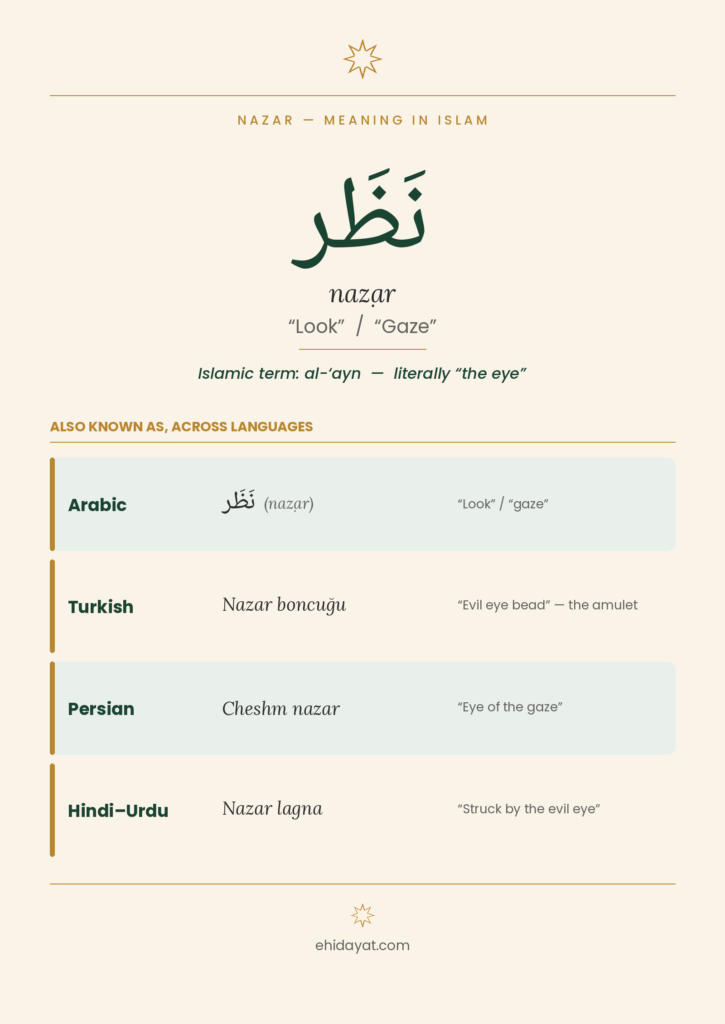
Nazar (نَظَر) is Arabic for “look” or “gaze.” In an Islamic context, it refers to the harm believed to result from an envious or intensely admiring look — the concept Islamic texts call al-‘ayn, literally “the eye.” That’s the plain English meaning most people searching this term are actually after: nazar is what English speakers usually just call “the evil eye.”
Two things worth separating right away. First, nazar doesn’t require ill intent — a genuine compliment given without saying “MashaAllah” can, in this belief, still carry it. Second, the word travels far outside Arabic. The same root shows up, reshaped, across several languages and cultures that also hold some version of this belief:
| Language | Term | Literal Meaning |
|---|---|---|
| Arabic | نَظَر (naẓar) | “Look” / “gaze” — Islamic term: al-‘ayn (“the eye”) |
| Turkish | Nazar boncuğu | “Evil eye bead” — the blue amulet, not the belief itself |
| Persian | Cheshm nazar | “Eye of the gaze” |
| Hindi-Urdu | Nazar lagna | “To be struck by the evil eye” |
[IMAGE PLACEHOLDER — infographic: a simple side-by-side chart showing “Nazar” in Arabic script, its transliteration, its literal meaning, and its Islamic-technical meaning (al-‘ayn). Alt text: “Nazar meaning definition chart showing Arabic root and cross-language terms.”]
Nazar (the Harm) vs. the Blue Nazar Amulet — Are They the Same?
No. This is where most non-Islamic sources blur two separate things together, and it’s exactly why searches like “what is a nazar” or “no nazar meaning” turn up confusing results.
Nazar, as discussed in Islamic texts, is the harmful spiritual effect of an envious or admiring gaze. The blue glass eye bead people also call “a nazar” — often with a name like nazar boncuğu — is a cultural amulet, older than Islam, used across the Mediterranean and Middle East to visually “ward off” that harm. They share a name and a general theme, but Islamically they’re not treated the same way at all.
| Nazar (the belief) | The Blue “Nazar” Amulet | |
|---|---|---|
| What it is | The harmful effect of an envious/admiring gaze | A glass or ceramic eye-shaped charm |
| Origin | Discussed in Quran and Hadith | Pre-Islamic, spread through Mediterranean and Middle Eastern folk culture |
| Islamic ruling | Accepted as a real, established phenomenon | Debated — relying on the object itself for protection is cautioned against |
The part scholars push back on isn’t belief in nazar itself — that’s well established — it’s placing protective power in the object. Trusting a bead to guard you, rather than trusting Allah, is the concern; it can edge toward shirk (associating power with something other than Allah). If you’re looking for what Islam actually prescribes instead of a bead, we’ve laid out authentic duas for protection from the evil eye in full detail, including how to perform ruqyah.
Is Nazar Real? What Islamic Scholars Say
Yes. Mainstream Sunni scholarship holds that nazar is real, and this isn’t a fringe or cultural add-on to the religion — it’s grounded directly in the Quran and Hadith.
The clearest Quranic reference is in Surah Al-Falaq, where believers are taught to seek refuge from “the evil of an envier when he envies” (113:5). You can read the full verse of Surah Al-Falaq on Quran.com — it’s short, and it’s recited specifically for protection from this kind of harm. A widely reported hadith in Sahih Muslim also has the Prophet ﷺ affirming plainly that the effect of the evil eye is real — a statement scholars point to as settling the question within Islamic belief rather than leaving it as folk superstition.
What’s worth holding onto here is the balance: nazar is real, but it isn’t an independent force. Islamic teaching is consistent that it only causes harm by Allah’s permission — meaning a person with strong faith, regular dhikr, and consistent prayer isn’t simply at its mercy. That balance — real, but not all-powerful, and never a reason to live in fear — is the actual scholarly position, not just “believe in it” or “it’s nonsense.”
This isn’t a minority opinion within Islamic scholarship, either. Across the major schools of Sunni thought, there’s broad agreement that denying the reality of nazar outright isn’t the correct position — the evidence in the primary texts is treated as too direct to read any other way. Where scholars do differ, and where they consistently urge caution, is on the cultural add-ons people build around it: blaming every setback on nazar, treating certain people as permanently “cursed,” or assuming any admiration is dangerous. That’s the excess Islam warns against — not the underlying belief itself.
Nazar vs. Hasad (Envy) — What’s the Difference?
They’re related but not identical. Hasad is the inner emotion — envy itself, wishing someone didn’t have what they have. Nazar (al-‘ayn) is the potential harmful effect that can follow from a look, and it can happen with or without conscious envy. Someone can admire your child, your new home, or your success with genuine warmth, and if they don’t attach a blessing like “MashaAllah” to it, Islamic belief holds that nazar can still occur. In short: hasad is what’s in the heart; nazar is what can happen through the eyes, whether or not hasad is present.
Is Nazar Real? Quotable Lines Rooted in the Quran and Sunnah
Search “nazar is real quotes” and you’ll mostly find Instagram captions with no source behind them at all. Here’s the sourced version — short lines you can actually stand behind, each tied to something real rather than a vibe.
- On its reality: Nazar isn’t dismissed in Islam as superstition — it’s named directly in the Quran, in the surah revealed specifically for protection from an envier’s gaze.
- On where it comes from: A look doesn’t need hatred behind it to cause harm — admiration without a blessing is enough, which is why “MashaAllah” is said as often as it is.
- On its limits: Nazar has no power of its own — Islamic teaching is clear that it only reaches someone by Allah’s permission, never independently.
- On protection, not fear: The reminder scholars return to again and again is that nazar is met with dhikr and dua, not dread — fear itself isn’t the Islamic response to it.
- Ibn al-Qayyim’s image of it: one of Islam’s most cited scholars on this topic described the evil eye as an arrow — one that only strikes an unguarded target, and can be turned back by a heart fortified through remembrance of Allah.
- On modesty as protection: long before social media, the guidance was the same — modesty in how blessings are shown is itself a form of guarding against nazar.
- On the story of Ya’qub: when Prophet Ya’qub (peace be upon him) told his sons to enter Egypt through different gates, it’s read as an early, practical example of taking precaution against nazar — without ever doubting that the real protection comes from Allah alone.
- On what actually shields you: it isn’t the bead, the ribbon, or the charm that guards against nazar in Islamic teaching — it’s a heart occupied with remembrance of Allah, which is offered as protection strong enough to need nothing else.
If lines like these are your kind of reading, you’ll probably also like more Quran-based quotes and reflections — same spirit, wider range.
[IMAGE PLACEHOLDER — 2 to 3 quote-card graphics: simple text-on-background designs, one per featured line above, sized for social sharing. Alt text: “Islamic quote about nazar and protection from the evil eye.”]
FAQ
What does nazar mean in English? Nazar is an Arabic word meaning “look” or “gaze.” In an Islamic context, it refers to harm believed to result from an envious or intensely admiring look — often translated simply as “the evil eye.”
What is nazar in Islam? Nazar, or al-‘ayn, is the belief that a look driven by envy or excessive admiration can cause real harm to a person, their health, or their belongings. Mainstream Islamic scholarship treats this as an established, though not independently powerful, spiritual reality.
Is nazar real according to Islam? Yes — scholars across Sunni schools of thought agree nazar is real, citing Quranic verses and hadith on the subject. Its harm only occurs by Allah’s permission, not as an independent force.
Is a nazar the same as the evil eye? Largely yes when discussing the belief itself. “Evil eye” is simply the common English translation of nazar/al-‘ayn. It’s a separate question from the blue nazar amulet, which is a cultural object, not the belief.
What’s the difference between nazar and hasad? Hasad is the inner emotion of envy. Nazar is the potential harmful effect that can follow from a look — which can happen even without deliberate envy, simply from admiration expressed without a blessing.
Does Islam allow wearing a nazar (blue eye) amulet for protection? This is debated. Many scholars caution against relying on the amulet itself, since attributing protective power to an object risks bordering on shirk. Protection is instead sought through Quranic recitation, dua, and remembrance of Allah.
How do you say “no nazar” or ward off nazar in Islam? There’s no single fixed phrase in Islamic practice the way “Masha’Allah” is used to prevent causing nazar. Protection from receiving it is instead sought through specific duas and ruqyah rather than a verbal charm.