
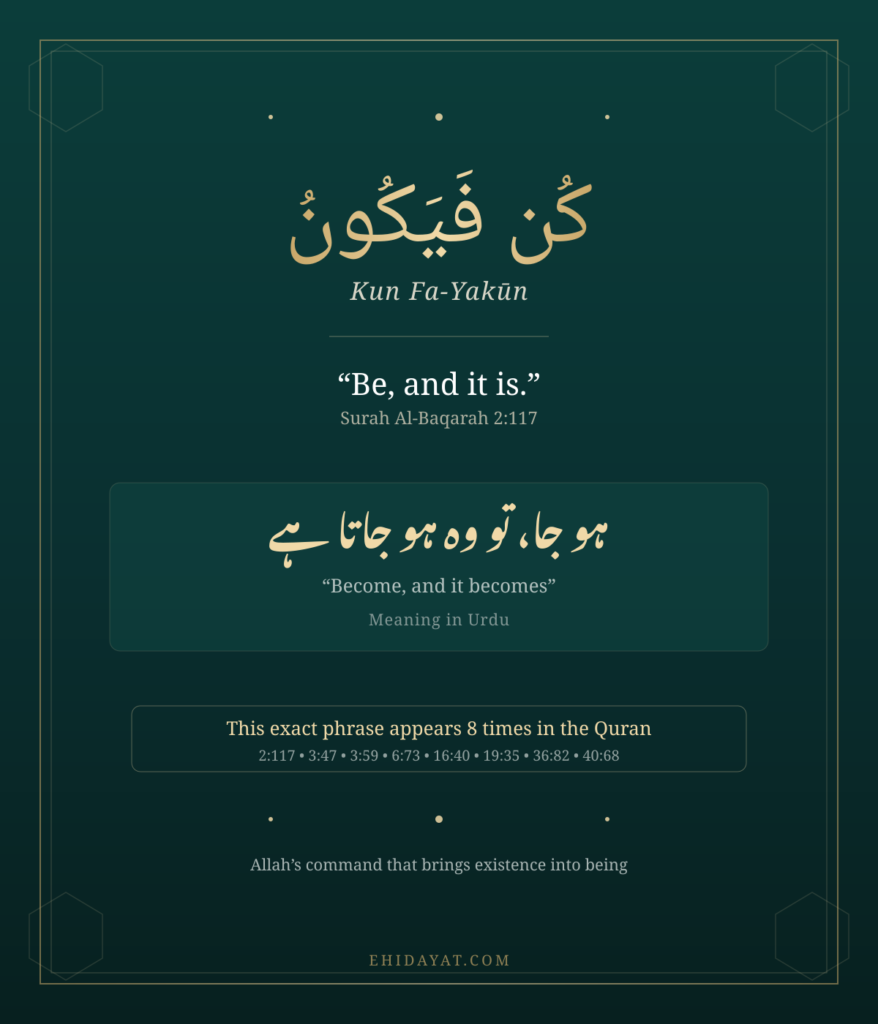
Kun Faya Kun (كُن فَيَكُونُ) means “Be, and it is.” It’s a Quranic phrase describing how Allah brings things into existence — through His command alone, with no process, material, or delay required. In Urdu it’s rendered as “ہو جا، تو وہ ہو جاتا ہے” — “Become, and it becomes.” It’s a description of Allah’s creative power, not a standalone dua formula or a ritual phrase with its own name.
The phrase appears eight times in the Quran, in contexts ranging from the birth of Prophet Isa (AS) to the Day of Judgment, and it sits at the center of a real theological question scholars have debated for centuries: what does it actually mean for Allah to “say” something to a thing that doesn’t yet exist? That’s the part most explanations skip. This one doesn’t.
Kun Faya Kun in Arabic (Correct Text)
The two-word Arabic phrase is كُن فَيَكُونُ, transliterated as Kun fa-yakūn (syllables: Kun fa-ya-kūn).
It breaks into two parts. Kun (كُن) is the imperative form of the verb “to be” — a direct command, “Be.” Fa-yakun (فَيَكُونُ) combines the prefix fa- (“so,” “then”) with yakūn (“it is” or “it becomes,” the present/future form of the same verb). Together, the phrase isn’t one word but a compact command-and-result construction: “Be — and so it is.”
Kun Faya Kun Meaning in Urdu (اردو ترجمہ)
The core Urdu rendering across nearly every Urdu Quran translation is:
“ہو جا، تو وہ ہو جاتا ہے”
The same wording (adjusted slightly for grammatical gender and number depending on the verse) carries through the Urdu translations of all eight verses where the phrase appears — you’ll see “ہو جا” and “وہ ہو جاتا ہے / ہو جاتی ہے / ہو گیا” as the consistent core across translators.
The phrase has a life in Urdu beyond translation, too. In Urdu poetry, “کُن فَیَکُوں” is used as an epithet for Allah Himself — نَقْش بَندِ کُن فَیَکُون (naqsh-band-e-kun-fayakūn), “the One who fashioned the universe by saying Kun.” And the phrase appears directly in the work of Muhammad Iqbal, the South Asian Islamic poet-philosopher, in his collection Bal-e-Jibril — a reminder that this isn’t just a dictionary phrase for Urdu-speaking Muslims, it’s one that’s been sat with and written into their own poetic tradition for a century.
Where Kun Faya Kun Appears in the Quran (All 8 Verses)
The phrase occurs exactly eight times in the Quran. Here’s every occurrence, in order:
| Verse | Context | English meaning |
|---|---|---|
| Al-Baqarah 2:117 | Allah described as the Originator of the heavens and the earth | “When He decrees a matter, He only says to it, ‘Be,’ and it is.” |
| Aal-e-Imran 3:47 | The angel’s answer to Maryam, asking how she could have a child | “When He decrees a matter, He only says to it, ‘Be,’ and it is.” |
| Aal-e-Imran 3:59 | Isa’s (AS) creation compared to Adam’s, created from dust | “He created him from dust; then He said to him, ‘Be,’ and he was.” |
| Al-An’am 6:73 | The Day of Judgment, when the Trumpet is blown | “And the day He says, ‘Be,’ and it is; His word is the truth.” |
| An-Nahl 16:40 | A general statement of Allah’s effortless creative power | “For whenever We intend a thing, We only say to it, ‘Be,’ and it is.” |
| Maryam 19:35 | Immediately after discussing Isa (AS), refuting that Allah has a son | “When He decrees a matter, He only says to it, ‘Be,’ and it is.” |
| Ya-Sin 36:82 | Answering someone who doubted Allah could recreate him after death | “His command is only, when He intends a thing, that He says to it, ‘Be,’ and it is.” |
| Ghafir 40:68 | Allah’s control over life and death | “It is He who gives life and causes death; and when He decrees a matter, He only says to it, ‘Be,’ and it is.” |
One structural detail worth noting: in seven of these eight verses, “kun fa-yakun” falls at the very end of the ayah. Al-An’am 6:73 is the exception — there, the phrase sits in the middle, with “قَوْلُهُ الْحَقُّ” (“His word is the truth”) following right after it in the same verse.
Is “Kun” a Literal Command? What the Scholars Say
Here’s the question the phrase actually raises once you sit with it: if something doesn’t exist yet, how can Allah address it with a command at all? A command needs someone or something on the receiving end.
Classical scholars of kalam (Islamic dialectical theology) split on this. The Ash’ari school — al-Baydawi among them — reads “Kun fa-yakun” as figurative, not literal. On this view, Allah isn’t actually speaking a word to a not-yet-existing thing; the phrase is an allegorical way of expressing that there’s no gap whatsoever between Allah willing something and it happening — no delay, no process, no interval for a “command” to even need to exist. The Maturidi school takes the phrase literally, which means it has to answer the very question that opens this section: how a non-existent thing can be addressed. Ma’arif-ul-Qur’an, the tafsir by Mufti Muhammad Shafi that carries particular weight in the South Asian Urdu-speaking tradition, lays out both positions directly in its commentary on 2:117.
Neither side disputes what the phrase is describing — Allah’s power operating without means, material, or delay. The disagreement is narrower and more interesting than that: whether “Kun” is a real utterance or a picture painted in words for something beyond words.
Doesn’t “Instant” Creation Contradict the Six Days of Creation?
If Allah simply says “Be” and something exists immediately, a fair question follows: why does the Quran also describe the heavens and earth being created in six days (Al-A’raf 7:54)?
The two aren’t in tension. The command “Kun” sets a process in motion instantly — there’s no delay between Allah’s will and its taking effect. But the process that command sets off can itself unfold over whatever span Allah decrees. The six days describe the unfolding, not a lag in the command reaching its target. Put another way: “Kun” is about the absence of any gap between will and outcome, not a claim that every outcome must be complete in a single instant.
Using This Phrase as a Personal Dua
Because the phrase affirms that Allah’s power isn’t bound by ordinary means, some Muslims turn to it when facing a situation that feels stuck or impossible — bringing a specific need to Allah and affirming that if He wills it resolved, no circumstance stands in the way.
It’s worth being direct about what this is and isn’t. “Kun Faya Kun” isn’t a ritual formula with a fixed method or a promised outcome from repetition — it’s a description of Allah’s attribute, not an incantation. Said sincerely, in your own words, alongside a specific dua for your situation, it functions the way remembering any of Allah’s names does: as an anchor for trust, not a technique. If you’re looking for how to structure that kind of focused dua more fully — for an exam, a decision, or anything else weighing on you — this guide on faith, focus, and dua walks through it properly.
FAQ
What does Kun Faya Kun mean in English? “Be, and it is.” It’s a Quranic phrase describing how Allah brings things into existence — through His command alone, with no process, material, or delay required.
What is the meaning of Kun Faya Kun in Urdu? ہو جا، تو وہ ہو جاتا ہے — “Ho ja, to woh ho jata hai,” meaning “Become, and it becomes.” The same rendering, adjusted for grammar, appears across the Urdu translations of all eight Quranic verses containing the phrase.
How many times does Kun Faya Kun appear in the Quran? Eight times: Al-Baqarah 2:117, Aal-e-Imran 3:47 and 3:59, Al-An’am 6:73, An-Nahl 16:40, Maryam 19:35, Ya-Sin 36:82, and Ghafir 40:68.
Is Kun Faya Kun a dua or a Bollywood song? It’s originally a Quranic phrase. A.R. Rahman composed a qawwali titled “Kun Faya Kun” for the film Rockstar (2011), drawing on the phrase’s Sufi and Quranic meaning — which is likely how many people first encounter it — but the phrase itself is from the Quran, describing Allah’s creative command.
Does “Kun” mean Allah literally speaks the word “Be”? Scholars are divided. The Ash’ari view treats it as figurative, illustrating that there’s no gap between Allah’s will and its result. The Maturidi view takes it literally, which raises the classical question of how a command can be addressed to something that doesn’t yet exist.
If Kun Faya Kun means instant creation, why did Allah create the heavens and earth in six days? The command sets a process in motion instantly; the process itself can unfold over whatever span Allah decrees. The six days describe the process, not a delay in the command taking effect.
Can I recite Kun Faya Kun as a dua for my needs? It can be said sincerely as an expression of trust that Allah’s power isn’t limited by your circumstances. It isn’t a ritual formula with guaranteed results — its value is in what it affirms about Allah, not in repetition as a technique.
The real weight of “Kun Faya Kun” isn’t in the two words themselves — it’s in what scholars have spent centuries working out about what it means for Allah to “speak” to what doesn’t yet exist, and whether that word is even the right one for what’s actually happening. If you’re looking at another short Quranic phrase and what it means in Urdu, Innallaha Ma Sabireen follows the same format as this piece. And since Kun Faya Kun is ultimately a demonstration of specific attributes of Allah — Al-Khaliq, Al-Qadir, Al-Badi’ — the 99 Names of Allah is a natural next read.
Sources: Al-Baqarah 2:117 — Quran.com · Ya-Sin 36:82 — Quran.com · Ma’arif-ul-Qur’an on 2:117 — Quran.com