
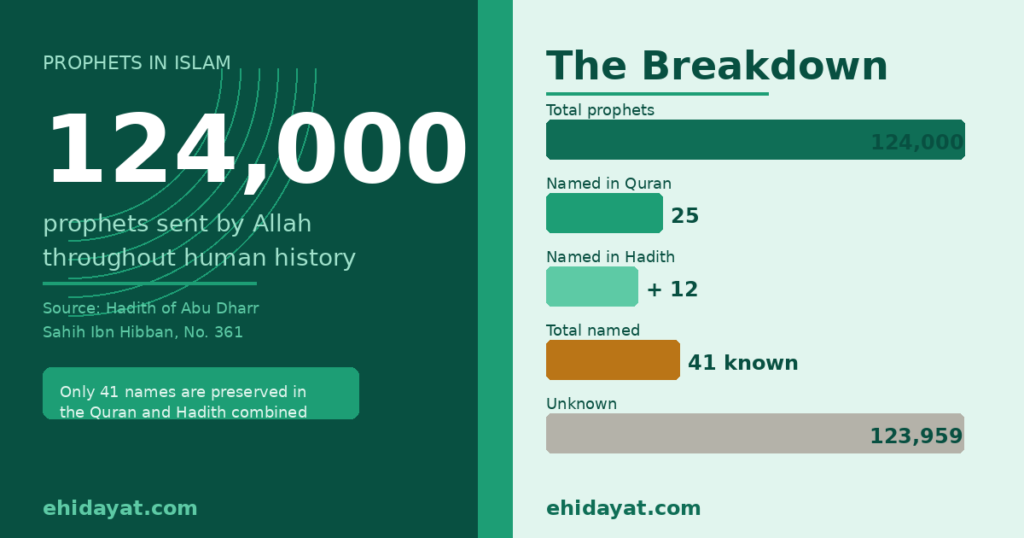
Islamic tradition holds that Allah sent 124,000 prophets throughout human history. Of those, only 41 are actually named anywhere in the Quran or Hadith. The Quran names 25 directly; 16 more come from Hadith literature and early Islamic historical sources. The remaining 123,959 are simply lost to history.
That gap is not an accident or an oversight — and the hadith the 124,000 figure comes from carries a scholarly grading most popular articles never mention. This guide covers all of it: where the number comes from, whether it holds up, and every name that made it into the written record.
How Many Prophets Are There in Islam?
Allah sent 124,000 prophets, according to a hadith narrated by Abu Dharr al-Ghifari. Of those, only 41 have been named in Islamic scripture — 25 in the Quran and 12 more in Hadith and early Islamic historical sources. The rest are unknown, and no text has ever recorded them.
The Quran itself confirms this openly. Surah Ghafir (40:78) says: “And We did certainly send messengers before you — among them are those whose stories We have related to you, and among them are those whose stories We have not related to you.” The 124,000 figure tells us the scale; the 41 names are simply what history preserved.
If you want the full story of each of the 25 core prophets — their lives, their miracles, their missions — the 99 Names of Allah guide on this site gives useful context on how Islamic tradition understands Allah’s relationship to His creation across all of prophetic history.
The Hadith of Abu Dharr: Where the Number 124,000 Comes From
The 124,000 figure does not appear in the Quran. It comes entirely from one narration. Abu Dharr al-Ghifari, one of the closest companions of the Prophet Muhammad ﷺ, asked him directly: how many prophets were sent? Two major hadith collections record the answer.
Arabic:
قَالَ قُلْتُ يَا رَسُولَ اللَّهِ كَمِ الأَنْبِيَاءُ قَالَ مِائَةُ أَلْفٍ وَأَرْبَعَةٌ وَعِشْرُونَ أَلْفًا مِنْهُمُ الرُّسُلُ ثَلَاثُمِائَةٍ وَثَلَاثَةَ عَشَرَ جَمًّا غَفِيرًا
Transliteration:
Qultu: yā Rasūlallāh, kamil-anbiyā’? Qāla: mi’atu alfin wa arba’atun wa ‘ishrūna alfā, minhum al-rusul thalāthu mi’atin wa thalāthata ‘ashara jamman ghafīrā.
Translation:
“I said: O Messenger of Allah, how many prophets were there? He said: One hundred and twenty-four thousand, of whom three hundred and thirteen were messengers — a great company.”
(Sahih Ibn Hibban, Hadith 361; also in Musnad Ahmad, Hadith 22288, via Abu Umamah al-Bahili)
The narration establishes two things at once — the total number of prophets and the smaller count of messengers among them. The phrase “a great company” (jamman ghafiran) is borrowed directly from the Quran (Surah An-Nisa, 4:173), which is why it has carried such weight in popular teaching even as scholars have questioned the chain beneath it.
313 or 315 Messengers? Resolving the Discrepancy
Both numbers appear in Islamic sources, and the difference causes genuine confusion. The version recorded in Sahih Ibn Hibban says 313. The version in Musnad Ahmad — transmitted through Abu Umamah rather than Abu Dharr — says 315.
Scholars do not treat this as a contradiction. It is a transmission variant of the ordinary kind: two reporters of the same event recall a number slightly differently across separate chains. Neither figure can be verified independently of the narration itself, which makes the discrepancy less significant than it first appears.
The number 313 carries additional resonance in Islamic tradition because it matches the number of Muslim fighters at the Battle of Badr — the first and most decisive early battle of Islam. That coincidence has led many scholars and teachers to favour 313, though no authoritative source resolves the question definitively.
Is the 124,000 Prophets Hadith Authentic?
This is the question almost no popular Islamic article addresses, despite being one of the most searched angles on this topic. The direct answer: the hadith is not graded sahih (authentic). Most hadith specialists grade it da’if (weak) or da’if jiddan (very weak). It cannot be treated as a confirmed fact the way an authentic narration can.
The core problem is the narrator Ibrahim ibn Hisham al-Ghassani. Three of the most respected hadith critics in Islamic history — Abu Hatim al-Razi, Abu Zur’ah al-Razi, and al-Dhahabi — described him explicitly as a liar (kadhdhab) and a fabricator. Ibn al-Jawzi went further and included this narration in al-Mawdu’at, his compiled list of fabricated hadith. That is one of the most severe classifications a narration can receive.
| Scholar | Source | Grading | Basis |
|---|---|---|---|
| Shu’ayb al-Arna’ut | Tahqiq of Sahih Ibn Hibban | Da’if jiddan (very weak) | Ibrahim ibn Hisham called a liar by Abu Hatim and Abu Zur’ah |
| Ibn al-Jawzi | Al-Mawdu’at | Munkar / mawdu’ (fabricated) | Narrator accused of fabrication; chain effectively broken |
| Ibn Taymiyyah | Majmu’ al-Fatawa | Da’if (weak) | “Was not proven from the Prophet, peace be upon him” |
| Al-Dhahabi | Mizan al-I’tidal | Da’if jiddan (very weak) | Considered Ibn Hisham among the most unreliable narrators |
| Ibn Kathir | Al-Bidaya wa al-Nihaya | Da’if (weak) | Weak but not fabricated; figure is widely transmitted |
| Imam al-Suyuti | Al-La’ali al-Masnu’ah | Da’if (weak) | Defends as weak-not-fabricated; Quran is consistent with a large number |
Not all scholars went as far as Ibn al-Jawzi. Ibn Kathir and al-Suyuti stopped short of calling it fabricated, arguing that the Quran’s repeated statement — that Allah sent messengers to every nation — is consistent with a very large number of prophets, even if the specific figure 124,000 cannot be proven. That is the middle position most traditional scholars hold today.
Ibn Taymiyyah’s practical guidance was sound: ground belief in what the Quran actually confirms — that countless messengers were sent, many of whose stories were never related — rather than building doctrine on a specific unverified count. The Quran’s assurance is sufficient. The number does not need to be 124,000 to make the theological point it is used to make.
Key takeaway: The 124,000 figure is not sahih. It rests on a weak narration disputed by major hadith scholars because of an unreliable narrator in its chain. Believing Allah sent an enormous, uncountable number of prophets is well-supported by the Quran. Treating 124,000 as a precisely confirmed count is not.
Why Has No One Listed All 124,000 Names?
There is no hidden list. No text — Quran, Hadith, or otherwise — records anything approaching a full catalogue of 124,000 prophets. This absence is not an oversight scholars have failed to fill. It is structurally impossible, and understanding why clarifies what the 124,000 figure is actually claiming.
In traditional Islamic chronology, roughly 5,000 years separate Adam from Muhammad ﷺ. If prophets were sent continuously and individually to every human community across that span — as Surah An-Nahl (16:36) states, “There is not a nation but that there has passed within it a warner” — then hundreds of prophets may have been active simultaneously in separate, unconnected civilisations across Africa, Asia, the Americas, and beyond. Most of those civilisations left no written record that has survived to us. Most of those prophets lived and died without their missions ever being documented in any form that reached seventh-century Arabia.
What the Quran preserved was the prophets whose missions were directly relevant to the chain of revelation culminating in Muhammad ﷺ — primarily the Abrahamic lineage and its branches. The rest are not lost from Allah’s knowledge; they are simply lost from ours. That is exactly what Surah Ghafir (40:78) is saying.
The Complete List of All 41 Named Prophets
Many versions of this list circulate online with errors: duplicated entries, wrong Quran mention counts, and figures included without noting that their prophet status is disputed. The tables below cross-reference multiple sources. Where scholarly opinion differs, that is noted explicitly — something most competitor lists quietly skip.
Part 1 — 29 Prophets Named in the Quran
| # | Name | Arabic | Biblical Equivalent | Quran Mentions |
|---|---|---|---|---|
| 1 | Adam | آدَم | Adam | 25 |
| 2 | Idris | إِدْرِيس | Enoch | 2 |
| 3 | Nuh | نُوح | Noah | 43 |
| 4 | Hud | هُود | Eber (approximate) | 7 |
| 5 | Salih | صَالِح | — | 9 |
| 6 | Ibrahim | إِبْرَاهِيم | Abraham | 69 |
| 7 | Lut | لُوط | Lot | 27 |
| 8 | Isma’il | إِسْمَاعِيل | Ishmael | 12 |
| 9 | Ishaq | إِسْحَاق | Isaac | 17 |
| 10 | Ya’qub | يَعْقُوب | Jacob | 16 |
| 11 | Yusuf | يُوسُف | Joseph | 27 |
| 12 | Ayyub | أَيُّوب | Job | 4 |
| 13 | Shu’ayb | شُعَيْب | Jethro (approximate) | 11 |
| 14 | Musa | مُوسَى | Moses | 136 |
| 15 | Harun | هَارُون | Aaron | 20 |
| 16 | Dhul-Kifl | ذُو الْكِفْل | Ezekiel (disputed) | 2 |
| 17 | Dawud | دَاوُود | David | 16 |
| 18 | Sulayman | سُلَيْمَان | Solomon | 17 |
| 19 | Ilyas | إِلْيَاس | Elijah | 2 |
| 20 | Al-Yasa’ | الْيَسَع | Elisha | 2 |
| 21 | Yunus | يُونُس | Jonah | 4 |
| 22 | Zakariyya | زَكَرِيَّا | Zechariah | 7 |
| 23 | Yahya | يَحْيَى | John the Baptist | 5 |
| 24 | Isa | عِيسَى | Jesus | 25 |
| 25 | Muhammad | مُحَمَّد | — | 4 direct + Ahmad (1) |
| 26 | Luqman | لُقْمَان | — | 2 (Majority view: wise man, not prophet — status disputed) |
| 27 | Talut | طَالُوت | Saul | 2 (King, not prophet — included on some lists in error) |
| 28 | Dhul-Qarnayn | ذُو الْقَرْنَيْن | Alexander (debated) | 3 (Identity and prophet status both disputed) |
| 29 | Khidr | الْخَضِر | — | Not named directly (Prophet or wali — scholars differ) |
A note on Musa: He is the most-mentioned prophet in the Quran at 136 references — nearly twice that of Ibrahim (69) in second place. Surah Al-Anbiya (chapter 21) contains the largest number of prophets named in a single chapter: 16.
Part 2 — 12 Prophets Named in Hadith and Islamic Scripture
These names do not appear in the Quran. They come from Hadith collections, early Islamic historical writing — particularly Ibn Kathir’s Al-Bidaya wa al-Nihaya — and Isra’iliyyat, traditions passed down from Jewish and Christian converts to early Islam. Their inclusion reflects widespread classical Islamic recognition, not Quranic confirmation.
| # | Name | Arabic | Biblical Equivalent | Primary Source |
|---|---|---|---|---|
| 30 | Sheeth | شِيث | Seth | Hadith |
| 31 | Shem | سَام | Shem (son of Noah) | Hadith |
| 32 | Ham | حَام | Ham (son of Noah) | Hadith |
| 33 | Japheth | يَافِث | Japheth (son of Noah) | Hadith |
| 34 | Hanzalah ibn Safwan | حَنْظَلَة بن صَفْوَان | — | Hadith |
| 35 | Khidr | الْخَضِر | — | Hadith / Quran narrative (Status disputed — also listed above) |
| 36 | Yusha ibn Nun | يُوشَع بن نُون | Joshua | Hadith |
| 37 | Shumail | شُمُوئِيل | Samuel | Hadith / Isra’iliyyat |
| 38 | Isaiah (Sha’ya) | شَعْيَا | Isaiah | Islamic historical sources |
| 39 | Armiya | إِرْمِيَا | Jeremiah | Islamic historical sources |
| 40 | Daniyal | دَانِيَال | Daniel | Islamic historical sources |
| 41 | Hizqeel | حِزْقِيَال | Ezekiel | Islamic historical sources |
How Does 124,000 Compare to Other Traditions?
Each of the three Abrahamic faiths has its own answer to how many prophets God sent, and the contrast is significant.
The Talmud (tractate Megillah) records 48 male and 7 female prophets in Jewish tradition — 55 total. Of those, 48 were considered significant enough that their prophecies were recorded for future generations; the rest spoke only to their immediate generation and left no written record. Christian traditions count differently depending on methodology. The Old Testament alone contains somewhere between 88 and 133 named individuals in prophetic roles, depending on how strictly “prophet” is defined.
Islam’s 124,000 is a claimed total of prophets sent — not a count of named ones. The 41 Islamic names preserved in the Quran and Hadith overlap almost entirely with prophets the other two traditions already recognise. What is distinctly Islamic is the theological claim underneath the number: that prophethood was not confined to one region or one people, but was sent to every civilisation, every community, across all of human history. The Quran does not describe Islam as the religion of one people. It describes it as the culmination of a universal prophetic mission that reached every corner of the earth long before Muhammad ﷺ was born.
Nabi vs. Rasul: What Is the Difference?
The hadith uses both words, and the distinction matters. A Nabi (نَبِيّ) is a prophet who receives revelation and upholds or teaches an existing divine law. A Rasul (رَسُول) is a messenger given an entirely new scripture to deliver to humanity — like Musa with the Torah, Isa with the Injil, or Muhammad ﷺ with the Quran.
Every Rasul is also a Nabi. Not every Nabi is a Rasul. Of the 124,000 prophets, only 313 (or 315, depending on the chain) were Rasuls. The word nabi and its forms appear around 75 times in the Quran; rasul and its derivatives appear over 300 times.
The highest rank among the Rasuls is the five Ulul Azm — the Prophets of Firm Resolve, those who carried the most demanding missions and endured the greatest tests:
- Nuh (Noah)
- Ibrahim (Abraham)
- Musa (Moses)
- Isa (Jesus)
- Muhammad ﷺ
These five are singled out together in Surah Al-Ahzab (33:7) and Surah Ash-Shura (42:13) as those with whom Allah took a solemn covenant. Understanding the last two ayat of Surah Al-Baqarah — which close one of the Quran’s longest chapters with a direct statement of belief in all of Allah’s messengers — gives important context for how this chain of prophethood is understood in Islamic theology.
Frequently Asked Questions
How many prophets are there in Islam? Islamic tradition holds that Allah sent 124,000 prophets throughout history, according to a hadith narrated by Abu Dharr. Of these, only 41 are actually named across the Quran (29) and Hadith and Islamic scripture (12). The rest remain unknown to history, by design — the Quran itself confirms that not all prophetic stories were revealed.
Is the 124,000 prophets hadith authentic? No. Hadith scholars including Shu’ayb al-Arna’ut and Ibn al-Jawzi grade this narration as da’if (weak) or da’if jiddan (very weak), primarily because of the unreliable narrator Ibrahim ibn Hisham al-Ghassani. It is not classified as sahih. Scholars like Ibn Kathir and al-Suyuti stopped short of calling it fully fabricated, but none grade it as authentic.
Why isn’t there a full list of all 124,000 prophet names? No textual source — Quran, Hadith, or otherwise — records all 124,000 names. With roughly 5,000 years of prophetic history across civilisations worldwide, most prophets lived in communities that left no surviving written record. The Quran (40:78) explicitly states that not all prophetic stories were revealed to Muhammad ﷺ.
How many prophets are named in the Quran? The Quran names exactly 25 prophets, from Adam to Muhammad ﷺ. Surah Al-Anbiya (chapter 21) is the single chapter that names the most prophets — 16 in one place.
Were there 313 or 315 messengers among the prophets? Both figures appear in different chains of the same hadith — 313 in the Ibn Hibban narration via Abu Dharr, and 315 in a Musnad Ahmad variant via Abu Umamah. Scholars treat this as a normal transmission variant, not a contradiction. Neither count can be independently verified.
What is the difference between a Nabi and a Rasul? A Nabi upholds an existing divine law; a Rasul brings an entirely new scripture. Every Rasul is also a Nabi, but not every Nabi is a Rasul. Of 124,000 prophets, only 313 or 315 were Rasuls. The five greatest Rasuls — Nuh, Ibrahim, Musa, Isa, and Muhammad ﷺ — are known as the Ulul Azm (Prophets of Firm Resolve).
Who are the 12 prophets named in Hadith but not the Quran? They are Sheeth (Seth), Shem, Ham, Japheth, Hanzalah ibn Safwan, Khidr, Yusha ibn Nun (Joshua), Shumail (Samuel), Isaiah, Armiya (Jeremiah), Daniyal (Daniel), and Hizqeel (Ezekiel). These come from Hadith collections and early Islamic historical sources, not from the Quran directly.
How does Islam’s prophet count compare to Judaism and Christianity? Jewish tradition names 55 prophets (48 male, 7 female) in the Talmud. Christian sources count between 88 and 133 named biblical prophets depending on methodology. Islam’s 124,000 is by far the largest claimed total — but it is a total of prophets sent across all of human history, not a list of named individuals. The 41 names Islam does preserve overlap almost entirely with those the other two traditions already recognise.
Sources
- Sahih Ibn Hibban, Hadith 361 (muhaqqiq: Shu’ayb al-Arna’ut, Mu’assasat al-Risalah)
- Musnad Ahmad ibn Hanbal, Hadith 22288
- Ibn al-Jawzi, Al-Mawdu’at (vol. 1)
- Ibn Taymiyyah, Majmu’ al-Fatawa (vol. 1)
- Al-Dhahabi, Mizan al-I’tidal
- Ibn Kathir, Al-Bidaya wa al-Nihaya
- Al-Suyuti, Al-La’ali al-Masnu’ah fi al-Ahadith al-Mawdu’ah
- Wikipedia — Prophets and messengers in Islam (for Quran mention counts and biblical equivalents)
This article is for educational reference. Matters of aqeedah (Islamic creed) should be verified with a qualified Islamic scholar