
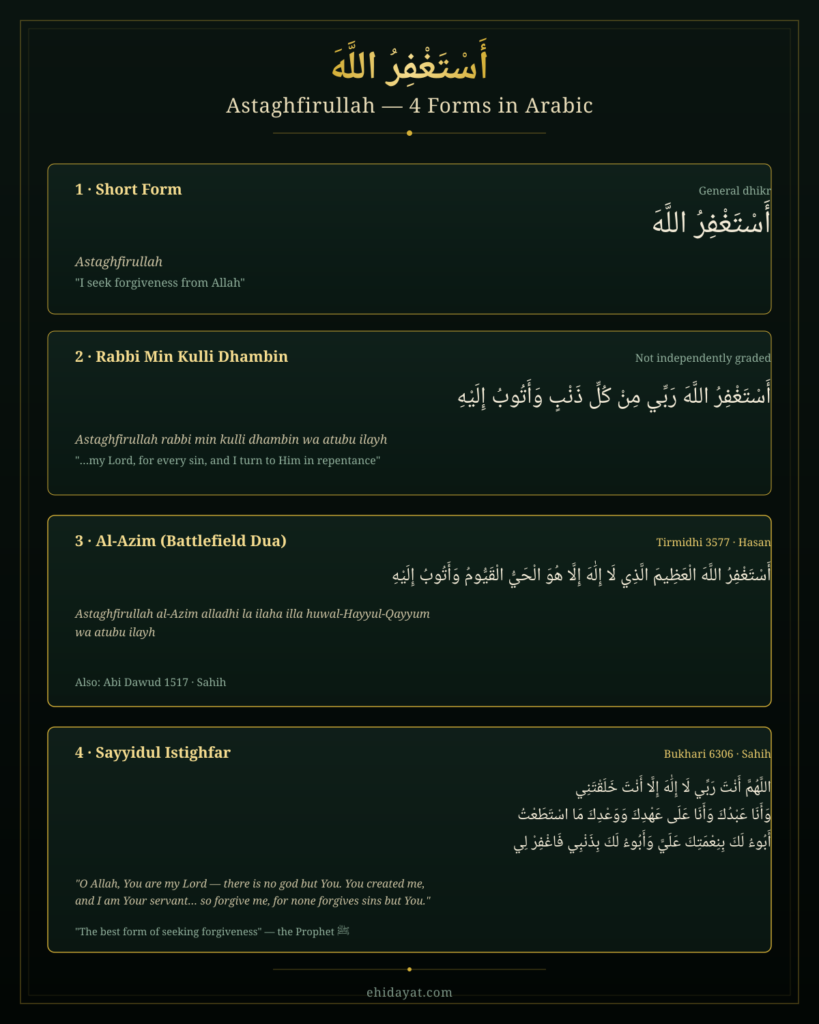
Astaghfirullah (أَسْتَغْفِرُ اللَّهَ) means “I seek forgiveness from Allah.” It’s the phrase Muslims reach for most — after a mistake, during Salah, or simply as daily dhikr — and it exists in several authentic Arabic forms, from the single word above to a full prophetic dua with its own hadith reference. Below is the Arabic text for each form, ready to copy, along with exactly where each one comes from and how strong that source actually is.
What Does Astaghfirullah Mean in Arabic?
Astaghfirullah breaks into two parts: astaghfiru (“I seek forgiveness”) and Allah (“God”). Put together, أَسْتَغْفِرُ اللَّهَ reads literally as “I seek forgiveness [from] Allah.”
Both words trace back to the root غ-ف-ر (gha-fa-ra), which doesn’t just mean “forgive” — it means “to cover” or “to shield.” So saying Astaghfirullah isn’t only asking Allah to pardon a mistake; it’s asking Him to cover it, the way a blanket covers something you’d rather not have exposed. That’s also where maghfirah, one of the Quran’s own words for divine forgiveness, comes from — same root, same idea of mercy that hides a fault rather than merely excusing it.
Astaghfirullah in Arabic Text — Copy and Paste
Here’s the Arabic text for the four most common forms, formatted to copy directly — for a WhatsApp status, a caption, or just to keep on hand.
Short form أَسْتَغْفِرُ اللَّهَ Astaghfirullah — “I seek forgiveness from Allah”
Rabbi min kulli dhambin أَسْتَغْفِرُ اللَّهَ رَبِّي مِنْ كُلِّ ذَنْبٍ وَأَتُوبُ إِلَيْهِ Astaghfirullah rabbi min kulli dhambin wa atubu ilayh — “I ask forgiveness of my sins from Allah, my Lord, and I turn to Him in repentance”
Al-Azim (the battlefield-forgiveness dua) أَسْتَغْفِرُ اللَّهَ الْعَظِيمَ الَّذِي لَا إِلَٰهَ إِلَّا هُوَ الْحَيُّ الْقَيُّومُ وَأَتُوبُ إِلَيْهِ Astaghfirullah al-Azim alladhi la ilaha illa huwal-Hayyul-Qayyum wa atubu ilayh — “I seek forgiveness from Allah the Magnificent, besides whom there is no god, the Ever-Living, the Sustainer of all, and I repent to Him”
Sayyidul Istighfar (the full prophetic dua) اللَّهُمَّ أَنْتَ رَبِّي لَا إِلَٰهَ إِلَّا أَنْتَ خَلَقْتَنِي وَأَنَا عَبْدُكَ وَأَنَا عَلَى عَهْدِكَ وَوَعْدِكَ مَا اسْتَطَعْتُ أَعُوذُ بِكَ مِنْ شَرِّ مَا صَنَعْتُ أَبُوءُ لَكَ بِنِعْمَتِكَ عَلَيَّ وَأَبُوءُ لَكَ بِذَنْبِي فَاغْفِرْ لِي فَإِنَّهُ لَا يَغْفِرُ الذُّنُوبَ إِلَّا أَنْتَ
One thing worth knowing before you paste any of these: some apps strip or reorder Arabic diacritics — the small marks above and below the letters — especially older WhatsApp builds and certain Android keyboards. If the text looks jumbled after pasting, switch to the plain consonant version without diacritics, أستغفر الله, which renders more reliably across platforms.
The 4 Main Forms of Astaghfirullah Dua in Arabic (Comparison Table)
Astaghfirullah isn’t one fixed phrase. It ranges from a single word to a full prophetic supplication, and each version has its own footing in the hadith literature — some stronger than others. Here’s how the four compare:
| Form | Arabic | Hadith Source | Authenticity Grade | Best Used When |
|---|---|---|---|---|
| Astaghfirullah (short) | أَسْتَغْفِرُ اللَّهَ | General istighfar is well-attested throughout the Sunnah, not tied to one hadith | N/A — a general dhikr, not a narrated formula | Quick, everyday repentance after a mistake, or casual dhikr |
| Rabbi min kulli dhambin | أَسْتَغْفِرُ اللَّهَ رَبِّي مِنْ كُلِّ ذَنْبٍ وَأَتُوبُ إِلَيْهِ | Widely recited; this exact wording isn’t traced to a specific hadith in Bukhari or Muslim | Not independently graded — general istighfar principle applies | When you want something fuller than the one-word version |
| Al-Azim (battlefield dua) | أَسْتَغْفِرُ اللَّهَ الْعَظِيمَ الَّذِي لَا إِلَٰهَ إِلَّا هُوَ الْحَيُّ الْقَيُّومُ وَأَتُوبُ إِلَيْهِ | Jami’ at-Tirmidhi 3577; Sunan Abi Dawud 1517 | Tirmidhi’s version graded Hasan by Al-Albani; Abi Dawud’s graded Sahih by Al-Albani | After a serious lapse, or whenever you want the strongest textual promise behind it |
| Sayyidul Istighfar | (full text above) | Sahih al-Bukhari 6306 | Sahih | Morning and evening — the form the Prophet ﷺ called the best |
Two things are worth pulling out of that table. First, only the last two forms carry a specific hadith reference. The short form and the “Rabbi min kulli” version get recited because they’re simple and meaningful — not because a particular narration prescribes those exact words. That’s not a problem; general istighfar is commanded throughout the Quran regardless of which phrasing carries it. But it does mean you shouldn’t attribute either one to “the Prophet said” without a citation you can actually check.
Second, wording matters for the Al-Azim dua specifically. Its hadith promise — forgiveness even for someone who fled the battlefield — is tied to that exact Arabic text, not a paraphrase of it. If the point of reciting it is the reward mentioned in the hadith, get the wording right.
Astaghfirullah Rabbi Min Kulli Dhambin — Meaning and Authenticity
“Astaghfirullah rabbi min kulli dhambin wa atubu ilayh” means “I ask forgiveness of my sins from Allah, my Lord, for every sin, and I turn to Him in repentance.” It’s the version most often taught right after the basic Astaghfirullah — longer, more specific, still short enough to say from memory.
Here’s the part most pages skip over: this exact phrasing isn’t recorded word-for-word as a hadith in Sahih al-Bukhari or Sahih Muslim. That doesn’t make it invalid — asking forgiveness “for every sin” is precisely what istighfar is meant to do, and the underlying practice is firmly established in authentic Sunnah. It just means this specific wording shouldn’t be cited as a numbered hadith the way the next two forms can be. Say it as a sincere, general dua rather than presenting it as a narrated Prophetic formula.
Astaghfirullah Al-Azim Alladhi La Ilaha Illa Huwa — The Battlefield-Forgiveness Dua
This is the longer form with the strongest documented promise attached to it: “I seek forgiveness from Allah the Magnificent, besides whom there is no god, the Ever-Living, the Sustainer of all, and I repent to Him.”
The hadith behind it appears in two places. Jami’ at-Tirmidhi records it as hadith 3577, graded Hasan by Al-Albani. The same dua shows up in Sunan Abi Dawud as hadith 1517, graded Sahih by Al-Albani — a stronger grading on its own. Imam Al-Hakim went further, authenticating the chain “on the conditions of Bukhari and Muslim,” a judgment the later scholar Adh-Dhahabi agreed with.
What sets this version apart is the specific promise attached to it: whoever recites it, Allah will forgive him — even if he fled the battlefield, historically one of the gravest sins a Muslim soldier could commit. Scholars point to this as illustrating a broader principle rather than a literal battlefield-only clause: if sincere istighfar covers something as serious as desertion in war, it isn’t too weak for the ordinary mistakes most people are actually seeking forgiveness for. Reach for this one when you want the version with the clearest textual backing, not just a general sense that “istighfar is good.”
Sayyidul Istighfar — The Greatest Form of Istighfar in Arabic
Sayyidul Istighfar — “the master of seeking forgiveness” — is the fullest version of the dua, and the one the Prophet ﷺ specifically named as the best. It’s recorded in Sahih al-Bukhari, hadith 6306, which makes it Sahih by definition; there’s no separate grading debate to have here.
The Arabic (shown in full in the copy-paste section above) translates roughly as: “O Allah, You are my Lord, there is no god but You. You created me and I am Your servant, and I hold to Your covenant and promise as best I can. I seek refuge in You from the evil I have done. I acknowledge Your favor upon me, and I acknowledge my sin — so forgive me, for none forgives sins except You.”
The hadith attaches a specific reward: whoever recites it during the day with firm faith and dies before evening enters Paradise, and the same holds for reciting it at night before morning. That’s a stronger claim than the shorter forms carry, and it’s part of why scholars rank this dua above them — not because the shorter versions are less valid, but because this one combines Tawheed, gratitude, confession, and a direct plea in a single supplication.
How to Pronounce Astaghfirullah Correctly
Break it into four pieces: As-tagh-fi-rul-lah.
- As — like the “us” in “must,” lightly stressed
- tagh — the tricky part. The غ is a soft, throaty sound, somewhere between a French “r” and a gentle gargle — not a hard English “g”
- fi-rul — flows quickly, closer to “fear-ul” than “fire-ul”
- lah — a soft, open “ah,” not “law”
Sincerity carries more weight than a perfect accent. But if you want to hear it said correctly before practicing, a short recitation clip from a native speaker will get you further than any phonetic guide, this one included.
Why Do Muslims Say Astaghfirullah? Quran and Hadith Evidence
Seeking forgiveness isn’t a side theme in Islam — it’s commanded directly. “And seek forgiveness of Allah. Indeed, Allah is ever Forgiving and Merciful” (Quran 4:106) is about as plain an instruction as scripture gives.
Surah Nuh ties istighfar to something beyond spiritual pardon: “Ask forgiveness of your Lord. Indeed, He is ever Forgiving. He will send [rain from] the sky upon you in abundance, and give you increase in wealth and children” (Quran 71:10–12). Whatever a person is short on — provision, ease, opportunity — this verse frames istighfar as a starting point worth taking seriously, not a transaction that guarantees an outcome.
The Prophet ﷺ modeled the practice constantly. Abu Hurairah reported hearing him say: “By Allah, I seek Allah’s forgiveness and turn to Him in repentance more than seventy times a day” (Sahih al-Bukhari). That’s the Prophet ﷺ — the one person Muslims believe was already forgiven — treating istighfar as a daily habit rather than an emergency measure. It’s a hard example to argue around when looking for a reason to skip it.
Is Astaghfirullah Only a Prayer, or Also an Everyday Expression?
Both. Alongside its use as dhikr, Astaghfirullah is commonly said as a spontaneous reaction — to shock, disapproval, or bad news, closer to how someone might say “oh no” or “good grief” in English. Hearing about an accident, watching someone behave badly, or catching your own mistake mid-sentence can all trigger it.
That dual use isn’t a departure from the religious meaning; it’s an extension of it. Reacting to something wrong by invoking Allah’s forgiveness — even reflexively — keeps the same root idea: turning toward Allah the moment something goes off track, instead of just shrugging it off. Linguists have documented it entering slang usage among younger multilingual English speakers, too, as a general exclamation of alarm separate from any specific religious context.
Where it does cross a line is sarcasm — using it to mock someone or tack onto a joke at their expense. That usage strips the phrase of the humility it’s supposed to carry, which is why most scholars discourage it even though the words themselves aren’t restricted to formal prayer.
When Should You Recite Astaghfirullah?
There’s no fixed schedule, but a few moments come up again and again in the Sunnah and in everyday practice:
- Right after each of the five daily prayers — the Prophet ﷺ reportedly said it three times upon finishing Salah
- Before sleeping, as a way to close out the day
- The moment you realize you’ve made a mistake, big or small
- During stretches of hardship or stress, which scholars connect directly to relief through istighfar
- As general dhikr, whenever there’s a quiet moment worth filling with remembrance rather than scrolling
None of these are requirements. Astaghfirullah works whenever it’s said and meant.
Astaghfirullah in Arabic, Urdu, and Roman Transliteration
For readers more comfortable reading Urdu or Roman script than Arabic, here’s how the two most common forms translate across scripts:
| Dua Form | Arabic | Urdu Translation | Roman Transliteration |
|---|---|---|---|
| Short form | أَسْتَغْفِرُ اللَّهَ | میں اللہ سے معافی مانگتا ہوں | Astaghfirullah |
| Rabbi min kulli dhambin | أَسْتَغْفِرُ اللَّهَ رَبِّي مِنْ كُلِّ ذَنْبٍ وَأَتُوبُ إِلَيْهِ | میں اپنے تمام گناہوں کی معافی اپنے رب سے مانگتا ہوں اور اسی کی طرف رجوع کرتا ہوں | Astaghfirullah Rabbi Min Kulli Zambin Wa Atubu Ilayh |
This table is meant as a quick reference rather than the full picture. For the deeper Urdu meaning, a word-by-word breakdown, and the “increase in rizq” connection scholars draw from Surah Nuh, see our Astaghfirullah meaning in Urdu guide.
FAQ
What does Astaghfirullah mean in Arabic? Astaghfirullah (أَسْتَغْفِرُ اللَّهَ) means “I seek forgiveness from Allah.” It comes from the root غ-ف-ر (gha-fa-ra), meaning “to cover” or “to protect,” so the phrase carries the sense of asking Allah to cover one’s sins and shield one from their consequences.
How do you write Astaghfirullah in Arabic text? The short form is written أَسْتَغْفِرُ اللَّهَ. Longer forms exist too — for example أَسْتَغْفِرُ اللَّهَ الْعَظِيمَ (Astaghfirullah al-Azim) adds “the Magnificent.” All four forms covered above can be copied directly from the text blocks in this guide.
What’s the difference between Astaghfirullah and Astaghfirullah Rabbi Min Kulli Dhambin? Astaghfirullah alone is the basic dhikr. “Rabbi min kulli dhambin wa atubu ilayh” extends it to “…my Lord, for every sin, and I turn to Him in repentance” — a fuller, more specific version of the same request.
Is the Astaghfirullah Al-Azim hadith authentic? Yes. The version ending “…alladhi la ilaha illa Huwa al-Hayy al-Qayyum wa atubu ilayh” is recorded in Jami’ at-Tirmidhi (3577), graded Hasan by Al-Albani, and in Sunan Abi Dawud (1517), graded Sahih by Al-Albani.
Can Astaghfirullah be said just as an expression, not a prayer? Yes — alongside its use as dhikr, Astaghfirullah is commonly used as an exclamation of shock, disapproval, or regret in everyday speech. Both uses carry the same root idea of turning away from something wrong, though it shouldn’t be used sarcastically.
What does Astaghfirullah mean in Urdu? In Urdu, Astaghfirullah is rendered as میں اللہ سے معافی مانگتا ہوں (main Allah se maafi maangta hoon) — “I ask forgiveness from Allah” — carrying the same meaning as the Arabic original.
How many times should Astaghfirullah be recited daily? There’s no fixed requirement. The Prophet ﷺ is reported to have sought forgiveness more than 70 times a day (Sahih al-Bukhari), and many scholars recommend at least 100 times daily as a Sunnah-based habit — though sincerity matters more than the count