
What Is Noorani Qaida?
Noorani Qaida is a short instructional book that teaches a complete beginner how to pronounce Arabic letters correctly before they ever open the Quran to read it. It isn’t a Quran translation, and it isn’t a vocabulary primer — it’s a phonetics course, built entirely out of real Quranic letters, vowel signs, and short words, so that by the time someone finishes it, they can look at any line of the Quran and read it out loud with the right sounds.
The name itself explains the intent. Qaida means “rule” or “foundation” in Arabic — the same word used for a grammar rulebook. Noorani (sometimes written Nuraniyah) means “luminous,” a nod both to the light of Quranic learning and to the scholar the book is named after. Put together, the title is a promise: this is the foundation everything else is built on.
Who Wrote Noorani Qaida, and When?
Compiled by Sheikh Noor Muhammad Haqqani in the late 1800s, the book was written after he noticed that students struggled to recite the Quran with the correct articulation points, and that dropping them straight into the full text of the Quran, without any preparation, left them either guessing at sounds or memorizing by ear without ever learning to read independently. His response was a short, sequenced primer that trains the tongue on isolated letters first, then gradually builds up to full words and short phrases — all lifted directly from the Quran itself, so the practice was never wasted on material students wouldn’t use again.
Historically, he’s dated to roughly 1872 to 1925 AD — one of the few specific details that shows up consistently across sources on the book’s origin, which otherwise tends to get summarized in vaguer terms like “a 19th-century Indian scholar.”
Why Learn Noorani Qaida Before Reading the Quran?
The usual argument for starting here is that skipping straight to the Quran means picking up pronunciation habits nobody ever corrects, and those habits calcify. That’s true, but it undersells what’s actually at stake. In Arabic, a lot of letters that look and sound almost identical to an untrained ear come from completely different points in the mouth and throat — and swapping one for the other doesn’t just sound slightly off, it changes the word.
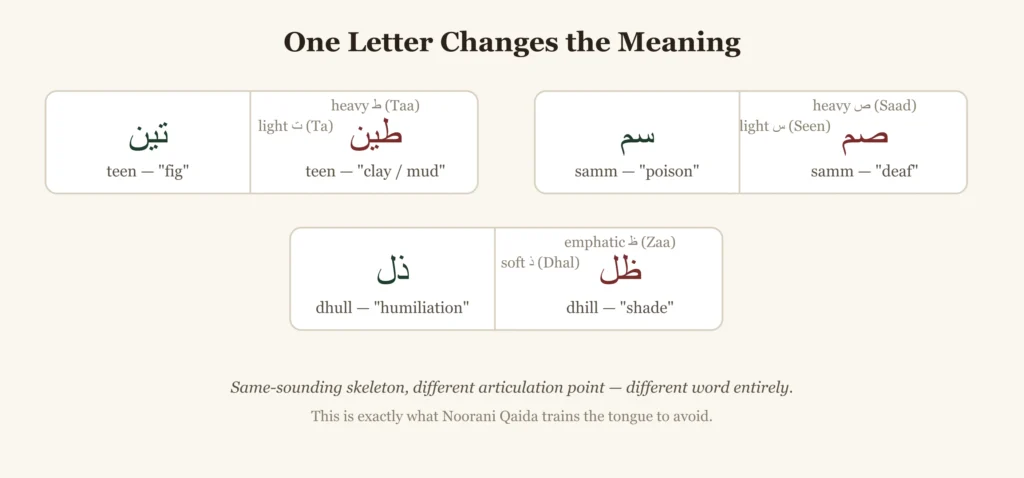
A few examples make this concrete rather than abstract:
- تين (teen, with a light ت) means “fig” — as in Surah At-Tin. طين (teen, with a heavy ط) means “clay” or “mud.” Same vowels, same rhythm, different letter, different word entirely.
- سم (samm, with a light س) means “poison.” صم (samm, with a heavy ص) means “deaf.” The only difference is where in the mouth that first sound is produced.
- ذل (dhull, a soft ذ) means “humiliation.” ظل (dhill, an emphatic ظ) means “shade.” Again — one articulation point separates two unrelated meanings.
None of these are edge cases invented to make a point. They’re ordinary, everyday Quranic words, and they’re exactly the kind of pair Noorani Qaida is designed to train a beginner out of confusing.
What Are the 17 Chapters of Noorani Qaida?
Editions vary slightly in page count and layout, but the sequence of what’s taught is remarkably consistent across print versions, and it almost always runs to 17 lessons:
| Lesson # | Topic | What It Teaches |
|---|---|---|
| 1 | Huroof al-Mufradat (individual letters) | Recognizing each of the 28–29 Arabic letters and their correct articulation point (Makhraj) |
| 2 | Huroof al-Murakkabat (joined letters) | How letters change shape at the beginning, middle, and end of a word |
| 3 | Huroof al-Muqatta’at | The disconnected letters that open certain Surahs |
| 4 | Harakat (short vowels) | Fatha, Kasra, and Damma — the three short vowel signs |
| 5 | Tanween | Double vowel endings (nunation) |
| 6 | Practice exercises | Combining Harakat and Tanween into readable words |
| 7 | Standing/vertical vowels | A regional variant notation for the same three short vowels |
| 8 | Huroof al-Maddah wa Leen | Rules for stretching (Madd) and softening (Leen) certain letters |
| 9 | Review | Consolidating lessons 1–8 before moving on |
| 10 | Sukoon | The “resting” sign, and how a vocalized letter links to a silent one |
| 11 | Sukoon exercises | Practicing that linkage fluently |
| 12 | Tashdeed | The doubling (Shaddah) sign |
| 13 | Tashdeed exercises | Words built around a doubled letter |
| 14 | Tashdeed with Sukoon | Combining doubling and silence in one word |
| 15 | Tashdeed with Tashdeed | Words with more than one doubled letter |
| 16 | Tashdeed with Madd | Long vowels layered with doubling |
| 17 | Final review | A summary lesson that hands the student off to actual Quran reading |
The logic behind the order matters more than the labels: nothing is introduced until the letter and vowel groundwork underneath it is solid, which is why rushing ahead a chapter or two tends to backfire later.
How Long Does It Take to Finish Noorani Qaida?
There’s no fixed timetable, but the ranges that come up again and again, across both age groups and different tutoring backgrounds, look like this:
| Age Band | Typical Duration |
|---|---|
| Young children (4–6 years) | 6–9 months |
| Children (7–10 years) | 4–6 months |
| Teenagers (11–15 years) | 3–5 months |
| Adults (16+) | 2–4 months |
Age explains some of the spread, but consistency explains more of it. Twenty to thirty minutes of focused daily practice will get a learner through faster than an hour once a week — irregular study is the single biggest reason completion times stretch out, regardless of how old the student is.
Noorani Qaida vs. Iqra vs. Yassarnal Qur’an vs. Madani Qaida
Noorani Qaida isn’t the only beginner’s primer in use — it’s just the most widely known one internationally. Depending on where someone is learning, a teacher might reach for a different book entirely, and it’s worth knowing how they differ before assuming Noorani Qaida is the default everywhere:
| Method | Where It’s Most Common | Main Focus | Best For |
|---|---|---|---|
| Noorani Qaida | South Asia, and widely exported to UK/US/Gulf academies | Letter articulation and phonetics first, Tajweed introduced gradually | Learners who want a slow, letter-by-letter foundation |
| Iqra | Southeast Asia (Indonesia, Malaysia) | A faster, more modular series of short booklets rather than one single book | Learners who prefer shorter, self-paced units |
| Yassarnal Qur’an | Bangladesh, parts of South Asia | Similar structure to Noorani Qaida but with regional notation differences | Learners already working with a Bangladeshi curriculum |
| Madani Qaida | Used alongside or after Noorani Qaida in many madrasas | Integrates Tajweed terminology and vocabulary earlier | Learners moving quickly toward full Tajweed study |
None of these is objectively “better” — the right one is usually whatever a learner’s teacher or local mosque already uses, since the sequencing and terminology can differ just enough to make switching mid-course confusing. Once any of them is finished, though, the next real step is the same: how to read and understand Quranic verses, which is a different skill from the phonetics these primers teach.
Is There a Noorani Qaida in Hindi?
Yes. Hindi-medium editions exist, and they’re genuinely common — search interest for “noorani qaida in hindi” is large enough that it’s clearly a real, recurring need, not a niche one. What a Hindi edition actually changes is worth being precise about: the instructions are written in Hindi (Devanagari script), explaining what each Harakat sign does, how Sukoon works, and so on — but the Quranic letters and words being taught are still Arabic. A Hindi edition doesn’t replace the Arabic script with Hindi script for the actual reading material; it uses Hindi as the teaching language, the same way an English edition uses English.
A properly built Hindi edition should still show every letter in its Arabic form, walk through the same 17-lesson sequence, and use transliteration only as a pronunciation guide — never as a substitute for reading the Arabic itself. Transliteration can get a learner close to the right sound, but Hindi (like English) doesn’t have letters that map cleanly onto sounds like the heavy ط or emphatic ظ from the examples above, so leaning on transliteration alone tends to reproduce exactly the kind of mix-ups Noorani Qaida exists to prevent.
Self-Check: Are You Ready for the Next Lesson?
A lot of people work through Noorani Qaida without a tutor, usually from a PDF or an app, and the biggest risk of studying that way isn’t laziness — it’s not knowing when you’re actually ready to move on. Before advancing a chapter, it’s worth being able to answer yes to all of these:
- Can you name every letter in the current lesson’s articulation point (Makhraj) without hesitating or guessing?
- Can you read three words you haven’t seen before, built only from letters covered so far, without sounding them out letter-by-letter first?
- If you record yourself reading a line and compare it to a qualified reciter’s audio, do the vowel lengths and letter emphasis actually match — not just the general shape of the word?
- Can you explain, out loud, what the current lesson’s rule (Sukoon, Tanween, Tashdeed, etc.) is doing — not just perform it, but describe it?
If any of these feels shaky, staying on the current lesson for another few days almost always costs less time overall than fixing a habit three chapters later.
Who Should Learn Noorani Qaida?
It’s built for anyone who can’t yet read Quranic Arabic fluently and accurately, not just young children. Kids from around age four can start with it as their first real exposure to Arabic literacy. Teenagers who already recognize the alphabet but read hesitantly use it to smooth out fluency and fix Harakat mistakes. Adults — including converts and lifelong Muslims who never formally learned to read — use it just as often, and starting from the basics as an adult isn’t a step backward; it’s usually faster to fix pronunciation early than to unlearn years of guesswork later. Non-native Arabic speakers of any age are, in a sense, the book’s core audience: it was designed from the outset for people who didn’t grow up hearing these sounds.
FAQ
What does “Noorani Qaida” mean? “Qaida” means rule or foundation, and “Noorani” (or Nuraniyah) means luminous — a reference both to the light of Quranic knowledge and to the book’s author, Sheikh Noor Muhammad Haqqani. Together the name signals a foundational, illuminating first step before Quran reading.
Who wrote Noorani Qaida? It was compiled by Sheikh Noor Muhammad Haqqani, a 19th-century Islamic scholar from the Indian subcontinent, after noticing students struggled to pronounce Quranic Arabic correctly. He designed a step-by-step method built entirely from real Quranic words and verses.
How many chapters does Noorani Qaida have? Most standard editions contain 17 lessons, moving from individual letters and their articulation points through vowel signs, letter joining, Sukoon, Tanween, Madd, and basic Tajweed, ending in a review chapter that prepares the student for actual Quran reading.
How long does it take to complete Noorani Qaida? It varies by age and consistency: young children often take 6–9 months, teens and adults commonly finish in 2–5 months with regular practice. Daily 20–30 minute sessions matter more for speed than age does.
Is Noorani Qaida only for children? No. It’s equally used by teenagers, adults, and new Muslims who are non-native Arabic speakers. Adults sometimes feel self-conscious starting from the basics, but skipping it typically means correcting deeper pronunciation habits later, which takes longer.
What’s the difference between Noorani Qaida and Madani Qaida? Noorani Qaida focuses primarily on letter pronunciation and phonetics; Madani Qaida integrates Tajweed and Quranic vocabulary earlier in the sequence. The right choice often depends on regional convention and a teacher’s preference rather than one being objectively “better.”
Is there a Noorani Qaida edition in Hindi? Yes — transliterated and Devanagari-script editions exist for Hindi-speaking learners in India, explaining the same letters, Harakat, and rules in Hindi. The Quranic Arabic text itself doesn’t change; only the instructional language and transliteration guidance do.
Can I learn Noorani Qaida without a tutor? It’s possible using audio-paired PDFs or apps, but self-teaching makes it easy to miss subtle articulation errors a teacher would catch immediately. If studying alone, recording yourself and comparing against a qualified reciter’s audio is the closest substitute