
Short answer: most scholars say yes, at least when instruments are involved. The majority position across all four Sunni madhhabs — Hanafi, Maliki, Shafi’i, and Hanbali — holds that instrumental music is haram, built on evidence from the Quran and from hadith. That’s not the whole picture, though. A documented minority of jurists, going back centuries, has disagreed — and the disagreement gets sharper the closer you look at unaccompanied singing versus instruments, at what the actual hadith say, and at how the ruling is even framed outside the Sunni schools.
This article walks through the evidence itself, names the scholars on both sides of the disagreement instead of gesturing vaguely at “some say otherwise,” and grades the hadith commonly cited rather than presenting all of them as equally certain.
The Quranic Evidence
The word for music, musiqa, never actually appears in the Quran. That surprises a lot of people who assume there’s a verse somewhere that says it plainly. There isn’t. The ruling is built through interpretation, mainly from two passages.
The first is Surah Luqman, verse 6:
وَمِنَ النَّاسِ مَن يَشْتَرِي لَهْوَ الْحَدِيثِ لِيُضِلَّ عَن سَبِيلِ اللَّهِ بِغَيْرِ عِلْمٍ
Wa minan-nāsi may-yashtarī lahwal-ḥadīthi liyuḍilla ‘an sabīlillāhi bighayri ‘ilm
The verse describes a person who trades in “idle talk” (lahw al-hadith) in order to lead others away from Allah’s path, without knowledge, and treats that path with mockery. On its own, “idle talk” is a broad phrase — it could mean any distracting or frivolous speech. The reason it gets tied specifically to music comes down to who explained it first.
The second passage often cited is Surah Al-Isra, verse 64, where Allah describes how Satan will try to unsettle people “with your voice” — a phrase early commentators connected to seductive or misleading sound, including singing and instruments.
What Did the Companions Say “Idle Talk” Meant?
Interpretation of scripture in Islam doesn’t stop at the words on the page — it leans heavily on how the Prophet’s companions understood them, since they heard the revelation directly and asked him about it. On Luqman 31:6, that chain of interpretation is unusually direct.
Ibn Mas’ud, one of the earliest and most respected companions, was reportedly asked what “idle talk” meant in this verse. He swore — three times, according to the narration — that it meant singing. Ibn Abbas, known as “the interpreter of the Quran” for his closeness to the Prophet’s own explanations, is reported to have held the same view. Later exegetes, including al-Tabari and Ibn Kathir in their respective tafsir works, recorded and built on this reading.
That’s a fairly unified early chain. It’s also the single biggest reason the majority position treats this verse as settled rather than ambiguous — not because the word “music” appears, but because the people closest to the revelation said this is what it meant.
The Hadith Evidence — With Authenticity Grading
The Quranic case leans on interpretation. The hadith case is more direct — hadith being the recorded sayings and actions of the Prophet, distinct from the Quran itself — but it’s also where a lot of online explainers get sloppy, repeating a saying as a hadith of the Prophet when it’s actually the recorded statement of a companion, or citing a hadith number that doesn’t check out. Here’s what the four most commonly cited narrations actually are, graded rather than flattened into one undifferentiated pile of “evidence”:
| Hadith (paraphrased) | Source | Grade | What it’s evidence for |
|---|---|---|---|
| Some among this Ummah will come to treat zina, silk (for men), wine, and musical instruments as lawful | Sahih al-Bukhari, Kitab al-Ashriba, commonly numbered 5590 — recorded by Bukhari in mu’allaq form (without his full connected chain), later traced to a continuous, sound isnad by scholars including Ibn Hajar and al-Albani | Sahih | The central hadith. Groups instruments alongside things universally agreed to be major sins. |
| Ibn ‘Umar covered his ears on hearing a shepherd’s pipe on the road, recalling the Prophet doing the same | Sunan Abi Dawud, via Nafi’ | Sahih (per al-Albani) | Shows an aversion to instrumental sound, though scholars distinguish hearing something in passing from intentionally listening to it. |
| Music or singing “makes hypocrisy grow in the heart the way water makes crops grow” | Reported through al-Bayhaqi’s Shu’ab al-Iman | Most commonly classed as the statement of the companion Ibn Mas’ud (mawquf), not a verified saying of the Prophet himself | Frequently misattributed online as a direct hadith with an invented book-and-number citation — it should be cited as Ibn Mas’ud’s own words, not the Prophet’s. |
| Two young girls sang war poetry in the Prophet’s home on the day of Eid, and he told Abu Bakr to leave them be | Sahih al-Bukhari | Sahih | Cited by some as proof singing is permitted; the majority reading treats it as a narrow exception tied specifically to Eid and to unaccompanied children’s poetry, not general permission. |
Worth sitting with that third row for a second. It’s one of the most-repeated lines on competing “why is music haram” pages, almost always presented as something the Prophet said directly. The more careful sourcing traces it to Ibn Mas’ud instead — which doesn’t erase its weight as evidence (a companion’s considered opinion still carries real authority in Islamic scholarship), but it’s a different kind of evidence than a direct hadith, and conflating the two is the sort of citation sloppiness that undermines an otherwise solid case.
Do All Scholars Agree Music Is Haram?
No — and the disagreement isn’t fringe internet chatter, it’s documented, named, and centuries old.
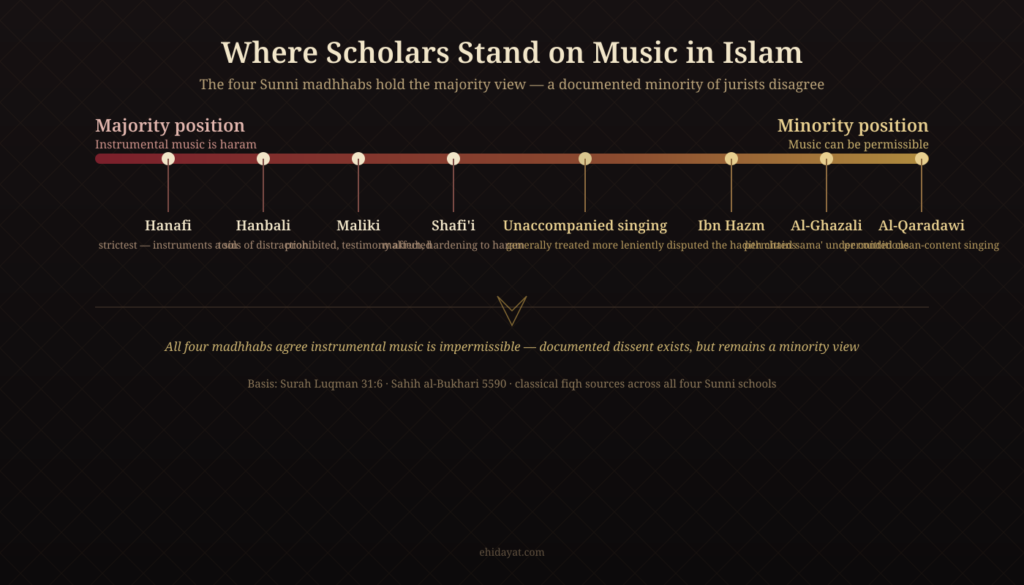
The four Sunni madhhabs converge on prohibition, though not with identical severity. Imam Abu Hanifah took the strictest line, holding that habitual listeners could have their courtroom testimony rejected. Imam Malik, when asked about music, is recorded as saying only the morally lax among the community indulge in it. Imam al-Shafi’i’s position sits closer to makruh — disliked rather than flatly forbidden — though he warned that habitual indulgence tips it into haram. Imam Ahmad ibn Hanbal treated instruments as tools that corrupt the heart’s attachment to worship.
Set against that is a real, named minority:
| Scholar | Position | Basis |
|---|---|---|
| Ibn Hazm (Zahiri jurist) | Rejected the authenticity of the isnads used to prohibit instruments; stated plainly that if any were proven sound, he’d follow them | Hadith criticism |
| Al-Ghazali | Permitted sama’ — spiritual musical audition — under specific conditions, in Ihya Ulum al-Din | Spiritual/Sufi framing |
| Yusuf al-Qaradawi | Permitted singing with content that isn’t obscene or morally harmful | Contemporary ijtihad, in his book The Halal and Haram in Islam |
| Adel Al-Kalbani | A former imam of the Grand Mosque in Makkah, who publicly reversed decades of strict opposition in 2010, stating there’s no clear-cut ruling against music | Public fatwa, reported by Gulf News |
That last case is worth dwelling on. Al-Kalbani wasn’t a fringe figure — he’d been one of the most vocal opponents of music in Saudi religious circles. His reversal split Saudi scholars publicly, and it’s a useful reminder that this isn’t a settled question with one side simply ignorant of the other’s arguments. It’s live scholarly disagreement, playing out among serious jurists, not just casual opinion online.
Here’s how the whole spectrum lines up, from strictest to most permissive:
For the fullest version of the majority case — verse by verse, hadith by hadith, with responses to nearly every counter-argument raised by the minority view — IslamQA’s detailed answer remains the most exhaustive single source on this exact question.
Is Singing Without Instruments Also Haram?
This is usually the very next question once someone’s read the ruling on instrumental music, and most explainers bury the answer mid-paragraph instead of giving it its own space. It deserves one.
Generally, no — unaccompanied singing is treated more leniently than music played with instruments, across every madhhab, including the stricter ones. Imam al-Nawawi, writing within the Shafi’i school, described singing without instruments as merely makruh rather than haram. The daff — a simple hand-drum without jingling attachments — has a specifically documented exception: women are permitted to play it at weddings and on Eid, based on multiple sound narrations, including the Eid episode mentioned above.
Where scholars genuinely split is on instruments themselves. The Hanafi, Shafi’i, and Hanbali schools generally treat instrumental accompaniment as prohibited. The Maliki school, along with Ibn Hazm, takes a more permissive line on instruments specifically.
But almost every scholar, strict or lenient, agrees on one thing: content matters more than melody. A song that praises Allah, encourages good character, or carries no objectionable content is judged very differently from one that glorifies intoxication or promiscuity — whether or not there’s an instrument underneath it. That shared ground gets lost in a lot of “is music haram” content that treats the whole topic as one flat yes-or-no question.
A Note on the Shi’a Ruling
Most English-language explainers on this topic — including the one you may have seen from IslamQA or similar Sunni sources — describe the ruling using Sunni fiqh categories. Twelver Shi’a scholarship approaches it differently.
Rather than drawing the line primarily between instrumental and vocal, contemporary Shi’a marja’ rulings generally distinguish lahwi (entertaining, frivolous) music from music or sound that isn’t. Under this framing, music that produces the kind of state associated with sin, distraction, and moral looseness is impermissible regardless of instrumentation, while non-entertaining sound — including, in some rulings, certain forms of recitation or commemorative poetry — is not automatically caught by the prohibition. It’s a genuinely different structure, not just a stricter or looser version of the Sunni position, and it matters for readers whose scholarly tradition follows the marja’ system rather than the four Sunni madhhabs.
Belief vs. Practice — What Muslims Actually Do
Here’s a gap that almost never makes it into articles on this topic: the ruling and lived practice aren’t the same thing, and the distance between them is measurable.
A large cross-national Pew Research survey of Muslims found that in most regions studied, majorities said Western music, film, and television pose a threat to public morality — and yet, on a personal level, many of the same respondents said they enjoy that entertainment. The gap varied a lot by region: around two-thirds of Muslims surveyed in Southern and Eastern Europe said they personally enjoy Western entertainment, roughly half in Central Asia and sub-Saharan Africa said the same, dropping to about two in five in Southeast Asia and the Middle East and North Africa, and down to about a quarter in South Asia.
That’s not a contradiction so much as it’s how religious rulings and everyday life usually coexist — a stated moral position doesn’t map cleanly onto individual behavior, and it rarely has, on this question or most others. Worth keeping in mind before assuming either “everyone follows the ruling” or “no one actually does.”
Practical Questions — Gym, Work, Weddings, Hearing vs. Listening
The abstract ruling is one thing. Actually living in a world where music is playing almost everywhere — gyms, shops, ads, a colleague’s wedding — is another, and it’s usually the part people are actually trying to figure out.
Classical scholars, including Ibn Taymiyah, drew a specific line here: between hearing something you didn’t seek out and intentionally listening to it. Sin, in this framework, attaches to the deliberate act of listening — sitting down to enjoy it, seeking it out, dwelling on it — not to music that happens to be playing in a space you’re passing through or working in without your control over it.
That distinction does real work in modern life. Music playing over a gym’s speaker system, in a shop you’re buying groceries in, or during an ad you didn’t choose to watch falls closer to “hearing” than “listening” under this reasoning. A colleague’s wedding with a live band is murkier — attending isn’t automatically the same as deliberately enjoying the music, though how someone chooses to engage with it during the event is a more personal judgment call. None of this dissolves the underlying ruling; it just means the ruling was never meant to demand controlling every sound within earshot, only what a person actively seeks out and settles into.
Conclusion — Where This Leaves a Muslim Today
The majority of scholars, across all four Sunni madhhabs, hold instrumental music to be haram, grounded in Luqman 31:6 as understood by the earliest companions and in a sahih hadith that places musical instruments alongside major sins. That’s the mainstream position, and it’s the one most religious guidance defaults to.
It isn’t the only position on record, though, and pretending otherwise doesn’t serve anyone. Ibn Hazm, al-Ghazali, and contemporary scholars including al-Qaradawi have made real, documented arguments for a more permissive reading — particularly around unaccompanied singing and content-focused rather than instrument-focused judgment. For a Muslim trying to decide how to live with this question day to day, the cautious default is to follow the majority view, especially with instrumental music and content that’s clearly indecent. Where the picture gets genuinely gray — a cappella nasheeds, background sound you didn’t choose, a wedding daff — there’s real scholarly room to think it through rather than treat every note as automatically forbidden.
FAQ
Is music haram in Islam? The majority of scholars across the four Sunni madhhabs hold that instrumental music is haram, based on Surah Luqman 31:6 and the hadith recorded in Sahih al-Bukhari (no. 5590). A documented minority — including Ibn Hazm and, among contemporary scholars, Yusuf al-Qaradawi — disagree, particularly on unaccompanied singing.
Why is music haram in Islam? Scholars holding this position point to the Quran’s warning against “idle talk” that misleads people from Allah’s path, understood by the companion Ibn Mas’ud to mean singing, and to a hadith that lists musical instruments alongside zina and alcohol as things some will wrongly try to make lawful.
Is singing without instruments haram too? Generally no. Most scholars, including within the stricter madhhabs, treat unaccompanied singing more leniently than instrumental music, provided the lyrics don’t promote sin. The daff is a specifically documented exception for women at weddings and Eid.
Do any scholars say music is halal? Yes. Ibn Hazm rejected the authenticity of the main prohibitive hadith chains, al-Ghazali permitted spiritual audition under conditions in Ihya Ulum al-Din, and contemporary scholars like Yusuf al-Qaradawi have permitted singing with clean content. This remains a minority position against the four-madhhab majority.
What does the Quran actually say about music? The word “music” never appears in the Quran. The ruling comes from interpretation — chiefly Surah Luqman 31:6, which Ibn Mas’ud and Ibn Abbas understood as referring to singing, and Surah Al-Isra 17:64’s reference to Satan’s “voice.”
Is the ruling the same in Shi’a Islam? Not exactly. Contemporary Twelver Shi’a marja’ rulings generally separate lahwi (entertaining) music from non-entertaining sound, rather than drawing the line mainly between instruments and voice the way Sunni fiqh does.
Can I listen to music playing in the background, like at a gym or in an ad? Classical scholars, including Ibn Taymiyah, distinguished between intentionally listening and simply hearing something you didn’t seek out. The ruling — and any sin — attaches to deliberate listening, not incidental hearing