
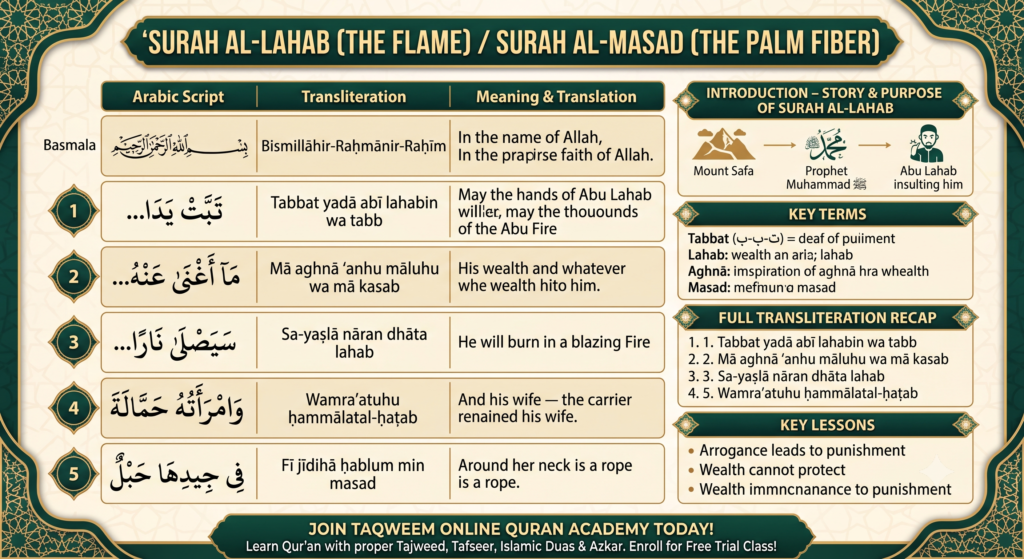
Surah Al-Lahab (Surah Masad) – Transliteration with Meaning
Introduction – Story and Purpose of Surah Al-Lahab
Surah Lahab Transliteration, also known as Surah Masad, is the 111th chapter of the Qur’an. It was revealed in Makkah and mentions Abu Lahab (the Prophet Muhammad ﷺ’s uncle) and his wife Umm Jameel.
The surah’s revelation is directly tied to a moment recorded in Sahih al-Bukhari (Hadith 4971). The Prophet ﷺ climbed Mount Safa and called out to the clans of Quraysh, warning them of a coming punishment if they didn’t turn to Allah. Abu Lahab responded with open contempt: “May you perish! Is this why you have gathered us?” Moments later, this surah was revealed as Allah’s direct answer to him.
In this Surah, Allah shows how those who oppose Islam and the Prophet ﷺ face humiliation and punishment. It serves as a timeless lesson and warning — showing the end of those who reject the truth.
Surah Al-Lahab at a Glance
| Detail | Info |
|---|---|
| Also known as | Surah Al-Masad, Surah Tabbat Yada |
| Revelation | Makkah (Meccan) |
| Number of verses | 5 |
| Chapter number | 111 |
| Juz | 30 (Juz ‘Amma) |
| Meaning of Al-Lahab | “The Flame” |
| Meaning of Al-Masad | “The Palm Fiber” (a twisted rope) |
Surah Al-Lahab (Surah Masad) – Arabic with Transliteration
| # | Arabic | Transliteration | Meaning |
|---|---|---|---|
| — | بِسْمِ اللَّهِ الرَّحْمَٰنِ الرَّحِيمِ | Bismillāhir-Raḥmānir-Raḥīm | In the name of Allah, the Most Gracious, the Most Merciful. |
| 1 | تَبَّتْ يَدَا أَبِي لَهَبٍ وَتَبَّ | Tabbat yadā abī lahabin wa tabb | May the hands of Abu Lahab be ruined, and ruined is he! |
| 2 | مَا أَغْنَىٰ عَنْهُ مَالُهُ وَمَا كَسَبَ | Mā aghnā ‘anhu māluhu wa mā kasab | His wealth and whatever he earned will not benefit him. |
| 3 | سَيَصْلَىٰ نَارًا ذَاتَ لَهَبٍ | Sa-yaṣlā nāran dhāta lahab | He will burn in a blazing Fire. |
| 4 | وَامْرَأَتُهُ حَمَّالَةَ الْحَطَبِ | Wamra’atuhu ḥammālatal-ḥaṭab | And his wife — the carrier of firewood. |
| 5 | فِي جِيدِهَا حَبْلٌ مِّن مَّسَدٍ | Fī jīdihā ḥablum min masad | Around her neck is a rope of twisted fiber. |
Full Transliteration Recap
Bismillahir Rahmanir Rahim Tabbat yada abī lahabin wa tabb Ma aghna ‘anhu maluhu wa ma kasab Sa-yasla naran dhata lahab Wamra’atuhu hammalata-l-hatab Fi jidiha hablun min masad
Simple English Translation
May the hands of Abu Lahab be ruined, and ruined is he. Neither his wealth nor his gains will benefit him. He will enter a blazing Fire. And his wife — the carrier of firewood — Around her neck will be a rope of palm-fiber.
You can also listen to the full recitation and compare additional translations on Quran.com.
Word-by-Word Meaning of Key Terms
A few words in this short surah carry weight far beyond their length. Knowing their roots makes the surah easier to remember — and easier to feel.
- Tabbat (from the root ت-ب-ب) — means “to be ruined, destroyed, with no good left.” It opens the surah as both a curse and a prophecy stated as already fulfilled.
- Lahab — literally “flame.” It’s the same root behind Abu Lahab’s own nickname, which he earned for his glowing, ruddy complexion. The surah later uses this same word again to describe the fire he’ll burn in — a deliberate, ironic echo of his own name.
- Aghnā — “to avail, benefit, or make self-sufficient.” Used here to say that neither his wealth nor his status could save him.
- Masad — “a twisted rope of palm fiber.” This word is worth pausing on: it’s a hapax legomenon, meaning it appears exactly once in the entire Qur’an — only here, in this closing verse. Out of everything that could have been chosen to end the surah, this rare, rough, humiliating word was chosen deliberately, and the whole chapter is named after it.
Who Was Abu Lahab’s Wife?
The surah’s fourth verse refers to Abu Lahab’s wife without naming her directly, but classical sources identify her as Umm Jameel, born Arwa bint Harb — the sister of Abu Sufyan, one of the most powerful men in Makkah at the time. Like her husband, she was an active and vocal opponent of the Prophet ﷺ.
The phrase “carrier of firewood” is understood two ways by the scholars:
- Literally — she would gather thorny branches at night and scatter them on the path the Prophet ﷺ walked, hoping to injure him.
- Metaphorically — “carrying wood” was an Arabic expression for spreading gossip and slander, the way one carries fuel to feed a fire. On this reading, she was “feeding” conflict between the Prophet ﷺ and her tribe.
A few commentators, including Mazhari, describe a specific account in which she died carrying such a bundle, with the rope around her neck, as a literal echo of verse 5. Most scholars, however, favor the metaphorical reading of both the firewood and the rope as symbols of her punishment in the Hereafter rather than a literal event in this life. Allah knows best.
Short Tafseer (Explanation in English)
Abu Lahab, the Prophet Muhammad ﷺ’s uncle, became one of Islam’s strongest enemies. When the Prophet ﷺ called people to Allah, Abu Lahab angrily said: “Tabban laka ya Muhammad!” — “May you be ruined, O Muhammad!”
In response, Allah revealed this Surah: “Tabbat yadā abī lahabin wa tabb” — meaning, “May the hands (deeds) of Abu Lahab be ruined.”
This Surah declared that his arrogance and enmity toward truth would lead him to destruction.
Key Lessons from Surah Al-Lahab
- Arrogance and hostility toward truth lead to punishment. Abu Lahab rejected Islam out of pride and ego.
- Wealth and status are useless in the Hereafter. “Ma aghna anhu maluhu” — his riches could not save him.
- Everyone is accountable — men and women alike. His wife, Umm Jameel, also mocked the Prophet ﷺ and shared in his fate.
- Islam teaches absolute justice. Even the Prophet’s relatives were not exempt from divine judgment if they rejected the truth.
Spiritual Benefits of Reciting Surah Al-Lahab
- Protection from Enemies – Regular recitation keeps one safe from those who wish harm.
- Protection from Jealousy & Evil Eye – Since Abu Lahab and his wife were full of envy, this Surah is a shield against envy and malice.
- Reminder of Accountability – Reminds us that power, pride, and wealth are meaningless before Allah.
- Strengthens Faith and Trust in Allah (Tawakkul) – Builds patience and reliance upon Allah in all trials.
When to Recite Surah Al-Lahab
| Time | Practice | Benefit |
|---|---|---|
| After Fajr | Recite 3 times | Protection from enemies |
| After Maghrib | Recite 7 times | Freedom from negativity and jealousy |
| Before sleeping | Recite once | Peace and calmness of heart |
Moral of Surah Al-Lahab
- Rejecting the truth leads only to failure.
- Ego and hatred destroy a person from within.
- Faith and patience are the true paths to salvation.
- “Whoever stands with Allah and His Messenger ﷺ — Allah is sufficient for him.”
For a fuller verse-by-verse translation and additional lessons drawn from this surah, see this complete guide to Surah Al-Lahab / Al-Masad.
Call to Action
If you want to learn the Qur’an with proper Tajweed and Tafseer, join Taqweem Online Quran Academy today!
Here you can learn:
- Qur’an with Tajweed
- Tafseer and Translation
- Islamic Duas & Azkar
- Classes for Kids and Adults
Enroll today and get a Free Trial Class! Start your journey to Qur’anic excellence and spiritual peace.
FAQs
1. What is the meaning of Surah Al-Lahab (Surah Tabbat Yadā)?
“Perish the hands of Abu Lahab, and perish he!” (Qur’an 111:1) It condemns Abu Lahab, the Prophet ﷺ’s uncle, who mocked and opposed Islam. Despite his wealth and pride, he would perish — showing that arrogance and disbelief lead to ruin.
2. Why is Surah Al-Lahab also called Surah Al-Masad?
Both names refer to the exact same 111th chapter. “Al-Lahab” (“the Flame”) comes from Abu Lahab’s own nickname in verse 1, while “Al-Masad” (“the palm-fiber rope”) comes from the closing word of verse 5. Classical scholars and modern Qur’an databases use both titles interchangeably for this surah.
3. Is “Tabbat Yada” the same surah as Surah Lahab?
Yes. “Tabbat Yada” is simply the opening phrase of the surah — “May the hands be ruined” — and is often used informally as a third name for the same chapter, alongside Al-Lahab and Al-Masad.
4. What are the benefits of Surah Tabbat Yadā (Surah Al-Lahab)?
Its main message is a warning against arrogance, but spiritually it:
- Reminds that wealth cannot protect from Allah’s judgment.
- Protects from arrogance and hatred.
- Strengthens faith by showing how Allah defended His Prophet ﷺ.
5. What is the miracle of Surah Al-Lahab?
It was a living prophecy. The Surah declared Abu Lahab would die a disbeliever while he was still alive. He could have pretended to believe — but he never did. This fulfilled prophecy proves the divine truth of the Qur’an.
6. What are the key lessons of Surah Al-Lahab?
- Pride and hatred destroy even family ties.
- Wealth and fame cannot save one from Allah’s punishment.
- Enemies of truth always fail — Allah protects His Messenger.
- Real success lies in faith and humility.
- Words and actions matter — Abu Lahab’s insults sealed his fate.
7. Which Surah removes all problems?
No Surah removes all problems, but these bring relief and protection:
- Surah Al-Inshirah (Ash-Sharh): Brings peace and comfort.
- Surah Al-Baqarah: Protects the home from Shayṭān.
- Surah Yāsīn: Brings ease and blessings.
- Surah Al-Wāqi’ah: Protects from poverty and hardship.
8. Which Surah gives beauty (light) to the face?
True beauty comes from spiritual purity, not just appearance. For inner radiance:
- Surah Yūsuf – for beauty of heart and face.
- Surah Al-Rahmān – brings calmness and grace.
- Regular wudu, Tahajjud, and Qur’an recitation bring light to the face.
The Prophet ﷺ said:
“Whoever prays Fajr in congregation, then remembers Allah until sunrise, his face will shine with light.