
Millions of people search for the same handful of things every day: a verse that speaks to whatever they’re going through, the meaning of a specific ayah someone mentioned, or a starting point for learning the Quran themselves. This guide brings those threads together — the most-searched verses, what a couple of specific ayat actually mean, the tradition of the Loh-e-Qurani, and a realistic answer to “how long will this actually take me.”
Heart-Touching and Famous Quranic Verses (With English Translation)
Some verses get shared and re-shared for a reason — they land differently than a paraphrase ever could. A few that consistently surface as “heart-touching” or frequently quoted:
- Surah Ash-Sharh 94:6 — “Indeed, with hardship comes ease.” A reminder that relief is paired with difficulty, not separate from it.
- Surah Al-Baqarah 2:153 — “Indeed, Allah is with the patient.” Comes right after the instruction to seek help through patience and prayer.
- Surah Al-Baqarah 2:152 — “So remember Me; I will remember you.” A direct, reciprocal promise.
- Ayat al-Kursi, Surah Al-Baqarah 2:255 — the longest single verse devoted entirely to describing Allah’s sovereignty and knowledge, commonly recited after prayer and before sleep.
- Surah Al-Ikhlas (112) — four verses stating Allah’s absolute oneness, described in hadith as equal in weight to a third of the Quran.
If you want a properly cross-checked list rather than the same few verses copied between sites with the surah and ayah numbers quietly swapped, this roundup of 50+ Quran quotes verifies each reference against the Arabic text and organizes them by theme — patience, hope, gratitude, trust, and how we treat one another.
The Last Three Surahs of the Quran
The Quran’s final three surahs are grouped together in daily practice for good reason:
- Surah Al-Ikhlas (112) — a four-verse statement of Allah’s oneness (tawheed).
- Surah Al-Falaq (113) — seeking refuge from external harm: darkness, envy, and black magic.
- Surah An-Nas (114) — seeking refuge from internal harm: whispered evil and misguidance.
Together they’re often called Al-Mu’awwidhatayn alongside Al-Ikhlas, and many Muslims recite all three after each of the five daily prayers and before sleep, since hadith describe the Prophet ﷺ doing exactly that. Their short length also makes them the natural entry point for anyone just starting to memorize the Quran.
Surah Al-Ahzab, Ayat 56 (Arabic, Urdu and English Meaning)
This is one of the most recited verses in Islam because it commands the specific act of sending durood (blessings) on the Prophet ﷺ.
Arabic: إِنَّ اللَّهَ وَمَلَائِكَتَهُ يُصَلُّونَ عَلَى النَّبِيِّ ۚ يَا أَيُّهَا الَّذِينَ آمَنُوا صَلُّوا عَلَيْهِ وَسَلِّمُوا تَسْلِيمًا
English meaning: Allah and His angels send blessings on the Prophet. Believers are instructed to do the same, and to greet him with abundant peace.
Urdu translation (commonly rendered): بے شک اللہ اور اس کے فرشتے نبی ﷺ پر درود بھیجتے ہیں۔ اے ایمان والو! تم بھی ان پر درود بھیجو اور خوب سلام بھیجا کرو۔
This verse is the basis for reciting Durood Sharif, and many scholars note it’s one of the few instructions in the Quran where Allah states He and the angels already do something, then commands believers to join in.
A Verse for New Journeys: “Subhanallazi Sakhara Lana” (Surah Az-Zukhruf 43:13)
This is the travel dua many people search for by its opening Arabic words without knowing the reference. It comes from Surah Az-Zukhruf, 43:13, and is traditionally recited when boarding a vehicle or setting out on a journey:
“Glory to Him who has subjected this to us, and we could never have accomplished this [by] ourselves.”
The verse acknowledges that safe transport — whether a camel in the original context or a car or plane today — isn’t something to take for granted.
What Is Loh-e-Qurani, and What Are Its Benefits?
A Loh-e-Qurani (“Quranic tablet”) is a decorative plaque, usually containing Ayat al-Kursi, the four Quls, or a selection of protective verses, hung near a home’s entrance or in a living space. It’s a cultural and devotional tradition especially common across South Asia rather than a specific ritual prescribed in a single hadith.
Believed benefits, according to tradition, include:
- Serving as a visible, constant reminder of faith for everyone who enters the home
- Bringing barakah (blessing) into the household
- Offering a sense of spiritual protection, tied to the protective themes of the verses it displays (Ayat al-Kursi and Al-Mu’awwidhatayn in particular are recited specifically for protection)
These are traditional beliefs held by many Muslims rather than claims that can be independently verified — the tablet itself has no power; any benefit is understood to come from Allah, with the plaque acting as a reminder rather than an object with its own effect.
How Long Does It Take to Memorize the Quran?
There’s no single number, but the ranges are consistent across Hifz programs and academies:
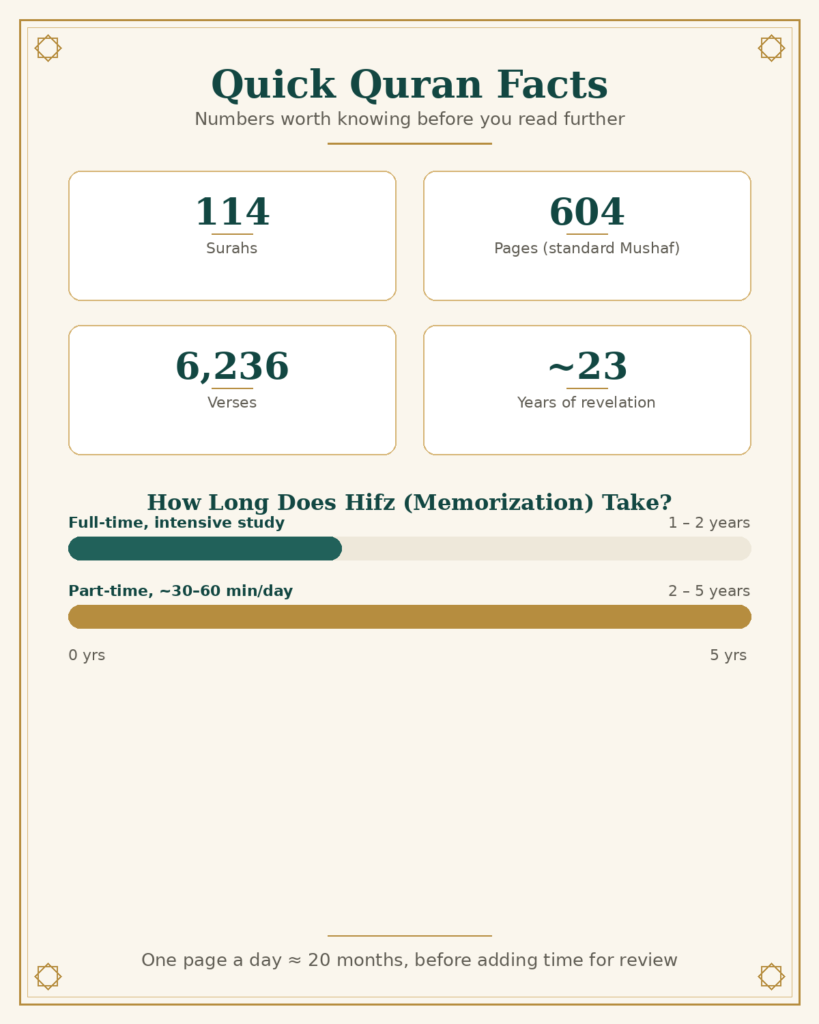
- Full-time, intensive programs: roughly 1 to 2 years, sometimes as fast as 6-12 months for highly disciplined students with prior Arabic fluency
- Part-time study (30–60 minutes a day): typically 2 to 5 years
- The math behind it: the Quran has 604 pages in the standard Mushaf and 6,236 verses across 114 surahs — memorizing one page a day works out to roughly 20 months, before adding time for the daily revision that keeps it retained
Whichever pace someone chooses, reviewers across Hifz academies agree on one thing: consistency in small daily amounts beats occasional long sessions, because the Quran is described in hadith as easy to hold onto but also easy to lose without regular revision.
How to Start Learning (or Teaching) the Quran as a Beginner
For someone starting from zero, the practical order that most Quran teachers recommend is:
- Learn the Arabic alphabet and basic pronunciation (often through a Noorani Qaida) before attempting to read verses.
- Start memorizing with the shortest surahs — Al-Ikhlas, Al-Falaq, An-Nas, and Al-Fatiha — since these are used in daily prayer regardless of memorization goals.
- Learn basic tajweed rules alongside recitation, rather than after, so correct pronunciation becomes a habit from the start rather than something to unlearn later.
- Read a translation alongside the Arabic to understand meaning, not just sound.
- Study under a teacher or structured program where possible — self-study is workable for reading, but pronunciation errors are hard to self-correct without a listener.
For anyone verifying a specific verse’s exact wording or Surah:Ayah reference before quoting it — for a khutbah, a caption, or an assignment — Quran.com is the standard primary source most Islamic content sites, including the quotes roundup linked above, check their references against.
Bringing It Together
Whether the starting point is a single verse that resonated, a Loh-e-Qurani, or the goal of memorizing the whole Quran, the underlying advice repeats: start small, verify what you read against a primary source, and let consistency do the work that intensity alone can’t