
What Is the Janaza Dua for a Female?
The Janaza dua for a female is the supplication recited during Salat al-Janazah — the Islamic funeral prayer — when the deceased is an adult woman. It’s the same prayer offered for a man, with one difference: the Arabic pronouns shift from masculine to feminine to reflect who is being prayed for. If you arrived here searching doa jenazah perempuan, janazah dua for woman, or aurat ke janaze ki dua, you’re in the right place — those are, respectively, the Indonesian and the Urdu/Hindi phrasings for exactly this dua, and the Arabic text below is identical no matter which language brought you here.
This page covers the full Arabic text with transliteration and translation, the three authentic versions scholars cite and when each is used, what specifically changes when the deceased is a woman rather than a man, and when you can recite this dua beyond the funeral prayer itself.
The Authentic Arabic Dua for a Deceased Woman
The fullest and most widely cited version comes from Sahih Muslim. It’s recited after the third Takbir of the funeral prayer.
Arabic:
اللَّهُمَّ اغْفِرْ لَهَا وَارْحَمْهَا، وَعَافِهَا وَاعْفُ عَنْهَا، وَأَكْرِمْ نُزُلَهَا، وَوَسِّعْ مُدْخَلَهَا، وَاغْسِلْهَا بِالْمَاءِ وَالثَّلْجِ وَالْبَرَدِ، وَنَقِّهَا مِنَ الْخَطَايَا كَمَا نَقَّيْتَ الثَّوْبَ الأَبْيَضَ مِنَ الدَّنَسِ، وَأَبْدِلْهَا دَارًا خَيْرًا مِنْ دَارِهَا، وَأَهْلًا خَيْرًا مِنْ أَهْلِهَا، وَزَوْجًا خَيْرًا مِنْ زَوْجِهَا، وَأَدْخِلْهَا الْجَنَّةَ، وَأَعِذْهَا مِنْ عَذَابِ الْقَبْرِ وَمِنْ عَذَابِ النَّارِ.
Transliteration:
Allāhumma ighfir lahā warhamhā, wa ‘āfihā wa’fu ‘anhā, wa akrim nuzulahā, wa wassi’ mudkhalahā, waghsil’hā bil-mā’i wath-thalji wal-barad, wa naqqihā mina al-khaṭāyā kamā naqqayta ath-thawba al-abyaḍa mina ad-danas, wa abdil’hā dāran khayran min dārihā, wa ahlan khayran min ahlihā, wa zawjan khayran min zawjihā, wa adkhil’hā al-jannah, wa a’idh’hā min ‘adhābi al-qabr wa min ‘adhābi an-nār.
Translation:
O Allah, forgive her, have mercy on her, grant her safety, and pardon her. Honor her arrival and expand her entrance. Wash her with water, snow, and hail, and cleanse her of sin as a white garment is cleansed of dirt. Grant her a home better than her home, a family better than her family, and a companion better than her companion. Admit her into Paradise, and protect her from the punishment of the grave and the torment of the Fire.
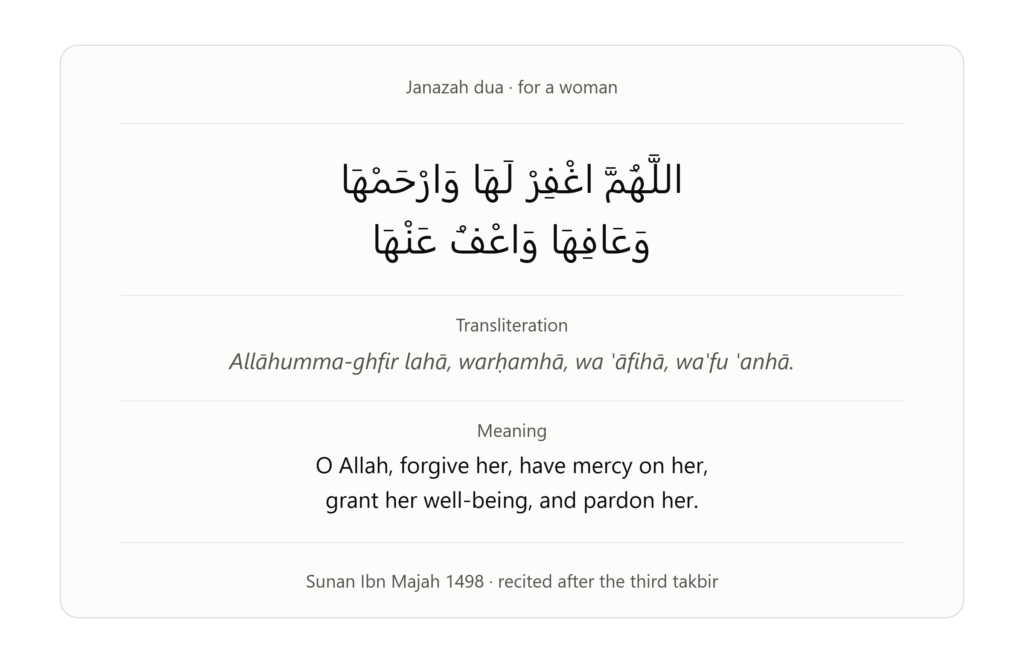
That’s the complete, formal version. If you haven’t memorized it, a shorter and equally valid wording is recited from Sunan Ibn Majah 1498 — it’s the version several madhhabs recommend as sufficient when the longer text isn’t available to you:
Arabic: اللَّهُمَّ اغْفِرْ لَهَا وَارْحَمْهَا وَعَافِهَا وَاعْفُ عَنْهَا
Transliteration: Allāhumma-ghfir lahā, warḥamhā, wa ‘āfihā, wa’fu ‘anhā.
Translation: O Allah, forgive her, have mercy on her, grant her well-being, and pardon her.
🖼️ [Suggested graphic here: the full Arabic dua laid out as a clean typographic card with transliteration and translation beneath — see brief Section 6 for spec]
Which Version of the Dua Should I Use? (3 Authentic Options)
All three of the following are authentic — scholars differ on which is preferable in a given school of thought, not on whether each one is valid. Use whichever you have memorized.
| Version | Hadith Source | When Typically Used | Key Phrase |
|---|---|---|---|
| Long form (Sahih Muslim) | Sahih Muslim 963 | The default full recitation when memorized | “…admit her into Paradise, protect her from the punishment of the grave…” |
| Short form (Hanafi-recommended) | Sunan Ibn Majah 1498 | Recommended by the Hanafi madhhab; also a fallback when the long form isn’t memorized | “Forgive her, have mercy on her, grant her well-being, and pardon her” |
| Conditional form (Al-Hakim) | Al-Hakim 1/359, graded sahih by Al-Albani | When the deceased’s character or level of righteousness isn’t known to the one praying | “If she was pious, increase her reward; if she fell short, forgive her” |
The third version is worth knowing on its own, because it solves a real dilemma: what do you say for a woman you didn’t know well? It doesn’t ask you to judge her — it hands that entirely to Allah, asking for more reward if she was righteous and forgiveness if she wasn’t.
None of this means you need to pick “the right one” before you can pray. If you’ve only ever memorized the short form, use it — the Hanafi madhhab treats it as the recommended wording, not a fallback for people who couldn’t manage something better. If you’ve memorized the long form from Sahih Muslim, that’s the more complete supplication and there’s no harm in using it every time. The conditional Al-Hakim wording tends to come up most often when a community prays over someone from outside their immediate circle — a neighbor, a relative of a relative, someone whose life you genuinely can’t speak to in detail. Reciting it isn’t a lesser choice; it’s arguably the more honest one in that situation.
What’s Different When the Deceased Is a Woman
Three things change when the Janazah prayer is offered for a woman rather than a man — and only one of them is in the dua itself.
The pronoun. Arabic marks gender directly in the suffix attached to a verb or preposition, not with a separate word the way English uses “him” or “her.” “Ighfir lahu” and “ighfir laha” are built from the exact same root verb — only the final letter changes, from the masculine ه (hu) to the feminine ها (ha). It isn’t a stylistic choice, a regional dialect, or something a reciter can skip — it’s built into the grammar of the sentence itself, the same way you couldn’t say “forgive he” in English and have it read correctly. Every other word in the prayer, and its meaning, stays identical.
The shroud. A woman’s kafan (burial shroud) is traditionally made of five pieces of cloth, compared to three for a man. The extra pieces provide more complete coverage, consistent with the modesty requirements observed for a woman’s body during Ghusl and burial.
The Imam’s position. During the prayer itself, the Imam stands opposite the middle of the body when the deceased is a woman, rather than opposite the head, which is the position used for a man. This single positioning detail is one of the more commonly asked questions from people attending their first female Janazah — it isn’t arbitrary, and most scholars tie it to the same modesty principle behind the extra shroud cloth. If you want the complete walkthrough of the four Takbirs and where everyone stands, see our guide to how to perform Salat al-Janazah step by step — (placeholder link: no such pillar page currently exists on taqweemacademy.com; either build one or repoint this anchor to an existing page before publishing).
When to Recite the Dua for Female Janaza
This dua isn’t limited to the funeral prayer itself. You can recite it:
- During the Janazah prayer — after the third Takbir, standing in congregation. This is the one moment where the recitation is a structured part of the prayer rather than a personal choice of wording.
- At the graveside, immediately after burial, while those present are still gathered. The Prophet ﷺ encouraged those attending a burial to remain a short while afterward and ask forgiveness for the deceased, since this is described as the point at which she is questioned in the grave.
- In your daily supplications, especially after any of the five daily prayers. Many people keep a mother, sister, or other loved one in their regular dua long after the funeral itself.
- On Fridays, which many scholars note as a time when supplications carry particular weight.
- When visiting her grave later, as an ongoing act of remembrance — you don’t need to be at the funeral to make this dua for her.
There’s no fixed time limit on when you can make this dua. Unlike the formal prayer, which is only offered once, this supplication is something you can return to for as long as you choose — and by most accounts, she continues to benefit from it long after the funeral itself has ended.
Aurat ke Janaze ki Dua — Roman Urdu Transliteration
If you’re more comfortable reading Roman Urdu than Arabic transliteration, here’s the same dua rendered phonetically:
Allahumma ighfir laha warhamha, wa aafiha wa’fu anha, wa akrim nuzulaha, wa wassi mudkhalaha, waghsilha bil ma-i was thalji wal barad, wa naqqiha minal khataya kama naqqaita as-thawbal abyada minad-danas, wa abdilha daran khairan min dariha, wa ahlan khairan min ahliha, wa zaujan khairan min zaujiha, wa adkhilha al-jannah, wa a’idhha min azabil qabri wa min azabin naar.
Matlab (Meaning): Ya Allah, is aurat ko bakhsh de, us par reham farma, use aafiyat aur maafi ata farma. Uski qabr ko izzat wali bana, aur uski jagah ko wasee kar de. Use gunahon se is tarah pak kar de jaise safed kapda maile se pak hota hai. Use uske ghar se behtar ghar, uske ghar walon se behtar ghar wale, aur uske sathi se behtar sathi ata farma. Use Jannat mein dakhil farma, aur use qabr ke azab aur jahannam ki aag se mehfooz rakh.
Short Dua for a Deceased Woman (If You Don’t Know the Full Version)
For moments outside the formal prayer — hearing news of a death, for instance — a brief line is enough:
Arabic: اللَّهُمَّ اغْفِرْ لَهَا وَارْحَمْهَا
Transliteration: Allāhumma ighfir lahā warhamhā.
Translation: O Allah, forgive her and have mercy on her.
It’s short enough to say quietly the moment you hear the news, and it’s fully valid even outside the structure of the funeral prayer. There’s a common misconception that a “proper” dua for the deceased has to be the long, formal version — it doesn’t. Scholars are clear that the short forms carry the same essential meaning, and reciting one sincerely is worth more than delaying a prayer for her because you’re trying to recall a longer text you’re not confident in.
Frequently Asked Questions
What is the correct dua for a female Janazah prayer? The most complete authentic version is “Allahumma ighfir laha warhamha wa ‘afiha wa’fu ‘anha…” from Sahih Muslim, recited after the third Takbir. A shorter version — “Allahumma ighfir laha warhamha” — is acceptable if the longer text hasn’t been memorized.
Why does the dua use “laha” instead of “lahu”? “Laha” (her) replaces “lahu” (him) because Arabic grammatically marks gender in pronouns attached to verbs. Every other word in the dua stays the same — only these pronoun endings change to match the deceased.
Is the janaza dua for a woman different from the one for a man? Only in pronoun, not in meaning or structure. The full text, hadith source, and recitation timing are identical for men and women — the words simply reflect the deceased’s gender.
What do I say if I don’t know whether the deceased woman was righteous? You can use the Al-Hakim version, which includes “if she was pious, increase her reward; if she fell short, forgive her” — a conditional phrase designed for exactly this situation, so you aren’t required to judge her character.
Where does the Imam stand for a woman’s Janazah prayer? The Imam stands opposite the middle of the body when the deceased is a woman, compared to opposite the head when the deceased is a man. The reasoning most commonly cited is modesty in positioning relative to the shrouded body.
Can I recite this dua outside of the funeral prayer? Yes. It’s commonly recited at the graveside after burial, during personal supplication after the five daily prayers, and when visiting the grave later — not only during Salat al-Janazah itself.
Doa jenazah perempuan sama dengan doa untuk orang meninggal perempuan? Doa jenazah perempuan dibaca khusus saat sholat jenazah (takbir ketiga), sedangkan “doa untuk orang meninggal” bisa mencakup doa ziarah kubur dan doa harian — isinya mirip, konteksnya berbeda.
May Allah have mercy on her, and on all who came before us in faith.
Editorial notes for the writer/publisher (remove before publishing):
- The internal link to a full “Salat al-Janazah step by step” pillar page is a placeholder — taqweemacademy.com doesn’t currently have that page. Either build it first, or repoint that anchor to the existing
/dua-for-the-deceased-in-arabic-for-female/article. - Per the brief, also add a link from the intro or conclusion to
/dua-for-the-deceased-in-arabic-for-female/(your existing page) — not yet placed in this draft; drop it wherever it reads most naturally once you see the final formatted page. - Outbound link to
ehidayat.com/surah-mulk-read-online/and the inbound link recommendation fromehidayat.com/allahummaghfirlaha-warhamha-dua-female/are cross-site additions per your brief — neither is placed in the body text above; add the outbound one wherever a Surah Al-Mulk / grave-protection mention fits naturally, e.g. near “protect her from the punishment of the grave” in the main dua section.