
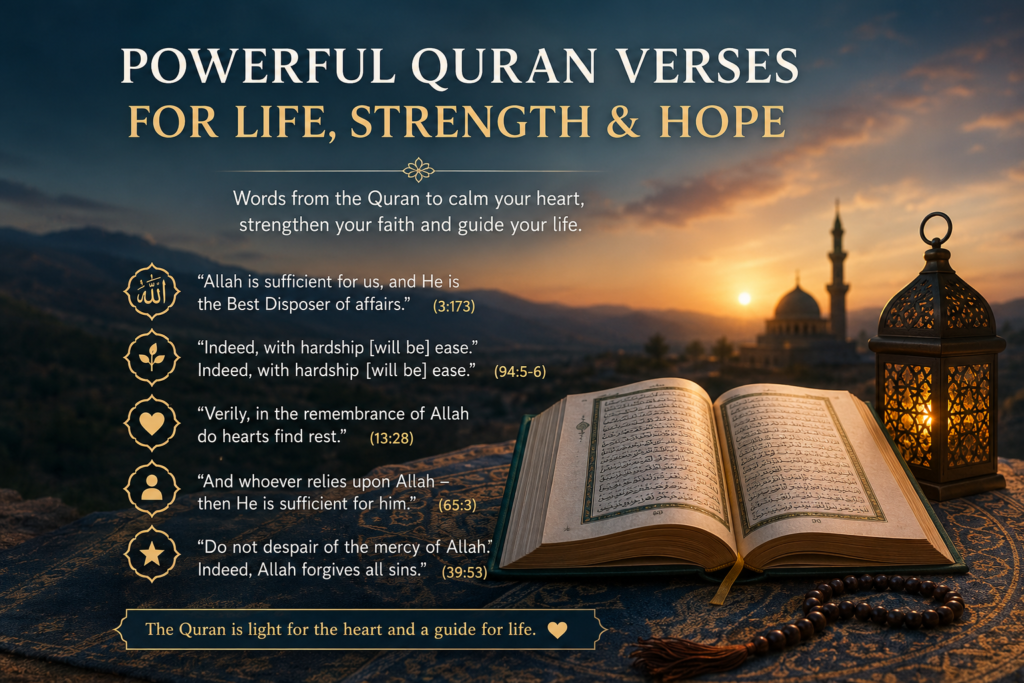
The most powerful Quran verses do more than provide temporary inspiration. They correct our perspective, strengthen faith, soften the heart and remind us that Allah’s knowledge, mercy and authority are greater than every difficulty we face.
Some people search for deep short Quran verses to memorize. Others need Quran verses about life, strength, patience, forgiveness or trusting Allah during uncertainty. This guide brings these themes together while explaining the meaning and lesson behind each ayah.
What Is the Most Powerful Ayat in the Quran?
Every verse of the Quran is the word of Allah and deserves reverence. Describing one verse as the “best” can therefore be subjective.
However, Ayat al-Kursi—Surah Al-Baqarah 2:255—is specifically identified as the greatest ayah in an authentic hadith. When the Prophet Muhammad ﷺ asked Ubayy ibn Ka‘b which verse was the greatest, Ubayy answered with Ayat al-Kursi, and the Prophet ﷺ approved his answer.
You can read the narration in Sahih Muslim 810 and view the complete Arabic, translation and tafsir of Ayat al-Kursi on Quran.com.
This does not mean other verses are unimportant. Different Quranic verses speak powerfully to different conditions: fear, grief, guilt, confusion, gratitude, hardship and the search for purpose.
Translation note: The English meanings below are concise paraphrases for reflection rather than replacements for a complete scholarly translation or tafsir. Some longer verses are represented by their most relevant Arabic passage.
Powerful Quran Verses at a Glance
| Need or Situation | Quran Verse | Central Message |
|---|---|---|
| Knowing Allah’s greatness | Al-Baqarah 2:255 | Allah is the Ever-Living Sustainer |
| Facing hardship | Ash-Sharh 94:5–6 | Ease accompanies difficulty |
| Feeling overwhelmed | Al-Baqarah 2:286 | Allah knows the capacity of every soul |
| Experiencing fear | Ali ‘Imran 3:173 | Allah is sufficient and the best Protector |
| Searching for peace | Ar-Ra‘d 13:28 | Hearts find comfort through remembering Allah |
| Regretting past sins | Az-Zumar 39:53 | Never despair of Allah’s mercy |
| Feeling uncertain | At-Talaq 65:3 | Allah is sufficient for those who trust Him |
| Needing motivation | Al-‘Ankabut 29:69 | Allah guides those who strive sincerely |
| Seeking life’s purpose | Adh-Dhariyat 51:56 | Humanity was created to worship Allah |
| Remembering the Hereafter | Ali ‘Imran 3:185 | Every soul will experience death |
The Greatest Ayat: Ayat al-Kursi
1. Allah Is the Ever-Living and All-Sustaining
Arabic excerpt:
اللَّهُ لَا إِلَٰهَ إِلَّا هُوَ الْحَيُّ الْقَيُّومُ
Transliteration:
Allahu la ilaha illa Huwa, Al-Hayyul-Qayyum.
Meaning:
No one deserves worship except Allah. He is eternally living and sustains everything that exists. Neither sleep nor tiredness affects Him, and His knowledge and authority encompass the heavens and the earth.
Reference: Surah Al-Baqarah 2:255
Ayat al-Kursi is powerful because it directs the heart away from created things and toward the absolute greatness of the Creator. Human beings become tired, distracted and unaware. Allah never does.
When life feels uncontrolled, this ayah reminds us that nothing escapes Allah’s knowledge or authority. True security begins with knowing who Allah is.
Powerful Quran Verses for Strength in Hard Times
2. With Hardship Comes Ease
Arabic:
فَإِنَّ مَعَ الْعُسْرِ يُسْرًا
إِنَّ مَعَ الْعُسْرِ يُسْرًا
Transliteration:
Fa-inna ma‘al-‘usri yusra. Inna ma‘al-‘usri yusra.
Meaning:
Alongside hardship, Allah brings ease.
Reference: Surah Ash-Sharh 94:5–6
The verses do not merely say that ease will arrive after every hardship. They teach that ease exists with hardship, even when we cannot yet recognize it.
The ease might appear as patience, helpful people, spiritual growth, a new opportunity or protection from something worse. This is one of the best short Quran verses to remember when a difficult period appears endless.
3. Allah Knows What Every Soul Can Carry
Arabic excerpt:
لَا يُكَلِّفُ اللَّهُ نَفْسًا إِلَّا وُسْعَهَا
Transliteration:
La yukallifullahu nafsan illa wus‘aha.
Meaning:
Allah does not hold a soul responsible for more than it has the capacity to bear.
Reference: Surah Al-Baqarah 2:286
This verse does not tell people to ignore pain or pretend that suffering is easy. It reminds believers that Allah understands their limits completely, including limits that other people cannot see.
The remainder of the ayah teaches believers to ask for pardon, forgiveness, mercy and divine help. For a detailed explanation of this passage, read about the last two ayat of Surah Al-Baqarah, their meaning and related hadith.
4. Do Not Lose Heart or Fall Into Despair
Arabic excerpt:
وَلَا تَهِنُوا وَلَا تَحْزَنُوا
Transliteration:
Wa la tahinu wa la tahzanu.
Meaning:
Do not become weak and do not surrender to grief.
Reference: Surah Ali ‘Imran 3:139
This ayah was revealed in a serious context involving hardship and loss. It therefore offers something deeper than generic positive thinking.
Faith does not mean that believers never feel sadness. It means sadness does not have to destroy their relationship with Allah, their principles or their willingness to continue doing what is right.
5. Seek Help Through Patience and Prayer
Arabic excerpt:
اسْتَعِينُوا بِالصَّبْرِ وَالصَّلَاةِ
إِنَّ اللَّهَ مَعَ الصَّابِرِينَ
Transliteration:
Ista‘inu bis-sabri was-salah. Innallaha ma‘as-sabirin.
Meaning:
Seek Allah’s help through patient perseverance and prayer. Allah is with those who remain patient.
Reference: Surah Al-Baqarah 2:153
The Quran connects spiritual resilience with action. A believer is not told simply to wait. The ayah combines sabr—steadfast patience—with salah, a direct act of worship and dependence upon Allah.
When pressure increases, prayer should not become the first thing abandoned. It can become the place where strength is renewed.
6. Whoever Trusts Allah Will Find Him Sufficient
Arabic excerpt:
وَمَن يَتَوَكَّلْ عَلَى اللَّهِ فَهُوَ حَسْبُهُ
Transliteration:
Wa man yatawakkal ‘alallahi fahuwa hasbuh.
Meaning:
Whoever places sincere trust in Allah will find that Allah is sufficient.
Reference: Surah At-Talaq 65:3
Tawakkul does not mean refusing to plan or make an effort. It means taking permissible action while recognizing that results ultimately belong to Allah.
This verse is especially powerful during financial uncertainty, family problems, career decisions and situations where the outcome cannot be controlled.
7. Allah Is Sufficient and the Best Protector
Arabic:
حَسْبُنَا اللَّهُ وَنِعْمَ الْوَكِيلُ
Transliteration:
Hasbunallahu wa ni‘mal-wakil.
Meaning:
Allah is sufficient for us, and He is the finest One in whom to place our affairs.
Reference: Surah Ali ‘Imran 3:173
These words were spoken when believers were threatened and told to fear their enemies. Instead of weakening them, the warning increased their faith.
This is not a promise that believers will never encounter danger. It is a declaration that fear should not become greater in the heart than reliance upon Allah.
Read the detailed Hasbunallahu wa ni‘mal wakeel meaning and context for a closer explanation of this powerful ayah.
8. Nothing Reaches Us Outside Allah’s Decree
Arabic excerpt:
لَنْ يُصِيبَنَا إِلَّا مَا كَتَبَ اللَّهُ لَنَا
هُوَ مَوْلَانَا
Transliteration:
Lan yusibana illa ma kataballahu lana; Huwa mawlana.
Meaning:
Nothing will reach us except what Allah has decreed for us. He is our Guardian.
Reference: Surah At-Tawbah 9:51
This ayah teaches courage without carelessness. Muslims still take precautions, seek treatment, protect their families and make responsible decisions. However, they do not believe that precautions possess power independently of Allah.
The verse releases the heart from constant fear of every possible outcome.
9. Allah Guides Those Who Strive
Arabic:
وَالَّذِينَ جَاهَدُوا فِينَا لَنَهْدِيَنَّهُمْ سُبُلَنَا
Transliteration:
Walladhina jahadu fina lanahdiyannahum subulana.
Meaning:
Allah will guide those who sincerely strive in His cause toward His paths.
Reference: Surah Al-‘Ankabut 29:69
Guidance is not always experienced as an instant feeling. It often appears while a person is making sincere effort: learning, repenting, resisting temptation, correcting habits and continuing acts of worship.
This is one of the most motivational Quranic verses for anyone who feels discouraged by slow progress.
Deep Short Quran Verses With Meaning
10. Never Despair of Relief From Allah
Arabic:
لَا تَيْأَسُوا مِنْ رَوْحِ اللَّهِ
Transliteration:
La tay’asu min rawhillah.
Meaning:
Do not give up hope in the relief and mercy that come from Allah.
Reference: Surah Yusuf 12:87
Prophet Ya‘qub عليه السلام spoke these words after years of grief and separation. His circumstances had not yet changed, but his understanding of Allah prevented despair from taking control.
Hope in Allah is not limited to moments when a solution appears close.
11. Do Not Despair of Allah’s Mercy
Arabic excerpt:
لَا تَقْنَطُوا مِنْ رَحْمَةِ اللَّهِ
Transliteration:
La taqnatu min rahmatillah.
Meaning:
Do not lose hope in Allah’s mercy, regardless of how far you believe you have fallen.
Reference: Surah Az-Zumar 39:53
This is among the most beautiful and powerful Quran verses for someone burdened by past sins. It opens the door of hope while calling the sinner back to Allah through sincere repentance.
The verse should not be used to make sin appear unimportant. Its message is that no sin is greater than Allah’s ability to forgive the person who genuinely returns to Him.
12. Hearts Find Peace in Remembering Allah
Arabic:
أَلَا بِذِكْرِ اللَّهِ تَطْمَئِنُّ الْقُلُوبُ
Transliteration:
Ala bidhikrillahi tatma’innul-qulub.
Meaning:
Hearts find true comfort through the remembrance of Allah.
Reference: Surah Ar-Ra‘d 13:28
The verse does not suggest that believers will never experience emotional distress. Rather, it identifies the deepest source of spiritual stability.
Dhikr includes remembering Allah with the tongue, heart and actions. It includes prayer, Quran recitation, gratitude, repentance and remaining conscious of Allah throughout daily life.
13. Call Upon Me; I Will Respond
Arabic:
ادْعُونِي أَسْتَجِبْ لَكُمْ
Transliteration:
Ud‘uni astajib lakum.
Meaning:
Allah commands His servants to call upon Him and promises to respond.
Reference: Surah Ghafir 40:60
Allah’s response does not always take the exact form or timing a person expects. A request may be granted, delayed, redirected toward something better or become a means of reward.
The heart of dua is not controlling the outcome. It is recognizing one’s need for Allah.
14. Do Not Be Afraid; I Hear and See
Arabic:
لَا تَخَافَا إِنَّنِي مَعَكُمَا أَسْمَعُ وَأَرَى
Transliteration:
La takhafa innani ma‘akuma asma‘u wa ara.
Meaning:
Do not be afraid. Allah hears and sees what is happening.
Reference: Surah Taha 20:46
These words were addressed to Musa and Harun عليهما السلام when they were commanded to confront Pharaoh. The context shows that courage does not require the absence of danger.
Courage grows when a believer knows that Allah sees the situation completely.
15. Allah Is Nearer Than the Jugular Vein
Arabic:
وَنَحْنُ أَقْرَبُ إِلَيْهِ مِنْ حَبْلِ الْوَرِيدِ
Transliteration:
Wa nahnu aqrabu ilayhi min hablil-warid.
Meaning:
Allah’s knowledge and awareness of a person are closer than the jugular vein.
Reference: Surah Qaf 50:16
This verse should be understood in a manner consistent with Allah’s majesty. Its central lesson is that no thought, fear, intention or hidden struggle escapes His knowledge.
A person may feel misunderstood by everyone else but never becomes unknown to Allah.
16. Gratitude Brings Increase
Arabic:
لَئِنْ شَكَرْتُمْ لَأَزِيدَنَّكُمْ
Transliteration:
La’in shakartum la-azidannakum.
Meaning:
Allah promises increase to those who are grateful.
Reference: Surah Ibrahim 14:7
The increase may include blessings, contentment, faith, understanding or the ability to use what one already possesses more wisely.
Gratitude is more than saying Alhamdulillah. It includes recognizing the Giver, using blessings responsibly and refusing to let blessings lead to disobedience.
Quran Verses About Life, Purpose and the Hereafter
17. Allah Knows What We Do Not Know
Arabic excerpt:
وَاللَّهُ يَعْلَمُ وَأَنْتُمْ لَا تَعْلَمُونَ
Transliteration:
Wallahu ya‘lamu wa antum la ta‘lamun.
Meaning:
Allah knows the complete reality, while human knowledge remains limited.
Reference: Surah Al-Baqarah 2:216
People naturally judge events by what they can see now. Something painful may contain long-term good, while something attractive may carry harm.
This verse teaches humility when making sense of unanswered prayers, closed doors and unexpected changes. It does not ask believers to call pain pleasant. It asks them to remember that their view is incomplete.
18. Life’s Central Purpose Is Worship
Arabic:
وَمَا خَلَقْتُ الْجِنَّ وَالْإِنْسَ إِلَّا لِيَعْبُدُونِ
Transliteration:
Wa ma khalaqtul-jinna wal-insa illa liya‘budun.
Meaning:
Allah created jinn and human beings to worship Him.
Reference: Surah Adh-Dhariyat 51:56
Worship in Islam is not confined to prayer and fasting. Permissible daily activities can become worship when they are performed sincerely, ethically and in accordance with Allah’s guidance.
This ayah gives life a stable purpose that does not disappear when employment, wealth, status or relationships change.
19. Life Is a Test of the Best Deeds
Arabic excerpt:
الَّذِي خَلَقَ الْمَوْتَ وَالْحَيَاةَ
لِيَبْلُوَكُمْ أَيُّكُمْ أَحْسَنُ عَمَلًا
Transliteration:
Alladhi khalaqal-mawta wal-hayata liyabluwakum ayyukum ahsanu ‘amala.
Meaning:
Allah created death and life to test which people are best in their actions.
Reference: Surah Al-Mulk 67:2
The ayah says “best in deeds,” not merely “most in deeds.” Sincere, correct and consistent actions may carry greater value than impressive actions performed for recognition.
Life’s tests reveal priorities, intentions and the direction in which a person chooses to walk.
20. Worldly Life Is Temporary
Arabic excerpt:
اعْلَمُوا أَنَّمَا الْحَيَاةُ الدُّنْيَا
لَعِبٌ وَلَهْوٌ وَزِينَةٌ
Transliteration:
I‘lamu annamal-hayatud-dunya la‘ibun wa lahwun wa zinah.
Meaning:
Worldly life can become play, distraction, decoration, competition and pride when it is treated as the final destination.
Reference: Surah Al-Hadid 57:20
Islam does not prohibit enjoying lawful blessings. The warning concerns becoming so absorbed in temporary things that the Hereafter is forgotten.
Wealth, appearance and achievement are tools. They make poor gods and unreliable measures of a person’s worth.
21. The Hereafter Is the Real and Lasting Life
Arabic excerpt:
وَإِنَّ الدَّارَ الْآخِرَةَ لَهِيَ الْحَيَوَانُ
Transliteration:
Wa innad-daral-akhirata lahiyal-hayawan.
Meaning:
The home of the Hereafter is the true and lasting life.
Reference: Surah Al-‘Ankabut 29:64
This ayah changes how believers measure success. A worldly loss is not necessarily an ultimate loss, and worldly comfort is not necessarily ultimate success.
The most important question is not simply, “What did I gain?” It is, “What will this mean when I return to Allah?”
22. Every Soul Will Taste Death
Arabic:
كُلُّ نَفْسٍ ذَائِقَةُ الْمَوْتِ
Transliteration:
Kullu nafsin dha’iqatul-mawt.
Meaning:
Every soul will experience death, and complete recompense will be given in the Hereafter.
Reference: Surah Ali ‘Imran 3:185
This is one of the deepest short Quran verses about life and death. It does not encourage hopelessness. It brings urgency and clarity.
Remembering death helps a person forgive sooner, repent sincerely, value time and stop treating temporary problems as though they will last forever.
Best Quranic Verses for Character and Relationships
23. True Honour Comes Through God-Consciousness
Arabic:
إِنَّ أَكْرَمَكُمْ عِنْدَ اللَّهِ أَتْقَاكُمْ
Transliteration:
Inna akramakum ‘indallahi atqakum.
Meaning:
The most honoured people before Allah are those with the greatest taqwa.
Reference: Surah Al-Hujurat 49:13
Race, nationality, tribe, wealth and social position do not determine a person’s value before Allah. The Quran directs attention toward taqwa: awareness of Allah expressed through faith and righteous conduct.
This ayah challenges racism, arrogance and every attempt to measure human worth by worldly labels.
24. Respond to Evil With What Is Better
Arabic:
ادْفَعْ بِالَّتِي هِيَ أَحْسَنُ
Transliteration:
Idfa‘ billati hiya ahsan.
Meaning:
Respond to wrongdoing in the manner that is best.
Reference: Surah Fussilat 41:34
The verse does not require remaining in an abusive or dangerous situation. Justice, boundaries and protection from harm remain important.
Its lesson is that believers should not allow another person’s bad character to determine their own. Wisdom, restraint and principled conduct can sometimes transform hostility into respect.
25. Allah Commands Justice and Excellence
Arabic excerpt:
إِنَّ اللَّهَ يَأْمُرُ بِالْعَدْلِ وَالْإِحْسَانِ
Transliteration:
Innallaha ya’muru bil-‘adli wal-ihsan.
Meaning:
Allah commands justice, excellence and generosity toward relatives, while prohibiting immorality, wrongdoing and oppression.
Reference: Surah An-Nahl 16:90
Justice gives people what they are rightfully owed. Ihsan goes further by encouraging excellence, kindness and sincere good conduct.
A spiritual life that ignores justice is incomplete. The Quran joins worship of Allah with responsibility toward other people.
How to Benefit From Powerful Quranic Verses
Reading a beautiful ayah can create an immediate emotional response, but lasting benefit requires more than collecting quotations.
Begin by reading the verses before and after the ayah so that its context is not lost. Compare a reliable translation with tafsir, especially when a verse concerns law, theology or a historical event. Memorize a small number of verses and repeat them in prayer or daily reflection.
Most importantly, identify the action each verse requires. A verse about patience should produce patience. A verse about repentance should lead to repentance. A verse about justice should improve how other people are treated.
The Quran was revealed as guidance, not merely as decorative words for captions and images.
For a larger collection arranged as concise quotations, see these verified Quran quotes with Arabic, meaning and references.
Frequently Asked Questions
What Is Considered the Most Powerful Ayat in the Quran?
Ayat al-Kursi, Surah Al-Baqarah 2:255, is identified as the greatest ayah in an authentic narration recorded in Sahih Muslim. It describes Allah’s oneness, eternal life, complete knowledge, authority and sustaining power.
What Is a Deep Short Quran Verse?
One of the best-known short verses is:
أَلَا بِذِكْرِ اللَّهِ تَطْمَئِنُّ الْقُلُوبُ
“Through the remembrance of Allah, hearts find comfort.”
It appears in Surah Ar-Ra‘d 13:28.
Which Quran Verse Gives Strength During Hardship?
Surah Ash-Sharh 94:5–6 is among the most motivational passages because it repeats that ease accompanies hardship. Al-Baqarah 2:286, Ali ‘Imran 3:139 and Al-Baqarah 2:153 also provide guidance about capacity, resilience, patience and prayer.
Which Quran Verse Is Best for Trusting Allah?
Surah At-Talaq 65:3 teaches that Allah is sufficient for the person who places sincere trust in Him. Ali ‘Imran 3:173 contains the well-known declaration, “Hasbunallahu wa ni‘mal-wakil”—Allah is sufficient for us and the best Protector.
What Does the Quran Say About the Purpose of Life?
Surah Adh-Dhariyat 51:56 states that humans and jinn were created to worship Allah. Surah Al-Mulk 67:2 explains that life and death form a test through which the quality of human deeds is revealed.
Which Quran Verse Offers Hope After Sin?
Surah Az-Zumar 39:53 tells those who have wronged themselves not to despair of Allah’s mercy. The verse encourages sincere repentance and teaches that a person’s past does not place them beyond Allah’s forgiveness.
Can Quran Verses Be Used as Motivational Quotes?
They can be shared as reminders, but they should be quoted accurately, referenced properly and treated respectfully. Avoid removing words in a way that changes the meaning or turning a context-specific passage into a promise the verse does not make.
Final Reflection
The best Quranic verse for a particular moment may be the one that corrects what the heart has forgotten.
When you are afraid, remember that Allah is sufficient. When you feel guilty, remember His mercy. When life appears purposeless, remember why you were created. When hardship becomes heavy, remember that ease is present even when it has not yet become visible.
Do not stop at reading these powerful verses of the Quran. Reflect on them, learn their context, recite them sincerely and allow them to change how you worship Allah and treat His creation