
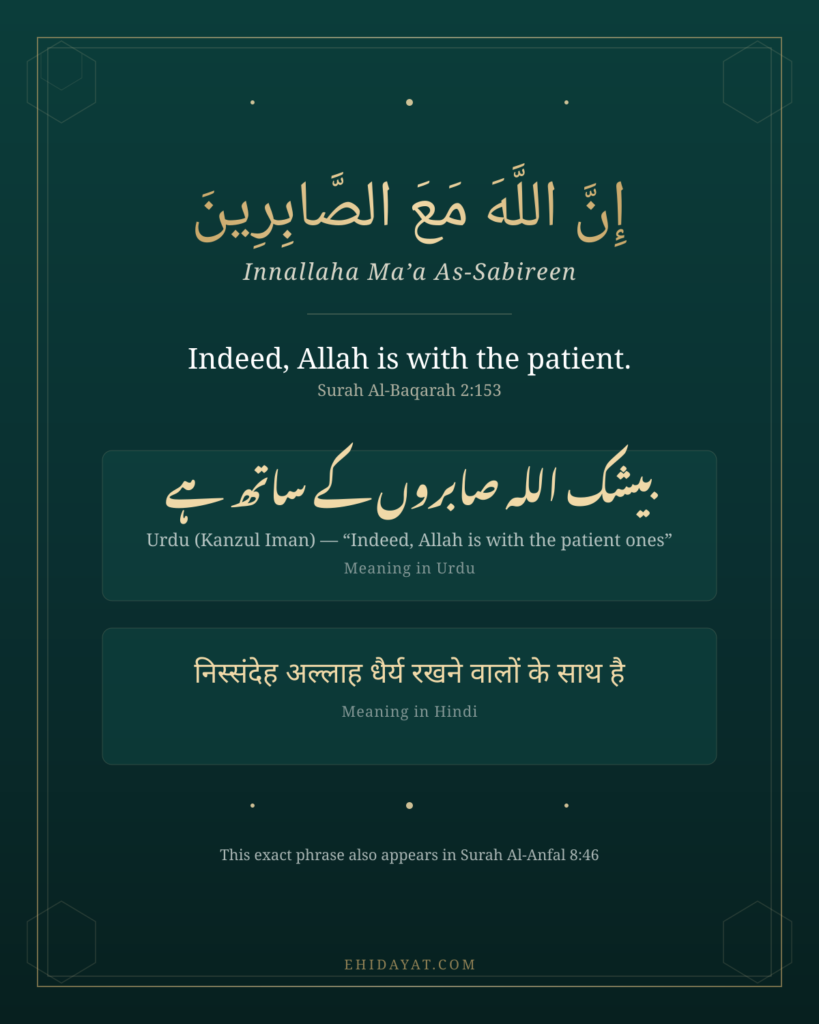
Innallaha Ma Sabireen (إِنَّ اللَّهَ مَعَ الصَّابِرِينَ) means “Indeed, Allah is with the patient.” It’s from Surah Al-Baqarah, verse 153, where believers are told to seek help through patience and prayer. In Urdu it’s most often rendered as بیشک اللہ صابروں کے ساتھ ہے, and it’s one of the most shared Quranic phrases among Urdu- and Hindi-speaking Muslims — on WhatsApp status, Instagram bios, and as a quiet reminder during hard days.
There’s more to the phrase than a single line of comfort, though. It shows up twice in the Quran, in two very different situations, and it rests on a specific theological idea about what Allah’s “being with” someone actually means. That’s what the rest of this covers.
Innallaha Ma Sabireen in Arabic (Correct Text)
The full Quranic wording, with diacritics, is:
إِنَّ اللَّهَ مَعَ الصَّابِرِينَ
Without diacritics: إن الله مع الصابرين
Transliteration: Innallaha ma’a as-sabireen (also written Innal-laha ma’as-sabireen). Break it into syllables and it reads: In-na-lla-ha ma-‘as-sa-bi-reen. Both spellings point to the same Arabic text — “Innallaha” is simply the connected form of “Inna Allaha.”
Word for word, it breaks down like this:
| Arabic | Transliteration | English |
|---|---|---|
| إِنَّ | Inna | Indeed / Surely |
| اللَّهَ | Allaha | Allah |
| مَعَ | Ma’a | With |
| الصَّابِرِينَ | As-Sabireen | The patient ones |
Innallaha Ma Sabireen Meaning in Urdu (اردو ترجمہ)
بیشک اللہ صابروں کے ساتھ ہے
That’s how the phrase reads in Kanzul Iman, the Urdu translation by Imam Ahmad Raza Khan (Aala Hazrat) that remains the most widely read Urdu Quran translation in South Asia. In context, the full ayah reads: “اے ایمان والو! صبر اور نماز سے مدد چاہو، بیشک اللہ صابروں کے ساتھ ہے” — “O believers, seek help through patience and prayer; indeed, Allah is with the patient.”
You’ll also come across a slightly different wording in other Urdu translations, most commonly بے شک اللہ صبر کرنے والوں کے ساتھ ہے (used in Fateh Muhammad Jalandhari’s translation, among others). The difference is stylistic, not a difference in meaning: “صابروں” (sabiron) is a direct cognate of the Arabic as-sabireen, while “صبر کرنے والوں” (sabr karne walon) is a more descriptive Urdu phrase for “those who do patience.” If you’ve seen the phrase written two different ways online, this is why — it isn’t an error on either side, just two translators making different word choices for the same Arabic.
Here’s the phrase broken down word by word with its Urdu meaning:
| Arabic | Transliteration | English | Urdu |
|---|---|---|---|
| إِنَّ | Inna | Indeed | بیشک |
| اللَّهَ | Allaha | Allah | اللہ |
| مَعَ | Ma’a | With | کے ساتھ |
| الصَّابِرِينَ | As-Sabireen | The patient | صابروں |
Innallaha Ma Sabireen Meaning in Hindi (हिंदी अर्थ)
In Devanagari, the phrase is commonly transliterated as इन्नल्लाहा मा अस-साबिरीन, meaning “निस्संदेह अल्लाह धैर्य रखने वालों के साथ है” — “Indeed, Allah is with those who keep patience (sabr).”
Worth being upfront about: this is a transliteration and rendering, not a line from an officially published Hindi Quran translation the way the Urdu version above is from Kanzul Iman. Hindi and Urdu speakers largely understand each other’s spoken language, so the concept comes through the same way — “sabr” carries into Hindi roughly as dhairya (धैर्य, patience/composure) or sahanshilta (सहनशीलता, endurance), both of which capture the active, faith-anchored patience the Arabic word implies rather than passive waiting.
Where Exactly Does This Phrase Appear in the Quran?
Here’s something most explanations of this phrase skip: the exact Arabic wording إِنَّ اللَّهَ مَعَ الصَّابِرِينَ occurs in exactly two places in the Quran, not “many times” or a vague count — two, word for word identical.
| Verse | Context | English meaning |
|---|---|---|
| Al-Baqarah 2:153 | Believers told to seek help through patience and prayer during everyday hardship | “O you who have believed, seek help through patience and prayer. Indeed, Allah is with the patient.” |
| Al-Anfal 8:46 | Command to obey Allah and His Messenger and not fall into disputes that would weaken unity before battle | “And obey Allah and His Messenger, and do not dispute and [thus] lose courage and [then] your strength would depart… and be patient. Indeed, Allah is with the patient.” |
The contrast is the interesting part. 2:153 is about personal, everyday patience — grief, hardship, the ordinary weight of life, met with prayer. 8:46 is about collective steadfastness — holding together as a group under real pressure, without infighting. Same six words, two completely different kinds of trial.
It’s worth flagging a third verse that gets mixed in with these two online, because it uses a related but different phrase: Aal-e-Imran 3:146 says وَاللَّهُ يُحِبُّ الصَّابِرِينَ — “And Allah loves the patient.” That’s “Allah loves” (yuhibbu), not “Allah is with” (ma’a) — a related idea about sabr, but a different Arabic construction and a different verse. If you found that one while searching for “Innallaha Ma Sabireen,” it’s related but not the same line.
What Kind of “With” Does This Verse Mean?
This is where a lot of explanations stop at “spiritual, not physical” and leave it there. Islamic theology actually has a more specific answer.
Scholars describe Allah’s “withness” (ma’iyyah) as being of two kinds. The first is ma’iyyah ‘ammah — general withness. This is Allah’s all-encompassing knowledge, covering every creature, believer and non-believer alike. Surah Al-Hadid 57:4 describes it: “He is with you wherever you are.” It’s not a promise of help; it’s a statement that nothing escapes His awareness.
The second is ma’iyyah khassah — specific withness. This one is conditional and reserved for the patient and the pious. It carries actual support: protection, strength, victory, guidance. Al-Anfal 8:46 is one of the classic proof-texts scholars point to for this type, alongside At-Tawbah 9:40, where the Prophet ﷺ tells Abu Bakr in the cave, “Do not grieve; indeed, Allah is with us” — a promise of help in a moment of real danger, not a general statement about divine knowledge.
That distinction matters for how you read “Innallaha Ma Sabireen.” It isn’t saying Allah is simply aware of the patient the way He’s aware of everyone. It’s saying something stronger: that patience — the deliberate, faith-anchored kind, not passive waiting — puts a person inside a specific category that receives active support. The promise is conditional on the response, not automatic.
The Hadith Behind This Verse
The Quranic promise is backed by an authentic hadith on the same theme. Abu Sa’id al-Khudri reported that some of the Ansar once asked the Prophet ﷺ for help, and he gave to them repeatedly until he had nothing left to give. He then told them: “…whoever remains patient, Allah will bestow patience upon him, and no one is ever given a gift better or more generous than patience.” It’s recorded in Sahih al-Bukhari (1469) and Sahih Muslim (1053) — agreed upon by both, which is the strongest grade a hadith can carry.
A second, less commonly cited hadith rounds out the picture. Suhaib reported the Prophet ﷺ saying: “Wondrous is the affair of the believer — there is good for him in every matter, and that applies to no one but the believer. If something good happens to him, he is grateful, and that is good for him. If something bad happens to him, he is patient, and that is good for him too.” This one is in Sahih Muslim (2999). Between the two hadiths, patience isn’t framed as gritting your teeth through a bad situation — it’s framed as a response that Allah rewards either way the situation turns out.
Why Muslims Recite This Phrase
The verse comes up in a handful of recurring situations. During grief or loss, it’s one of the most common lines shared or said quietly to someone mourning — a reminder that hardship doesn’t mean abandonment, which is part of why it’s so often paired with condolence duas. In daily hardship — a difficult diagnosis, a job loss, a strained relationship — it functions as a short, memorable anchor, the kind of line that’s easy to hold onto when longer duas feel like too much in the moment.
Some recite it as a habit tied to prayer itself, since the ayah pairs patience directly with salah rather than treating them as separate responses to hardship — the implication being that patience without prayer, or prayer without patience, is only half the instruction. And increasingly, it shows up as a public declaration of faith: an Instagram bio, a WhatsApp status, a phone wallpaper — less a private dua now than a visible marker of what someone is holding onto.
Innallaha Ma Sabireen for Instagram Bio, Status and Wallpapers
A few ready-to-use formats, since this is clearly how a lot of people encounter the phrase in the first place:
- Arabic only: إِنَّ اللَّهَ مَعَ الصَّابِرِينَ
- Urdu only: بیشک اللہ صابروں کے ساتھ ہے
- Bilingual (Arabic + English): إِنَّ اللَّهَ مَعَ الصَّابِرِينَ — “Indeed, Allah is with the patient.”
- Full line with reference: Innallaha ma’a as-sabireen — Surah Al-Baqarah 2:153
FAQ
What does Innallaha Ma Sabireen mean in English? “Indeed, Allah is with the patient.” It’s from Surah Al-Baqarah, verse 153, where believers are told to seek help through patience and prayer.
How do you write Innallaha Ma Sabireen in Urdu? The Quranic Arabic is إِنَّ اللَّهَ مَعَ الصَّابِرِينَ. In Kanzul Iman it’s translated as بیشک اللہ صابروں کے ساتھ ہے (“Indeed, Allah is with the patient ones”).
Is Innallaha Ma Sabireen mentioned more than once in the Quran? Yes — the exact phrase appears in two places: Al-Baqarah 2:153 and Al-Anfal 8:46, in two different situations, personal hardship and battlefield steadfastness.
What is the hadith about patience connected to this verse? Sahih al-Bukhari (1469) and Sahih Muslim (1053) record the Prophet ﷺ saying that whoever strives to be patient, Allah will grant him patience, and no gift is better or more generous than it.
Does “Allah is with the patient” mean He is physically near them? No. Scholars describe this as ma’iyyah khassah — a specific companionship of support, protection, and help reserved for the patient and pious, distinct from Allah’s general, knowledge-based awareness of all creation.
What is the meaning of Innallaha Ma Sabireen in Hindi? Roughly, “निस्संदेह अल्लाह धैर्य रखने वालों के साथ है” — a transliteration-based rendering rather than an official Hindi Quran translation, conveying the same meaning as the Urdu and English versions.
When do Muslims typically say or share this phrase? Most commonly during grief or loss, as a reminder during personal hardship, and increasingly as an Instagram bio or WhatsApp status line expressing patience and trust in Allah.
The six words are simple. What they’re actually promising isn’t automatic comfort — it’s support that responds to how you show up in the hardship. Read the meaning and hadith behind the last two ayat of Surah Al-Baqarah, the closing verses of the same surah this phrase comes from. If you’re looking for a similar phrase for hard moments, Hasbunallahu Wa Ni’mal Wakeel carries a closely related meaning — trusting Allah as sufficient support. And for a deeper look at how hadith are graded and cited, see what hadith means in Islam.
Sources: Al-Baqarah 2:153 — Quran.com · Al-Anfal 8:46 — Quran.com · Sahih al-Bukhari 1469 — Sunnah.com · Sahih Muslim 2999 — Sunnah.com