
A hadith is a recorded report of something the Prophet Muhammad ﷺ said, did, or silently approved of. Alongside the Quran, hadith make up Islam’s second major source of guidance — and in practical terms, they’re where most of the “how” of Islamic life actually comes from. The word is also spelled Hadees or Hadis in South Asian and Southeast Asian usage, and you’ll see it written both ways across Urdu, Hindi, and Indonesian Islamic literature.
This article is a companion to our What Does Hadith Mean? piece, which digs into the word’s origin and basic definition in more depth. Here, we’re covering the bigger picture: how a hadith is structured, how scholars decide whether one is trustworthy, why Sunni and Shia Muslims don’t actually rely on the same hadith books, and what to do the next time a “hadith” shows up in your WhatsApp family group that sounds a little off.
What Does “Hadith” Actually Mean?
The word hadith (حديث) comes from the Arabic root ḥ-d-th, which carries the sense of “to happen” or “to report.” At its core, a hadith is exactly that — a report. Specifically, a report about something the Prophet said, did, or tacitly allowed to happen in his presence without objecting to it.
That last category trips people up. If a companion did something and the Prophet ﷺ saw it and stayed quiet, that silence itself becomes part of the religious record. Scholars call this taqrir, and it’s treated with the same seriousness as his direct words.
We go deeper into the etymology and the word’s early usage in our dedicated hadith meaning article — worth a read if you want the linguistic side of this in full.
What Is the Difference Between Hadith and Sunnah?
People use these two words almost interchangeably, and honestly, in casual conversation that’s fine. But there’s a real distinction. Sunnah is the broader term — it refers to everything the Prophet ﷺ said, did, or approved of, viewed as a lived example. Hadith is the record of that example: the written, narrated report that preserves it.
Sunnah gets broken down into three types by scholars: qawliyyah (his sayings), fi’liyyah (his actions), and taqririyyah (his silent approvals). Hadith is how all three of those get passed down to us. Think of it this way — the Sunnah is what the Prophet lived; hadith is how we know about it.
What Is the Structure of a Hadith? (Isnad and Matn)
Every hadith has two parts, and understanding them is the key to understanding everything that follows in this article.
The isnad is the chain of narrators — literally, “who told whom.” A hadith doesn’t just say “the Prophet said X.” It says “person A heard it from person B, who heard it from person C, who heard the Prophet say it.” Scholars traced every single name in that chain, checked when each person lived, whether they could have plausibly met the person before them in the chain, and whether they had a reputation for honesty and accurate memory.
The matn is the actual content — the words or description of the action itself. Even a hadith with a flawless chain gets checked against the Quran and other established hadith. If the content contradicts the Quran, or contradicts something well-established, that’s a red flag regardless of how clean the chain looks.
Verifying the isnad wasn’t a one-time check either. Early hadith scholars developed a comparative method: if a companion had narrated a saying to fifteen different students, later scholars would ask each of those students, separately, to recite it back. If thirteen agreed on the wording and two didn’t, that wasn’t treated as a minor discrepancy — it flagged the two outliers as having weaker memory, and their future narrations got weighed accordingly. This is part of why the process took generations to formalize rather than happening overnight.
Here’s a concrete example most Muslims have heard: “Actions are judged by intentions” (innama al-a’malu bi’n-niyyat). This is recorded in Sahih al-Bukhari, hadith 1, and Sahih Muslim, hadith 1907 — it’s actually the opening hadith in Bukhari’s entire collection, and one of the most frequently cited hadith in Islamic scholarship. Both the isnad and the matn passed the strictest scrutiny available, which is why it’s graded Sahih.
How Are Hadiths Classified? Sahih, Hasan, and Da’if Explained
Not every reported hadith gets treated the same way. Scholars built an entire discipline — ʿilm al-hadith, the science of hadith — specifically to sort authentic reports from weak ones and outright forgeries. There are three main grades, plus a fourth category for what fails the test entirely.
A Sahih (authentic) hadith has an unbroken chain of narrators, every one of them known for reliability and accurate memory, and text that doesn’t contradict the Quran or other Sahih hadith. A Hasan (good) hadith clears the same bar on chain continuity and narrator character, but one or more narrators has a slightly weaker memory — good enough to accept, not quite the gold standard. A Da’if (weak) hadith has some identifiable flaw: maybe a narrator’s reliability is disputed, or there’s a gap in the chain. And then there’s Mawdu’ (fabricated) — a report scholars have determined was invented outright and falsely attached to the Prophet ﷺ.
One distinction worth sitting with: weak is not the same as fake. A da’if hadith might still describe something true, just with insufficient documentation to be certain — scholars sometimes still cite da’if hadith for general moral encouragement (fada’il al-a’mal), while refusing to use them to establish a ruling. A mawdu’ hadith is a different animal entirely — it’s a known fabrication, and Islamic scholarship treats spreading one as a serious matter, precisely because the Prophet ﷺ himself warned against attributing false statements to him.
It’s also worth knowing that grading isn’t always unanimous. Two respected hadith scholars can look at the same narrator and reach different conclusions about his reliability, which is why you’ll occasionally see a hadith graded Sahih by one scholar and Hasan by another. That’s a disagreement within a shared rigorous method, not a sign the method itself is arbitrary.
| Grade | Arabic | Criteria | Can It Be Used for Rulings? |
|---|---|---|---|
| Sahih | صحيح | Unbroken chain, reliable narrators, no contradiction | Yes |
| Hasan | حسن | Reliable chain, but narrator memory slightly weaker | Yes |
| Da’if | ضعيف | Flaw in chain or narrator reliability | Not alone |
| Mawdu’ | موضوع | Fabricated — never actually said by the Prophet ﷺ | No — must not be attributed to him |
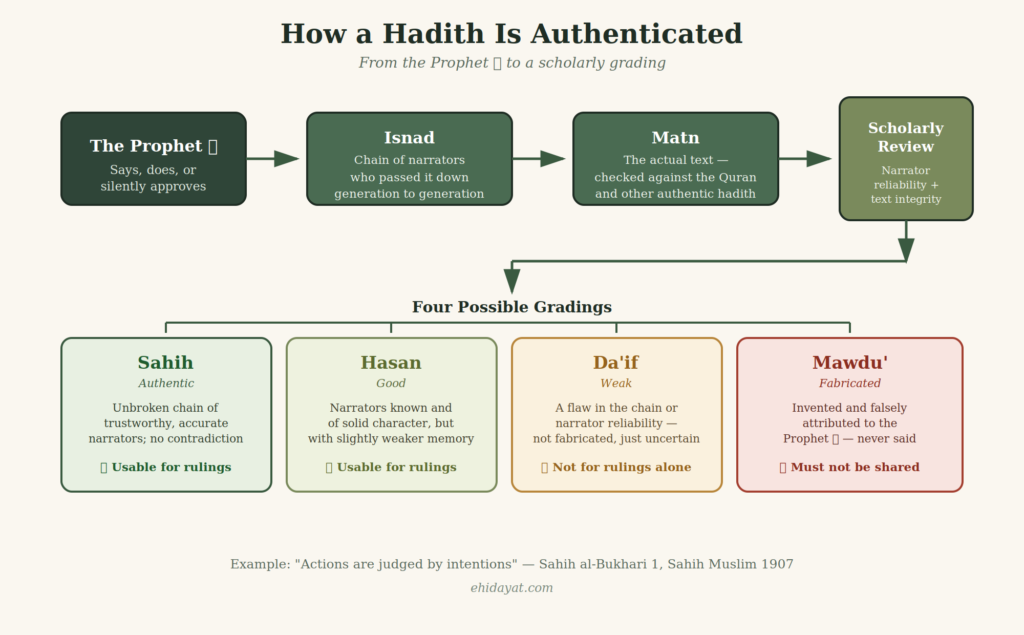
How a hadith moves from narration to scholarly grading — and what each grade means for whether it can be used in Islamic rulings.
Are Hadiths the Same for Sunni and Shia Muslims?
No, and this is something a lot of hadith explainers skip entirely.
Sunni Muslims rely on six canonical collections known as the Kutub al-Sittah — the Six Books. These are Sahih al-Bukhari, Sahih Muslim, Sunan Abu Dawud, Jami’ at-Tirmidhi, Sunan an-Nasa’i, and Sunan Ibn Majah, all compiled roughly between 840 and 912 CE. Bukhari and Muslim are usually treated as the top tier of the six.
Twelver Shia Muslims work from a different set entirely: the Kutub al-Arba’ah, the Four Books. These are al-Kafi, Man La Yahduruhu al-Faqih, Tahdhib al-Ahkam, and al-Istibsar. Rather than centering on the Prophet’s companions as the primary chain of transmission, these collections give special weight to narrations that pass through the Twelve Imams — particularly Ja’far al-Sadiq, who appears constantly as a source in Shia hadith literature.
The two traditions also lean on slightly different evaluation instincts. Sunni hadith scholarship built its authentication method mainly around scrutinizing the individual narrators across the whole chain, generation by generation. Twelver Shia scholarship does this too, but also gives particular standing to narrations that reach back through the Imams, since they’re considered infallible transmitters of the Prophet’s teaching in that framework.
| Tradition | Canonical Collections | Core Focus |
|---|---|---|
| Sunni | Kutub al-Sittah (Bukhari, Muslim, Abu Dawud, Tirmidhi, Nasa’i, Ibn Majah) | Broad narrator-chain scrutiny across companions and successors |
| Twelver Shia | Kutub al-Arba’ah (al-Kafi, Man La Yahduruhu al-Faqih, Tahdhib al-Ahkam, al-Istibsar) | Narrations transmitted through the Twelve Imams, especially Ja’far al-Sadiq |
Neither approach is “less rigorous” — they’re built on different premises about where reliable transmission comes from. If you’re reading hadith content aimed at a broad Muslim audience, it helps to know which tradition a given collection or scholar is drawing from before assuming it applies universally.
What Are the Most Trusted Hadith Collections?
Within the Six Books, Sahih al-Bukhari and Sahih Muslim are known together as the Sahihayn — “the two authentics” — and they’re the two most rigorously screened collections in Sunni Islam. Imam Bukhari reportedly reviewed over 600,000 narrations over roughly sixteen years of travel and research, and kept only around 7,000 of them (fewer if you strip out repetitions). That ratio alone tells you how demanding the standard was.
The remaining four books — Abu Dawud, Tirmidhi, Nasa’i, and Ibn Majah — are called the Sunan, and while still authoritative, they include a somewhat broader mix of Sahih, Hasan, and occasionally weaker narrations, usually flagged as such within the text itself.
If you’re just starting to read hadith rather than read about hadith, most teachers point beginners toward the 40 Hadith of Imam Nawawi first. It’s a compact selection — around forty core hadiths covering the essentials of the faith — rather than the full weight of Bukhari or Muslim on day one.
Why Does Hadith Matter in Islamic Law and Daily Life?
Here’s the practical problem hadith actually solves. The Quran commands Muslims to pray — but nowhere does it walk through how many units (rak’ahs) each prayer contains, what to recite in each position, or the exact physical movements involved. Without hadith, you’d have the command with none of the instructions.
This is exactly where Islamic jurisprudence, or Usul al-Fiqh, comes in. The four major Sunni schools of law — Hanafi, Maliki, Shafi’i, and Hanbali — all use graded hadith as a primary source alongside the Quran when deriving rulings, and they don’t always weigh a given hadith identically. Two madhabs looking at the same Hasan-grade narration might land on slightly different conclusions about how strictly it applies. That’s a normal, long-recognized feature of Islamic legal reasoning, not a flaw in the system.
Prayer isn’t the only example. The Quran commands fasting in Ramadan but leaves the exact conditions that break a fast to hadith. It commands zakat but leaves the specific thresholds and percentages — the nisab calculations jurists still use today — to hadith and the reasoning built on it. Even something as everyday as how to enter a mosque, greet another Muslim, or handle a dispute traces back to a specific hadith rather than a Quranic verse. Strip hadith out of the picture and most of daily Islamic practice loses its instruction manual.
This same hadith-to-ruling pipeline is exactly what produces a fatwa — a scholarly religious ruling on a specific question. If you want to see how that process actually plays out from source hadith to final answer, our fatwa meaning in Islam article walks through the full six-stage process.
A Fabricated Hadith Almost Everyone Has Heard
Here’s one nearly every Muslim has come across at some point: “Hubb al-watan min al-iman” — “love of homeland is part of faith.”
It sounds reasonable. It gets shared constantly, especially around national holidays. And it isn’t a hadith at all. Hadith critics including al-Saghani and Mulla ‘Ali al-Qari classified it as mawdu’ — fabricated — centuries ago (recorded in al-Mawdu’at al-Saghani, hadith 81, and Al-Masnu’, hadith 106). No reliable chain traces it back to the Prophet ﷺ.
To be clear, this isn’t a judgment on the sentiment. Loving where you’re from isn’t un-Islamic, and there are genuine, authentic hadith showing the Prophet’s own attachment to Makkah and Madinah. The issue is narrower and more specific than that: this particular phrase was never something he actually said, and attributing invented words to him — however harmless the words sound — is exactly the kind of thing the science of hadith exists to catch.
This is also not an isolated case. Our Hasbunallahu Wa Ni’mal Wakeel piece covers a similar situation — a popular claim about a specific recitation count that has no basis in the actual sources, addressed directly by IslamQA fatwa #22457. These fabricated-hadith and inflated-claim problems show up more often than most people realize, usually because a comforting or motivating phrase spreads faster than anyone checks it.
How to Check If a Hadith Is Authentic Before You Share It
Three steps, and none of them require a hadith degree.
First, look up the actual source — the collection name and hadith number — instead of trusting a screenshot, a quote graphic, or a forwarded message. If a “hadith” is floating around with no book and number attached, that alone is a warning sign.
Second, cross-reference it against a recognized hadith database, such as Sunnah.com, which lets you search collections directly and see the grading scholars have assigned. It takes about as long as reading the quote itself.
Third, if the grading still isn’t clear, or the hadith touches on something with real consequences (a ruling, a warning, a claim about reward or punishment), ask someone actually qualified — a local scholar or imam — before repeating it as settled fact.
None of this is about being suspicious of everything you read. It’s about protecting what gets attributed to the Prophet ﷺ, which is the entire reason the science of hadith exists in the first place.
FAQ
What is a hadith in simple terms? A hadith is a recorded report of something the Prophet Muhammad ﷺ said, did, or silently approved of. Alongside the Quran, hadiths are Islam’s second source of religious guidance, preserved through a chain of narrators back to the Prophet himself.
What is the difference between hadith and Quran? The Quran is the direct, unaltered word of Allah revealed to the Prophet Muhammad ﷺ. Hadith are reports about the Prophet — his sayings, actions, and approvals — recorded and graded by later scholars, ranking second in authority after the Quran.
How many hadiths are there in Islam? Estimates run into the hundreds of thousands of individual reports across history, though far fewer are considered authentic. Imam Bukhari alone reportedly examined over 600,000 narrations and included only around 7,000 in Sahih al-Bukhari after applying his authentication criteria.
What does “sahih hadith” mean? Sahih means “authentic” — a hadith with an unbroken chain of trustworthy, accurate narrators and a text that doesn’t contradict the Quran or other established hadith. Sahih hadiths can be used as evidence in Islamic law.
Is a weak (da’if) hadith the same as a fake one? No. A da’if (weak) hadith simply has a flaw somewhere in its chain or text — such as a narrator with an imperfect memory — while a mawdu’ (fabricated) hadith is one scholars have determined was invented and falsely attributed to the Prophet ﷺ.
Do Sunni and Shia Muslims use the same hadith collections? No. Sunni Muslims rely on the Kutub al-Sittah (Six Books), led by Sahih al-Bukhari and Sahih Muslim. Twelver Shia Muslims rely on the Kutub al-Arba’ah (Four Books), which center on narrations transmitted through the Twelve Imams.
What are the best hadith collections for beginners? Scholars commonly recommend starting with the 40 Hadith of Imam Nawawi — a short, widely studied selection of authentic hadiths covering the essentials of the faith — before moving to the larger Sahih al-Bukhari or Sahih Muslim collections.
How can I tell if a hadith I saw online is real? Look up its collection and hadith number rather than trusting a screenshot or quote card, cross-check it against a database like Sunnah.com, and ask a qualified scholar if the grading isn’t clear before sharing or acting on it