
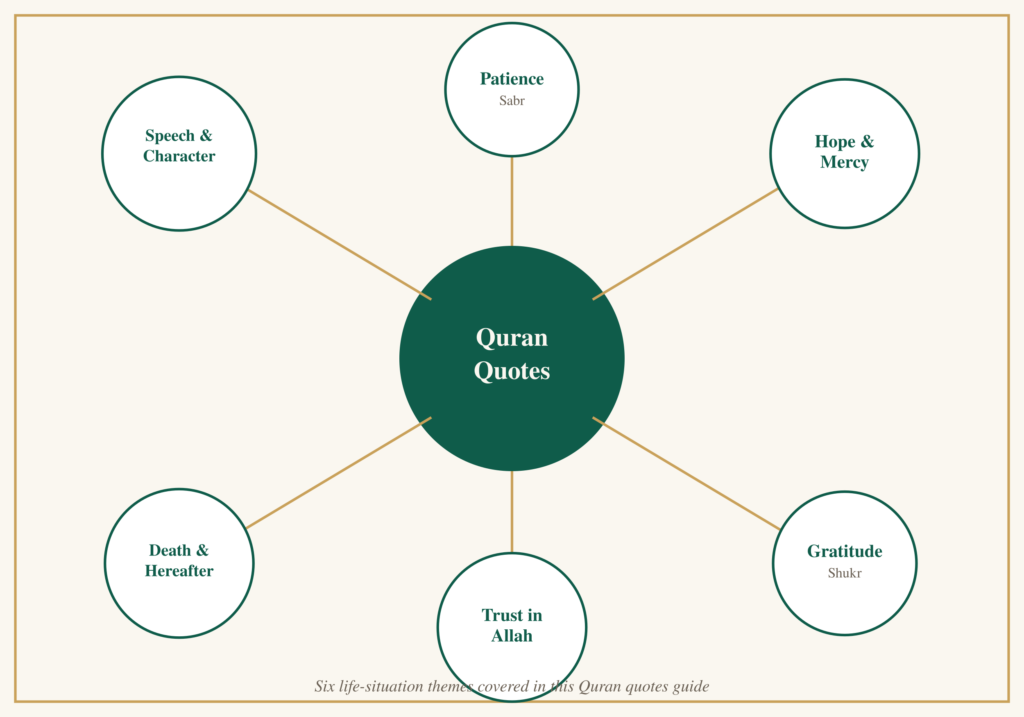
Search “quran quotes” and you’ll find the same handful of verses copied from site to site — often with the Surah and ayah number changed somewhere along the way. This list has been checked against the Arabic text and a standard English translation before publishing, so the reference next to each quote is the one you can actually use, whether you’re citing it in a khutbah, a caption, or a school assignment. It covers the phrasing people search for interchangeably — quotes in Quran, a quran quote, famous quran quotes — organized by the situations they actually speak to: patience, hope, gratitude, trust, death, and how we treat each other.
A Note on Accuracy — Why Surah:Ayah References Matter
Plenty of Quran quote roundups online carry mismatched verse numbers, and the mistakes travel — one site copies another’s citation, and an error that started as a typo ends up repeated across a dozen pages. A quote attributed to the wrong ayah is still Allah’s word, but citing it correctly matters if you want to look it up yourself, share it with confidence, or use it in something like a khutbah or a school assignment. Every reference below has been checked against the Arabic text and Quran.com’s Sahih International translation. Note also that Quran quotes and hadith quotes are not the same thing — the Quran is the literal word of Allah, while hadith are the Prophet Muhammad’s ﷺ recorded sayings and actions. Where the two are closely connected, that’s called out explicitly below rather than left vague.
Quran Quotes About Patience (Sabr)
Patience (sabr) is one of the most repeated themes in the Quran, and it’s almost always paired with a promise — relief, reward, or Allah’s own nearness.
اِنَّ مَعَ الْعُسْرِ يُسْرًا Inna ma’al-‘usri yusra “Indeed, with hardship comes ease.” — Surah Ash-Sharh 94:6
This line is often quoted alone, but it’s worth knowing it repeats an almost identical phrase from the verse just before it (94:5), which is why you’ll sometimes see the same quote cited as “94:5” on one site and “94:6” on another — both verses carry the promise, but the second one is the more commonly quoted of the two.
وَبَشِّرِ الصَّابِرِينَ Wa bashshiris-sabireen “And give good tidings to the patient.” — Surah Al-Baqarah 2:155
إِنَّ اللَّهَ مَعَ الصَّابِرِينَ Innallaha ma’as-sabireen “Indeed, Allah is with the patient.” — Surah Al-Baqarah 2:153
This verse comes right after the Quran’s command to “seek help through patience and prayer” (2:153) — patience isn’t presented as passive endurance, but as something paired with active worship.
فَاصْبِرْ صَبْرًا جَمِيلًا Fasbir sabran jameela “So be patient with gracious patience.” — Surah Al-Ma’arij 70:5
وَنَبْلُوكُم بِالشَّرِّ وَالْخَيْرِ فِتْنَةً “…and We test you with evil and with good as trial…” — Surah Al-Anbya 21:35
This verse frames hardship itself as a test rather than a punishment — a distinction that gets flattened in most one-line quote lists, but changes how the verse actually reads in context.
يَا أَيُّهَا الَّذِينَ آمَنُوا اصْبِرُوا وَصَابِرُوا وَرَابِطُوا Ya ayyuhal-ladheena amanus-biroo wa sabiroo wa rabitoo “O you who have believed, persevere and endure and remain steadfast.” — Surah Al-Imran 3:200
Commentators read sabiroo here as more than personal endurance — it also carries a sense of outdoing one another in patience, framing it as something believers actively compete in rather than simply tolerate.
Quran Quotes About Hope & Mercy
فَإِنَّ اللَّهَ هُوَ الْغَفُورُ الرَّحِيمُ “…indeed, it is He who is the Forgiving, the Merciful.” — Surah Az-Zumar 39:53
The full verse opens with “Do not despair of the mercy of Allah. Indeed, Allah forgives all sins” — one of the most direct statements of hope in the entire Quran, addressed to “My servants who have transgressed against themselves.”
وَرَحْمَتِي وَسِعَتْ كُلَّ شَيْءٍ Wa rahmati wasi’at kulla shay’ “…and My mercy encompasses all things.” — Surah Al-A’raf 7:156
فَاذْكُرُونِي أَذْكُرْكُمْ Fadhkurooni adhkurkum “So remember Me; I will remember you.” — Surah Al-Baqarah 2:152
This verse has a well-documented hadith connection that most quote lists mention only in passing, if at all. In a hadith recorded in both Sahih al-Bukhari 7405 and Sahih Muslim 2675, Allah says: “I am with him as he remembers Me… and if he comes to Me walking, I come to him running.” The Quranic verse and the hadith are making the same promise from two different angles — reciprocity for remembrance — and citing them together is more useful than either quote sitting alone.
وَهُوَ مَعَكُمْ أَيْنَ مَا كُنتُمْ “…and He is with you wherever you are.” — Surah Al-Hadid 57:4
وَاللَّهُ خَيْرُ الْمَاكِرِينَ Wallahu khayrul-makireen “And Allah is the best of planners.” — Surah Al-Anfal 8:30
This one is worth a caution: it’s frequently quoted as a general “trust Allah’s plan” reassurance, but the verse is specifically about the Quraysh’s plot to kill or imprison the Prophet ﷺ before his migration to Madinah — the “planning” being described is a direct response to that conspiracy, not a general statement about everyday hardship.
Quran Quotes About Gratitude (Shukr)
وَلَئِن شَكَرْتُمْ لَأَزِيدَنَّكُمْ Wa la’in shakartum la’azeedannakum “If you are grateful, I will surely increase you [in favor].” — Surah Ibrahim 14:7
This is often quoted as a stand-alone promise, but the verse continues with a warning attached — “but if you deny, indeed, My punishment is severe” — so gratitude in this context is framed as a condition, not just a nice sentiment.
وَمَا بِكُم مِّن نِّعْمَةٍ فَمِنَ اللَّهِ Wa ma bikum min ni’matin faminallah “And whatever you have of favor — it is from Allah.” — Surah An-Nahl 16:53
وَإِن تَعُدُّوا نِعْمَتَ اللَّهِ لَا تُحْصُوهَا “And if you should count the favors of Allah, you could not enumerate them.” — Surah An-Nahl 16:18
Practically, this verse is often used to argue against treating gratitude as a checklist — the point isn’t to count blessings one by one, but to recognize their sheer number is beyond counting in the first place.
Quran Quotes About Trust in Allah (Tawakkul)
Tawakkul — trust or reliance on Allah — shares its root with the word wakeel, meaning trustee or guardian. The same root shows up in the phrase Hasbunallahu wa ni’mal wakeel (“Allah is sufficient for us, and He is the best guardian”), which is itself a Quran quote from Surah Al-Imran (3:173) built entirely around this concept.
إِنَّ اللَّهَ يُحِبُّ الْمُتَوَكِّلِينَ Innallaha yuhibbul-mutawakkileen “Indeed, Allah loves those who rely upon Him.” — Surah Al-Imran 3:159
وَمَن يَتَوَكَّلْ عَلَى اللَّهِ فَهُوَ حَسْبُهُ Wa mai yatawakkal ‘alallahi fahuwa hasbuh “And whoever relies upon Allah — then He is sufficient for him.” — Surah At-Talaq 65:3
This verse comes at the end of a passage about Allah providing “from where he does not expect” — trust here isn’t abstract; it’s tied directly to provision arriving through unexpected means.
وَتَوَكَّلْ عَلَى اللَّهِ ۚ وَكَفَىٰ بِاللَّهِ وَكِيلًا Wa tawakkal ‘alallah, wa kafa billahi wakeela “And rely upon Allah; and sufficient is Allah as Disposer of affairs.” — Surah Al-Ahzab 33:3
Quran Quotes About Death & the Hereafter
كُلُّ نَفْسٍ ذَائِقَةُ الْمَوْتِ Kullu nafsin dha’iqatul-mawt “Every soul will taste death.” — Surah Al-Imran 3:185
This exact phrase also appears in Surah Al-Anbya (21:35) and Surah Al-Ankabut (29:57). What often gets lost is that in 3:185, the very same verse continues: “and the worldly life is not but the enjoyment of delusion.” Some quote lists present these as two separate Quran quotes from two different places — they’re actually one continuous verse.
خَلَقَ الْمَوْتَ وَالْحَيَاةَ لِيَبْلُوَكُمْ أَيُّكُمْ أَحْسَنُ عَمَلًا “[He] created death and life to test you [as to] which of you is best in deed.” — Surah Al-Mulk 67:2
Surah Al-Mulk opens with a series of reflections on Allah’s dominion over life, death, and creation — if this theme resonates, the full surah with translation is worth reading in sequence rather than as isolated verses.
فَصَلِّ لِرَبِّكَ وَانْحَرْ Fasalli lirabbika wanhar “So pray to your Lord and sacrifice [to Him alone].” — Surah Al-Kawthar 108:2
Al-Kawthar is the shortest surah in the Quran at just three verses, and this second verse is often quoted as a standalone reminder that worship and gratitude go together.
Quran Quotes About Speech, Character & Dealing with Others
This is one of the most practical themes in the Quran, yet it’s consistently thin across most quote roundups — usually reduced to one line with no real explanation of how the verse applies day to day.
وَقُولُوا لِلنَّاسِ حُسْنًا Wa qooloo linnasi husna “And speak to people good words.” — Surah Al-Baqarah 2:83
وَلَا تَسْتَوِي الْحَسَنَةُ وَلَا السَّيِّئَةُ ۚ ادْفَعْ بِالَّتِي هِيَ أَحْسَنُ “Good and evil are not equal. Repel [evil] with that which is better.” — Surah Fussilat 41:34
The verse doesn’t stop at “be nice” — it makes a specific claim about outcomes, continuing: “and thereupon the one whom between you and him is enmity will be as though he was a devoted friend.” It’s framed as a strategy for turning an actual enemy into an ally, not just generic advice to stay calm.
يَا أَيُّهَا الَّذِينَ آمَنُوا لَا يَسْخَرْ قَومٌ مِّن قَومٍ “O you who have believed, let not a people ridicule [another] people.” — Surah Al-Hujurat 49:11
This verse also prohibits nicknames meant to demean and closes with a warning against holding onto that behavior after claiming faith — a fuller picture than the “don’t mock others” summary it usually gets reduced to.
وَقُل لِّعِبَادِي يَقُولُوا الَّتِي هِيَ أَحْسَنُ Wa qul li’ibadi yaqoolul-lati hiya ahsan “And tell My servants to say that which is best.” — Surah Al-Isra 17:53
The verse continues by naming exactly why this matters: “Indeed, Satan induces dissension among them.” The instruction to choose kind words isn’t presented as etiquette — it’s framed as a direct countermeasure to something actively working to divide people.
What Is the Most Famous Verse in the Quran?
There’s no single verse Muslims universally agree is “the most famous,” but two are named far more often than any others: Ayat al-Kursi (2:255) for its description of Allah’s sovereignty, knowledge, and throne, and Surah Al-Ikhlas (112) for its four-verse statement of Allah’s absolute oneness. Al-Ikhlas carries particular weight because of a hadith recorded in Sahih al-Bukhari 5013: a companion overheard a man reciting only this surah, repeatedly, in his prayers, and reported it to the Prophet ﷺ as though he thought it wasn’t enough on its own. The Prophet ﷺ replied, “By Him in Whose Hand my life is, this Surah is equal to one-third of the Qur’an.” A related hadith recorded at Sahih al-Bukhari 5015 adds a second version of the same episode, where the Prophet ﷺ asks his companions whether reciting a third of the Quran in one night feels difficult, then answers his own question by naming this surah.
Ayat al-Kursi, meanwhile, is recommended in multiple hadith for recitation after prayer and before sleep, which is part of why it’s often the first verse new memorizers are taught after the short surahs. It’s also the single longest verse in the Quran to focus entirely on Allah’s attributes rather than a narrative or ruling, which is likely why it gets singled out from the rest of the 286 verses in Surah Al-Baqarah as a standalone quote far more often than any of its neighbors.
Quick Quran Facts
| Fact | Detail |
|---|---|
| Number of surahs | 114 |
| Longest surah | Al-Baqarah (286 verses) |
| Shortest surah | Al-Kawthar (3 verses) |
| Revelation period | ~23 years |
| First surah revealed (in part) | Al-‘Alaq |
Frequently Asked Questions
What is the most powerful quote in the Quran? There’s no single official “most powerful” verse, but Ayat al-Kursi (2:255) and Surah Al-Ikhlas (112) are the two most frequently cited — Ayat al-Kursi for describing Allah’s sovereignty and knowledge, and Al-Ikhlas for its concise statement of Allah’s oneness.
What does the Quran say about patience? The Quran repeatedly links patience with divine support and reward — most directly in Surah Ash-Sharh 94:6 (“Indeed, with hardship comes ease”) and Surah Al-Baqarah 2:153 (“Indeed, Allah is with the patient”).
Can I quote the Quran without knowing Arabic? Yes. English translations convey the meaning, though the Arabic carries linguistic depth no translation fully captures. Reading the transliteration alongside the English, as done throughout this article, helps you connect to the original wording even without reading Arabic script.
Are Quran quotes the same as hadith quotes? No. Quran quotes are verses of the Quran itself, which Muslims believe to be the literal word of Allah. Hadith are the Prophet Muhammad’s ﷺ recorded sayings and actions, collected separately in books like Sahih Bukhari and Sahih Muslim — you can read more on what hadith actually means if the distinction is new to you.
What is the shortest surah with a quotable verse? Surah Al-Kawthar (108), the shortest surah in the Quran at three verses, is often quoted in full — its second verse, “So pray to your Lord and sacrifice [to Him alone]” (108:2), is the one most commonly cited on its own.
How do I know a Quran quote I found online is accurate? Cross-check the Arabic and the Surah:Ayah reference against a primary source like Quran.com. As this article’s introduction notes, many popular quote lists carry mismatched verse numbers that have simply been copied from one site to the next