
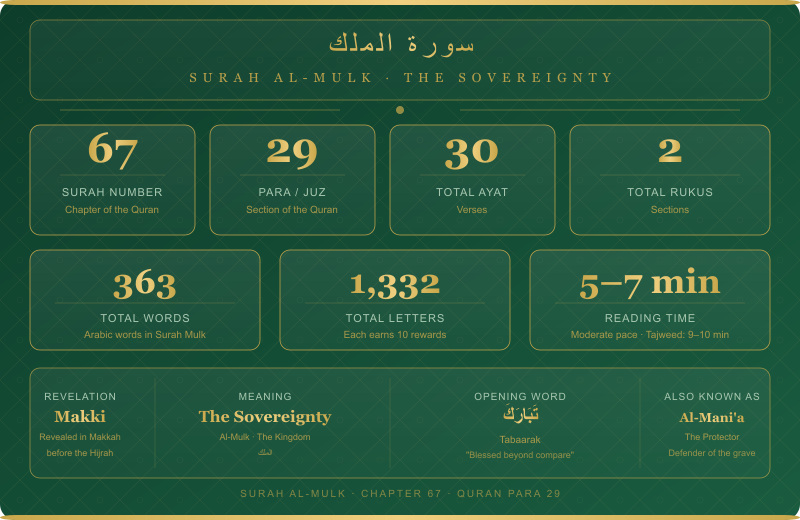
Surah Al-Mulk (سورة الملك) is the 67th chapter of the Holy Quran, located in Para 29. It contains 30 ayat and 2 rukus, revealed in Makkah before the Hijrah. Known as Al-Mani’a — The Protector — it is one of the most consistently recited surahs in the Muslim world, especially before sleeping. Whether you want to read Surah Mulk online, listen to a recitation, download a PDF, or understand its meaning verse by verse, everything you need is on this page.
Quick Facts About Surah Al-Mulk
| Detail | Answer |
|---|---|
| Surah Number | 67 |
| Para / Juz | 29 |
| Total Ayat | 30 |
| Total Rukus | 2 |
| Revelation | Makki (revealed in Makkah) |
| Meaning | The Kingdom / The Sovereignty |
| Opening Word | Tabaarak (تَبَارَكَ) |
| Total Words | 363 |
| Total Letters | 1,332 |
| Average Reading Time | 5–7 minutes at a moderate pace |
📌 For offline access, see the full Surah Mulk PDF download section below.
Read Surah Al-Mulk Online (Arabic Text)
The Arabic text below is based on the Uthmani script — the authenticated Arabic text standard established by the King Fahd Complex for the Printing of the Holy Quran, which is the globally recognised reference for Quranic script.
Reading the Quran in Arabic carries direct reward regardless of whether you fully understand the words. A well-known hadith narrated by Ibn Mas’ud states that every letter of the Quran recited earns ten rewards — and that the letter alif, lam, and meem are each counted separately, not as a single unit. This is worth remembering when you sit down to read Surah Mulk: 1,332 letters, each one counting.
Three formats are available for reading:
- Plain Arabic text — for those who read Arabic fluently or want a clean recitation experience
- Tajweed colour-coded — colours mark recitation rules (Ikhfa, Ghunna, Qalqala, Idghaam) to guide proper pronunciation
- Image/scan format — the original Mushaf layout, preferred by those accustomed to reading from a physical copy
بِسْمِ اللَّهِ الرَّحْمَٰنِ الرَّحِيمِ
تَبَٰرَكَ ٱلَّذِى بِيَدِهِ ٱلْمُلْكُ وَهُوَ عَلَىٰ كُلِّ شَيْءٍ قَدِيرٌ ١
ٱلَّذِى خَلَقَ ٱلْمَوْتَ وَٱلْحَيَوٰةَ لِيَبْلُوَكُمْ أَيُّكُمْ أَحْسَنُ عَمَلًا ۚ وَهُوَ ٱلْعَزِيزُ ٱلْغَفُورُ ٢
ٱلَّذِى خَلَقَ سَبْعَ سَمَٰوَٰتٍ طِبَاقًا ۖ مَّا تَرَىٰ فِى خَلْقِ ٱلرَّحْمَٰنِ مِن تَفَٰوُتٍ ۖ فَٱرْجِعِ ٱلْبَصَرَ هَلْ تَرَىٰ مِن فُطُورٍ ٣
ثُمَّ ٱرْجِعِ ٱلْبَصَرَ كَرَّتَيْنِ يَنقَلِبْ إِلَيْكَ ٱلْبَصَرُ خَاسِئًا وَهُوَ حَسِيرٌ ٤
وَلَقَدْ زَيَّنَّا ٱلسَّمَآءَ ٱلدُّنْيَا بِمَصَٰبِيحَ وَجَعَلْنَٰهَا رُجُومًا لِّلشَّيَٰطِينِ ۖ وَأَعْتَدْنَا لَهُمْ عَذَابَ ٱلسَّعِيرِ ٥
وَلِلَّذِينَ كَفَرُوا۟ بِرَبِّهِمْ عَذَابُ جَهَنَّمَ ۖ وَبِئْسَ ٱلْمَصِيرُ ٦
إِذَآ أُلْقُوا۟ فِيهَا سَمِعُوا۟ لَهَا شَهِيقًا وَهِىَ تَفُورُ ٧
تَكَادُ تَمَيَّزُ مِنَ ٱلْغَيْظِ ۖ كُلَّمَآ أُلْقِىَ فِيهَا فَوْجٌ سَأَلَهُمْ خَزَنَتُهَآ أَلَمْ يَأْتِكُمْ نَذِيرٌ ٨
قَالُوا۟ بَلَىٰ قَدْ جَآءَنَا نَذِيرٌ فَكَذَّبْنَا وَقُلْنَا مَا نَزَّلَ ٱللَّهُ مِن شَيْءٍ إِنْ أَنتُمْ إِلَّا فِى ضَلَٰلٍ كَبِيرٍ ٩
وَقَالُوا۟ لَوْ كُنَّا نَسْمَعُ أَوْ نَعْقِلُ مَا كُنَّا فِىٓ أَصْحَٰبِ ٱلسَّعِيرِ ١٠
فَٱعْتَرَفُوا۟ بِذَنۢبِهِمْ فَسُحْقًا لِّأَصْحَٰبِ ٱلسَّعِيرِ ١١
إِنَّ ٱلَّذِينَ يَخْشَوْنَ رَبَّهُم بِٱلْغَيْبِ لَهُم مَّغْفِرَةٌ وَأَجْرٌ كَبِيرٌ ١٢
وَأَسِرُّوا۟ قَوْلَكُمْ أَوِ ٱجْهَرُوا۟ بِهِۦٓ ۖ إِنَّهُۥ عَلِيمٌۢ بِذَاتِ ٱلصُّدُورِ ١٣
أَلَا يَعْلَمُ مَنْ خَلَقَ وَهُوَ ٱللَّطِيفُ ٱلْخَبِيرُ ١٤
هُوَ ٱلَّذِى جَعَلَ لَكُمُ ٱلْأَرْضَ ذَلُولًا فَٱمْشُوا۟ فِى مَنَاكِبِهَا وَكُلُوا۟ مِن رِّزْقِهِۦ ۖ وَإِلَيْهِ ٱلنُّشُورُ ١٥
ءَأَمِنتُم مَّن فِى ٱلسَّمَآءِ أَن يَخْسِفَ بِكُمُ ٱلْأَرْضَ فَإِذَا هِىَ تَمُورُ ١٦
أَمْ أَمِنتُم مَّن فِى ٱلسَّمَآءِ أَن يُرْسِلَ عَلَيْكُمْ حَاصِبًا ۖ فَسَتَعْلَمُونَ كَيْفَ نَذِيرِ ١٧
وَلَقَدْ كَذَّبَ ٱلَّذِينَ مِن قَبْلِهِمْ فَكَيْفَ كَانَ نَكِيرِ ١٨
أَوَلَمْ يَرَوْا۟ إِلَى ٱلطَّيْرِ فَوْقَهُمْ صَٰٓفَّٰتٍ وَيَقْبِضْنَ ۚ مَا يُمْسِكُهُنَّ إِلَّا ٱلرَّحْمَٰنُ ۚ إِنَّهُۥ بِكُلِّ شَيْءٍۭ بَصِيرٌ ١٩
أَمَّنْ هَٰذَا ٱلَّذِى هُوَ جُندٌ لَّكُمْ يَنصُرُكُم مِّن دُونِ ٱلرَّحْمَٰنِ ۚ إِنِ ٱلْكَٰفِرُونَ إِلَّا فِى غُرُورٍ ٢٠
أَمَّنْ هَٰذَا ٱلَّذِى يَرْزُقُكُمْ إِنْ أَمْسَكَ رِزْقَهُۥ ۚ بَل لَّجُّوا۟ فِى عُتُوٍّ وَنُفُورٍ ٢١
أَفَمَن يَمْشِى مُكِبًّا عَلَىٰ وَجْهِهِۦٓ أَهْدَىٰٓ أَمَّن يَمْشِى سَوِيًّا عَلَىٰ صِرَٰطٍ مُّسْتَقِيمٍ ٢٢
قُلْ هُوَ ٱلَّذِىٓ أَنشَأَكُمْ وَجَعَلَ لَكُمُ ٱلسَّمْعَ وَٱلْأَبْصَٰرَ وَٱلْأَفْـِٔدَةَ ۖ قَلِيلًا مَّا تَشْكُرُونَ ٢٣
قُلْ هُوَ ٱلَّذِى ذَرَأَكُمْ فِى ٱلْأَرْضِ وَإِلَيْهِ تُحْشَرُونَ ٢٤
وَيَقُولُونَ مَتَىٰ هَٰذَا ٱلْوَعْدُ إِن كُنتُمْ صَٰدِقِينَ ٢٥
قُلْ إِنَّمَا ٱلْعِلْمُ عِندَ ٱللَّهِ وَإِنَّمَآ أَنَا۠ نَذِيرٌ مُّبِينٌ ٢٦
فَلَمَّا رَأَوْهُ زُلْفَةً سِيٓـَٔتْ وُجُوهُ ٱلَّذِينَ كَفَرُوا۟ وَقِيلَ هَٰذَا ٱلَّذِى كُنتُم بِهِۦ تَدَّعُونَ ٢٧
قُلْ أَرَءَيْتُمْ إِنْ أَهْلَكَنِىَ ٱللَّهُ وَمَن مَّعِىَ أَوْ رَحِمَنَا فَمَن يُجِيرُ ٱلْكَٰفِرِينَ مِنْ عَذَابٍ أَلِيمٍ ٢٨
قُلْ هُوَ ٱلرَّحْمَٰنُ ءَامَنَّا بِهِۦ وَعَلَيْهِ تَوَكَّلْنَا ۖ فَسَتَعْلَمُونَ مَنْ هُوَ فِى ضَلَٰلٍ مُّبِينٍ ٢٩
قُلْ أَرَءَيْتُمْ إِنْ أَصْبَحَ مَآؤُكُمْ غَوْرًا فَمَن يَأْتِيكُم بِمَآءٍ مَّعِينٍ ٣٠
What Does “Tabaarak” Mean? The Opening Word Explained
Tabaarak (تَبَارَكَ) means “Blessed beyond compare” — and the word is not merely a common Islamic greeting repurposed here. It comes from the Arabic root b-r-k (بَرَكَة, barakah), which carries the meaning of abundant, enduring, self-renewing blessing. But “Tabaarak” is specifically an intensive superlative: it describes a magnitude of blessedness so complete that it can only ever belong to Allah.
What makes this linguistically striking is its rarity. Across the entire Quran — 114 chapters, 6,236 verses — this specific verb form tabaarak is used at the opening of only two surahs: Surah Al-Mulk (67:1) and Surah Al-Furqan (25:1). The choice to begin with this word is deliberate. Before a single fact about creation, death, or the Hereafter is mentioned, the Surah anchors everything in Allah’s absolute, inexhaustible greatness.
When you read the opening — Tabaarak alladhi biyadihi al-mulk (“Blessed is He in Whose hands rests all dominion”) — you are not just reciting words. You are affirming a framework: everything that follows in these 30 verses happens inside a reality that belongs entirely to Him.
What Is Surah Mulk About? A Section-by-Section Overview
Surah Al-Mulk moves through four distinct thematic arcs across its 30 verses. Understanding the structure before reading helps you follow the argument — not just the words.
| Ayat Range | Theme | Core Lesson |
|---|---|---|
| 1–5 | Allah’s Sovereignty & The Perfection of Creation | All power belongs to Allah; look at the heavens and you will find no flaw — look twice, and your sight returns humbled |
| 6–11 | The Fate of Those Who Reject Truth | Disbelievers will confess in Hell that they were warned and chose to ignore it |
| 12–22 | God-Consciousness vs. Heedlessness | Those who fear Allah unseen will be forgiven; Allah knows every whispered secret; He sustains creation at every moment |
| 23–30 | Total Human Dependence on Allah | Allah created hearing, sight, and hearts; He dispersed us across the earth; if your water sank into the ground, who could bring it back? |
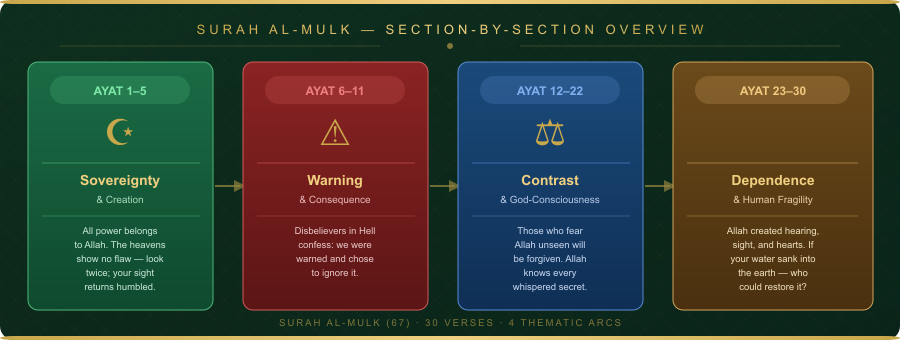
The Surah opens with Allah’s dominion and closes with human fragility. That contrast is the whole argument. Sovereignty and dependence — and the test of life sitting between them.
Should I Read Surah Mulk in Arabic or with Transliteration?
Read in Arabic if you can, even if you do not fully understand every word — the reward of Quran recitation applies to each Arabic letter. Use transliteration if you are still learning to pronounce Arabic correctly; it is a valid learning bridge, not a permanent substitute. Read an English or Urdu translation separately, alongside the Arabic, to understand the meaning.
Here is when each format is most useful:
Arabic text is the primary format for recitation. The reward is tied to the Arabic letters — “Alif, Lam, Meem is not counted as one letter but three,” as the Prophet ﷺ is reported to have said (At-Tirmidhi). If you can read even basic Arabic, start here and improve as you go.
Transliteration (Roman English) is ideal for new Muslims, children, or anyone who has not yet learnt the Arabic alphabet. It allows you to pronounce the words correctly before you can read the script. But be cautious: transliteration cannot capture every Arabic sound precisely. Prioritise transitioning to the Arabic script as soon as possible.
Translation (English / Urdu) is for comprehension, not recitation. Read the translation after your recitation, verse by verse, to let the meaning settle. Understanding what you are saying to Allah transforms the experience of recitation from repetition into conversation.
How Long Does It Take to Read Surah Mulk?
Surah Al-Mulk takes approximately 5 to 7 minutes to recite at a moderate, comfortable pace. Reciting slowly with Tajweed rules properly applied may extend this to 9 or 10 minutes. The Surah contains 363 Arabic words and 1,332 letters across its 30 verses.
For context, a 5-minute recitation before sleeping is a remarkably small investment for what is — based on authenticated hadith — reported to be one of the most spiritually protective habits a Muslim can maintain. Most people spend more time than that scrolling a phone between Isha prayer and sleep.
If you are new to reading Arabic, do not worry about speed. Read slowly, pause at the end of each verse, and focus on correct pronunciation. Pace will come with consistency.
Benefits and Virtues of Reciting Surah Mulk (With Hadith References)
Three major hadith establish the specific rewards of reciting Surah Al-Mulk. They are listed below with their source references — because in Islamic content, an unverified claim is no claim at all.
1. Protection from the punishment of the grave
Ibn Abbas (may Allah be pleased with them both) narrated that the Messenger of Allah ﷺ said: “Surah Mulk is a protector; a rescuer; saving from the chastisement of the grave.” (At-Tirmidhi and Al-Hakim)
This is the origin of the name Al-Mani’a — The Defender. Scholars describe this Surah as standing between its reciter and the trials of the grave, interceding on their behalf.
2. Intercession until forgiveness is granted
Abu Hurayrah (may Allah be pleased with him) reported hearing the Messenger of Allah ﷺ say: “There is a Surah in the Quran which contains thirty Ayat which kept interceding for a man until his sins are forgiven — Tabaarak alladhi biyadihi al-mulk.” This hadith is recorded in Jami’ at-Tirmidhi (2891), Sunan Abu Dawud (1400), and Sunan Ibn Majah (3786), and is classified as Hasan by Tirmidhi — meaning sound and acceptable as evidence.
3. A nightly Sunnah of the Prophet ﷺ
It is authentically reported that the Prophet Muhammad ﷺ did not sleep until he had recited Surah As-Sajdah (Chapter 32) and Surah Al-Mulk (At-Tirmidhi). This was not an occasional practice — it was a consistent, nightly habit.
| Benefit | Hadith Source | Classification |
|---|---|---|
| Protection from punishment of the grave | At-Tirmidhi; Al-Hakim (narrated by Ibn Abbas) | Hasan |
| Intercession on the Day of Judgment | Tirmidhi 2891; Abu Dawud 1400; Ibn Majah 3786 (Abu Hurayrah) | Hasan |
| Established nightly Sunnah of the Prophet ﷺ | At-Tirmidhi | Authenticated |
When Should You Recite Surah Mulk?
Every night before sleeping — this is the strongest and most consistently supported recommendation. It was the established Sunnah of the Prophet ﷺ, and the protection narrated in hadith is specifically tied to nightly recitation.
Beyond that, there are no restrictions. Surah Mulk can be recited after Isha prayer, during voluntary (Nawafil) prayers, at moments of reflection, during travel, or at any other time of day or night. There is no specific day of the week designated for it, and it can be recited from memory or from a copy of the Quran or a screen.
What Is Surah Mulk About in English? — Full Translation
The following is a paraphrased rendering of the meaning, section by section, based on established scholarly translations (Sahih International, Yusuf Ali, and Maududi). For verse-by-verse precision, use the Quran.com reader or download a bilingual PDF.
Ayat 1–5 — Sovereignty and the Flawless Heavens Blessed is He in Whose hands rests all dominion — He is capable over all things. He who created death and life to test you: which of you is best in conduct? He is the Mighty, the Forgiving. He created seven heavens in layers. You will find no flaw in the creation of the Most Merciful. Look again — can you see any crack? Look a second time, and your sight returns to you humbled and worn out. He adorned the nearest heaven with stars and made them missiles against the devils, for whom a blazing fire has been prepared.
Ayat 6–11 — The Warning and Its Consequences For those who disbelieve in their Lord is the punishment of Hell — what an evil destination. When they are thrown into it, they hear its roaring as it boils, almost bursting with rage. Its keepers will ask every group thrown in: “Did no warner come to you?” They will say: “A warner did come, but we rejected him.” They will confess their sins — and far removed from mercy are the people of the Blazing Fire.
Ayat 12–22 — Contrast Between Awareness and Heedlessness Those who fear their Lord unseen will have forgiveness and a great reward. Whether you conceal your speech or speak aloud — He knows what the hearts contain. Would He who created not know? He is the All-Subtle, the All-Aware. He made the earth manageable for you — walk its paths and eat from His provision; to Him you will be resurrected. Do you feel secure that He who controls the heavens will not cause the earth to swallow you? Or that He will not send a storm of stones against you? Look at the birds above you — spreading and folding their wings — nothing holds them up except the Most Merciful. He sees everything.
Ayat 23–30 — Creation, Fragility, and Complete Dependence Say: it is He who brought you into being, gave you hearing, sight, and hearts — yet how little you are grateful. Say: it is He who scattered you across the earth, and to Him you will be gathered. They ask when this promise will be fulfilled — say: that knowledge belongs to Allah alone, and I am only a clear warner. When they see it drawing near, the faces of those who disbelieved will be overcome with grief. Say: whether Allah causes me and those with me to perish, or shows us mercy — who can protect the disbelievers from a painful punishment? Say: He is the Most Merciful; we have believed in Him and placed our trust in Him. Say: consider — if your water were to sink into the earth, who could bring you flowing water?
How to Memorise Surah Mulk — A 30-Day Plan
One verse a day. Surah Al-Mulk has 30 verses. That is one month, at the lowest sustainable pace, and the full Surah — 363 words — is yours.
This works because the brain consolidates memory during sleep. If you recite the new verse before sleeping, review it the next morning, and add it to everything you have already memorised before moving to the next, the chain stays intact. Here is the method:
Step 1 — Listen before you read. Before memorising a new verse, listen to it 5 to 10 times in a row from a reliable reciter (Mishary Rashid Alafasy is widely recommended for clarity). The pronunciation and rhythm settle into your memory before you even try to read the text.
Step 2 — The single-verse rule. Read the verse while looking at it — 5 repetitions. Then close the page and repeat it from memory — 5 more times. Do not move on until this verse is solid.
Step 3 — Connect every verse forward. Before starting a new verse, recite every previously memorised verse from the beginning. This is the step most people skip. It is also why most people forget what they memorised a week earlier.
Step 4 — Understand the meaning. Read the translation of each verse you are memorising. When you know what the words mean, your brain creates an associative structure — meaning becomes an anchor for sound. Verses about the flawless heavens (ayat 3–4), the birds held aloft only by the Most Merciful (ayat 19), and the question about water sinking into the earth (ayat 30) become vivid, not abstract.
Step 5 — Recite in prayer. Use your Nawafil (voluntary prayers) to lock the memorised verses in. Speaking them in Salah — standing before Allah — does something to the memory that silent repetition cannot replicate.
After 30 days, Surah Al-Mulk is memorised. After 30 more days of nightly recitation, it is permanent.
📌 If you want to extend this to the full Quran with proper Tajweed guidance, consider enrolling with a qualified teacher — see our Quran learning with Tajweed courses.
Download Surah Mulk PDF
PDF versions allow you to read offline without an internet connection — useful for travel, areas with poor signal, or anyone who prefers reading from a screen without distractions.
Two formats are recommended:
Standard Arabic PDF — clean Arabic text, suitable for printing and reading on mobile. Best for those who read Arabic confidently.
16-Line Madrasa Format PDF — each page starts and ends at a complete verse, with large clear text. This layout is used in Islamic schools and is particularly useful for memorisation — Huffaz students will recognise it immediately. Every page is structured so that revision and tracking are easy.
Tajweed Colour-Coded PDF — different colours mark Tajweed rules (Ikhfa in blue, Ghunna in orange, QalQala in red, Idghaam in green). Essential if you are working on correct pronunciation.
Listen to Surah Mulk — MP3 Audio Recitation
Listening to Surah Al-Mulk carries its own reward and benefit — especially for those still learning to read Arabic, or for those who want to improve their pronunciation by following along.
Mishary Rashid Alafasy — The most recommended reciter for beginners and read-along practice. His recitation is measured, clear, and phonetically precise. Each word is distinct. If you are memorising Surah Mulk, this is the voice to use.
Abdul Rahman Al-Sudais (Imam of Masjid al-Haram) — A powerful, focused style best suited for daily listening and repeated recitation. Many people who have memorised Surah Mulk find that Sudais’s voice helps them maintain the emotional connection to the text over time.
Saad Al-Ghamdi — A slower, more deliberate pace; recommended for those who are still learning Tajweed and need time to follow along letter by letter.
Frequently Asked Questions
What is Surah Mulk in the Quran? Surah Al-Mulk (سورة الملك) is the 67th chapter of the Holy Quran, located in Para 29. It contains 30 verses and 2 rukus, was revealed in Makkah before the Hijrah, and means “The Sovereignty.” Its central theme is Allah’s absolute dominion over all of creation, the purpose of life and death as a test, and the reality of accountability in the Hereafter.
Why is Surah Mulk called “Al-Mani’a” — The Protector? Surah Mulk is called Al-Mani’a because authentic hadith report that it protects its regular reciter from the punishment of the grave. Ibn Abbas narrated that the Prophet ﷺ described it as “a protector, a rescuer, saving from the chastisement of the grave” (At-Tirmidhi and Al-Hakim). This is why millions of Muslims recite it every night before sleeping.
How long does it take to read Surah Mulk? Reading Surah Al-Mulk takes approximately 5 to 7 minutes at a moderate pace. Reciting slowly with Tajweed rules may extend this to 9 or 10 minutes. The Surah contains 363 Arabic words and 1,332 letters across 30 verses.
Can I read Surah Mulk in transliteration if I don’t know Arabic? Yes — transliteration is a valid step for beginners and those still learning the Arabic alphabet. The reward of reciting the Quran is tied to the Arabic letters themselves, so the goal is to transition to reading Arabic directly as soon as you are able. Transliteration is a bridge, not a destination.
What is the best time to recite Surah Mulk? Every night before sleeping — this was the consistent, established practice of the Prophet Muhammad ﷺ. It can also be recited after Isha prayer, during Nawafil, or at any other time. There is no specific day or hour restriction, but nightly recitation is the authentic Sunnah.
Is Surah Mulk Makki or Madani? Surah Al-Mulk is a Makki Surah — revealed to the Prophet ﷺ in Makkah before the migration to Madinah. Makki surahs focus on foundational beliefs: the oneness of Allah, the Hereafter, and the purpose of life. All three are central to Surah Mulk.
What does the opening word “Tabaarak” mean? Tabaarak (تَبَارَكَ) means “Blessed beyond compare.” It comes from the root b-r-k (باركة, barakah) and describes a level of blessing so complete it can only belong to Allah. This verb form appears at the opening of only two surahs in the entire Quran: Surah Al-Mulk (67:1) and Surah Al-Furqan (25:1).
What are the main themes of Surah Al-Mulk? Surah Al-Mulk covers five interconnected themes: Allah’s absolute sovereignty over all creation; the perfection of the heavens as a sign of His power; life and death as a test to reveal who performs the best deeds; accountability in the Hereafter; and total human dependence on Allah for provision, safety, and sustenance.
How many hadith support the virtues of Surah Mulk? Three major hadith are most frequently cited by scholars: the intercession narration from Abu Hurayrah (Tirmidhi 2891, Abu Dawud 1400, Ibn Majah 3786 — classified Hasan), the grave-protection narration from Ibn Abbas (At-Tirmidhi and Al-Hakim), and the report of the Prophet’s ﷺ nightly recitation practice (At-Tirmidhi). All three are considered sound by hadith scholars.
May Allah make Surah Al-Mulk a protector, an intercessor, and a source of peace — for every person who recites it tonight and every night after